


.webp)


The necessity for quick data transport is growing in the fast-paced, technologically advanced world of today. This advancement in communication is based on fibre optics, which enables massive amounts of data to go across long distances with little loss. However, signal deterioration over long distances is a significant problem in fibre transmission.
In this situation, EDFA Amplifier is useful. While maintaining the speed and precision of data transfer, these gadgets have revolutionised communication by enhancing communications without changing them back into electrical signals.
Erbium-Doped Fiber Amplifier (EDFA): A segment of optical fiber with injected rare earth element erbium is used in an Erbium Doped Fiber Amplifier (EDFA) to improve light signals. In communication, it is frequently utilized in the C and L bands, which are renowned for their high signal loss. The goal of this amplification approach is to boost the signal's optical strength, which is essential for efficient long-distance fiber optic transmission. In fiber optics, optical amplification was first conceived in the 1960s. It wasn't practically possible until the 1980s and early 1990s.Researchers started looking into using rare earth elements like erbium to boost signals in the 1550 nm telecommunication wavelength region. The development of EDFAs was a breakthrough that increased the economy and efficiency of optical networks.
How Is EDFA Operational?
In order to enable effective long-distance communication, an EDFA uses complex procedures to amplify weak optical signals into stronger ones. EDFAs use precise pumping techniques with the properties of erbium-doped fibers to deliver high-performance signal amplification with low noise. The main ideas and elements that go into how an EDFA operates are described as follows:
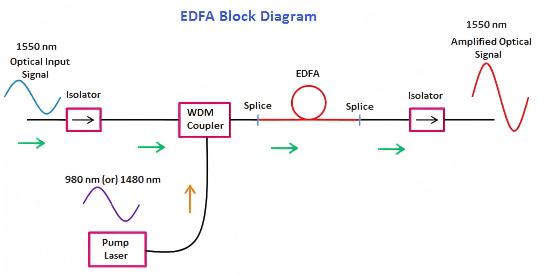
Fundamentals of EDFA Amplifier Operation
For an EDFA amplifier’s operation, the stimulated photons emission forms the basis. Here's a detailed process breakdown:
- Fibre Doping: To dope an optical fibre section, Erbium ions are used. This doping process facilitates infusion of Erbium atoms into the fibre. Thus, they can interact with incoming light signals subsequently.
- Pump Laser: A high-power of around 980 nm or 1480 nm wavelength laser light is pumped into the doped fibre. This pump light elevates the erbium ions to a higher energy level from a very low level.
- Signal Injection: The weak optical signal demanding amplification fills the erbium-doped fibre.
- Stimulated Emission: the weak signal light stimulates the excited erbium ions to return to their ground state. This, with the same wavelength as the incoming signal, releases the excess energy in as more photons. This technique is used to amplify the signal light.
- Output: The signal is significantly more intense when it leaves the fibre than when it first entered.
- Energy Levels of the Detailed Mechanism: Distinct energy levels are exhibited by the fiber's erbium ions. The erbium ions' electrons, when pumped with light at 980 nm or 1480 nm, change from the ground state (E1) to an excited state (E3 or E2).
- Metastable State: the metastable state (E2) is the ultimate stage after the excited state (E3) of electrons. It is a lower energy level. As a result of its elongated durability, energy can be stored temporarily in the erbium ions in this state.
- Stimulated Emission: An incoming signal light photon makes the excited erbium ions electrons return to the ground state (E1). This photon travels through the doped fibre. Thus, more photons are emitted whose phase and direction are aligned with the incoming signal. Thus, signal amplification occurs.
Elements of EDFA
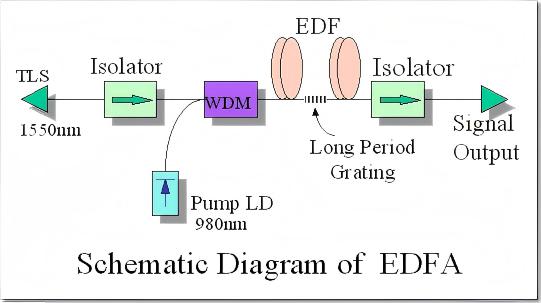
Typically, an EDFA system consists of the following parts:
- The core medium in which amplification takes place is erbium-doped fibre.
- The pump laser supplies the energy essential for exciting the erbium ions.
- The wavelength division multiplexer (WDM) combines the signal light and pump laser light. These lights then make way into the doped fibre.
- Isolators: Isolators ensure that the signal restricts undesired reflections and moves in one way only.
- Optical filters: To guarantee pure signal amplification, eliminate undesired noise and out-of-band frequencies.
The Significance of EDFAs
Amplification without Conversion: The capacity of EDFAs to magnify optical impulses without transforming them back into electrical signals is one of their main advantages. This all-optical amplification preserves the bandwidth and high speed of the original signal. Contemporary high-speed communication networks needs this vitally.
Long-Distance Communication: The signal gets deteriorated by attenuation and dispersion although fibre optic cables can send data over great distances. Without suffering appreciable deterioration, EDFAs enable data to travel greater distances significantly by strengthening these weak signals. For long-distance underwater connections and terrestrial networks, this is very much vital.
Cost-Effectiveness: EDFAs, when compared to alternative amplification techniques, are quite economical. You don’t need expensive and intricate electronic parts and regeneration systems when you have EDFAs. Network architecture gets simplified and operating costs minimises with EDFA. This is because it removes optical-electrical-optical (O-E-O) conversion.
Low Noise and High Gain: EDFAs facilitates high gain and low noise levels. This indicates that without adding a lot of noise, they can boost signals efficiently. This preserves long distance signal integrity.
Compatibility with Wavelength Division Multiplexing (WDM): Facilitating simultaneous optical signals transmission over a single fibre at different wavelengths, EDFAs work in alignment with WDM technology. Compatible EDFAs are necessary for fulfilling the increasing demand for data transfer and expanding capacity of optical networks.
Stability and Reliability: EDFAs are reliable and stable. They exhibit lengthy operational life and can work efficiently in a variety of environmental settings. In different terrestrial communication networks, such as space, environments, and underwater, they are perfect for deployment.
Applications of EDFAs

Internet Backbone: EFDA is the major aspect of the internet backbone consisting of high-capacity fibre optic cables to sustain strong and clear data signals over extended distances. Thus, users all over the world get reliable and fast internet access.
Telecommunications: For boosting transmissions, EDFAs form a major part in long-distance and metro networks. They guarantee that regular signal regeneration is not necessary while sending data over hundreds or even thousands of kilometres.
To disperse television signals over large regions, EDFAs are used by cable television (CATV) systems. High-quality video transmissions are available for multiple subscribers because of EDFAs. EFDAs facilitate no compromise in signal quality.
Research and Development: Many experimental configurations in research and development employ EDFAs. These include optical sensing, laser physics, and spectroscopy. They are useful instruments in scientific research because of their capacity to deliver steady and powerful optical amplification.
Military and Aerospace: EDFA Amplifier is employed in aerospace and military applications for reliable and safe communication. Systems that must transmit data at high speeds and be resistant to adverse environmental conditions use EFDAs.





No comments have been posted yet.