


.webp)


In today's era of information explosion, we interact daily, often unknowingly, with a revolutionary technology - Optical Fiber. From high-speed internet to HD video calls, from telemedicine to smart homes, optical fiber act like the nervous system of modern society, silently supporting our digital lives. Let's explore the principles behind this technology and its widespread applications in our daily routines.
What is Optical Fiber? The "Ballet" of Light
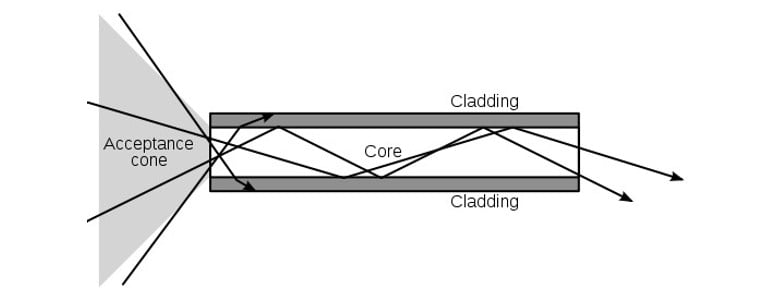
The core principle of fiber optic communication is remarkably elegant. Imagine shining a flashlight into a stream of bending water; the light travels along the curve of the water—this is the basic concept behind how optical fiber work.
Each optical fiber, thinner than a human hair, is precisely composed of two parts:
● Core: The central channel made of ultra-pure glass or plastic.
● Cladding: Material with a lower refractive index surrounding the core.
When a light signal enters the core, it doesn't travel straight through. Instead, it undergoes "total internal reflection" at the interface between the core and the cladding. Like a skier gliding along a slope without veering off track, light waves continually reflect forward inside the fiber, transmitting information with minimal loss even when the fiber bends.
This design offers three key physical advantages:
● Extremely Low Loss: Signals can travel tens or even hundreds of kilometers without needing amplification.
● Exceptionally High Bandwidth: A single fiber can theoretically carry millions of telephone calls simultaneously.
● Strong Immunity to Interference: Unaffected by electromagnetic interference, ensuring stable and secure signals.
Optical Fiber Applications: More Than Just "Fast Internet"
People often equate optical fiber with "fast internet," but that's just the tip of the iceberg. Its core advantages are: immense transmission capacity (high bandwidth), extremely high speed, very low loss, strong immunity to electromagnetic interference, lightweight and radiation-free nature, and high security. These advantages have spurred revolutionary changes in the following fields:
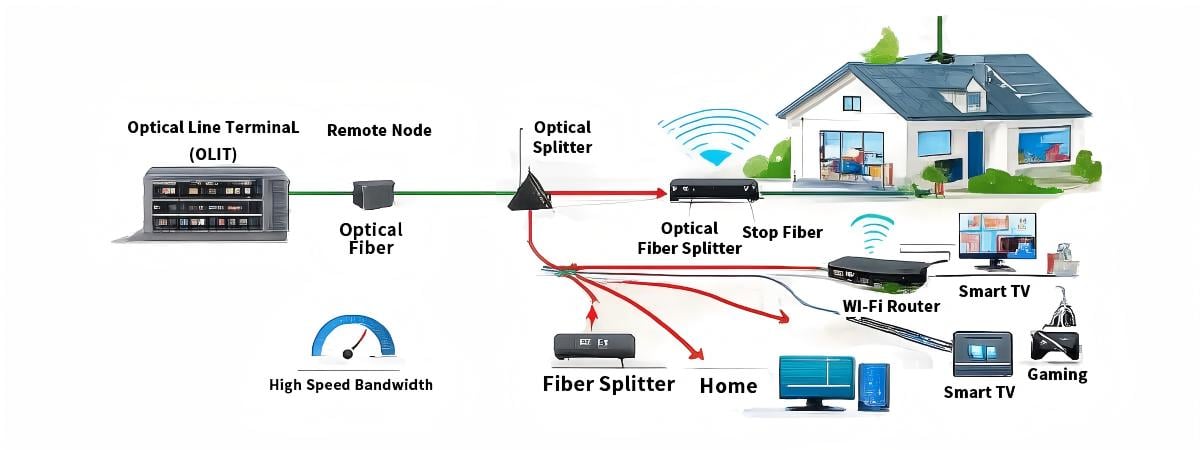
1. Home and Personal Digital Life: From "Best Effort" to "Instant Gratification"
True Gigabit to the Home: Traditional copper cables are like narrow, winding country roads, while optical fiber are straight, wide superhighways. This brings not just the "thrill" of downloading a movie in seconds instead of minutes, but a qualitative leap in experience:
● Zero-Latency Immersion: Online 4K/8K video streaming and cloud gaming (e.g., via Xbox Cloud, GeForce NOW) are highly sensitive to latency. The low-latency nature of optical fiber makes actions and on-screen feedback nearly simultaneous, eliminating lag and "slideshow" effects.
● The Neural Network for the Smart Home: When a home has dozens of smart devices (cameras, locks, appliances, speakers), the stable, high-concurrency connectivity provided by fiber ensures all devices respond quickly and work together seamlessly, without commands "queuing up" because one device is streaming video.
● The Solid Backbone for Hybrid Work: HD video conferencing, real-time syncing of large files, and remote desktop control demand high upload bandwidth. The symmetrical high-speed upload and download capabilities of fiber make working from home feel identical to being on the corporate network.
2. Healthcare: The "Light of Life" for Greater Precision and Minimally Invasive Procedures
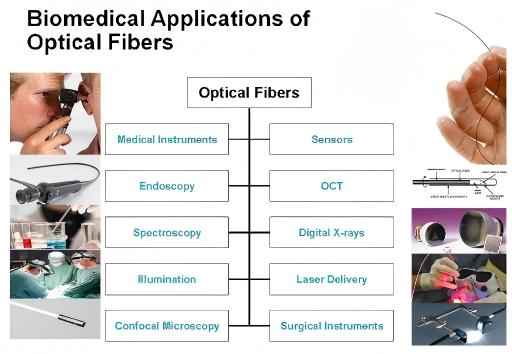
The thin, flexible, and EMI-immune properties of optical fiber make them a doctor's "super eyes and fingers."
● Transforming Endoscopy: Traditional rigid endoscopes cause discomfort and offer limited visibility. Fiber optic endoscopes (e.g., for gastroscopy, colonoscopy, bronchoscopy) are soft and flexible, easily navigating complex body cavities and transmitting real-time, high-definition, magnified images of internal tissues to a screen. This significantly reduces patient discomfort and allows doctors to detect early, minute lesions, improving diagnostic accuracy.
● The "Light Scalpel" in Surgery: In minimally invasive surgery, optical fiber are the precise channel for delivering high-energy laser light. Through tiny incisions, doctors can insert fibers to perform precise tumor ablation,Stop bleeding, and stone fragmentation, resulting in minimal surgical trauma and faster patient recovery.
● In-Vivo Vital Sign Monitoring: Fiber optic-based biosensors can be implanted or placed inside the body to continuously monitor key metrics like glucose, blood oxygen, and pH levels in real-time, providing dynamic data for intensive care and chronic disease management.
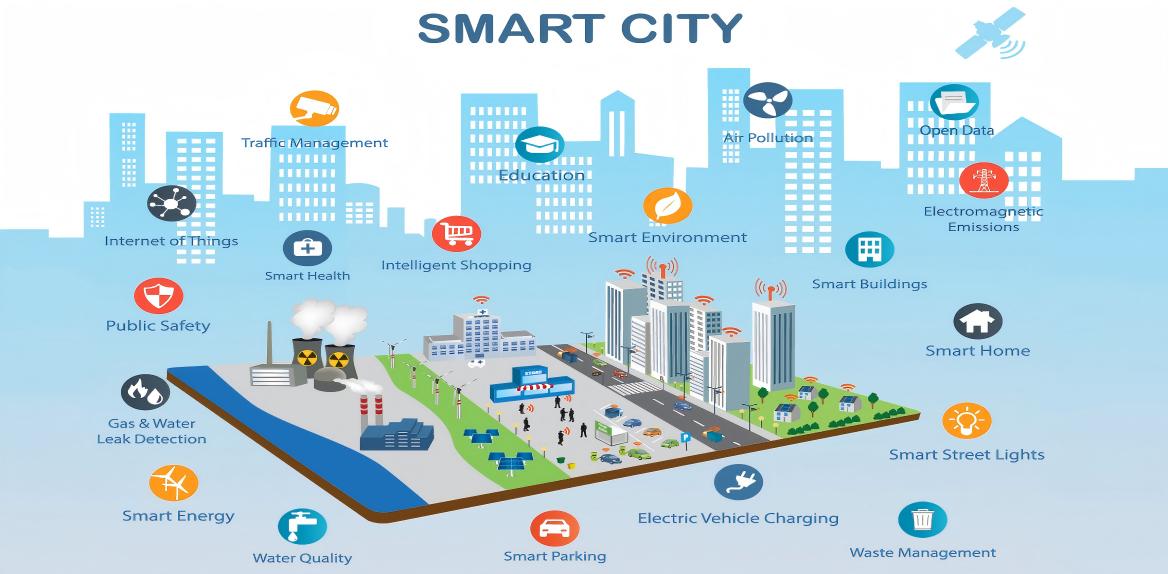
3. Public Safety & Urban Management: The Intelligent Guardian of City "Lifelines"
Fiber optic cables themselves can function as sensors, highly sensitive to environmental changes (vibration, stress, temperature).
● "Invisible Tripwire" for Perimeter Security: Special sensing fiber cables buried under fences or walls around airports, military bases, nuclear plants, or school campuses. Any attempt to climb, dig, or touch triggers the system, which can pinpoint the intrusion location (with meter-level accuracy) and raise an alarm within seconds, enabling proactive, 24/7, gap-free protection.
● "Health Monitor" for Infrastructure: Embedded in bridge piers, tunnel linings, dam structures, and oil/gas pipelines. optical fiber can monitor structural stress, deformation, cracks, and temperature 24/7. Any abnormal change is recorded and analyzed, enabling predictive maintenance for critical infrastructure and issuing warnings before potential hazards occur, preventing disasters.
● A Flame-Free Fire Safety Sentinel: In areas like petrochemical plants, utility tunnels, and historic buildings where open flames are prohibited and electromagnetic environments are complex, fiber optic temperature sensing fire alarm systems are the only reliable choice. They detect temperature anomalies using light signals, are intrinsically safe, immune to EMI, and have long detection ranges.
4. Specialized Lighting & Creative Design: Merging Safety and Aesthetics
● Absolutely Safe Lighting Solutions: For lighting in swimming pools, fountains, gas stations, or display cases for artifacts—wet, potentially explosive, or precious item environments where traditional wiring poses shock or short-circuit risks. Fiber optic lighting systems place the light source (lamp) in a remote, safe location, transmitting only light through the fibers. The illuminated points carry no electricity and generate no heat, fundamentally eliminating shock and fire hazards.
● A Tool for Ultimate Aesthetics: optical fiber can be used to create "starry sky ceilings," outline building contours, and create dreamlike stage effects. The light is pure and soft, with programmable color changes, and the light-emitting points can be made extremely small, creating a precise and hazy artistic atmosphere that traditional lighting fixtures cannot achieve.

5. Transportation & Industry: The Reliable "Nerves" in Harsh Environments
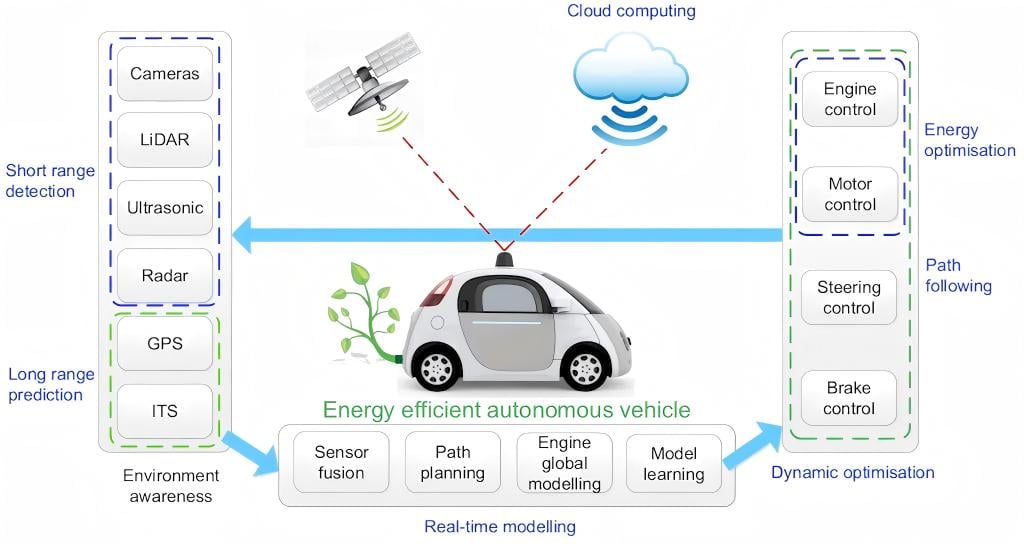
● The "Central Nervous System" of Future Vehicles: With the development of autonomous driving and Advanced Driver-Assistance Systems (ADAS), the data generated by onboard cameras, radar, and LiDAR is exploding. Fiber optic networks (e.g., automotive Ethernet) can reliably transmit massive data within confined spaces while resisting intense electromagnetic interference with minimal weight, ensuring driving safety.
● The High-Speed Backbone for Industrial Automation: In factory settings with heavy machinery causing strong EMI, optical fiber connect robots, PLCs, and control systems, ensuring absolute stability of control commands and data transmission, free from interference. This is key infrastructure for smart manufacturing and Industry 4.0.
6. Military Applications: Gaining the Edge in Complex Electromagnetic Environments
The modern battlefield is a complex electromagnetic environment where the physical properties of Military optical fiber offer unique solutions.
● Reconnaissance & Strike Platforms: The fiber-optic guided drones seen in the Russia-Ukraine conflict are a prime example. Connected to a ground control station via a thin fiber, they achieve complete immunity to electromagnetic interference for real-time HD video transmission and stable control. Similarly, fiber-optic guided missiles allow operators to "see" the missile's seeker view and make mid-course corrections, offering high accuracy and jamming resistance.
● Command, Radar & Sensor Networks: Radio Frequency over Fiber (RFoF) technology allows for lossless, interference-resistant long-distance transmission of radar RF signals, separating bulky radar processing equipment from lightweight front-end antennas, enhancing system survivability. Fiber itself can also be used as a Distributed Acoustic Sensor (DAS); once deployed, it can pinpoint the location of intrusive vibrations, useful for base perimeter security.
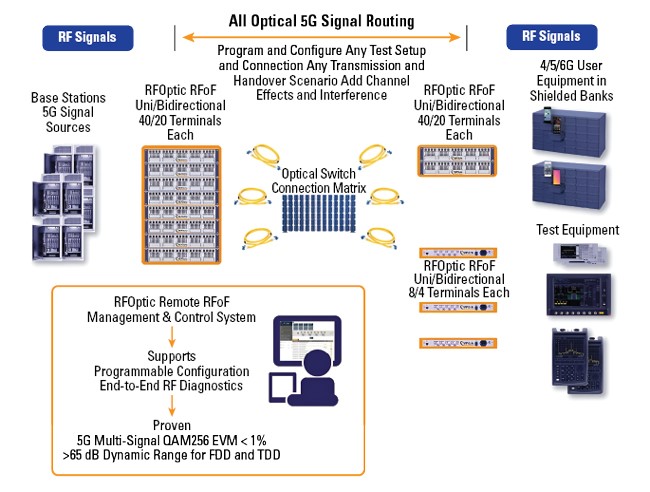
Block diagram of RFoF application in 5G testing
7. Space Applications: Pushing the Limits in Extreme Environments
In the extreme conditions of space, fiber optic technology faces challenges and inspires unprecedented innovation.
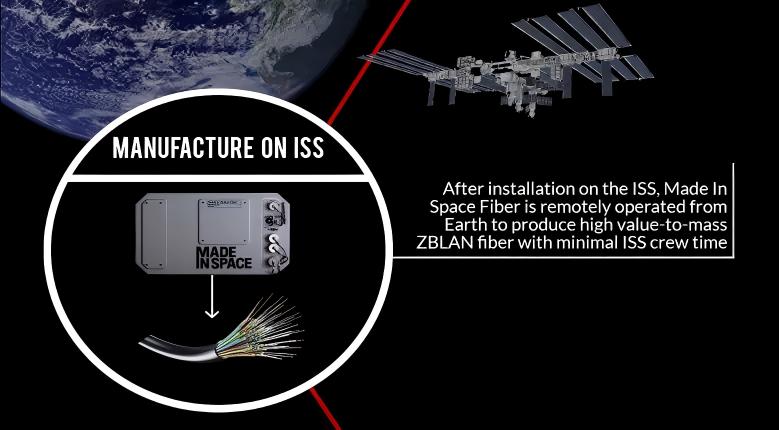
● In-Space Manufacturing: The "Super Fiber" Made in Orbit. When manufacturing a special ultra-low-loss fiber called ZBLAN on Earth, gravity causes internal crystalline defects. In the microgravity environment of a space station, ZBLAN fiber with nearly zero defects can be produced. Its theoretical transmission loss could be 10 to 100 times lower than conventional fiber, promising a leap in communication capacity.
● Critical Systems for Spacecraft: For a satellite's "heart"—the fiber optic gyroscope—its light source degrades under space radiation. Chinese scientists developed a "photobleaching" technique that uses specific wavelength light to repair this radiation damage in real-time, completely, significantly enhancing satellite reliability and lifespan. Furthermore, fiber Bragg grating sensors, being hair-thin, corrosion-resistant, and immune to EMI, are extensively embedded in composite structures like aircraft wings and spacecraft, forming a "nervous" network for real-time structural health monitoring.
Conclusion
From the information backbone enabling global connectivity, to diagnostic tools probing inside our bodies, to countless details safeguarding security and illuminating life, optical fibers, with its speed, security, reliability, and versatility, has become an indispensable foundational pillar of modern civilization. It's like an invisible, intricate web of light, quietly weaving the fabric of our more efficient, convenient, and secure future. The next time you seamlessly watch an HD live stream or a doctor alleviates suffering through a minimally invasive procedure, remember that within it all, a beam of intelligent light is flowing silently along a slender strand of glass.
Frequently Asked Questions (FAQ)
1. What are the most common applications of optical fiber?
Communication, internet, medicine, automotive, telephone, inspection devices, military, space, and cable TV.
2. Why is optical fiber better than copper cables for communication?
It offers higher bandwidth, faster speed, lower signal loss, and immunity to electromagnetic interference.
3. How is optical fiber used in the medical field?
In endoscopes, otoscopes, and surgical lasers for diagnostics and treatments due to flexibility and safety.
4. What role does fiber optic technology play in the automotive industry?
Used for lighting, infotainment systems, collision sensors, and fast signal transfer between vehicle systems.
5. How is optical fiber applied in military systems?
For secure communication, avionics, mission control, sensor fusion, and weapons system operations.
6. Why is fiber optic cable important for internet connectivity?
It transmits large volumes of data quickly, with low latency and minimal signal degradation.
7. What advantages does optical fiber bring to space applications?
Lightweight, high-bandwidth, and interference-free performance for satellites, sensing, and laser systems.
8. Is optical fiber cost-effective compared to traditional cables?
Although installation costs are higher, long-term benefits like durability, bandwidth, and efficiency reduce overall costs.





No comments have been posted yet.