


.webp)


Rows upon rows of servers stand neatly aligned. The blinking indicator lights between cabinets seem to converse in data. The "translators" enabling this signal transmission between devices are the optical transceivers—components that look similar yet perform distinct functions.
Have you ever been confused by abbreviations like SR, LR, FX, and LX in optical transceiver model codes when selecting components? These seemingly cryptic letter combinations actually conceal crucial information about transmission distance, fiber type, and operating wavelength.
Understanding these standards not only helps you make the correct equipment choices but also avoids unnecessary network deployment errors.
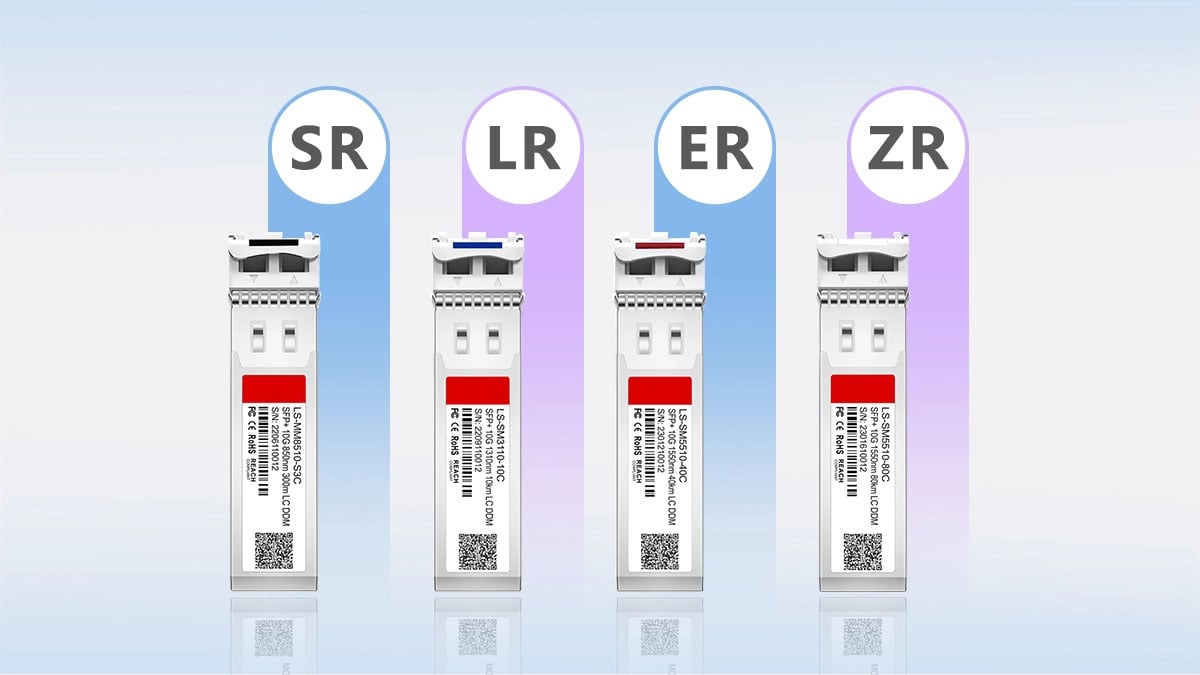
The Logical System Behind Optical Transceiver Naming
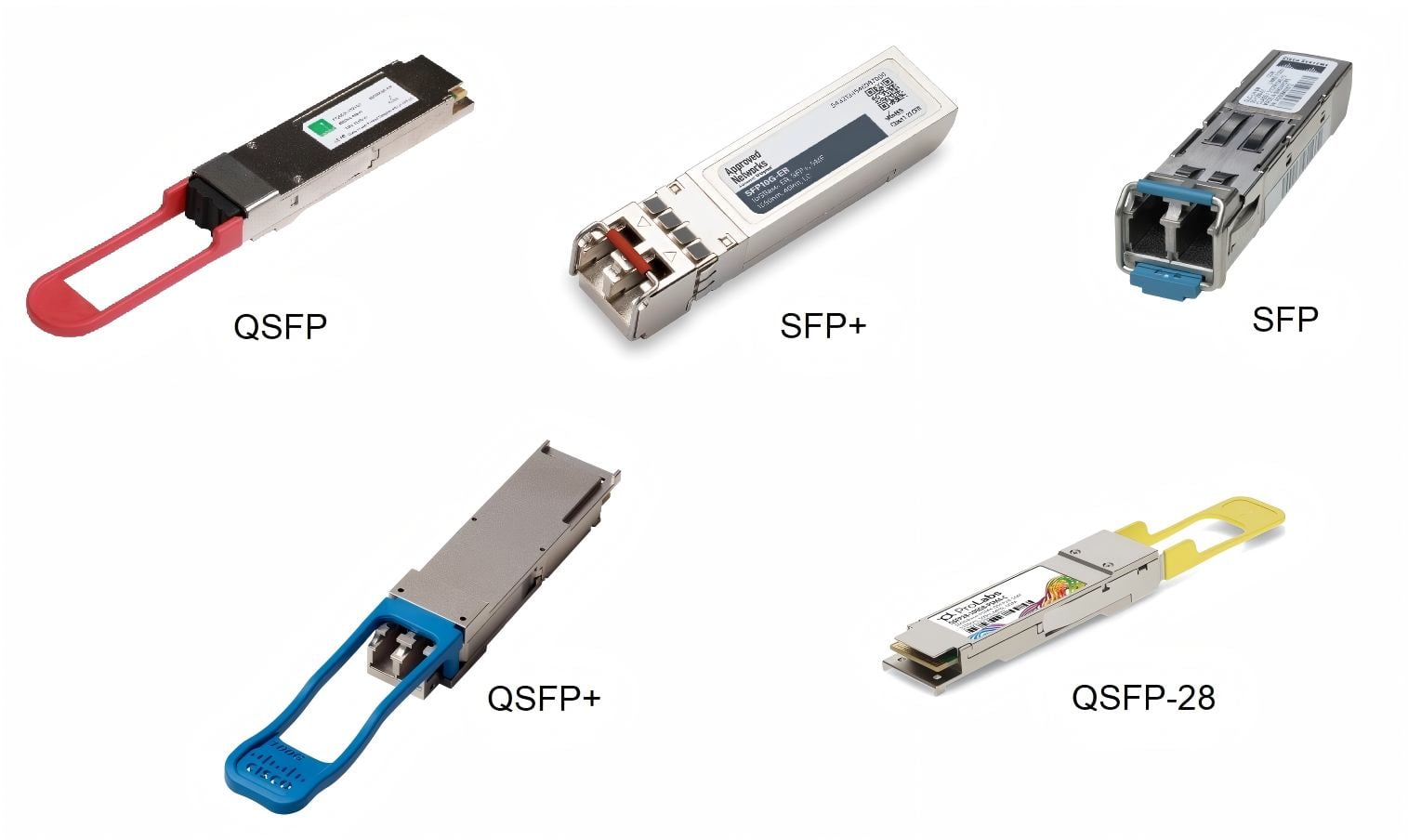
The naming of optical transceivers is not arbitrary but follows a systematic coding logic. It typically begins with the physical form factor, such as SFP (Small Form-factor Pluggable), QSFP (Quad Small Form-factor Pluggable), etc., which determines the module's physical size and interface type.
Following that is the data rate identifier, for example, 10G, 25G, 100G, etc. This clearly indicates the data transmission rate supported by the module.
The final few letters in the model code are the most critical. They represent the optical interface standard, directly defining the module's optical performance parameters such as transmission distance, operating wavelength, and required fiber type.
Understanding this three-part naming logic is the first step in mastering optical transceiver selection. It is this systematic naming convention that allows network engineers to quickly identify a module's suitable application scenario.
Detailed Explanation of 1G Optical Transceiver Standards
The IEEE established a standardized naming system for optical transceivers with transmission rates up to 1G. These standards typically appear as suffixes in SFP module model numbers.
SX (Short Wavelength)
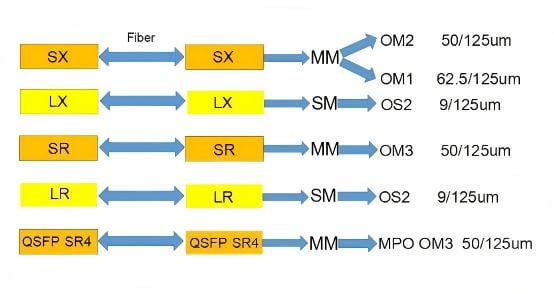
SX (Short Wavelength) standard is designed for multimode fiber, operates at an 850 nm wavelength, and typically supports transmission distances up to 550 meters. This module is primarily used for short-distance connections within local area networks and data centers. For example, the SFP 1G SX 850nm 550m module offered by Fibermart is a typical representative for such applications.
FX (Fast Ethernet)
FX (Fast Ethernet) is a legacy standard specifically designed for 100Mbps networks, suitable for early LAN environments. Modules like the 100BASE-FX SFP support distances up to 2 kilometers.
LX (Long Wavelength)
LX (Long Wavelength) standard uses a 1310 nm operating wavelength and can achieve transmission over up to 10 kilometers on single-mode fiber. It is widely used in data centers, enterprise networks, and telecommunications systems. A typical SFP 1G LX 1310nm 10km module meets most enterprise network interconnection needs.
ZX (Extended Wavelength)
For longer transmission distances, EX (Extended Wavelength) modules can reach 40 km, while ZX (Extended Wavelength) modules can achieve ultra-long-distance transmission of up to 80 kilometers. The latter uses a 1550 nm wavelength and is common in metropolitan area networks (MANs) and long-distance telecommunication links. Corresponding products include 1G EX 1310nm 40km and 1G ZX 1550nm 80km SFP modules.
The table below summarizes the key parameter differences between these standards:
| Standard Code | Full Name | Operating Wavelength | Fiber Type | Transmission Distance | Primary Application Scenarios |
|---|---|---|---|---|---|
| SX | Short Wavelength | 850 nm | Multimode | ≤ 550 meters | LAN, Intra-Data Center Connections |
| FX | Fast Ethernet | Various Options | Multimode | ≤ 2 kilometers | 100 Mbps Ethernet LAN |
| LX | Long Wavelength | 1310 nm | Single-mode | ≤ 10 kilometers | Enterprise Networks, Data Center Interconnection |
| EX | Extended Wavelength | 1310 nm | Single-mode | ≤ 40 kilometers | Metropolitan Area Networks, Cross-Building Links |
| ZX | Extended Wavelength | 1550 nm | Single-mode | ≤ 80 kilometers | Long-Distance Telecommunication Networks |
Comparison Table of Different 1G Optical Transceiver Standards
Evolution of Standards for High-Speed Optical Transceivers
As network speeds evolved from 1G to 10G, 40G, and even 400G, new naming standards emerged. These standard suffixes typically appear in the model numbers of high-speed modules like SFP+, QSFP+, etc.
SR (Short Range)
SR (Short Range) standard continues to use multimode fiber and 850 nm wavelength, but transmission distance is reduced in high-speed networks. This module is suitable for intra-rack or intra-data center scenarios requiring low latency and high bandwidth. Examples from Fibermart include the SFP+ 10G SR 850nm 300m and the QSFP28 100G SR4 850nm 100m modules, common choices for high-speed interconnects within data centers.
In 40G and 100G applications, you may also see variants like SR4 and SR8, where the number indicates the lane count. These modules typically support 100 meters over OM4 multimode fiber.
LR (Long Range)
LR (Long Range) standard uses single-mode fiber and a 1310 nm wavelength, with transmission distances ranging from 10 km to 40 km. It is suitable for cross-rack, cross-building, or metropolitan area network connection requirements. Similarly, LR4 and LR8 represent 4-lane and 8-lane long-range modules, respectively. Examples are the 25G SFP28 LR 1310nm 10km and the 100G QSFP28 LR4 1310nm 10km modules.
ER (Extended Range)
When transmission distances exceeding 40 km are needed, the ER (Extended Range) standard becomes the preferred choice. It uses a 1550 nm wavelength and typically supports 40 km to 80 km transmission, widely used in MANs and long-distance telecommunication networks. An example is the 10G SFP+ ER 1550nm 40km module.
ZR/ZR+ (Zero-dispersion-shifted Range)
Scenarios demanding extreme distances may require the ZR/ZR+ (Zero-dispersion-shifted Range) standard. This module can achieve 80 km or even longer distances (ZR+), with the latest models like 400G QSFP-DD ZR+ reaching an impressive 480 km.
To more clearly illustrate the key characteristics of high-speed optical transceivers, the table below compares mainstream standards:
| Standard Code | Full Name / Description | Operating Wavelength | Fiber Type | Typical Distance | Primary Application Scenarios |
|---|---|---|---|---|---|
| SR / SR4 / SR8 | Short Range | 850 nm | Multimode (OM3/OM4) | 100m (40/100G SR4 on OM4) | Intra-Data Center, Ultra-High-Speed Interconnect Within Same Room |
| DR / DR4 | Dual Range / 500m Range | 1310 nm | Single-mode (OS2) | 500 meters | High-Speed Interconnect Within Data Center Campuses, Between Buildings |
| FR / FR4 | Far Range / 2km Range | 1310 nm / CWDM4 | Single-mode (OS2) | 2 kilometers | Data Center Campuses, Metropolitan Area Network Access Layer |
| LR / LR4 / LR8 | Long Range | 1310 nm | Single-mode (OS2) | 10 kilometers | Enterprise Network Core, MAN, Telecommunications Access |
| ER / ER4 | Extended Range | 1550 nm | Single-mode (OS2) | 40 kilometers | Metropolitan Area Networks, Long-Haul Telecommunication Networks |
| ZR / ZR+ | Zero-dispersion / Ultra-Long Range | 1550 nm | Single-mode (OS2) | 80 km (ZR) / 120+ km (ZR+) | Ultra-Long-Distance Backbone Networks, Cross-Regional Interconnect |
High-Speed Optical Transceiver Standards Comparison Table
Special Standards and Selection Strategy
Beyond mainstream standards, you may encounter special standards in network environments, optimized for specific application needs.
DR (Dual Range)
DR (Dual Range) modules offer a flexible solution, supporting both short and long-distance transmission within a single module, providing a cost-effective option for network expansion and optimization.
FR (Far Range)
FR (Far Range) standards are specifically designed for ultra-long-distance transmission exceeding 100 kilometers or even several hundred kilometers, suitable for backbone network connections across cities or regions.
Faced with numerous standards, how does one make the right choice? It is recommended to follow this decision-making path:
First, determine the transmission distance requirement. This is the most critical factor in selecting the optical standard.
Next, consider the available fiber type. Multimode fiber has lower cost but limited distance, while single-mode fiber supports longer distances.
The operating wavelength determines compatibility with existing fiber links, and the data rate must match the network equipment ports.
Finally, conduct a cost-benefit analysis, choosing the most economical solution that meets performance requirements.
In Fibermart's warehouse, whether it's SFP+ SR modules suitable for short-distance data center connections or QSFP28 LR4 modules needed for cross-metro transmission, they all rest quietly in anti-static packaging, waiting to be selected by engineers and inserted into network equipment ports.
The moment their indicator lights illuminate, data begins its journey through the fiber, spanning distances from 550 meters to 480 kilometers.
Frequently Asked Questions FAQs
What is the transceiver module and what does it do?
The transceiver module is an electronic device that contains both a transmitter and a receiver in one package. It is created for communication systems to translate electrical signals into optical signals for fiber optic communications. These modules are typically employed in Ethernet networks, data centers, and Internet service providers.
What is an Optical Transceiver and what is its primary function?
An optical transceiver is a modular device that serves as both a transmitter and a receiver (hence the name). It plugs into network equipment (like switches, routers, or servers) and its primary function is to convert electrical signals from the device into light signals for transmission over fiber optic cables, and then convert received light signals back into electrical signals. It's fundamental for high-speed data transmission.
What does the jargon "SR", "LR", "ER", and "ZR" mean?
These abbreviations denote the transceiver's reach and the type of fiber it's designed for:
● SR (Short Reach): For short distances (up to ~500m) over multi-mode fiber (MMF).
● LR (Long Reach): For long distances (up to 10km) over single-mode fiber (SMF).
● ER (Extended Reach): For extended distances (up to 40km) over SMF.
● ZR (Long Haul): For very long distances (up to 80km+) over SMF.
Can I plug a 10G SFP+ module into a 1G SFP port?
No. SFP+ modules typically require 10G ports. However, you can usually plug a 1G module into a 10G port (it will just run at 1G).
What is the difference between QSFP+ and QSFP28?
Speed. QSFP+ supports 40G (4x10G), while QSFP28 supports 100G (4x25G). They look identical physically but are electrically different.





No comments have been posted yet.