


.webp)


In today's rapidly evolving information age, fiber optic communication serves as the backbone of information transmission, and its core physical interface—the fiber optic connector—plays a crucial role. These connectors are not only critical nodes in the optical link, whose performance directly affects the stability and efficiency of the entire network system, but their types and structures also determine the density, flexibility, and maintainability of the cabling system. Faced with a wide variety of connectors on the market, understanding their characteristics and application scenarios is the foundation for proper selection and efficient deployment.
This article will provide a detailed analysis of several commonly used fiber optic connectors, including LC, SC, ST, FC, MPO/MTP, E2000, MU, and MTRJ. By examining their structures, characteristics, and typical applications, we aim to help you make informed choices in the complex world of network cabling.
LC Connector Components
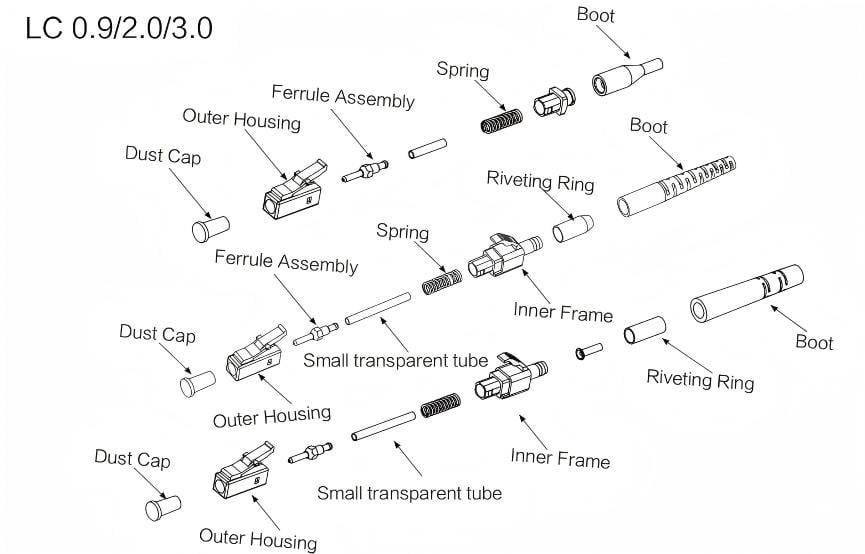
Exploded view of 0.9/2.0/3.0mm LC fiber optic connector
As shown in the figure, the structure of the LC connector varies depending on the diameter of the fiber pigtail. The diagram illustrates the typical structure of LC connector components.
The LC connector is highly popular in modern networks due to its small size. It uses a 1.25mm ferrule, making it very suitable for high-density application environments like data centers and telecommunications racks. Its push-pull latch design facilitates easy operation, and LC connectors typically appear in duplex configurations, supporting bidirectional transmission.
SC Connector Components
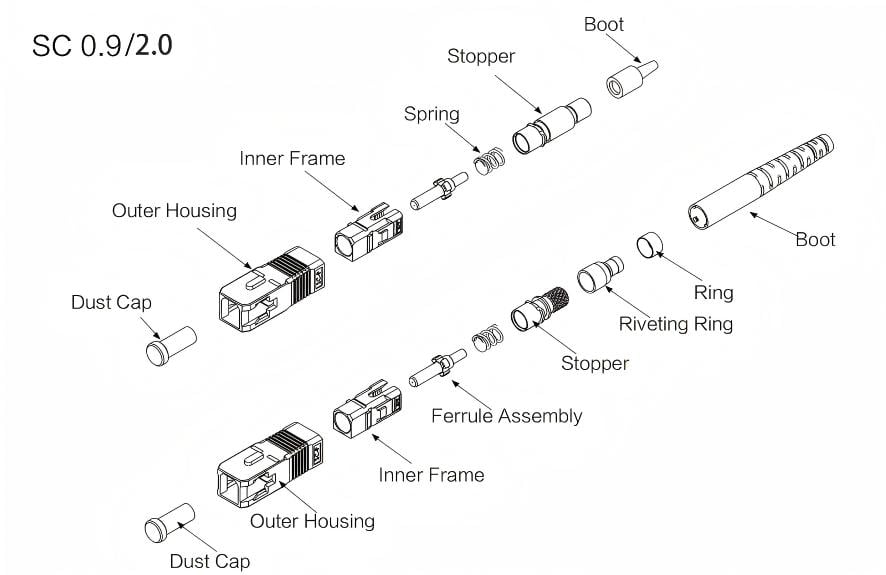
Exploded view of 0.9/2.0mm SC fiber optic connector
As shown, the structure of the SC connector is relatively simple. In fact, an SC connector occupies about twice the space of an LC connector, meaning two LC connectors can be installed in the same panel space.
The SC connector was developed by NTT and features a 2.5mm ferrule and a push-pull design. It was one of the first connectors to be standardized and is still widely used in areas such as telecommunications and CATV. Although larger than the LC, the SC connector remains popular due to its ruggedness and ease of use.
ST Connector Components
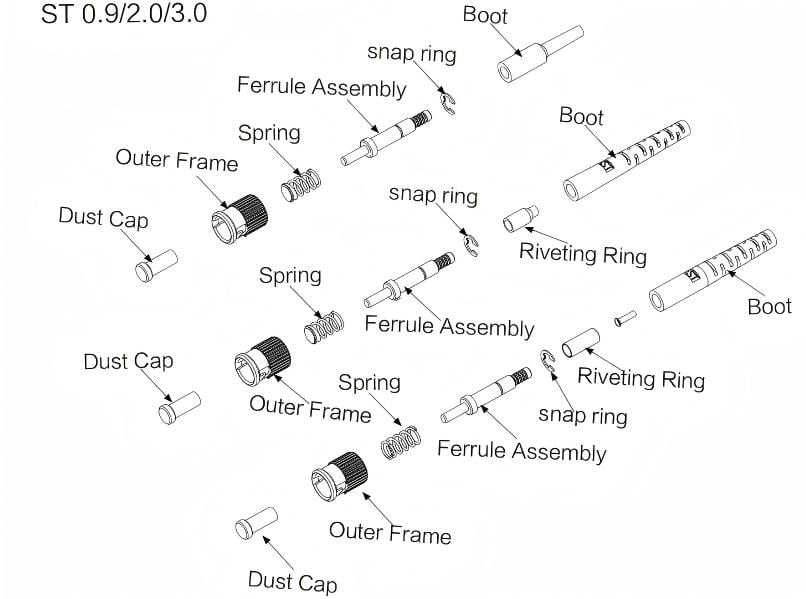
Exploded view of 0.9/2.0/3.0mm ST fiber optic connector
The ST connector uses a bayonet-style twist-lock design with a 2.5mm ferrule. It was very widely used in early fiber optic installations, particularly in local area networks (LANs) and campus network environments. Although less common in new deployments, it can still be found in some legacy systems.
This design secures and releases the fiber by rotating an external metal ring. To connect, the connector is inserted into the adapter and rotated clockwise about half a turn to lock; to disconnect, it is rotated counterclockwise and pulled out. Its structure is relatively simple and low-cost. However, the bayonet design can potentially suffer from lock loosening with frequent mating cycles, affecting connection stability. This is one reason it has gradually been replaced by subsequently introduced push-pull or other more convenient latching connectors. Furthermore, the ST connector's 2.5mm ferrule size is the same as the SC connector, allowing them to be interconnected via specific adapters in scenarios with low compatibility requirements. However, its larger size also limits installation density in high-density cabling environments, making it difficult to meet the stringent space utilization requirements of modern data centers.
FC Connector Components
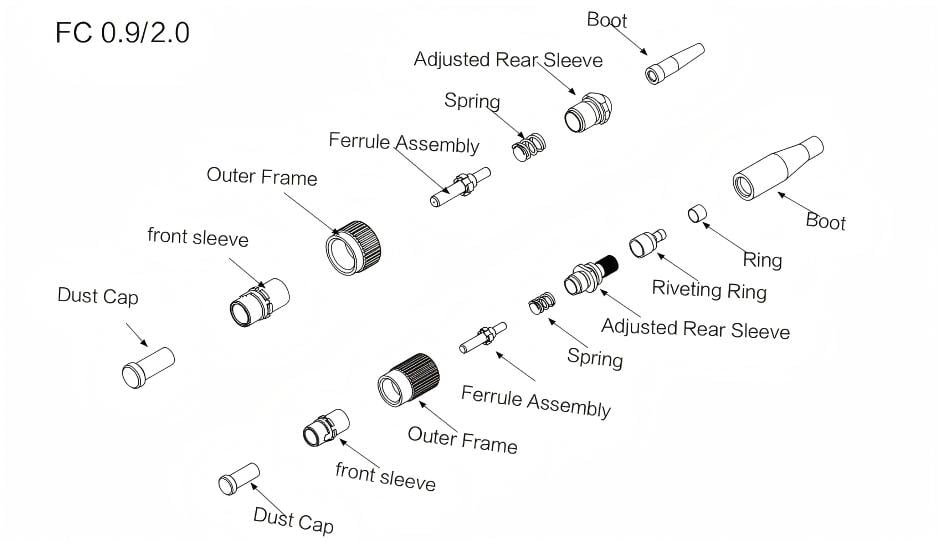
Exploded view of 0.9/2.0 FC fiber optic connector
The FC connector uses a screw-on threaded structure, providing excellent stability, making it suitable for high-precision, high-vibration resistance applications such as measurement instruments. Although not widely used in modern data centers, it still holds an important position in specialized fields.
Its design characteristic is achieving precise alignment through the threaded connection. This structure effectively reduces the impact of external vibration and shock on connection performance, ensuring stable and reliable optical signal transmission. The FC connector's ferrule diameter is also 2.5mm, similar to SC and ST connectors, but the screw-on fixation method makes it less prone to loosening over long-term use, maintaining low insertion loss and high return loss. In scenarios with extremely high demands for connection stability, such as scientific experimental equipment, laser medical instruments, and aerospace fiber optic systems, the FC connector still plays an irreplaceable role due to its superior mechanical performance and connection precision. Additionally, the metal housing design of the FC connector enhances its resistance to electromagnetic interference, further ensuring signal transmission quality in complex environments.
MPO/MTP Connector Components
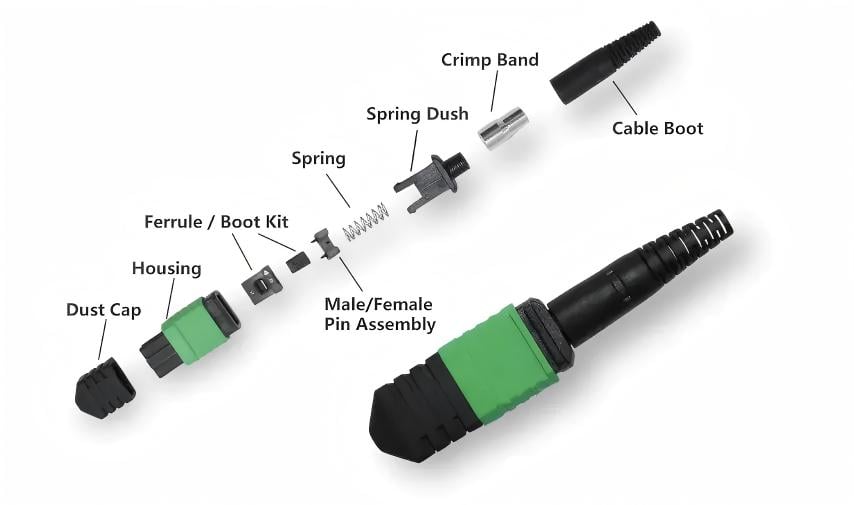
Disassembled view of an MPO fiber optic connector
MPO (and its enhanced version, MTP) connectors are designed for multi-fiber connections, typically housing 12 or 24 fibers in a rectangular ferrule. These connectors are crucial in high-density cabling systems, especially in data centers with strict requirements for space and scalability. Furthermore, MPO/MTP connectors support parallel optical transmission systems in 40G/100G/400G Ethernet.
As shown, the MPO connector consists of multiple precision components ensuring accurate alignment of multiple fibers. The high performance of MPO connectors relies on their precise alignment structure and end-face polishing processes, ensuring low insertion loss and high return loss. Their multi-fiber parallel transmission capability gives them significant advantages in high-speed network deployments, widely used especially in data center interconnect scenarios requiring short distances and large bandwidth.
E2000 Connector Components
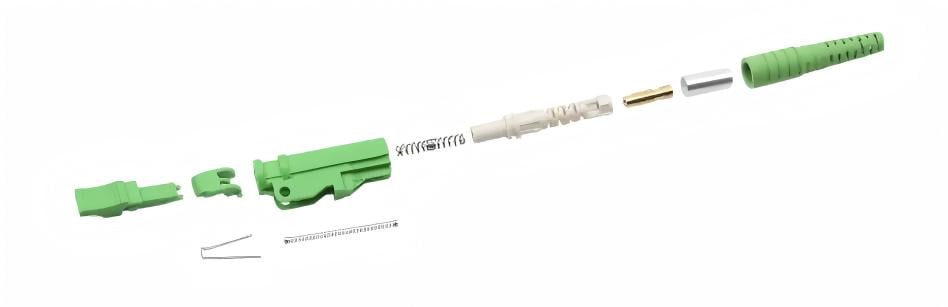
Exploded view of an E2000 fiber optic connector
The E2000 connector, developed by Diamond, features a built-in protective shutter that automatically covers the ferrule when disconnected. This design effectively prevents dust contamination and avoids accidental laser exposure to users. This connector is widely used in Europe in telecommunications and high-performance applications.
Compared to other connectors, the E2000 connector has a more compact structure, allowing it to adapt to high-density fiber patch panels, meeting the space utilization requirements of modern communication networks. It uses a precision ceramic ferrule to ensure accurate alignment between fibers, thus achieving stable optical performance with excellent key metrics like insertion loss and return loss. Additionally, the E2000 connector supports various fiber types, including single-mode and multi-mode, enabling its use in different communication scenarios, such as metropolitan area networks, access networks, and specific industrial control fields. Its reliable performance and unique safety design make it highly competitive in applications demanding high stability and security.
MU Connector Components
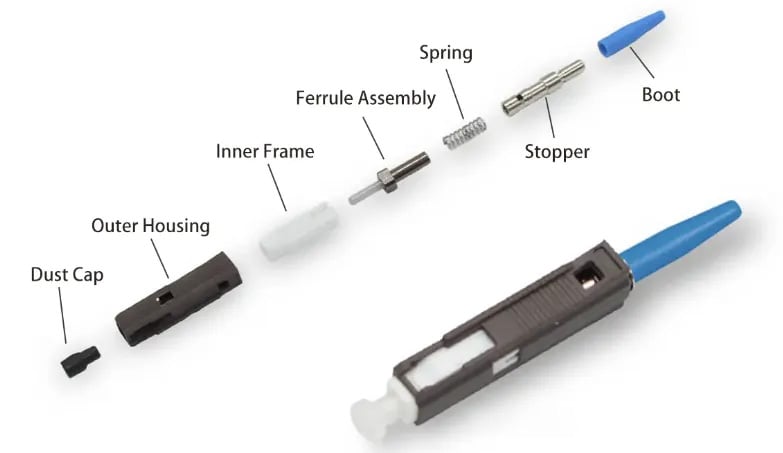
Exploded view of an MU fiber optic connector
The MU connector is a miniaturized version of the SC connector, using a 1.25mm ferrule similar to the LC. Although compact and reliable, its market share is low, and its application is not as widespread as the LC connector.
Given the limited market application of the MU connector, this article will not elaborate further.
MTRJ Connector Components
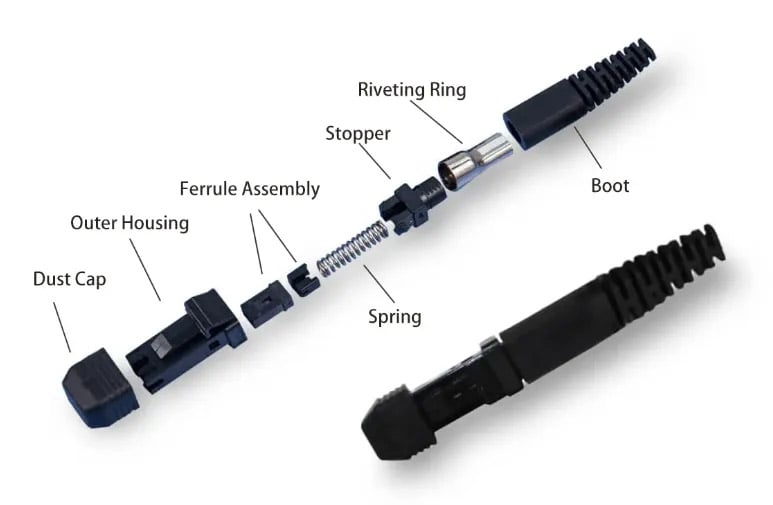
Exploded view of an MTRJ fiber optic connector
The MTRJ connector borrows from the RJ-45 design concept, with a single connector housing two fibers. Although compact, given the significant advantages of LC connectors in performance and universality, MTRJ connectors have essentially been replaced by LC connectors in modern systems.
Conclusion
In summary, the world of fiber optic connectors is an ecosystem constantly evolving and balancing standardization and specialization. From the small, flexible LC dominating modern data centers, to the rugged SC and ST common in traditional telecom networks; from the FC specialized for high-precision testing, to the MPO/MTP born for high-density, high-speed transmission; down to the distinctive E2000, MU, and MTRJ, the emergence and decline of each connector reflect the technological needs and market choices of specific historical periods.
Overall, connector development shows clear trends towards miniaturization (e.g., LC replacing MTRJ and MU), higher density (the rise of MPO), and continuously increasing demands for performance and reliability. In practical projects, there is no "optimal" universal connector, only the "most suitable" choice. Decision-makers need to comprehensively consider the application scenario, space constraints, cost budget, performance requirements, and compatibility with existing infrastructure to select the connection solution that best meets current and future needs. Understanding the subtle differences between these connectors is the first step in building efficient, reliable, and future-proof fiber optic networks.
No matter which fiber optic connector solution mentioned in this article you require, Fibermart can be your reliable professional partner. We provide a full range of high-quality fiber optic connector products, from standard LC, SC to high-density MPO/MTP patch cords, all undergoing strict quality control to ensure excellent and stable performance. Simultaneously, our expert team is ready to provide technical selection and project planning support. Welcome to visit the Fibermart website www.fiber-mart.com, explore our product matrix, obtain free technical resources, or contact our professional team to support your project.
FAQ Frequently Asked Questions
Q: Why do the exploded views of components for the same type of connector (e.g., LC, ST) show different fiber pigtail diameters like 0.9mm and 2.0mm?
A: This is because the outer jacket of the fiber itself varies in diameter. The internal structure, clamping mechanism (such as the resilient sleeve and rear boot), and external components of the connector kit must correspond to the different cable diameters to ensure the fiber is securely fastened and provided with sufficient strain relief. Selecting the correct component kit is crucial for a successful termination.
Q: The SC connector's components are described as "relatively simple." What are the practical benefits of this in installation and maintenance?
A: A simpler component structure means fewer parts and more straightforward assembly steps. This reduces the complexity of field installation and the probability of errors, making the termination process faster. It also facilitates reassembly or quick replacement during future maintenance. Its push-pull design also eliminates the need for a complex latching mechanism, further simplifying insertion and removal within a panel.
Q: What is the main potential drawback of the "bayonet-style twist-lock design" used in ST connector components, and how is this related to its component structure?
A: Its main potential drawback is that frequent mating and un-mating can cause the lock to loosen, affecting connection stability. This drawback is directly related to its component design: its locking function relies on an external, rotatable metal ring engaging with bays on the adapter. Compared to a one-piece or push-pull design, this mechanical structure—composed of multiple moving parts (metal ring, spring)—is more susceptible to performance degradation from tolerances changing after long-term wear.
Q: How do the components of an FC connector achieve high stability and vibration resistance through their "screw-on structure"?
A: The FC connector's component design features a metal housing with threads. When connected to an adapter, screwing the threads down completely provides a holding force far greater than a friction-based fit. This structure effectively resists vibration and shock, preventing the connector from working loose. Simultaneously, its precision ceramic ferrule ensures that the fiber end-faces remain precisely aligned even as the metal housing is tightened.
Q: What is a unique safety component within the E2000 connector set, and how does it work?
A: A unique component in the E2000 connector set is the built-in automatic protective shutter. This shutter is a spring-loaded mechanical part. When the connector is disconnected, the spring drives the shutter to close automatically, completely covering the critical ceramic ferrule end-face. This design integrates two key functions at the component level: preventing dust from contaminating the ferrule and avoiding exposure to potential laser radiation, thereby protecting the operator.





No comments have been posted yet.