


.webp)


In the era of global digitalization, fiber cable has evolved from a niche transmission medium to the cornerstone of modern communication infrastructure. Carrying over 90% of global internet data traffic, fiber cable enables ultra-high-speed, long-distance, and anti-interference data transmission that far outperforms traditional copper cables. This article systematically classifies mainstream fiber cable types, elaborates on their structural characteristics, transmission performance, and applicable scenarios, and provides a professional reference for network planning, engineering deployment, and equipment selection. By clarifying the technical differences and application boundaries of various fiber cables, readers can accurately match products to networking requirements and build stable, efficient, and future-proof optical communication systems.

Introduction to Fiber Cable Fundamentals
1.Basic Composition and Working Principles
Fiber cable is a transmission medium that uses light pulses to transfer data, signals, and video through glass or plastic filaments. A typical optical fiber consists of three coaxial layers: core, cladding, and coating. The core is the central light-transmitting component, usually made of high-purity silica; the cladding has a slightly lower refractive index to achieve total internal reflection and confine light within the core; the coating provides mechanical protection, moisture resistance, and bending resistance.
The core principle of fiber cable is total internal reflection. When light enters the core at a specific angle, it continuously reflects along the core-cladding boundary without penetrating the cladding, achieving low-loss long-distance transmission. Compared with copper cables, fiber cable offers higher bandwidth, lower latency, stronger electromagnetic interference resistance, and lighter weight, making it irreplaceable in 5G, data centers, fiber-to-the-home (FTTH), and long-haul backbone networks.
2.Classification Logic of Fiber Cable
Fiber cable can be classified by transmission mode, core structure, application scenario, and mechanical performance. This article adopts a practical classification combining transmission mode and engineering application: single-mode fiber cable, multi-mode fiber cable, and special-purpose fiber cable. Each category has clear technical indicators and usage boundaries, supporting precise selection for different network architectures.
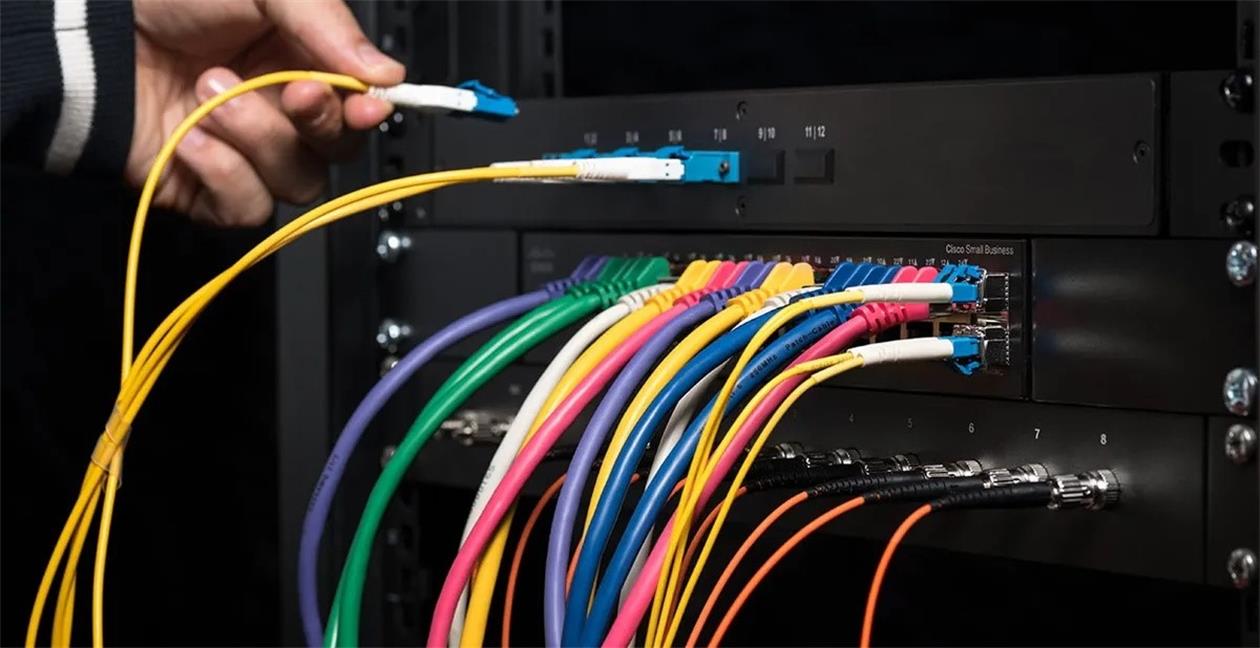
Single-Mode Fiber Cable: The Backbone of Long-Distance Communication
1.Structural Characteristics and Performance Advantages
Single-mode fiber (SMF) cable has an ultra-fine core of approximately 9 μm, allowing only one mode of light to propagate. This structure minimizes modal dispersion and attenuation, supporting high-speed transmission over dozens to hundreds of kilometers. Common operating wavelengths are 1310 nm and 1550 nm, with the 1550 nm band showing the lowest loss and being widely used in wavelength-division multiplexing (WDM) systems.
Mainstream ITU-T standards include G.652 (conventional single-mode), G.655 (non-zero dispersion-shifted), G.654 (ultra-low loss), and G.657 (bend-insensitive). G.652 is universally applied in metropolitan and access networks; G.655 suppresses nonlinear effects and suits high-capacity long-haul systems; G.657 improves bending resistance for indoor FTTH deployment.
2.Typical Applications
Long-haul telecommunication backbone: Trans-provincial and international transmission, undersea cables, and operator core networks, carrying intercontinental data and voice services.
Data center interconnection (DCI): High-speed links between large data centers, supporting 400G/800G and above rates.
FTTH and fiber-to-the-node (FTTN): Last-mile connections for residential and commercial broadband, enabling gigabit access.
5G/6G bearer networks: Front-haul, mid-haul, and back-haul links for base stations, ensuring low latency and high stability.
Specialized sensing: Distributed temperature/strain sensing, oil/gas pipeline monitoring, and bridge health detection.
Single-mode fiber cable is the first choice for large-scale, long-distance, and high-speed optical networks, representing the mainstream deployment direction of global fiber infrastructure.
Multi-Mode Fiber Cable: High-Efficiency Short-Distance Transmission
1.Structural Characteristics and Performance Advantages
Multi-mode fiber (MMF) cable has a large core of 50 μm or 62.5 μm, supporting multiple light modes simultaneously. This increases optical power coupling efficiency and lowers component and termination costs, though modal dispersion limits distance and bandwidth. Operating wavelengths are mainly 850 nm and 1300 nm, matching low-cost VCSEL lasers widely used in data centers.
MMF is divided into OM1–OM5 grades. OM5 (wideband multi-mode) supports short-wave WDM (SWDM) to boost parallel transmission capacity, suitable for 100G/200G/400G short links.
2.Typical Applications
Data center internal cabling: Server-switch, switch-switch, and storage connections within racks or between adjacent racks.
Enterprise LAN and campus networks: Building backbones and floor cabling, covering hundreds of meters.
Industrial automation: Industrial Ethernet, robot control, and production-line communication resistant to electromagnetic interference.
Medical and imaging equipment: High-definition video transmission and image sensing in medical devices.
Broadcasting and AV systems: Live 4K/8K video and large-screen signal transmission.
Multi-mode fiber cable balances cost, performance, and ease of installation, dominating short-range high-speed scenarios.
Special-Purpose Fiber Cable: Custom Solutions for Harsh Environments
1.Outdoor and Mechanically Protected Fiber Cable
Outdoor fiber cable requires waterproofing, tensile strength, and rodent resistance. Common types:
Stranded loose-tube cable: Tubes spiraled around a strength member, good for tensile and lateral pressure; used in aerial, duct, and direct-buriel long-haul lines.
Central loose-tube cable: Compact and lightweight, ideal for aerial access networks.
Armored cable: Metal or reinforced protective layer, anti-crushing and rodent-resistant for direct burial and industrial sites.
2.Industrial and Harsh-Environment Fiber Cable
Industrial fiber cable: Oil-resistant, chemical-resistant, and wide-temperature, for manufacturing, wind farms, and power systems.
Radiation-hardened fiber cable: Special doping for nuclear power and space applications resisting radiation-induced loss.
FTTA fiber cable: Weatherproof and UV-resistant for 5G base stations and tower connections.
3.High-Density and Miniaturized Fiber Cable
High-density fiber cable: Reduced size and weight for crowded data centers, improving airflow and management.
Multi-core fiber cable: Multiple cores in one cable for high-capacity, space-limited scenarios like data centers and submarine links.
Special-purpose fiber cable extends optical communication to extreme environments, supporting industrial digitalization and infrastructure upgrades.
Selection Principles of Fiber Cable
1.Core Selection: Single-Mode vs. Multi-Mode
Choose based on transmission distance, bandwidth, and budget:
Distance > 2 km or high capacity: single-mode fiber cable.
Distance < 500 m and cost sensitivity: multi-mode fiber cable.
Mixed long/short haul: single-mode for backbone, multi-mode for horizontal cabling.
2.Structural Selection by Deployment Environment
Indoor: bend-insensitive, flame-retardant, low-smoke zero-halogen (LSZH).
Outdoor/aerial: waterproof, tensile, UV-resistant.
Direct burial: armored, rodent-resistant.
Industrial: chemical, temperature, and vibration resistant.
3.Future-Proofing Considerations
Select higher grades (e.g., OM5 over OM3/OM4, G.655/G.657 over basic G.652) to support 400G/800G/1.6T and extend lifecycle.
Development Trends of Fiber Cable Technology
Ultra-high speed and large capacity: 1.6T/3.2T commercialization, few-mode and multi-core fibers for exponential capacity growth.
Full-optical network popularization: end-to-end optical switching from backbone to access for lower latency and higher reliability.
Special fiber innovation: hollow-core and photonic crystal fibers for lower loss and delay, supporting next-gen sensing and computing.
Intelligent operation and maintenance: integrated sensing and communication for real-time monitoring and automatic fault location.
Fiber cable will remain the core physical layer for global digital infrastructure.

Fiber cable is essential to modern communication, supporting digital life, industrial production, and technological innovation. Single-mode fiber cable dominates long-distance and high-capacity scenarios; multi-mode fiber cable excels in short-range high-speed systems; special-purpose fiber cable enables harsh-environment applications. With 5G-Advanced, 6G, and cloud computing, fiber cable technology will keep innovating.





No comments have been posted yet.