


.webp)


If you’ve ever dealt with faulty fiber links, unrecognized third-party modules, unexpected port downtime or overheating optical modules in your data center, you know how tricky optical transceiver selection can be.
Optical transceivers act as the bridge between electrical switch signals and optical fiber signals, and every wrong choice leads to avoidable outages and budget waste. As data centers scale from 10G/25G up to 100G and 400G speeds, engineers face more pain points: confusing form factors, vendor lock-in restrictions, overlooked thermal risks, and unclear upgrade paths for 100G-to-400G migration.
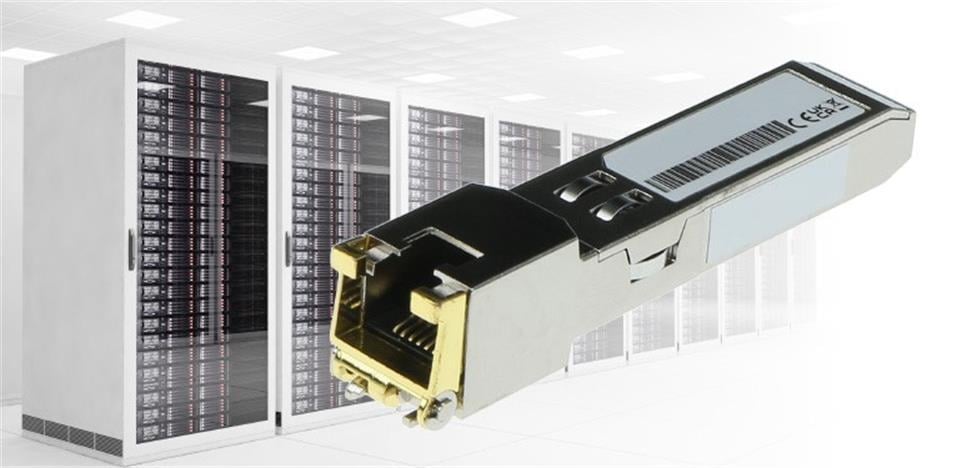
This hands-on optical transceiver guide cuts through overly theoretical documentation. It covers transceiver fundamentals, industry standard code meanings, a clear breakdown of SFP vs QSFP differences, a full QSFP28 guide for 100G deployments, cross-vendor compatibility rules for Cisco, Juniper and Arista, 100G/400G migration strategies, and critical thermal design considerations you can’t ignore in production environments.
Optical Transceiver Basics You Need to Know
What Is an Optical Transceiver?
An optical transceiver (or optical integrated transceiver) is a hot-swappable pluggable module that converts electrical signals to optical signals for fiber transmission, and vice versa. It’s deployed across switches, routers, firewalls and SAN storage devices, and forms the foundation of all fiber-based network infrastructure.
How Optical Transceivers Work
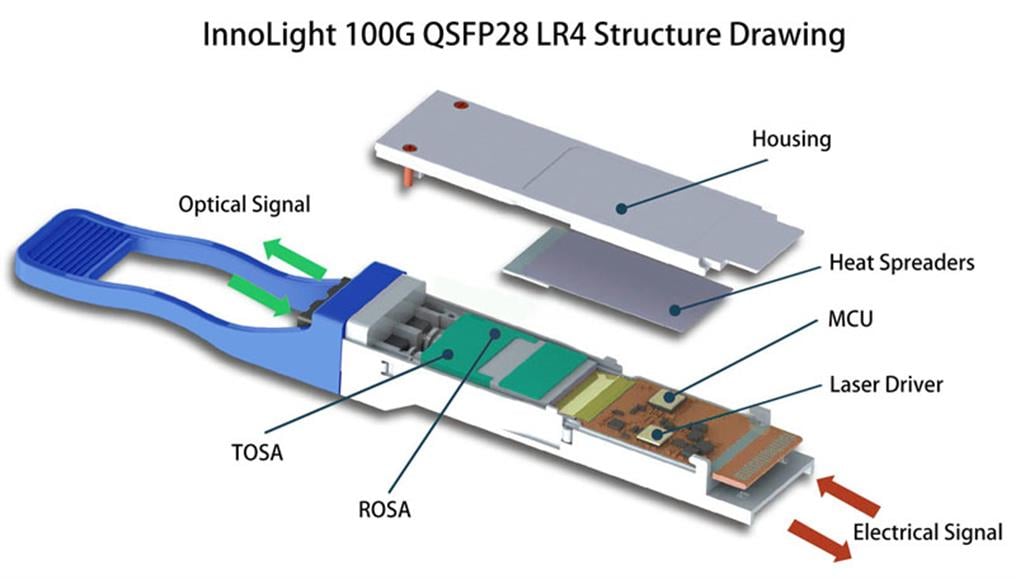
Every standard transceiver consists of three core parts: optoelectronic chips, functional driver circuits and fiber interfaces. Its operation splits clearly into transmit and receive paths:
● Transmit path: An internal driver chip processes incoming electrical signals, then drives onboard lasers or LEDs to generate modulated optical signals. A built-in automatic power control circuit stabilizes output light power to prevent unstable signal strength over fiber links.
● Receive path: A photodiode captures incoming optical signals and converts them back to electrical signals. After pre-amplification, the module outputs standard PECL electrical signals. It also triggers a real-time alarm once received optical power drops below the safe threshold, helping you troubleshoot fiber faults faster.
Key Specs That Drive Your Selection
Three core specs decide your basic transceiver match, while secondary parameters determine long-term stability in production:
Three Primary Technical Parameters
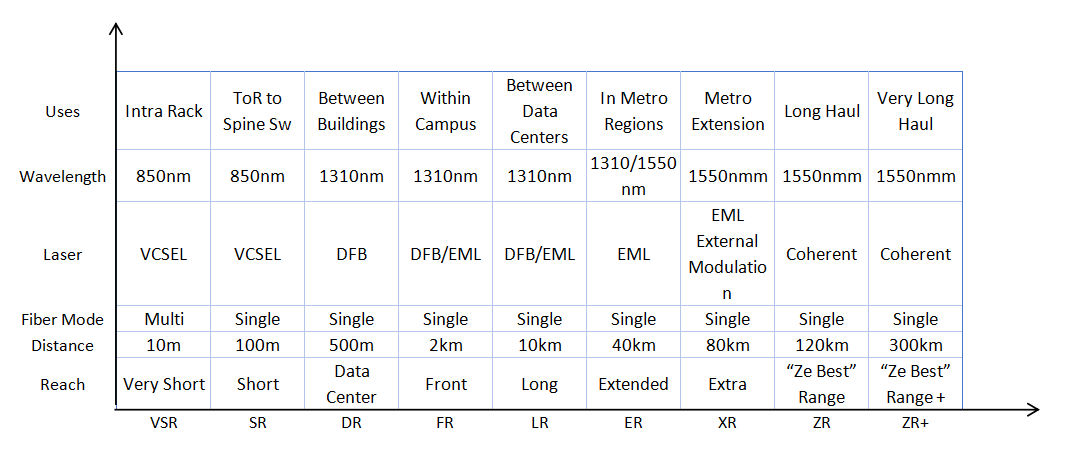
● Central Wavelength (nm)
850nm: Multimode fiber only, low cost, short reach (max 550m) for intra-datacenter connections
1310nm: Single-mode fiber, low dispersion, 0.35dB/km link loss, ideal for links under 40km
1550nm: Single-mode fiber, low fiber attenuation, higher dispersion, supports long-haul links up to 120km without signal amplification
● Transmission Rate: Common rates cover 155Mbps (Fast Ethernet), 1.25Gbps (Gigabit Ethernet), 10Gbps for general LAN; 2G/4G/8Gbps for SAN storage networks. Most rates support backward compatibility for legacy network hardware.
● Transmission Distance: Standard reach options include 550m (multimode), 15km, 40km, 80km and 120km (single-mode). Maximum reach is limited jointly by fiber signal loss and chromatic dispersion.
Secondary Critical Specs for Production Deployment
● Laser Type: FP lasers fit links under 40km with lower cost; DFB lasers deliver better wavelength stability for links over 40km but come with a higher price tag.
● Tx Power & Rx Sensitivity (dBm): Use these two values to calculate maximum loss-limited reach: Loss-limited distance Transmit Power - Receive Sensitivity) / Fiber Attenuation. This formula helps you avoid link loss budget failures before deployment.
● Service Lifetime: All commercial transceivers follow a unified industry standard: 50,000 hours (roughly 5 years) under 7×24 non-stop operation.
● Fiber Interface: LC ports for mainstream SFP/QSFP modules; SC ports for legacy GBIC modules; FC/ST ports for industrial network deployments.
Decode Common Transceiver Suffix Codes (IEEE & MSA Standards)
Manufacturers add standardized letter suffixes to transceiver part numbers to indicate reach and fiber type. You’ll see these codes on every module label, and mixing them up is one of the most common beginner mistakes.
1G Transceiver Suffix Codes
● SX: 850nm multimode, short reach up to 550m for rack-to-rack leaf connections
● FX: 100Mbps fast Ethernet, designed for short-range LAN access switches
● LX: 1310nm single-mode, standard 10km reach for building-to-building links
● EX: Extended reach, 1310nm single-mode, supports up to 40km metro links
● ZX: Long extended reach, 1550nm single-mode, covers up to 80km for metropolitan core networks
High-Speed 10G/40G/100G/400G Suffix Codes
● SR: Short Range, 850nm multimode; 550m over OM2 fiber, 300m over OM3/OM4 fiber for in-datacenter short hops
● LR: Long Range, 1310nm single-mode, standard 10km reach for inter-building uplinks
● ER: Extended Range, 1550nm single-mode, 40km reach for metro network interconnections
● DR / FR: Double Reach and Far Reach, MSA-defined specs for flexible medium and long-distance links
● ZR / ZR+: Ultra-long haul modules; ZR supports 80km cross-city links, while modern 400G ZR+ modules extend reach up to 480km
● SR4 / LR4 / LR8: Multi-channel parallel modules for 40G/100G/400G high-density uplink ports
SFP vs QSFP: Direct Comparison + Complete QSFP28 Guide
Form factor selection directly impacts port compatibility, rack density and thermal load. Below is a side-by-side comparison of mainstream pluggable modules, plus a dedicated QSFP28 guide for your 100G fabric deployments.
Pluggable Transceiver Form Factor Compatibility Table
|
Form Factor
|
Typical Speed
|
Channel Design & Signaling
|
Common Interface
|
Primary Use Case
|
Hot-Swappable
|
|---|---|---|---|---|---|
|
SFP
|
155M – 2.5G
|
Single lane, NRZ
|
LC
|
Access layer switches, low-speed LAN ports
|
Yes
|
|
SFP+
|
10G
|
Single lane, NRZ
|
LC
|
ToR server uplinks, 10G leaf switch ports
|
Yes
|
|
QSFP+
|
40G
|
4×10G lanes, NRZ
|
LC / MPO
|
Legacy 40G leaf-spine fabric uplinks
|
Yes
|
|
QSFP28
|
100G
|
4×25G lanes, NRZ
|
LC / MPO
|
Standard 100G leaf-spine data center fabrics
|
Yes
|
|
QSFP-DD
|
400G / 800G
|
8×50G lanes, PAM4
|
MPO-12 / MPO-16
|
400G core uplinks, compact 800G leaf ports
|
Yes
|
|
OSFP
|
800G
|
8×100G lanes, PAM4
|
MPO-16
|
800G spine core ports, AI high-density clusters
|
Yes
|
Differences: SFP vs QSFP
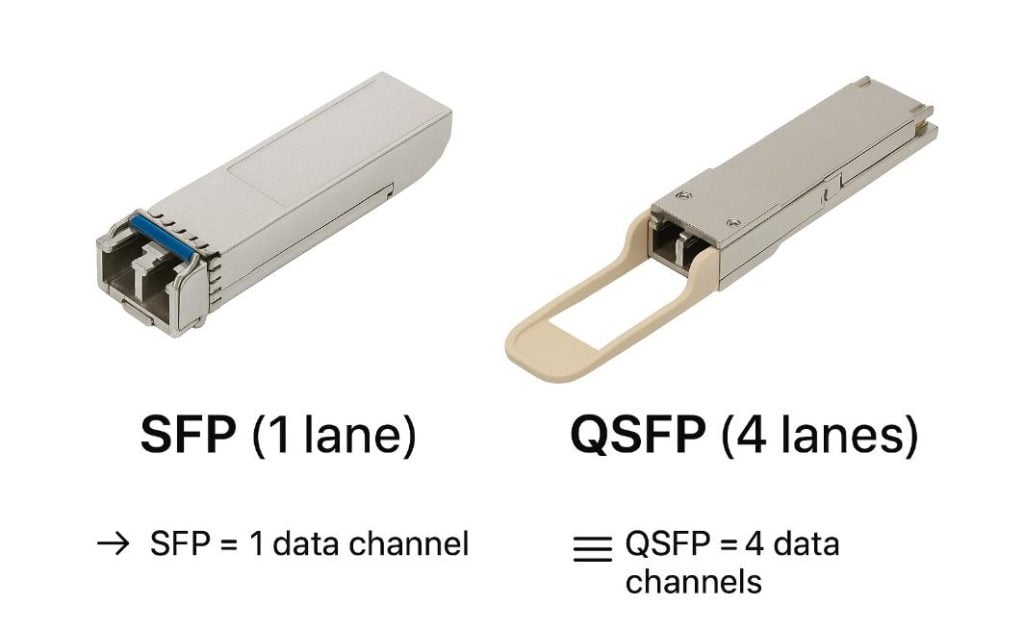
● Port Density: SFP and SFP+ use single-channel architecture for low-density access ports. QSFP modules leverage parallel multi-channel design to pack more bandwidth into the same port slot, saving rack space and overall switch port costs.
● Power Draw & Heat Output: QSFP modules consume more power and generate more heat than SFP variants. This makes thermal management far more critical for QSFP deployments.
● Backward Compatibility: QSFP ports work with SFP modules via simple adapters. However, SFP ports cannot support any QSFP high-speed modules, so port upgrade requires hardware replacement.
QSFP28 Guide: Standard Transceiver Modules for 100G
QSFP28 is now the dominant 100G form factor across modern data centers. It shares the exact same physical size as older QSFP+ modules, so you can upgrade from 40G to 100G without replacing existing switch hardware. The three most widely deployed QSFP28 modules are listed below:
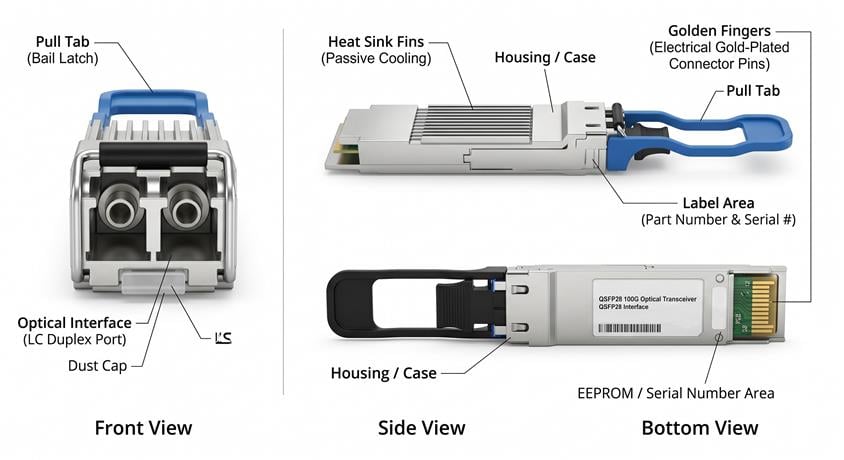
● QSFP28-SR4: 100G short reach, 100m over multimode fiber, for intra-spine rack connections
● QSFP28-LR4: 100G standard reach, 10km over single-mode fiber, for cross-building uplinks
● QSFP28-ER4: 100G extended reach, 40km over single-mode fiber, for metro data center interconnections
400G & 800G Ultra-High-Speed Transceiver Overview
Driven by AI training workloads, generative AI clusters and surging east-west traffic inside modern data centers, 400G has become mainstream for spine core uplinks, while 800G transceivers are fast emerging as the next-gen standard for greenfield hyperscale data centers. Unlike legacy 10G/100G modules using NRZ signaling, all 400G and 800G optics adopt PAM4 4-level pulse amplitude modulation, doubling bandwidth per optical lane without boosting physical lane speed, which balances port bandwidth density and hardware heat generation.
400G Optical Transceivers (QSFP-DD Form Factor)
400G modules universally use QSFP-DD double-density packaging, backward compatible with existing QSFP+/QSFP28 ports via adapters. Below are field-proven 400G mainstream variants:
● 400G-DR4: 100m short reach, 4 parallel lanes, MPO-12 interface, for intra-data center rack-to-rack connections
● 400G-FR4: 2km medium reach, single-mode fiber, cost-effective for campus core interconnections
● 400G-LR4: 10km standard long reach, widely used for cross-building core uplinks
● 400G-ZR4/ZR4+: 80km~120km coherent long-haul modules, designed for inter-metro and cross-site data center links
800G Optical Transceivers (OSFP & QSFP-DD)
800G is built exclusively for AI computing clusters with ultra-high bandwidth demands. It has two dominant industrial form factors with clear application segmentation:
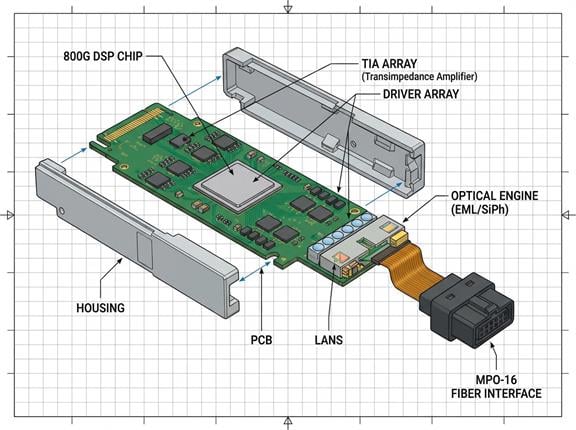
● OSFP 800G: Larger physical size with integrated built-in heat sink, higher power budget, better thermal dissipation. Preferred by Cisco, Arista for spine switch core ports; supports breakout into 2×400G / 4×200G ports for flexible bandwidth allocation.
● QSFP-DD 800G: Same footprint as 400G QSFP-DD modules, perfect for switch hardware reuse; compact size saves rack space but faces stricter thermal limits compared with OSFP variants.
Common 800G Standard Codes: 800G-VR8 (100m multimode), 800G-DR8 (500m single-mode), 800G-FR8 (2km), 800G-LR8 (10km). Most 800G modules adopt MPO-16 fiber interfaces to support 8 parallel optical lanes.
Vendor Compatibility: Cisco, Juniper and Arista Support
Vendor lock-in is one of the biggest headaches when sourcing third-party transceivers. Each major switch vendor adopts different policies for generic unbranded modules. The table below summarizes real-world production compatibility rules for Cisco, Juniper and Arista:
|
Vendor
|
Official OEM Modules
|
Third-Party Generic Module Support
|
Known Compatibility Limitations
|
Field Recommendation
|
|---|---|---|---|---|
|
Cisco
|
Full lineup with strict DOM digital optical monitoring enforcement
|
Disabled by default; requires manual CLI commands to unlock
|
Unlocked generic modules lose partial DOM alarm reporting functions
|
Use Cisco original modules or fully coded compatible third-party modules
|
|
Juniper
|
Complete 10G/100G/400G OEM module portfolio
|
Fully open compatibility with no unlock commands required
|
No functional restrictions for MSA-compliant standard modules
|
Standard MSA third-party modules work perfectly with no extra config
|
|
Arista
|
Basic OEM modules for bare-metal switching platforms
|
Native open compatibility built for hyperscale data center use cases
|
Zero limitations for all IEEE/MSA compliant transceivers
|
Cost-effective generic QSFP28 and SFP modules are fully production-safe
|
Field Tip: No matter the vendor, non-standard custom modules that break IEEE or MSA specs will cause port flapping and DOM failures. Always stick to industry-standard modules regardless of cost savings.
100G → 400G → 800G Three-Stage Data Center Migration Roadmap
Driven by AI workloads and massive east-west traffic, modern data centers follow a clear three-phase bandwidth upgrade path from legacy 100G fabric to cutting-edge 800G AI-optimized fabric. Each stage matches dedicated transceiver models and minimizes hardware replacement costs.
Phase 1: Hybrid 100G + 400G Coexistence (Low-Risk Intermediate Upgrade)
Keep existing 100G QSFP28 leaf switches unchanged, deploy new 400G QSFP-DD spine switches. Use 400G-to-100G breakout cables to split one 400G port into four independent 100G ports. This approach requires no leaf switch hardware replacement and minimizes service interruption for general cloud and enterprise data centers.
Phase 2: Full 400G Fabric Upgrade (Current Mainstream Deployment)
Upgrade both leaf and spine switches to full QSFP-DD 400G ports. Deploy 400G DR4/FR4 modules for short and medium-reach links. QSFP-DD ports offer native backward compatibility with existing QSFP28 modules, so you can reuse current 100G inventory to cut upgrade costs. This stage fits most standard cloud data centers without extreme AI bandwidth demands.
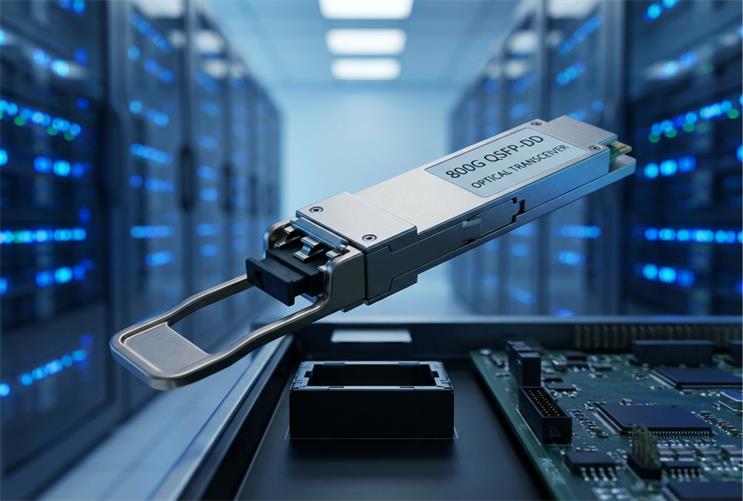
Phase 3: 400G to 800G AI-Optimized Upgrade (Next-Gen Fabric)
For AI training clusters and hyperscale greenfield data centers, upgrade spine ports to OSFP 800G modules while retaining QSFP-DD leaf ports. 800G optics cut nearly 50% required physical ports compared with 400G fabric, reducing overall switch quantity, cabling workload and rack space occupation. Operators can also use 800G-to-400G breakout ports to achieve smooth downward compatibility.
Key Migration Best Practices
● Retain existing LC duplex fiber cabling for medium-reach links to avoid costly rewiring
● Deploy MPO multi-fiber patch cords for short-range rack uplinks to boost port density
● Select coherent ZR/ZR+ modules for long-haul cross-data-center inter-site connections
● Prioritize OSFP 800G over QSFP-DD 800G for spine core ports to resolve thermal bottlenecks
Driven by AI workloads and massive east-west traffic, data centers are steadily migrating from mature 100G leaf-spine fabrics to 400G high-bandwidth architectures. Below is a two-phase migration plan tailored for real network environments, with matched transceiver selection guidance.
Thermal Considerations Most Guides Ignore
Most transceiver selection guides only cover speed, reach and compatibility, but thermal performance is a top cause of silent link drops in high-speed fabrics. High-power optical modules generate significant heat, and poor cooling leads to laser drift, rising bit error rates and permanent module damage over time.
Thermal Risks for Modern High-Speed Modules
● Rising power consumption gradient: 10G SFP+ <1.5W; 100G QSFP28 5–7W; 400G QSFP-DD 12–14W; 800G OSFP up to 18–20W. Ultra-high-speed modules bring exponential thermal load growth, becoming the top bottleneck for high-density switch deployment.
● Laser & PAM4 signal sensitivity: Onboard FP/DFB lasers suffer severe wavelength drift above 35°C. Worse still, PAM4 signaling adopted by 400G/800G modules is more sensitive to temperature fluctuation than traditional NRZ signals; minor heat rise will directly trigger rising BER and intermittent packet loss.
● Hot aisle harsh conditions: Rear rack hot aisles often hit 40°C–45°C in production data centers, exceeding standard commercial module operating temperature. 800G modules have almost no tolerance for high ambient temperature, making active heat dissipation mandatory.
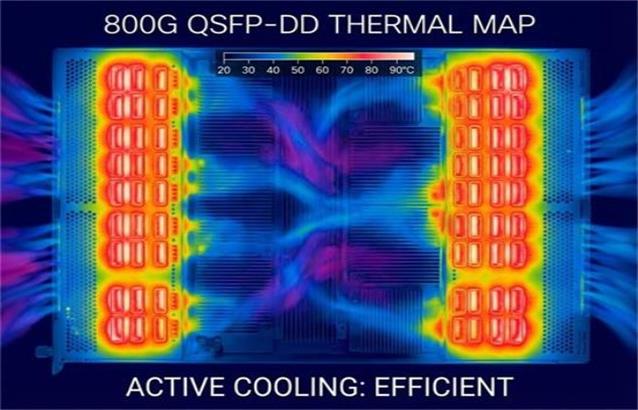
Thermal Deployment Rules for Production
● Match module temperature grade to rack position: Use commercial-grade modules (0°C–70°C) for cold aisle front ports; use industrial-grade modules (-40°C–85°C) for hot aisle rear ports and outdoor cabinets. All 800G core ports require industrial-grade modules by default.
● TEC & integrated heat sink mandatory for ultra-high-speed optics: All 400G long-reach and all 800G modules must equip built-in TEC coolers and integrated top heat sinks to stabilize laser temperature and PAM4 signal quality.
● Strict airflow deployment rules: Adopt front-to-back high-speed airflow switches for 400G/800G ports; reserve extra ventilation gaps between adjacent 800G modules, and never stack high-heat modules densely without airflow isolation.
Step-by-Step Transceiver Selection Workflow
● Confirm your switch vendor and available port form factor (SFP vs QSFP/QSFP28)
● Define required speed and fiber distance, then match the correct wavelength and suffix code
● Check vendor third-party module policies to pick OEM or generic modules
● Evaluate rack ambient temperature and select matching temperature-grade modules
● Calculate fiber loss budget using Tx power and Rx sensitivity to avoid marginal link performance
FiberMart Optical Transceiver Module Solutions
FiberMart delivers a full-stack optical transceiver portfolio spanning legacy low-speed 1G SFP modules all the way up to cutting-edge 800G QSFP-DD and OSFP high-speed modules, covering every mainstream form factor including SFP+, QSFP+, QSFP28 to match full lifecycle data center networking demands. All modules strictly follow IEEE and MSA industry standards, with complete wavelength options and variants for short-reach intra-rack connections, medium-reach building uplinks and long-haul cross-metro inter-site links. Every unit undergoes precise calibration on transmit power, receive sensitivity and optical performance, allowing network engineers to build accurate fiber loss budgets upfront and avoid hidden link instability risks in production environments.
● SFP Transceiver: Compatible 1G SFP, 100G Base SFP
● SFP+ Transceiver: Compatible 10G SFP+
● 100/400/800G Transceiver: 100G QSFP28, 800G QSFP-DD/OSFP
Conclusion
Choosing the right optical transceiver is far more than matching speed and reach. It requires careful evaluation of form factor gaps between SFP and QSFP, QSFP28 100G fabric requirements, multi-vendor compatibility limitations, 100G-to-400G upgrade planning, and often-overlooked thermal constraints.
This end-to-end optical transceiver guide covers basic module specs, code decoding, SFP vs QSFP form factor comparison, QSFP28 100G deployment guidance, multi-vendor compatibility, full 100G/400G/800G migration strategies and overlooked thermal risks. It helps network engineers avoid common field failures, cut hardware procurement costs, and build stable, scalable fiber fabrics for both traditional cloud and AI data centers. As 1.6T transceivers are under standardization, thermal management, PAM4 signal integrity and cross-vendor interoperability will remain permanent core selection criteria for next-generation optical networking.
FAQs
What is the practical difference between SFP and QSFP modules?
SFP series adopts single-lane design for low-speed access ports, while QSFP uses multi-lane parallel transmission for higher bandwidth. QSFP ports support backward compatibility with SFP modules via adapters, but SFP ports can never run QSFP modules. Besides, all QSFP modules generate far more heat than SFP counterparts.
Which form factor is better for 800G deployment: QSFP-DD or OSFP?
Choose OSFP 800G for spine core ports thanks to better native heat dissipation and higher power budget. Pick QSFP-DD 800G for leaf ports to reuse existing switch slots and save hardware investment, but ensure sufficient airflow for thermal cooling.
Are third-party generic modules safe for Cisco, Juniper and Arista switches?
Arista and Juniper fully support standard MSA generic modules with no extra configuration. Cisco blocks un-coded third-party modules by default, requiring CLI unlock commands; partial DOM monitoring functions will still be missing after unlocking. Original coded modules are recommended for Cisco production core networks.
Why do 400G/800G modules have higher bit error rates than legacy 10G/100G modules?
Ultra-high-speed modules adopt PAM4 signaling, which is more sensitive to temperature changes and fiber loss than traditional NRZ signaling. Meanwhile, their much higher power consumption leads to laser wavelength drift under poor cooling conditions, causing intermittent link errors silently.
What is the lowest-risk 100G to 800G upgrade roadmap?
Follow three-phase upgrade: hybrid 100G+400G coexistence → full 400G fabric deployment → spine-only 800G upgrade. Use breakout cables for port splitting to avoid full switch replacement and protect existing optical module and cabling assets.
What is the most frequent mistake when matching transceiver suffix codes?
Mixing multimode and single-mode fiber for SR/LR modules. SR modules only work with multimode fiber, while LR/ER/ZR modules require single-mode fiber. Wrong fiber matching causes immediate link down regardless of correct wavelength and speed settings.
Posted on 29 May, 2026, by Francisco, Fibermart, All Copy Right Reserved.





No comments have been posted yet.