


.webp)


Polarization maintaining fiber is essential in fiber optics because standard fibers randomly scramble the polarization state of light due to inherent stresses and imperfections, which is critically problematic in applications where information is encoded in the polarization or where system performance, like in fiber optic gyroscopes, coherent communications, and quantum key distribution, depends on preserving a stable and known polarization state from the source to the detector.
What is Fiber Polarization?
As a light wave propagates through a point in space, its fundamental nature as a transverse electromagnetic wave is defined by mutually perpendicular, oscillating electric and magnetic field vectors, denoted as E and B respectively, which reside in the transverse plane oriented at a right angle to the direction of travel. The signal of the polarized light wave is captured by the specific behavior of these fields, particularly the path traced in time by the direction and amplitude of the vibrating electric field. While the wave consists of both components, its polarizing properties are most conveniently described by studying the oscillations of its electric field, E, as this vector provides the primary influence in most optical interactions, even though the effects of light can also be formulated in terms of its magnetic field.
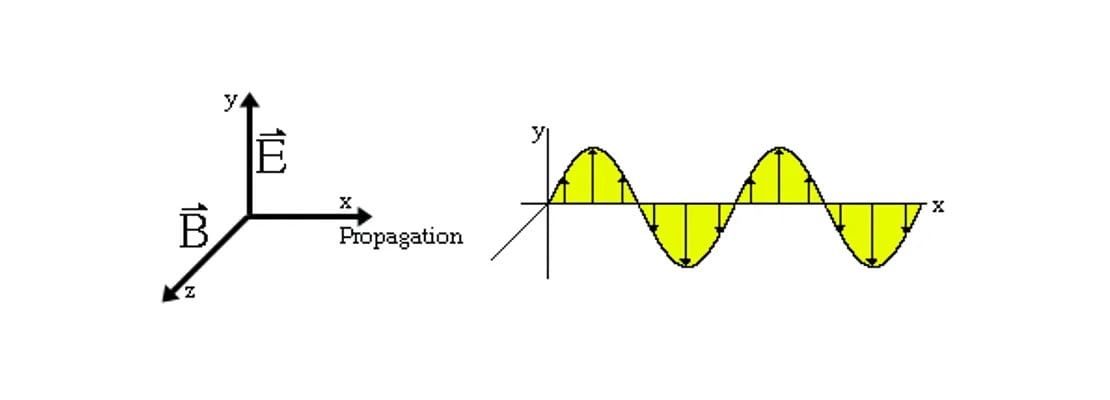
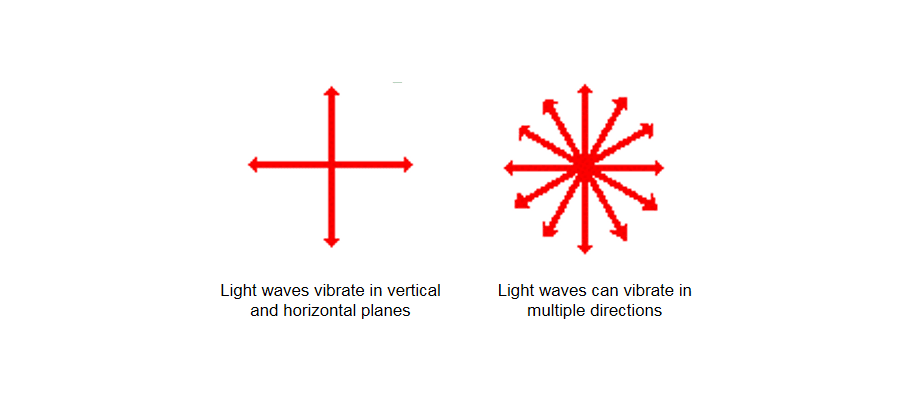
This leads to the classification of light based on its vibration: polarized light results when the wave vibrations are confined to a single, specific direction within a plane, such as strictly up and down, whereas unpolarized light is characterized by vibrations occurring in many rapid and random directions across multiple planes simultaneously, such as a combination of up/down and left/right.
Polarization Maintaing Fiber Structure And Type Classification
PM Fiber Structure
Theoretically, an optical fiber with a perfectly circular core and symmetrical structure should not exhibit birefringence, allowing the polarization state of light to remain unchanged throughout propagation. However, in practice, conventional fibers inevitably develop internal stress during manufacturing and are subjected to external forces such as bending and pressure, leading to geometric imperfections like non-uniform thickness. These factors induce birefringence, meaning the fiber develops two distinct optical axes with different refractive indices. Consequently, when light travels through a standard fiber, any external influence—including changes in wavelength, mechanical bending, or temperature fluctuations—alters this birefringence, causing the polarization state to become scrambled and unpredictable.
.jpg "PM Fiber Structure")
This problem of unstable polarization is addressed by Polarization-Maintaining (PM) fiber. It is crucial to understand that PM fiber does not eliminate birefringence; rather, it intentionally creates a consistent, high level of birefringence by designing specific geometric asymmetries into the fiber core, such as with stress-applying parts. This controlled design effectively neutralizes the variable effects of random external stress on the incident light's polarization.
Therefore, how does PM fiber precisely manage this birefringence? During the fiber drawing process, specific features (like a Panda or Bow-Tie structure) are incorporated to define two principal characteristic axes: a fast axis and a slow axis. When linearly polarized light is launched precisely along one of these axes, the strong, built-in birefringence acts to preserve that polarization. The goal is to minimize the coupling of optical signal from the launched axis to the perpendicular one. Any undesired coupling that does occur will degrade performance by reducing the ratio of the desired polarized output signal to the leaked one—a key performance metric known as the extinction ratio. It is this very high extinction ratio, achieved by suppressing cross-coupling, that defines the effectiveness of the PM fiber's birefringence in maintaining a stable polarization state.
PM Fiber Type
Polarization-maintaining fibers (PMFs) are generally categorized into two main types: stress-induced and geometrical. Geometrical PMFs, such as those with an elliptical core, are used in some special applications, but stress-induced types are more common. Among these, several distinct structures have been developed, each with its own advantages and limitations:
(1) Panda PMF: This design is known for its relatively large preform size, which makes it highly suitable for mass production. A key drawback, however, is its large stress zone area, which makes it more sensitive to temperature variations.
(2) Elliptical Cladding PMF: This type offers good stability. Its primary disadvantages are a small preform size, stress that is concentrated at the tip of the stress-applying region, and a tendency to crack during the cleaving process.
(3) Bow-Tie PMF: This structure is capable of achieving very high birefringence. The challenges with this design lie in the difficulty of controlling the core's geometry with precision and, similar to the elliptical cladding type, its small preform size.
(4) Elliptical Core PMF: As a geometrical PMF, its key benefits include insensitivity to temperature and an ease of grinding the fiber cross-section. Its main weakness is that it produces only weak birefringence.
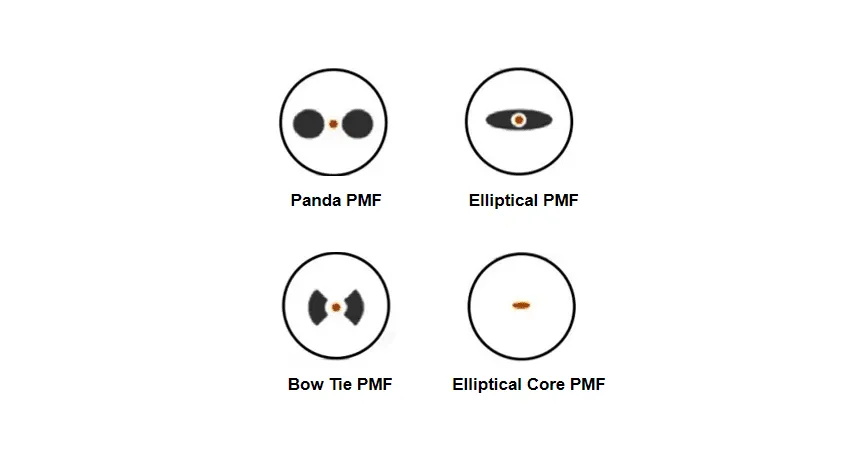
When these types are compared, Panda polarization-maintaining fiber demonstrates natural advantages in overall performance. It excels in critical parameters such as birefringence level, geometric characteristics, structural symmetry, and longitudinal uniformity along the fiber's length. Furthermore, its manufacturing process is a significant benefit; unlike some designs that must be completed in a single step, the Panda fiber's preform is constructed from separate, independently manufactured components. This allows for superior control over the final fiber's structure and composition. This controlled process ensures that a single preform can draw tens to over a hundred kilometers of uniform PMF product, solidifying its suitability for mass production. It is for these combined reasons of performance and manufacturability that the Panda-type polarization-maintaining fiber is the most commonly used design in the industry.
The Characteristic Parameters of Polarization Maintaining
Fast Axis and Slow Axis in PM Fiber
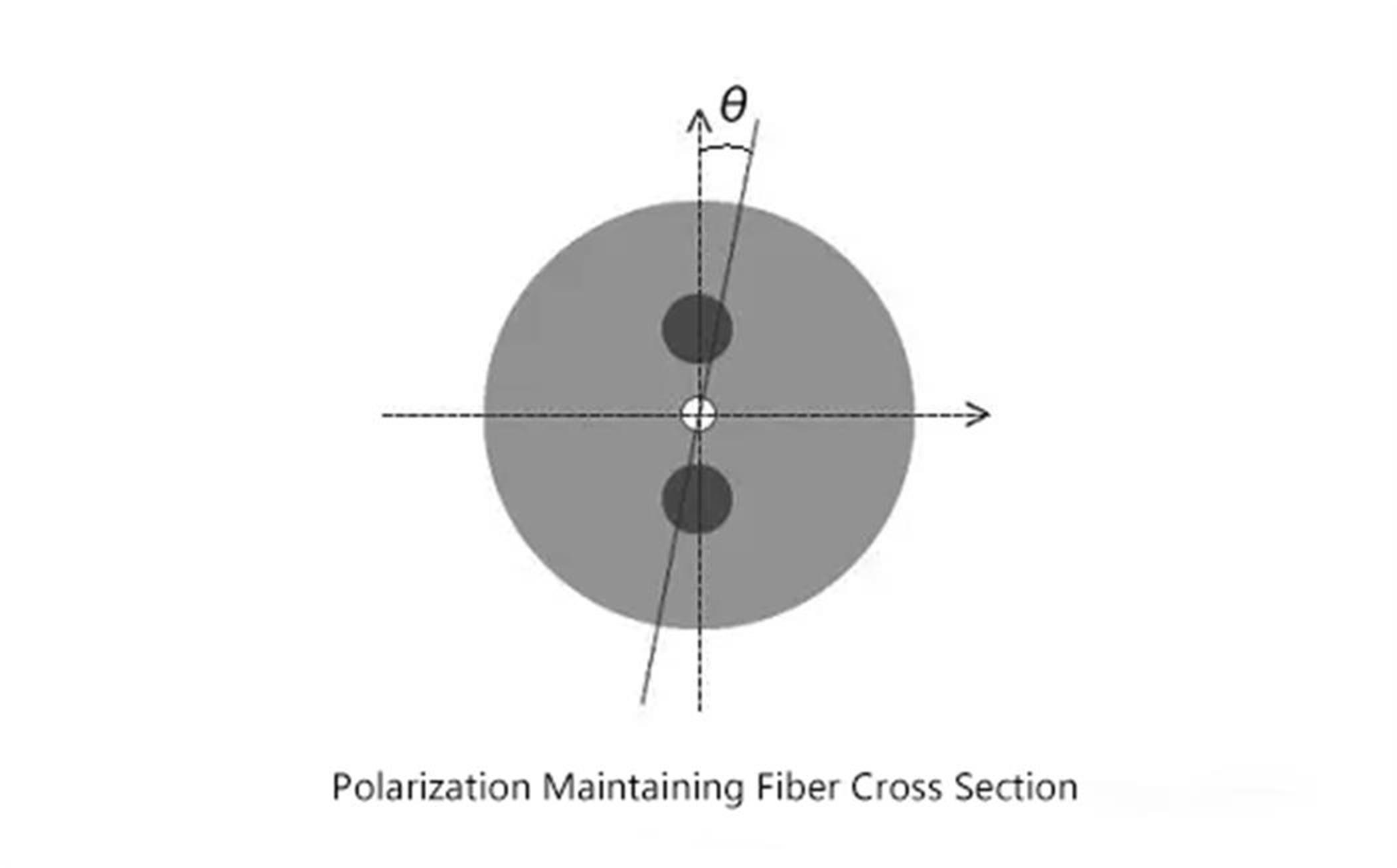
During the manufacturing of certain polarization-maintaining fibers like the Panda type, two stress zones with a different thermal expansion coefficient than the surrounding cladding are created on either side of the single-mode fiber core. As the fiber preform is drawn and rapidly cooled from a high temperature, these stress zones contract. This contraction is hindered by the surrounding quartz material, which generates significant mechanical stress. This stress field pulls the fiber core outward along the line connecting the two stress zones (the x-axis) and creates a compressive stress in the perpendicular direction (the y-axis), thereby inducing a controlled, permanent stress birefringence within the core.
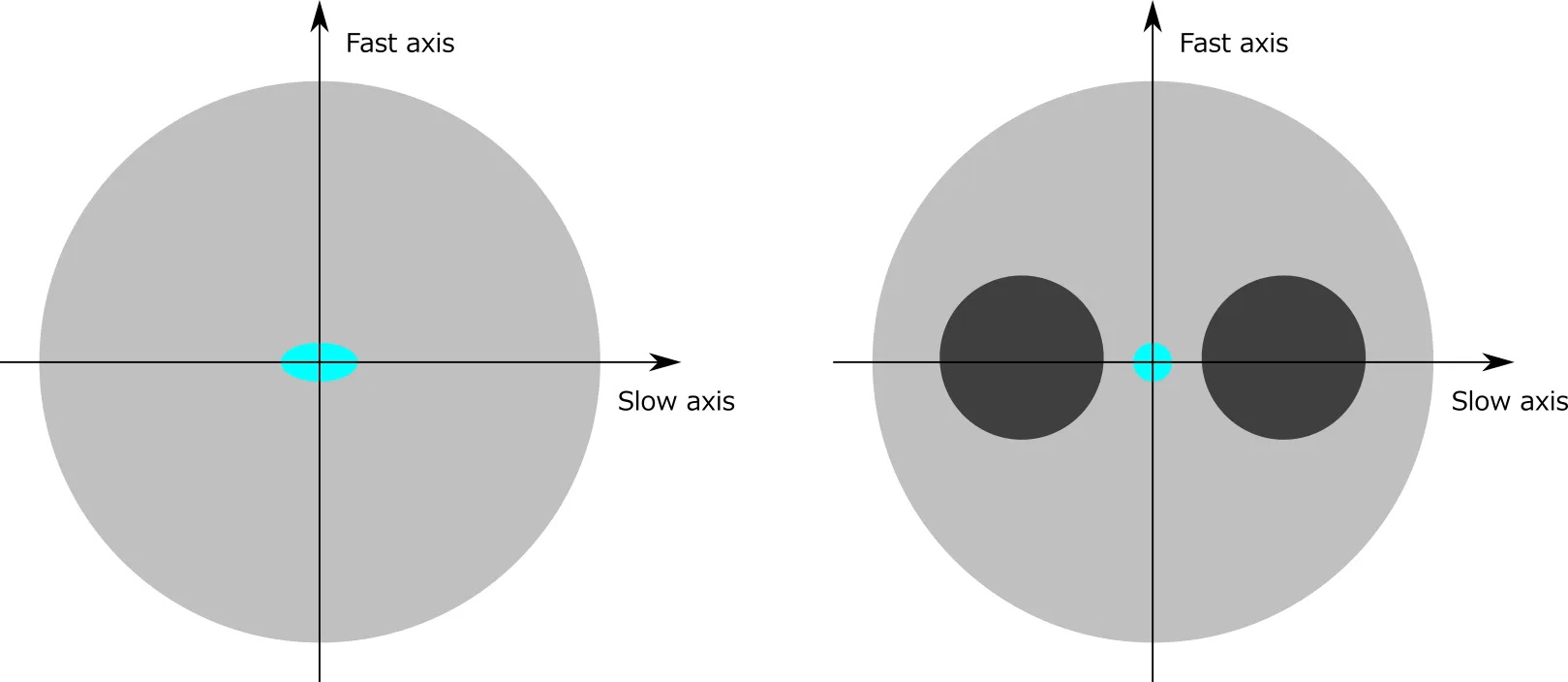
This engineered birefringence results in two orthogonal principal axes with different refractive indices. The axis aligned with the line connecting the stress zones experiences higher stress, leading to a higher effective refractive index; light travels slower in this direction, making it the slow axis. Conversely, in the perpendicular direction, the refractive index is lower, and light travels faster, making this the fast axis. Thus, the slow axis is defined as the optical axis that passes through the centers of the two stress zones, while the fast axis is the one that passes perpendicularly through the midpoint of the line connecting them.
The fundamental operating principle of polarization-maintaining fiber is to create and maintain a consistent difference in the speed of light for two perpendicular polarization states. This birefringence establishes two distinct transmission paths: the fast axis (with a small refractive index and faster speed) and the slow axis (with a large refractive index and slower speed). By launching light that is linearly polarized along one of these principal axes, the strong, built-in birefringence prevents the coupling of light to the other axis, thereby preserving the initial polarization state throughout the fiber's length.
Beat Length in PM Fiber
If the polarization direction of the incident linearly polarized light aligns precisely with either the fast or slow axis of the polarization-maintaining fiber, its polarization state will remain unchanged during transmission. However, if the incident light's polarization direction enters at an angle to these principal axes, it simultaneously excites both of the orthogonal polarization modes, which have different propagation constants. This causes the optical power to exchange periodically between the two polarization components along the fiber's length.
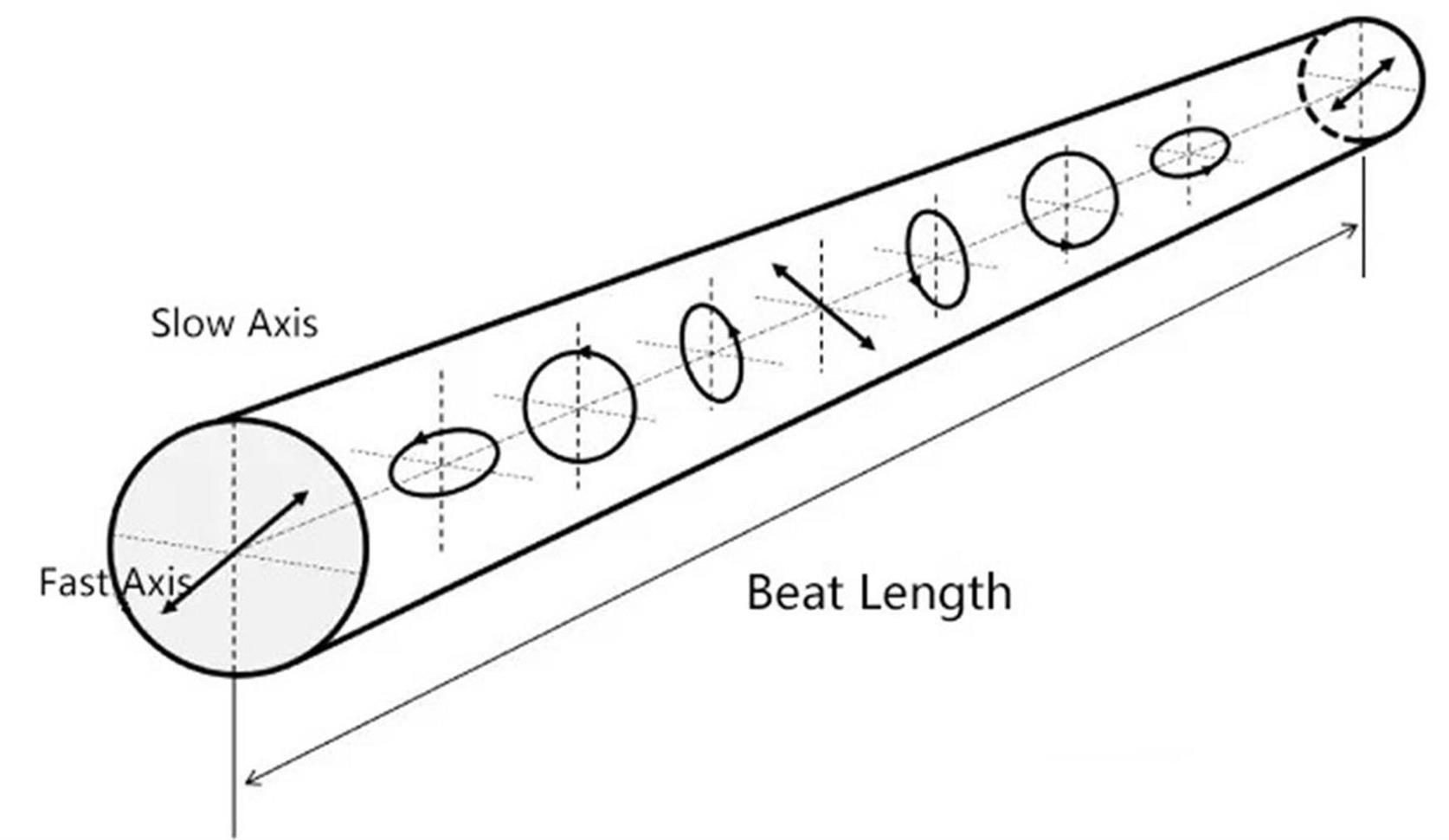
The distance over which this full power transfer occurs is known as the beat length. The beat length is an objective and fundamental parameter that directly quantifies the degree of the fiber's intrinsic birefringence; it is independent of the fiber's total length, the input light's polarization, and alignment conditions. It perfectly reflects the periodic evolution of the polarization state along the fiber, which cycles through a sequence from linear polarization → elliptical polarization → circular polarization → elliptical polarization → and back to the original linear polarization state after each integer multiple of the beat length.
The difference in propagation constants Δβ between the two polarization modes is called modal birefringence (Bm); modal birefringence is usually normalized such that it has no unit, and provided as:

where k0=2π/λ0 (λ0: wavelength in vacuum). Large modal birefringence reduces polarization crosstalk, thus enables better ability to maintain polarization modes. PMFs typically exhibit modal birefringence larger than 10^-4.
Two polarization modes have different propagation constants in a PMF. Beat length (LB) is the length where the accumulated phase difference reaches 2π, and is provided as:
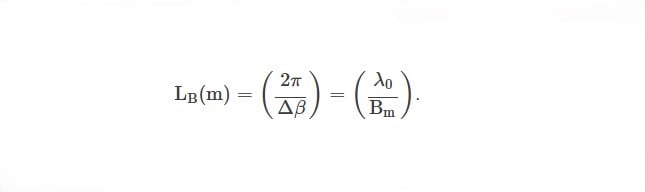
Beat length is another way to quantify the amount of birefringence, and is inversely proportional to birefringence. The larger the birefringence becomes, the shorter the beat length becomes.
Polarization Extinction Ratio (PER)
When the polarization direction of incident light is precisely aligned with one of the principal axes (either the fast or slow axis) of a polarization-maintaining fiber, the excitation of the orthogonal axis is minimized. This confinement of light to a single axis is what allows the polarization state to be maintained during transmission. The effectiveness of this process is quantified by the extinction ratio (ER).
The extinction ratio is defined as the ratio of the optical power remaining in the desired, launched axis to the power that has coupled into the unwanted, orthogonal axis. A high ER indicates that very little light has crossed into the perpendicular axis, meaning the fiber is excellently maintaining the linear polarization. Therefore, the extinction ratio serves as a critical parameter for measuring the quality of the polarization maintenance; a larger extinction ratio corresponds directly to a higher-quality polarization-maintaining fiber.
Note: More information with Polarization Maintaining Extinction Ratio and measurement approaches, please refer to the previous post - What is Polarization Extinction Ratio? How to Measure the PER in PM Fibers?
Polarization Maintaining Fiber Optics Main Application
PM Fiber Patch Cable
A Polarization-Maintaining (PM) Patch Cable from Fibermart is a specialized fiber optic assembly designed to transmit light while preserving its linear polarization state. Unlike standard patch cables that scramble polarization, PM cables are built with a fiber that has a high built-in birefringence, creating distinct fast and slow axes. For the cable to function correctly, the polarized input light must be precisely aligned and launched into one of these principal axes during the connector termination process. This critical alignment ensures that the polarization state of the light remains stable from the source to the destination component, preventing the random polarization drift that occurs in conventional fiber links.
The primary application of PM patch cables is in advanced systems where the polarization of light is fundamental to performance. They are essential in fiber optic gyroscopes for navigation, where polarization instability causes signal drift and noise. In quantum key distribution (QKD) systems, they protect the integrity of quantum states encoded in photon polarization. Furthermore, they are indispensable in coherent optical communications for connecting lasers and receivers, and for interconnecting other polarization-sensitive components like modulators and amplifiers, ensuring maximum signal integrity and system efficiency.
The primary application of PM patch cables is in advanced systems where the polarization of light is fundamental to performance. They are essential in fiber optic gyroscopes for navigation, where polarization instability causes signal drift and noise. In quantum key distribution (QKD) systems, they protect the integrity of quantum states encoded in photon polarization. Furthermore, they are indispensable in coherent optical communications for connecting lasers and receivers, and for interconnecting other polarization-sensitive components like modulators and amplifiers, ensuring maximum signal integrity and system efficiency.
PM Fiber Splitter
A PM Fiber Splitter is a passive component designed to divide an optical signal from one input PM fiber into two or more output PM fibers while rigorously maintaining the polarization state of the light. Unlike conventional splitters that ignore polarization, the core of a PM splitter is fabricated and fused with extreme precision to ensure the principal axes (the slow and fast axes) of the input and all output fibers are perfectly aligned. This critical alignment prevents the coupling of light from one axis to the other at the split point, ensuring that linearly polarized light entering the splitter on its slow axis, for example, will exit all output ports on their slow axes as well.
The applications for PM splitters from Fibermart are found in systems where a polarized signal must be distributed without degradation. They are essential in advanced sensing arrays, such as for distributing a reference signal in a multi-axis fiber optic gyroscope. In quantum optics, they are used to split single-photon streams for protocols like quantum key distribution (QKD), where preserving the photon's polarization is mandatory. They also play a vital role in coherent communication systems and laboratory setups where a single, stable polarized source must be shared between multiple detectors or instruments without introducing polarization-dependent noise or loss.
The applications for PM splitters from Fibermart are found in systems where a polarized signal must be distributed without degradation. They are essential in advanced sensing arrays, such as for distributing a reference signal in a multi-axis fiber optic gyroscope. In quantum optics, they are used to split single-photon streams for protocols like quantum key distribution (QKD), where preserving the photon's polarization is mandatory. They also play a vital role in coherent communication systems and laboratory setups where a single, stable polarized source must be shared between multiple detectors or instruments without introducing polarization-dependent noise or loss.
Summary
In summary, polarization-maintaining fiber addresses a fundamental challenge in photonics: the inherent instability of light's polarization state in standard optical fibers. By intentionally engineering a consistent and high level of birefringence within the fiber core, PM technology creates two distinct optical paths—the fast and slow axes. This design allows a linearly polarized input signal, when properly aligned with one of these axes, to propagate without significant coupling to the orthogonal axis, thereby preserving its state from source to detector. This capability is not a mere enhancement but a critical requirement for the functionality of numerous high-precision systems.
The performance and quality of PM fibers are objectively quantified by key parameters such as beat length, which measures the intrinsic birefringence, and the polarization extinction ratio (PER), which gauges the effectiveness of polarization preservation in practice. These metrics guide the selection of appropriate PM fiber types, such as the widely adopted Panda fiber, which balances strong birefringence with manufacturability. The underlying principle remains consistent across designs: to create a dominant, controlled anisotropy that suppresses the detrimental effects of random external stresses, ensuring predictable and stable polarization transmission.
Ultimately, the value of polarization-maintaining technology is realized through its critical components, such as PM patch cables and splitters, which form the backbone of advanced optical systems. From ensuring the accuracy of fiber optic gyroscopes and the security of quantum key distribution to enabling the high data rates of coherent communications, PM fibers provide the foundational stability required for next-generation technologies. Their role is to act as a reliable conduit for polarized light, transforming it from a fragile property into a robust and usable tool for science, industry, and data infrastructure.


-on-the-Poincaré-Sphere.jpg "What is Polarization Extinction Ratio? How to Measure the PER in PM Fibers?")





No comments have been posted yet.