


.webp)


In the architecture of modern networks, the physical cabling is the unsung hero, a critical foundation that dictates performance, reliability, and scalability. While the question "Is CAT6A better than CAT6?" can be answered with a technical "yes," the more practical question is, "Which is the better choice for my specific needs?" The decision is a strategic balance of performance, cost, and future-proofing. This guide synthesizes technical specifications with real-world considerations to provide a definitive comparison, empowering you to build an infrastructure that meets both present and future demands.
What is CAT6?
Upon its standardization in 2002, Category 6 cabling entered the market just a year after its predecessor, Cat 5e. While Cat 5e reliably delivered Gigabit speeds across 100 meters using a 100 MHz signal, Cat 6 elevated the operational frequency to 250 MHz. A logical question arises as to its purpose, given that its maximum standardized speed was also Gigabit Ethernet, especially considering its initial cost was nearly 50% higher. The justification lay not in raw speed, but in performance headroom and reliability. Cat 5e offered minimal margin for error, often succumbing to higher bit error rates in electrically noisy conditions or under heavy data loads.
Cat 6 directly addressed these shortcomings with its higher bandwidth, the inclusion of a plastic spline to minimize internal crosstalk, and a thicker 23 AWG conductor gauge. This more robust construction also proved better at dissipating heat, making it a more suitable medium for the emerging Power over Ethernet (PoE) standards, which delivered up to 30W of power. As adoption increased, the price gap significantly narrowed, with Cat 6 now typically costing only 10-15% more than Cat 5e.

What is CAT6A?
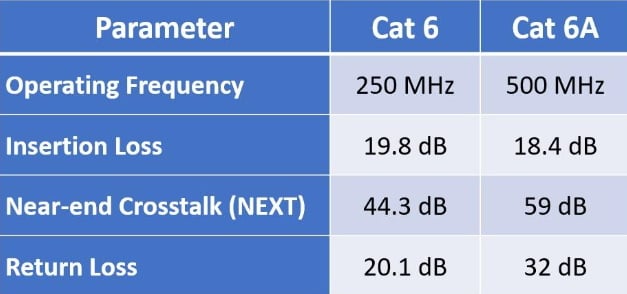
The subsequent evolution arrived with Category 6A, ratified in 2009, which truly augmented performance by doubling the available bandwidth to 500 MHz. This enhancement explicitly enabled 10 Gigabit Ethernet transmission over the full 100-meter distance. Achieving this required more precise manufacturing with tighter tolerances and twist rates, resulting in measurable performance gains; for instance, Cat 6A offers a 25% improvement in near-end crosstalk and a 37% better return loss compared to Cat 6.
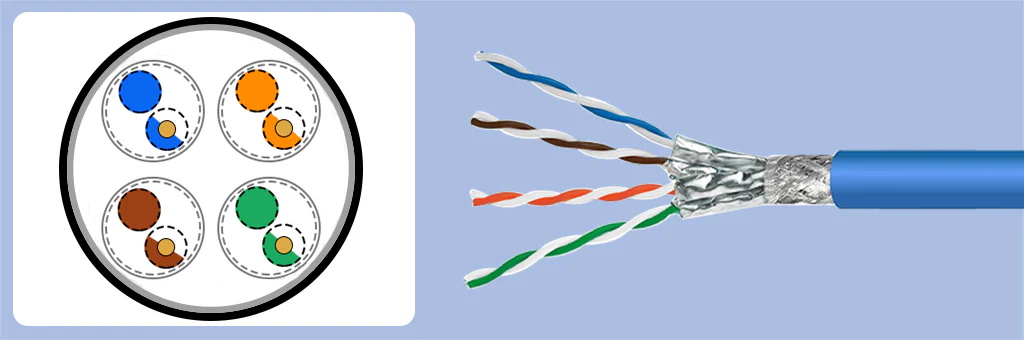
Physically, these advancements translated to a thicker and heavier cable, with early versions reaching diameters of 0.35 inches compared to Cat 6's 0.24 inches due to a larger spline and thicker jacketing. This larger form factor demanded more pathway space and greater care during installation. However, ongoing manufacturing innovations have since succeeded in reducing the diameter of modern Cat 6A cables closer to that of Cat 6 without sacrificing performance, and the cost premium has similarly stabilized to around 20% above standard Cat 6.
Differences Between CAT6 and CAT6A
While they share a family name, the operational boundaries and physical nature of CAT6 and CAT6A diverge in ways that critically impact their application.
Performance and Bandwidth
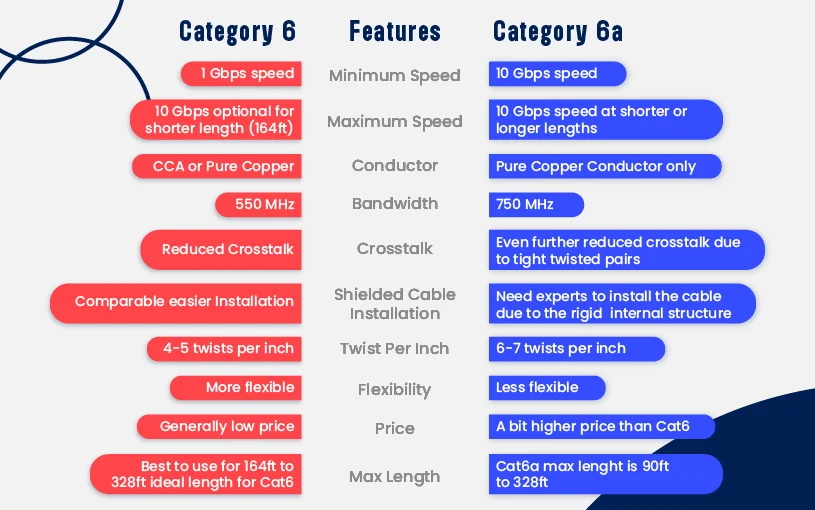
The most pivotal distinction lies in their performance envelope. CAT6 cabling, ratified in 2002, operates at a frequency of 250 MHz. While it is technically capable of 10 Gigabit Ethernet, this speed is only guaranteed under ideal conditions for distances up to 55 meters. In environments with heavy crosstalk, this effective distance can drop to just 33 meters. CAT6A, or "Augmented" Category 6, was standardized in 2009 to directly address this limitation. It doubles the operational bandwidth to 500 MHz and guarantees full 10 Gigabit performance across the entire 100-meter channel. This is achieved through measurably better performance characteristics, including a 25% improvement in near-end crosstalk and a 37% improvement in return loss.
Physical Build and Installation
This enhanced performance in CAT6A comes with tangible physical consequences. To meet stricter specifications, CAT6A cables are manufactured with tighter twist tolerances, a larger spline, and thicker insulation and jacketing. This results in a cable that is noticeably thicker, heavier, and less flexible than CAT6. While modern manufacturing has reduced the diameter of some CAT6A cables, they remain bulkier. This can complicate installation, requiring larger conduits, more pathway space, and greater care during termination, which can increase labor time and cost.
Power over Ethernet (PoE) Support
As networked devices demand more power, cabling's role in Power over Ethernet (PoE) becomes critical. The improved insertion loss performance of CAT6A makes it inherently superior for supporting higher PoE standards. While CAT6 handles older Type 1 (15W) and Type 2 (30W) PoE adequately, CAT6A is the recommended medium for the heat management and efficiency required by the latest Type 3 (60W) and Type 4 (90W) PoE applications, especially over full 100-meter runs.
Cost Considerations
The advanced materials and precision manufacturing of CAT6A translate to a higher price point, typically 20-30% more than CAT6. However, this is only part of the cost story. To achieve a fully functional 10GBASE-T network, the investment must also extend to higher-performance switches, patch panels, and RJ45 connectors that meet CAT6A specifications.
Choosing Your Best Network Solution from CAT6 and CAT6A
The choice between CAT6 and CAT6A is a balance between immediate budgetary constraints and long-term network strategy. The following framework guides this critical decision.
When CAT6 is a Sufficient and Cost-Effective Choice
CAT6 remains an excellent solution for small to medium-sized networks where cable runs are under 55 meters and the primary need is for reliable Gigabit Ethernet. It is perfectly suited for most homes, small offices, and environments with no immediate plan to upgrade to 10GbE equipment. It can also support newer 2.5GbE and 5GbE speeds for Wi-Fi 6 access points over the full 100 meters. If your budget is tight and your equipment does not require 10GbE, CAT6 delivers robust performance without unnecessary expenditure.
When the Investment in CAT6A is Justified
CAT6A is the strategic choice for future-proofing your infrastructure. It is essential for large enterprises, data centers, academic campuses, and any environment where 10 Gigabit speeds are required over long distances (up to 100 meters). It is also the prudent choice for new construction or major renovations where the cabling will be inaccessible and cost-prohibitive to replace later. If you are deploying high-wattage PoE devices (like advanced security cameras, access points, or LED lighting) or operate in an electrically noisy environment, CAT6A’s superior shielding and performance headroom mitigate risk and ensure reliability.
The Critical Role of Equipment and Testing
A single piece of CAT6A cabling cannot create a faster network; the entire channel, including switches and network interface cards, must support the target speed. For existing CAT6 installations that may need to support 10GbE on shorter runs, qualification testing is highly recommended to verify performance. However, for guaranteed performance and peace of mind, CAT6A provides a certified path.

Conclusion
The Ethernet cables we choose, carry the lifeblood of modern communication. Selecting between CAT6 and CAT6A is a foundational decision that balances today's needs against tomorrow's possibilities. CAT6 remains a powerful, economical workhorse for contained networks with predictable demands. In contrast, CAT6A emerges as the robust, forward-looking backbone for ambitious, high-growth environments. By carefully evaluating your application requirements, network scale, and upgrade roadmap, you can invest in a cabling solution that not only meets current challenges but also gracefully accommodates the innovations of the next decade, ensuring a robust and efficient network for years to come.





No comments have been posted yet.