


.webp)


In the modern data-intensive world, demand for faster and more reliable high-capacity communication networks continues unabated. While global internet traffic is growing, driven by the development of cloud computing, 4K video streaming, IoT devices, and cross-border digital services, network operators need to deploy advanced technologies to maintain signal integrity over longer distances. One of the most important inventions supporting such growth is the EDFA optical amplifier, which revolutionized long-haul and high-capacity fiber transmission systems. The optical amplifier has become an integral part of modern optical communication infrastructure because it boosts weakened light signals without electrical conversion.
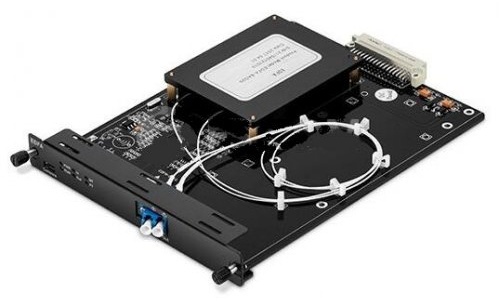
The Role of Optical Amplifiers in Long-Distance Transmission
Natural attenuation causes a loss in the signal when optical signals travel through hundreds or thousands of kilometers of fiber. Conventional methods for regeneration convert optical signals into electrical forms, amplify them, and reconvert them back to light. This procedure is expensive, complicated, and power-consuming. The development of the optical signal amplifier removed the requirement for all these O-E-O conversions.
An optical amplifier is a device that amplifies light directly in its optical form. This makes it significantly more efficient, scalable, and cost-effective for long-distance transmission, especially in DWDM systems. With global networks increasingly based on high-bandwidth connections between continents, the adoption of EDFA optical amplifier solutions continues to grow.

Why EDFA Optical Amplifier Technology Became the Global Standard
EDFA stands for Erbium-Doped Fiber Amplifier, and it is the most common type of optical amplifier in current use in telecommunications. A number of the EDFA optical amplifier's advantages help explain its dominance:
1. Wide Wavelength Compatibility
An EDFA operates in the C-band and L-band, which are the most common low-loss transmission windows in optical communications. For this reason, it is very suitable for multi-wavelength amplification in DWDM systems.
2. High Gain and Low Noise
It features high gain and a low noise figure to ensure excellent signal quality at the end of a chain consisting of several successive amplifier stages. This is imperative for the long-haul submarine cables and terrestrial backbone networks.
3. Energy efficiency and reliability
Because the EDFA optical amplifier operates directly on optical signals, without electrical conversion, it reduces overall energy consumption and removes many points of failure. It is for this reason that it became the preferred solution for carriers due to its stability and reliability.
4. Compatibility with Existing Fiber Infrastructure
EDFAs are easily integrated into current single-mode fiber networks, thus providing seamless upgrades that do not require expensive infrastructure changes.

Key Applications of Optical Signal Amplifiers
Optical signal amplifiers support a variety of sectors and use cases:
Long-Haul and Subsea Communication
Continental undersea cables rely on chains of optical amplifier units, spaced at intervals to maintain signal strength. EDFA technology ensures continuous global data flow.
Metro and Regional Networks
Even short- to medium-range fiber networks require amplification in order to support ever-growing bandwidth demand for both 5G backhaul and data center interconnection.
Data Centers and Cloud Networks
Modern data centers exchange high volumes of traffic over fiber links. The implementation of an optical amplifier like EDFA means the operators reduce signal degradation, hence fostering better network performance.
CATV and FTTH Systems
The optical amplifier solutions allow cable television providers and fiber-to-the-home networks to distribute high-quality signals to large numbers of end users.

How EDFA Optical Amplifiers Maintain Signal Quality
The principle behind an EDFA rests on a simple yet powerful physical idea: a segment of fibre within the amplifier is doped with erbium ions. Pumped by laser energy, the doped fibre becomes an active medium that can amplify weak optical signals passed through it. Hence, an optical signal amplifier can be highly effective in compensating for link losses due to fibre attenuation, splitters, and connectors.
The advanced models feature built-in gain control, wavelength stabilisation, and noise management to ensure that each optical amplifier stage maintains consistent output. The features described above become essential for supporting high-density wavelength channels in modern networks.
Future Trends and the Continued Importance of EDFA Technology
While new technologies such as Raman amplifiers and semiconductor optical amplifiers have emerged, the EDFA optical amplifier remains at the core of global fiber-optic communication. Its reliability, efficiency, and compatibility ensure continued relevance with increased data demands.
In the future, AI-driven 8K media and massive cloud-scale computing will drive demands on the networks for even more robust optical backbone infrastructures. The optical signal amplifier will be of prime importance in ensuring clean, stable, and high-capacity data transmission as service providers expand their DWDM capacity and push transmission distances even further.
Conclusion
In particular, EDFA technology drives the optical amplifier in the development of today's long-haul and high-bandwidth networks in optical communications. The EDFA optical amplifier has grown to be a vital part of the global telecommunications infrastructure with its provision of high gain, low noise, and excellent compatibility with the existing fiber infrastructures. These amplifiers will also remain a cornerstone for efficient, scalable, and high-performance optical systems as data requirements further increase.





No comments have been posted yet.