


.webp)


Driven by the rapid development of artificial intelligence (AI), machine learning, and high-performance computing (HPC), modern data centers are continuously upgrading toward 800G Ethernet and 1.6T network architectures. High-speed parallel optical transmission requires a sharp increase in fiber counts and connection density, putting forward stricter requirements for cabling connectors.

For more than a decade, traditional MTP/MPO connectors have served as the mainstream high-density cabling solution for data centers, supporting multi-fiber parallel transmission for 100G, 400G and other mainstream optical links. However, constrained by physical size and structural design, MTP/MPO gradually reaches performance bottlenecks in ultra-high-density AI clusters and hyperscale data centers.
As a next-generation Very Small Form Factor (VSFF) connector, MMC (Multiport Modular Connector) adopts innovative TMT ferrule technology. It retains the mature structural advantages of traditional MTP/MPO while reducing the size to one-third of the original. It achieves 3 times higher fiber density, lower insertion loss and better scalability, becoming an optimal solution for next-generation high-speed data centers. This article systematically compares the technical differences between MMC and MTP/MPO connectors, sorts out performance parameters, practical deployment cases and applicable scenarios, and provides clear selection and migration guidelines for data center architects.
Overview of MMC Connector and MTP/MPO Connector
MTP/MPO Connector
Standardized under IEC 61754-7, MPO (Multi-Fiber Push-On) is a classic multi-fiber connector for high-density cabling. MTP is an optimized upgraded version of MPO with higher precision and better mechanical performance, and the two are usually collectively referred to as MTP/MPO in the industry.

MPO Structural Features
● MT Ferrule Structure: Adopts traditional MT ferrule with single-row fiber arrangement; common fiber counts include 8, 12, 16 and 24 cores.
● Size Specification: The overall dimension is fixed at approximately 12.5 mm × 7.6 mm, with no size difference among 12/16/24-fiber models.
● Gender Classification: Male connectors with alignment pins and pinless female connectors to ensure accurate mating.
● Compatibility: Supports single-mode and multimode optical fibers (OM3/OM4/OM5), widely compatible with legacy data center equipment.
Application Background
MTP/MPO is widely used in traditional high-speed optical links: 100G, 200G and 400G SR4/VR4/DR4 applications adopt 8-fiber configuration (4 transmitting + 4 receiving); 400G and 800G SR8/VR8/DR8 applications are equipped with 16 fibers to meet high-bandwidth transmission requirements. It is the mainstream cabling choice for enterprise data centers and medium-scale cloud data centers.
MMC Connector
Launched by US Conec, the MMC connector is a VSFF next-generation connector tailored for high-density AI and hyperscale data centers. It solves the density and performance limitations of MTP/MPO, and is fully compatible with the existing MT-based optical fiber system.
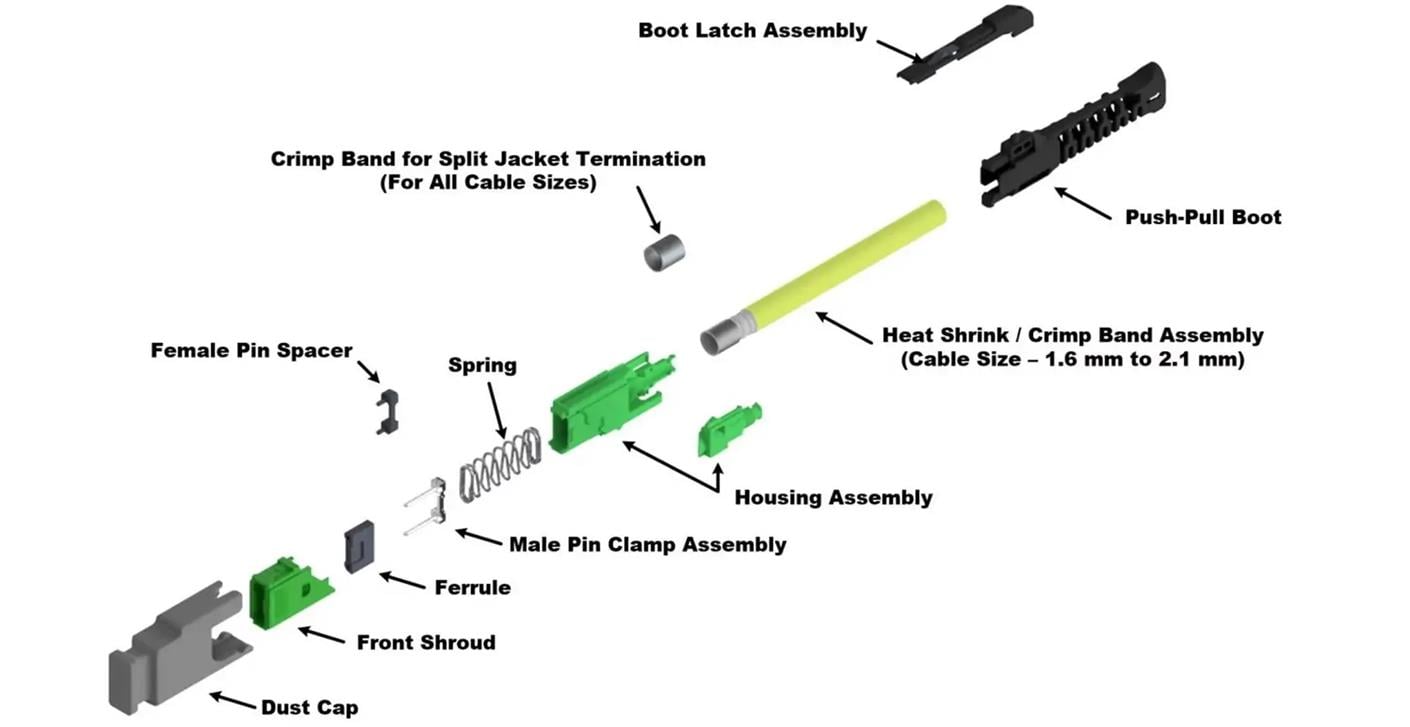
MMC Structural Features
● Innovative TMT Ferrule: Optimized on the basis of MT ferrule, retaining the same pin alignment structure and fiber spacing, with vertical stacked fiber layout.
● Miniaturized Size: The volume is only one-third of MTP/MPO, realizing ultra-compact packaging.
● Humanized Design: Equipped with Push-Pull boot and DirectConec™ push-pull sleeve, which is convenient for plugging and unplugging in dense wiring environments.
● Optical Optimization: Adopts Angled Physical Contact (APC) end face to reduce reflectance and optimize return loss performance.
Application Background
MMC is oriented to high-end scenarios such as AI GPU clusters, HPC high-performance computing, and 800G/1.6T ultra-high-speed networks. It supports flexible fiber counts of 16, 24 and 48+ cores, and can be double-stacked in QSFP-DD800 and OSFP-XD transceivers to realize 1.6 Terabit ultra-high bandwidth transmission.
Technical Differences Between MMC and MTP/MPO
The essential gap between the two connectors lies in ferrule structure, physical size and optical performance. The detailed technical comparison is shown in the table below:
|
Comparison Dimension
|
MTP/MPO Connector
|
MMC Connector
|
Technical Advantage Side
|
|---|---|---|---|
|
Form Factor & Size
|
Standard size (12.5mm×7.6mm); fixed volume
|
VSFF ultra-small size; 1/3 volume of MTP/MPO
|
MMC
|
|
Ferrule Technology
|
Traditional MT ferrule, single-row fiber arrangement
|
TMT optimized ferrule, vertical stacked fiber
|
MMC
|
|
Fiber Count
|
Fixed: 8/12/16/24 cores
|
Flexible: 16/24/48+ cores
|
MMC
|
|
Insertion Loss
|
Typical 0.35dB, high signal attenuation
|
Typical 0.25dB, low signal degradation
|
MMC
|
|
Return Loss
|
Ordinary end face, high reflectance
|
APC end face, low reflectance
|
MMC
|
|
Rack Density
|
Limited port count per rack unit
|
3× fiber density compared with MTP/MPO
|
MMC
|
|
Installation Difficulty
|
Mature process, low technical threshold
|
Precise operation required, professional training needed
|
MTP/MPO
|
|
Upfront Cost
|
Low procurement cost
|
High initial cost, low long-term operating cost
|
MTP/MPO (short-term)
|
|
Network Adaptability
|
Suitable for 40G/100G/400G legacy networks
|
Optimized for 800G/1.6T future AI networks
|
MMC
|
Density Gap: The Most Intuitive Technical Difference
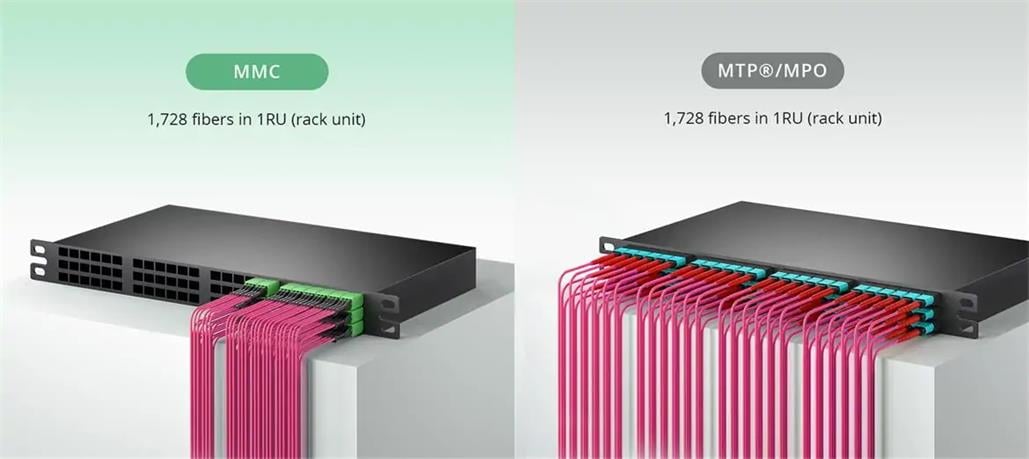
Density is the core advantage of MMC, and the gap is verified by industry-standard rack equipment data:
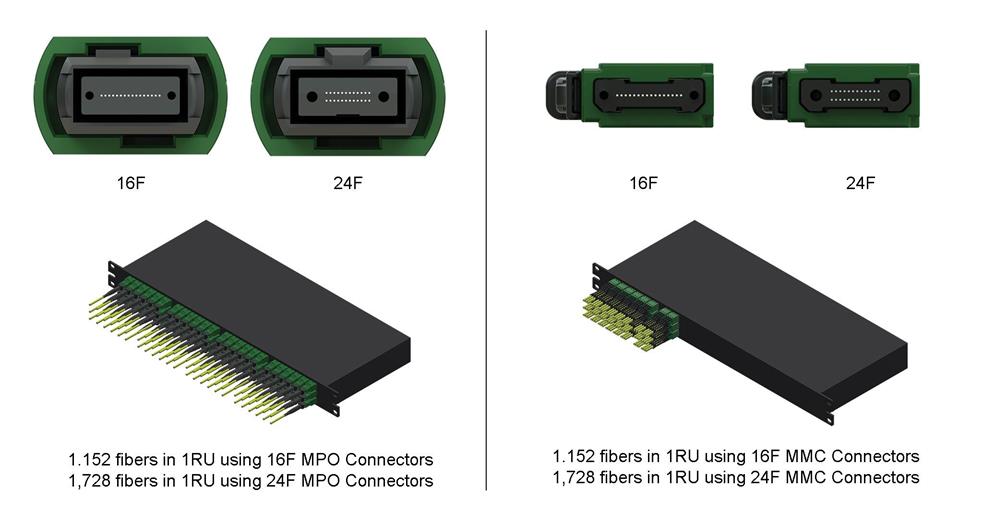
● 1RU Patch Panel: A 1RU panel with MTP/MPO-16 supports up to 80 ports (1280 fibers); while MMC-16 can carry 216 ports (3456 fibers). For 24-fiber models, MTP/MPO supports 1728 fibers per 1RU, and MMC completes the same fiber capacity in only 1/3 of the space.
● 42U Standard Rack: An AI cluster rack equipped with NVIDIA DGX system can only hold 96 fibers with MTP/MPO, while MMC can reach 288 fibers, greatly saving cabinet space.
Higher density effectively optimizes cabling paths, improves internal airflow of the cabinet, and reduces heat dissipation pressure of high-power AI equipment.
Optical Performance: MMC Optimizes High-Speed Signal Transmission
Affected by ferrule precision and end face design, MMC has more excellent optical performance: the insertion loss is reduced from 0.35dB of MTP/MPO to 0.25dB. Combined with APC end face technology, it suppresses optical signal reflectance.
This optimization is particularly critical for short-reach DR and FR single-mode applications. Low-power lasers used in such scenarios are highly sensitive to reflectance, and MMC can effectively avoid signal distortion and ensure transmission stability of 800G+ high-speed links.
Compatibility & Scalability
MMC retains the MT ferrule alignment structure of MTP/MPO, realizing interworking compatibility through hybrid adapters, and supports existing single-mode/multimode optical fibers without large-scale replacement of legacy fiber resources.
In terms of future scalability, MTP/MPO is limited by physical size and cannot adapt to ultra-high-density stacking; MMC supports double-layer stacking of transceivers, and is compatible with future 200 Gb/s lane rate. It can realize 4×400G, 2×800G and even 3.2 Terabit ultra-high bandwidth transmission, meeting the long-term iteration needs of AI clusters.
Typical Application Scenarios of MMC Cables
Against the backdrop of tight rack space in high-performance data centers, MMC makes up for the space shortage of MTP/MPO and is widely used in high-end interconnection scenarios:
AI Cluster Interconnection
A small-scale AI cluster contains 100 GPU nodes, requiring nearly 1,000 multi-fiber connections. MMC-16 breakout cables (one end MMC-16, two ends 8-fiber MTP/MPO) can connect one 800G switch port to two 400G ports. A 72-port 800G high-density switch can interconnect 18 GPU nodes, perfectly matching the parallel computing needs of AI clusters.

High-Density Cross-Connection
In carrier colocation data centers, the cross-connection space between the meet-me room and tenant cabinets is extremely precious. MMC minimizes the occupancy of wiring space, realizing efficient management of dense cables and supporting the rapid migration of switch bandwidth to 400G/800G.
High-Speed Transceiver Packaging
MMC-16 connectors can be double-stacked in QSFP-DD800 and OSFP-XD transceivers to support 32-fiber 1.6T links. Meanwhile, it can be used as a board-mounted connector inside the switch, increasing the number of ports in a single chassis and reducing the construction cost of equipment.
Connector Selection Guidelines
Choose MTP/MPO Fiber Cable If You Meet The Following Conditions
● Traditional enterprise data centers with low density requirements and no ultra-high-speed expansion plan;
● Projects with strict budget constraints and priority to reduce upfront procurement costs;
● Operation and maintenance teams proficient in MTP/MPO installation and maintenance processes;
● Legacy network architecture dominated by 40G/100G/400G links.

Choose MMC Fiber Cable If You Meet The Following Conditions
● Hyperscale cloud data centers and AI/HPC high-performance computing clusters;
● Scenarios with tight rack space and requirements for high-density cabling;
● Need to reserve expansion space for 800G/1.6T future networks;
● Colocation data centers pursuing long-term space cost optimization.
Industry Migration Strategy: From MTP/MPO to MMC
MMC will not completely replace MTP/MPO in the short term. A large number of legacy MTP/MPO infrastructures are still in stable operation, and the two will coexist for a long time. The recommended phased migration strategy is as follows:
● Asset Assessment: Screen high-density cabinets and AI computing nodes that are sensitive to space, and prioritize MMC upgrading;
● Mixed Deployment: Retain MTP/MPO for legacy low-speed services, and deploy MMC for new high-speed 800G+ links;
● Technical Training: Conduct professional training for operation and maintenance personnel to standardize MMC ferrule operation and ensure low insertion loss;
● Data Recording: Sort out cable polarity, fiber type and insertion loss data to realize seamless connection of the entire network.
FiberMart MMC Cable Solutions
FiberMart offers standardized and customized MMC-16/MMC-24 cabling solutions for AI clusters and 800G/1.6T high-speed data centers. Compliant with industrial specifications, both connectors adopt TMT ferrules and APC end faces to ensure low insertion loss and high density. Specifically, MMC-16 is tailored for cost-effective 800G mass deployment. Compatible with QSFP-DD800 transceivers, it has a user-friendly push-pull structure, and its breakout cables enable seamless 800G-to-400G migration. In contrast, MMC-24 provides 50% higher fiber density to support 1.6T networks, allowing stacked installation in OSFP-XD transceivers; its superior temperature resistance helps cut long-term operational costs for hyperscale data centers.
● MMC-16 Trunk Cable 16-384 Fibers OM4 Multimode LSZH
● MMC-24 Trunk Cable 24-576 Fibers OM4 Multimode LSZH
● MMC-24 to MTP®-24 Fiber Jumper Cable 24 Fibers OM4 Multimode LSZH
● MMC-16 to 8 Duplex LC Breakout Cable 16 Fibers OS2 SingleMode LSZH
All FiberMart MMC cables are interoperable with legacy MTP/MPO systems to reduce migration expenditure, supporting personalized customization of cable length, polarity and sheath types. Every product undergoes rigorous testing, accompanied by one-stop technical services including deployment guidance and migration optimization to guarantee stable and reliable system operation.

Conclusion
Technically, the essential difference between MMC and MTP/MPO lies in ferrule innovation and miniaturization design. MMC breaks through the density bottleneck of traditional connectors with TMT ferrule and VSFF size, and achieves better optical performance and future scalability; MTP/MPO relies on mature technology and low cost to maintain advantages in legacy low-density scenarios.
With the continuous expansion of AI computing power and the iterative upgrading of 800G/1.6T networks, MMC will become the mainstream choice for hyperscale data centers. Enterprises should select connectors based on their own architectural planning and space constraints, and adopt phased migration to balance cost and performance.
As a professional supplier of optical fiber connectors, FiberMart provides customized MTP/MPO and MMC cabling solutions, with high-precision optical components to ensure low insertion loss and high stability of products. Professional technical teams can provide one-stop services such as scheme design, deployment guidance and migration optimization for data centers.
Frequently Asked Questions (FAQ)
Q1: Is MMC physically compatible with traditional MTP/MPO?
A1: Yes. MMC adopts the same MT pin alignment structure as MTP/MPO, and can realize mutual mating through hybrid adapters, compatible with all existing single-mode and multimode optical fibers.
Q2: Will MMC completely eliminate MTP/MPO in the future?
A2: No. MTP/MPO will continue to serve traditional enterprise and low-speed data centers due to its low cost and mature technology. MMC is mainly oriented to high-end high-density scenarios, and the two form a differentiated market layout.
Q3: What are the hidden costs of MMC?
A3: MMC has higher upfront procurement and labor training costs, but it saves cabinet space, reduces heat dissipation costs and simplifies cable management. The comprehensive cost is lower in long-term high-density operation.
Q4: Which business scenarios are mandatory for MMC deployment?
A4: Large-scale AI GPU clusters, HPC high-performance computing rooms, carrier colocation computer rooms and data centers planning to upgrade to 1.6T bandwidth.
Posted on 13 May, 2026, by Francisco, Fibermart, All Copy Right Reserved.





No comments have been posted yet.