


.webp)


Silicon Photonics Technology: Leading the Chip-Level Optical Revolution in High-Speed Interconnects
I. What is Silicon Photonics Technology?
Silicon Photonics Technology, also known as silicon photonics, is a cutting-edge technology that utilizes mature silicon-based semiconductor processes to integrate optoelectronic devices onto chips, enabling the transmission, processing, and computation of information using optical signals.
Its core vision is to construct miniaturized "optical pathway systems" on silicon wafers, using light to replace or assist electricity, thereby overcoming the speed and power consumption bottlenecks of traditional electrical interconnects.
To understand silicon photonics technology, one only needs to grasp the following three key points:
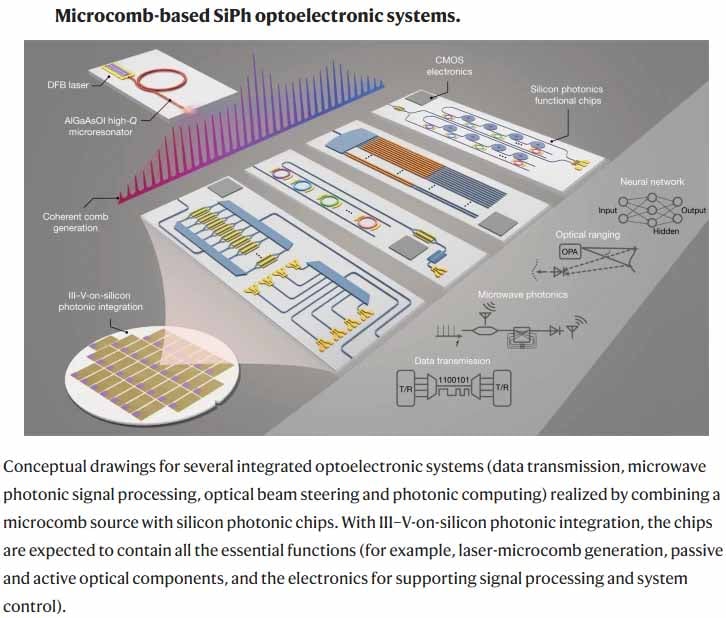
1. The Material Foundation: Ubiquitous Silicon
Silicon photonics technology uses silicon as its core material, which provides two inherent advantages:
-
Cost Advantage: Silicon is the second most abundant element in the Earth's crust, making raw material costs significantly lower than traditional optical communication materials like Indium Phosphide and Gallium Arsenide (III-V compounds).
-
Ecosystem Advantage: Over 90% of the world's integrated circuits are based on silicon CMOS processes. This means silicon photonics technology can directly leverage the existing vast, advanced, and continuously cost-optimized semiconductor supply chain, without needing to build new production lines from scratch.
As the technology iterates and production scales up, the cost of silicon photonic chips is expected to decrease further.
2. The Technical Key: Extreme Integration
Traditional optical modules are "assembled." Discrete devices like lasers, modulators, and detectors need to be manufactured separately first, then interconnected through complex packaging processes.
In contrast, silicon photonics technology utilizes the CMOS process to achieve monolithic integration of various optical devices on a single silicon substrate. This is like turning scattered "courtyards" into dense "skyscrapers," allowing optical signals to flow efficiently within the chip, greatly enhancing integration density. This advantage is crucial in data center optical modules that pursue high bandwidth and small size.
3. The Fundamental Driver: The Inherent Advantages of Optical Signals
In short-distance, high-speed data transmission, electrical signals face challenges such as surging power consumption, speed bottlenecks, and electromagnetic interference.
Optical signals, however, possess inherent characteristics of high bandwidth, low latency, low power consumption, and immunity to electromagnetic interference.
The essence of silicon photonics technology is the perfect fusion of the performance advantages of optical signals with the manufacturing advantages of silicon material.
II. The Epitome of Silicon Photonics Technology: The Silicon Photonic Transceiver
The Silicon Photonic Transceiver is the most typical and mature product form of silicon photonics technology. It is essentially a new generation of optical communication module that uses silicon photonic chips, directly embodying the aforementioned high integration characteristics.
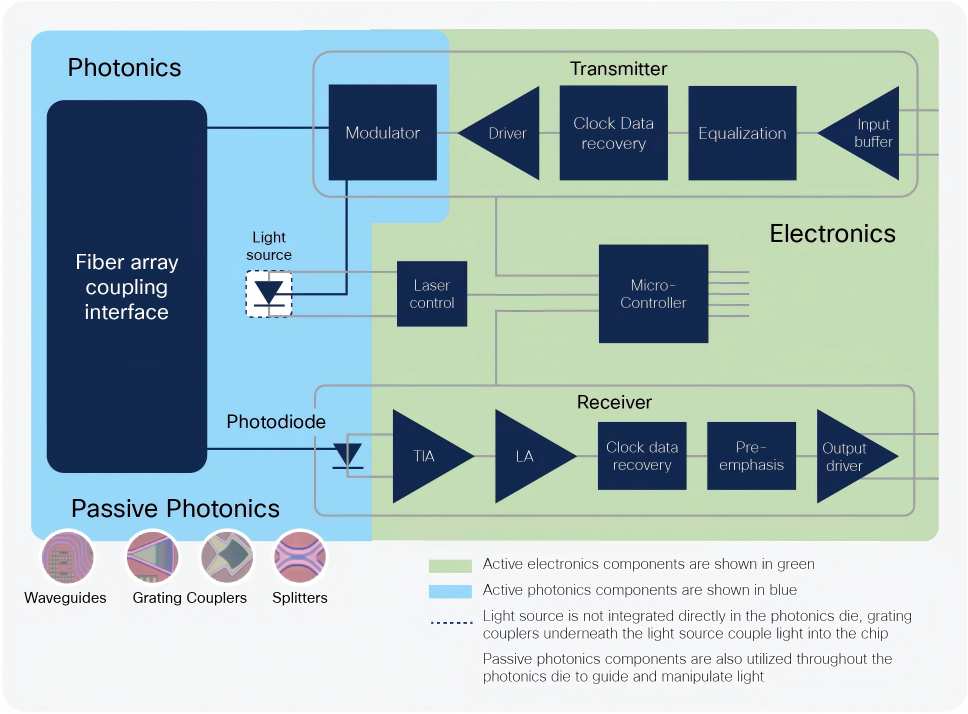
Schematic diagram of an optical transceiver
Core Difference from Traditional Optical Modules:
-
Traditional Optical Modules: Use discrete packaging, "piecing together" multiple independently manufactured optical devices.
-
Silicon Photonic Transceivers: Integrate passive and active devices like waveguides, modulators, and detectors onto a single chip, realizing a chip-level "optical pathway system."
This fundamental structural difference brings significant advantages to silicon photonic transceivers:
-
High Integration Density: Achieves chip-level photonic integration, forming the foundation for "photoelectric fusion."
-
Low-Cost Potential: Silicon material is cheap, and compatibility with CMOS processes enables the genetics for large-scale, low-cost manufacturing.
-
Low Power Consumption Potential: High integration reduces energy loss from inter-device connections, and components like TECs are often not required.
-
High Bandwidth Density: Smaller size means more ports can be deployed on the same equipment panel area, increasing overall bandwidth capacity.
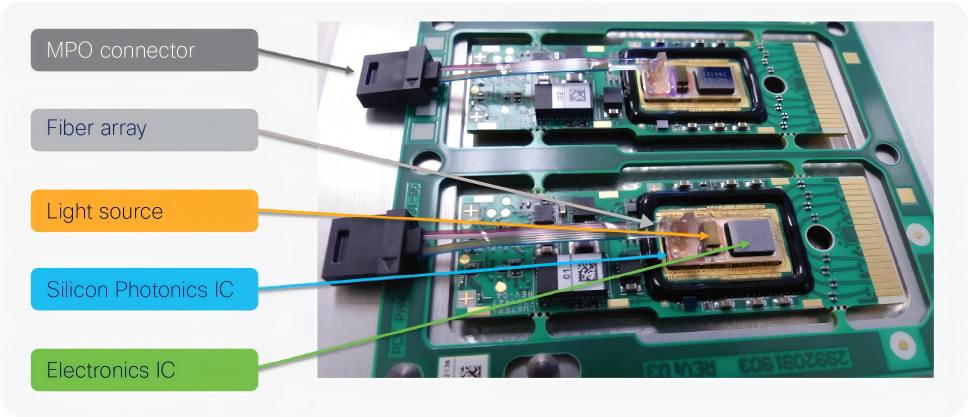
Example of a silicon photonics based 100-Gbps optical module
III. Opportunities and Challenges: The Current State of Silicon Photonic Transceivers
While developing rapidly, silicon photonic transceivers still face several core challenges, particularly prominent at the technical, manufacturing, and industrial ecosystem levels:
1. Fundamental Technical Challenges
-
Light Source Integration Challenge: Silicon is an indirect bandgap material and cannot emit light efficiently by itself. Modules must rely on external III-V material (e.g., Indium Phosphide) lasers. Efficiently integrating the laser onto the silicon photonic chip with high efficiency, low loss, and high alignment accuracy is a long-standing technical bottleneck. Mainstream techniques like wafer bonding and discrete mounting still need improvement in process complexity and production yield for mass manufacturing.
-
Device Performance Trade-offs: Silicon-based modulators still exhibit performance gaps compared to traditional Indium Phosphide or Lithium Niobate modulators in aspects such as bandwidth, drive voltage, and linearity. For instance, achieving high efficiency and low power consumption is a major technical focus when pursuing high-speed modulation exceeding 200 Gbps per channel.
-
Signal Transmission Loss and Thermal Management: The transmission loss of silicon waveguides and the coupling loss between optical fibers and nano-scale silicon waveguides are key factors affecting module performance. Furthermore, the significant influence of temperature on device power and wavelength stability poses a challenge to long-term system reliability in environments with temperature fluctuations, such as data centers.
2. Manufacturing and Supply Chain Maturity Challenges
-
Process Complexity and Yield Improvement: Silicon photonics processes involve the complex integration of multiple optical and electrical domains, resulting in high fabrication complexity. Compared to mature CMOS logic chip manufacturing, silicon photonics process technology is still maturing. Challenges remain in improving yield rates and reliability. For example, in data center operating environments where temperature and humidity fluctuate frequently with seasons and equipment status, insufficient reliability of silicon photonic devices can lead to performance degradation, failure, or damage, affecting the stability of the entire data center network.
-
Limited High-End Fabrication Resources: Although major foundries like IMEC and TSMC offer silicon photonics fabrication services, their capacity and support levels still lag behind those for traditional electronic chips. Mature Process Design Kits (PDKs) and standardized manufacturing flows are crucial for scaled production but are still being perfected.
-
Complex Testing Process and High Cost: The testing process for optoelectronic chips is inherently complex, costly, involves numerous manufacturing steps, has high process complexity, and suffers from high scrap rates. Pre-testing and screening at the wafer level add additional process steps and cost.
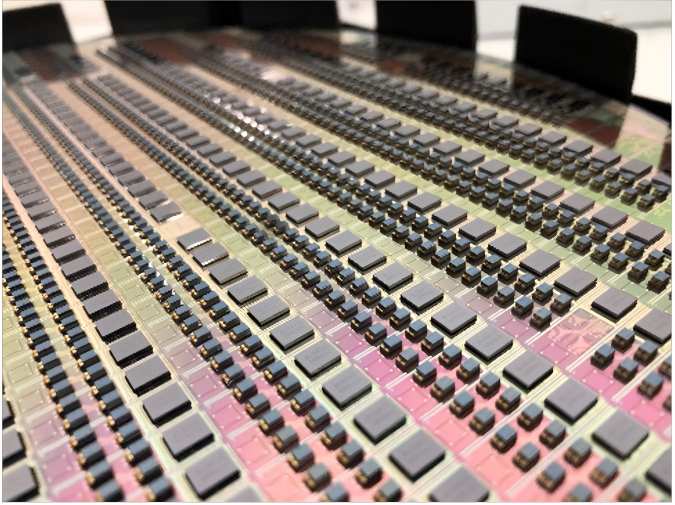
Multiple silicon photonics devices on a single wafer, processed in a commercial semiconductor fab
3. Industrial Ecosystem and Standardization Challenges
-
Diverse Technical Paths, Lack of Standards: Compared to traditional optical modules, silicon photonic transceivers have a lower degree of standardization, and the industrial chain maturity needs improvement. The field of silicon photonics exhibits significant technical diversity. Different customers often adopt unique technical paths, from fiber array choices (e.g., 250um vs. 127um fiber arrays), to differences in waveguide types (e.g., Si waveguides vs. SiN waveguides), and a wide variety of components like photodetectors and modulators (e.g., Ge photodetectors, MZM, MRM). Each component requires individual performance and reliability validation, which significantly increases the industrialization difficulty of silicon photonics technology and hinders mass production and adoption.
-
New Challenges with CPO Technology: While Co-Packaged Optics (CPO) holds great promise, beyond the manufacturing challenges and the goal of achieving lower power consumption, end users need to accept CPO as an effective solution for continuously reducing costs. Initial products are based on proprietary designs, which can be a significant adoption barrier for large cloud companies that typically design their own servers, switches, and all interconnect solutions. Establishing a competitive ecosystem supporting large-scale CPO deployment still requires time.
IV. Application Scenarios and Development Trends
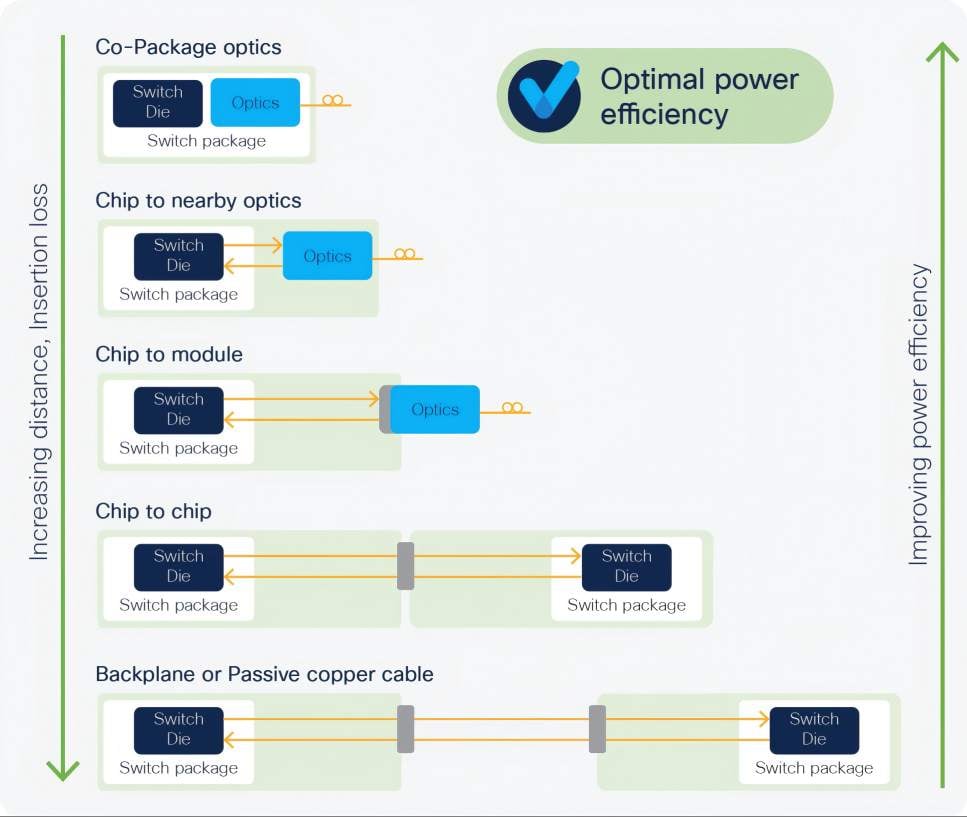
Relation between electrical link length, power efficiency, and type of electrical connectivity
Current Core Application Scenarios
-
Data Center Internal Interconnects: This is the largest and most mature market for silicon photonic transceivers. Especially in short-reach (e.g., 500 meters) 400G/800G/1.6T optical modules, silicon photonic solutions have become the mainstream choice due to their high density, low power consumption, and cost potential. With the surge in AI computing demand, its driving force for high-speed optical interconnection is particularly strong.
-
Telecom Networks: In areas such as 5G fronthaul, metropolitan area networks, and Wavelength Division Multiplexing (WDM) systems, silicon photonic modules are gradually penetrating the market, leveraging their integration advantages and potential cost benefits.
-
Emerging High-Potential Scenarios: Silicon photonics technology is also becoming the preferred technology for supporting optical interconnects in AI clusters. Furthermore, it shows application potential in fields like LiDAR and optical quantum computing.
Future Development Trends and Vendor Landscape
-
Speed Evolution towards 1.6T and Beyond: Optical module data rates are advancing from 400G/800G towards 1.6T and 3.2T. For instance, NVIDIA has announced the world's first 1.6T CPO system using novel micro-ring modulators and plans to introduce related silicon photonic switches and optical subsystems.
-
Technology Convergence: CPO and LPO:
-
CPO: Co-packaging the optical engine with the switch chip can further reduce power consumption and latency, making it a key direction for addressing the high-bandwidth demands of AI cluster scale-up interconnects. Besides NVIDIA, companies like AMD are also accelerating their layout in co-packaged optics through acquisitions (e.g., Enosemi).
-
LPO: The Linear-drive Pluggable Optics (LPO) scheme, which simplifies signal conditioning, is also gaining attention for specific short-reach applications. Combined with silicon photonics technology, it helps drive market share growth.
-
-
Technology R&D and Industry Alliance Progress:
-
EU STARLight Project: This is a major project led by STMicroelectronics and supported by the European Commission. It aims to establish a 300mm silicon photonics chip mass production line by 2028, develop technology for data rates of 200 Gbps per channel and above, and focus on data center, AI cluster, telecommunications, and automotive markets.
-
Intel: As one of the pioneers of silicon photonics technology, Intel has long been invested in this field and considers it a key part of its future vision. Although it sold its pluggable optical module business, its accumulated expertise in silicon photonics R&D and forward-looking areas like CPO remains influential.
-
Cisco Systems: As one of the leading global players in silicon photonics modules, Cisco, through its market position and technological investments, continues to promote the application and development of silicon photonics technology in data center networks.
-
-
Market Size and Share Growth: Market research firm LightCounting predicts that the market share of silicon photonics technology in the optical transceiver market will increase from 30% in 2025 to 60% by 2030. Yole Intelligence forecasts that the global sales of the silicon photonics module market will reach $10.3 billion by 2029, with a Compound Annual Growth Rate (CAGR) as high as 45%.





No comments have been posted yet.