


.webp)


Driven by the large-scale commercial adoption of generative AI foundation models, network traffic patterns within modern AI data centers have undergone fundamental shifts. Conventional north-south traffic-oriented data center architectures can no longer satisfy the performance demands of high-density AI computing workloads. Massive east-west traffic generated by GPU-to-GPU parallel computing exposes critical limitations of copper-based cabling, including constrained bandwidth, high latency and excessive power draw, which bottleneck large-scale AI training and inference tasks. Optical fiber infrastructure has evolved from a basic signal transmission medium in traditional cloud data centers into a core foundational component that dictates the overall computing efficiency of GPU clusters. This paper reviews AI traffic growth trends over the past decade, analyzes three generations of data center network architecture upgrades tailored for AI workloads, and delivers practical optical fiber cabling specifications for mainstream 400G, 800G and next-generation 1.6T Ethernet deployments. Validated with field data from four global regions, this whitepaper quantifies performance gains including PUE reduction, latency optimization and OPEX cut brought by all-optical cabling solutions, delivering comprehensive engineering guidelines for AI data center planning, deployment and future network expansion.

AI Computing over Optical Fiber Network Architecture
By 2026, artificial intelligence workloads have matured beyond laboratory validation and become the primary driver for global data center infrastructure upgrades. Unlike conventional public cloud workloads dominated by user access requests, AI training and inference present two distinct network characteristics. First, a single GPU cluster requires thousands of compute nodes to run parallel synchronous computing with ultra-frequent node-to-node data exchange. Second, inter-node data traffic grows exponentially during large model parameter updates. Industry monitoring statistics confirm that each full iteration of large foundation models doubles east-west fabric traffic and overall cluster computing requirements.
Legacy copper cabling fails to support nanosecond-scale clock synchronization required for synchronized GPU computing, due to inherent electrical signal attenuation and timing jitter. Today, all hyperscale AI supercomputing facilities worldwide adopt an optical-first network design philosophy. The core performance bottleneck of modern AI clusters no longer lies in GPU or switch chip hardware capability, but in optical link bandwidth density, end-to-end latency consistency and uniform optical loss across the entire fabric. For network engineers and data center system integrators, scientific fiber selection and hierarchical structured optical deployment are essential to unlock full native computing power of GPU clusters.

Root Causes of AI Traffic Explosion
A decade ago, the daily north-south external access traffic of enterprise data centers remained at tens of terabytes. In 2026, a complete offline training task for trillion-parameter GPT-5 equivalent large models generates up to 2 to 3 petabytes of internal interactive data between GPU chips per day. Continuous gradient parameter interaction and real-time tensor data synchronization impose stringent and non-negotiable technical requirements on network throughput and latency stability.
Traditional Ethernet architectures paired with copper cabling cannot support high-speed signal transmission above 400G. Inherent signal attenuation and clock jitter will directly cause clock desynchronization in multi-GPU clusters, resulting in an effective computing power drop of more than 20%. The table below summarizes the parameter scale, traffic variation and supporting optical fiber backbone solutions of mainstream AI models from 2015 to 2026, demonstrating the inevitable trend that all-optical networks replace electrical networks in the industry.
|
Year
|
Mainstream AI Model
|
Model Parameter Scale
|
Daily GPU Node Interactive Traffic
|
Standard Optical Fiber Backbone Networking Solution
|
|---|---|---|---|---|
|
2015
|
AlexNet
|
60 Million
|
Approx. 10TB
|
10G Ethernet + OM3 Multimode Optical Fiber Cabling
|
|
2020
|
GPT-3
|
175 Billion
|
Approx. 500TB
|
100G/400G Ethernet + OS2 Single-mode Optical Fiber Backbone Network
|
|
2026
|
GPT-5 Ultra-large Model
|
1 Trillion - 2 Trillion+
|
2PB - 3PB
|
800G/1.6T High-speed Ethernet + G.654.E Ultra-low Loss Single-mode Optical Fiber + MTP/MPO Parallel High-density Optical Cabling
|
The statistical traffic data above clearly proves that network transmission capability has become the decisive bottleneck limiting GPU cluster performance. Under current commercial technical specifications, only optical fiber media can satisfy three non-negotiable requirements for hyperscale AI clusters: ultra-high bandwidth capacity, sub-nanosecond consistent latency, and stable low optical attenuation across the entire switching fabric.
Iteration of Three Generation Data Center Network Architectures
Traditional data center network architectures are designed for north-south external access traffic, which cannot adapt to the demand for full-mesh large-volume east-west transmission between GPU nodes in AI clusters. The global data center industry has completed three complete rounds of network architecture iteration, and each architecture upgrade requires supporting upgrades of underlying optical fiber cabling systems.
● Three-tier Core-Aggregation-Access Architecture (Traditional Data Center Stage): This architecture adopts layered forwarding logic with numerous network forwarding hops and low overall optical fiber cabling density. It cannot support horizontal interconnection of large-scale computing nodes and has been completely phased out in all newly-built AI data centers;
● Leaf-Spine Distributed Architecture (Public Cloud Data Center Stage): All leaf switches and spine switches are fully interconnected to solve massive east-west traffic forwarding problems of cloud services. This architecture requires a large number of long-distance backbone optical fiber links and serves as a transitional network form from traditional cloud data centers to AI computing power data centers;
● AI Mesh Super Cluster Architecture (Mainstream AI Computing Data Center Stage in 2025): All GPU nodes adopt switch-free full-mesh direct interconnection to minimize intermediate network forwarding nodes, taking nanosecond-level end-to-end latency as the core design standard. High-density modular MTP/MPO optical fiber cabling systems are mandatory, and this architecture has become the unified standard network architecture adopted by global leading AI training clusters.
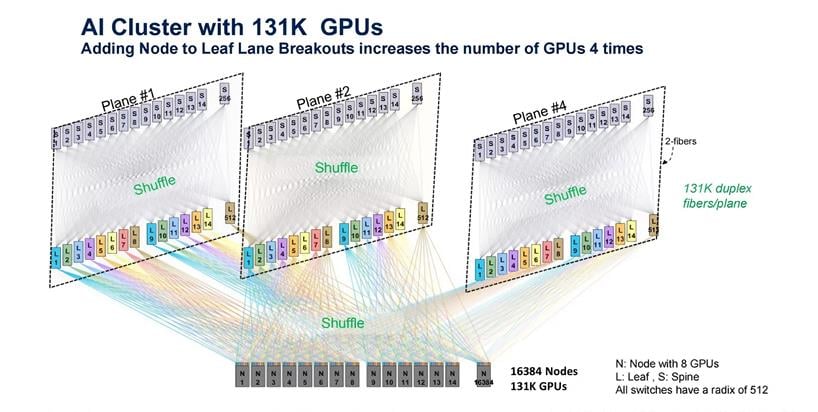
Within the switchless full-mesh AI fabric, minor latency deviation caused by inconsistent fiber cable lengths and connector insertion loss will directly degrade synchronous computing efficiency across GPU arrays. Accordingly, full-fabric equal-length fiber routing and low-loss passive component specification are mandatory design requirements for AI data center cabling systems, rather than optional performance optimizations.
Optical Fiber in AI Data Center Classification, Application and Selection
Combined with the latest IEEE 802.3df and 802.3dj high-speed Ethernet standards released in 2025 and on-site construction experience of global frontline AI data centers, this chapter classifies four most widely used optical fiber cables in current AI data centers. It provides deployable selection standards for engineers from four dimensions including transmission distance, rate compatibility, deployment location and full life cycle cost, avoiding common selection errors in on-site cabling projects.
OM4 Multimode Optical Fiber
● Core Optical and Electrical Parameters: Supports stable transmission of 400G parallel optical signals within 100 meters, with lower comprehensive raw material cost and native compatibility with VCSEL optical modules;
● Fixed Application Scenarios: Short-distance connection between GPU servers and TOR access switches inside cabinets, point-to-point short-distance interconnection links within AI computing Pods;
● Engineer Selection Notes: Outdated OM3 multimode optical fiber is prohibited for all high-speed short-reach links above 400G; OM5 broadband multimode optical fiber brings no performance gain in AI single-wavelength parallel optical transmission scenarios, so large-scale deployment is not recommended to control overall capital expenditure;
● Objective Engineering Limitations: Unable to support medium and long-distance signal transmission across cabinets and Pods; optical signal attenuation rises sharply when the transmission distance exceeds 100 meters.
OS2 Standard Single-mode Optical Fiber
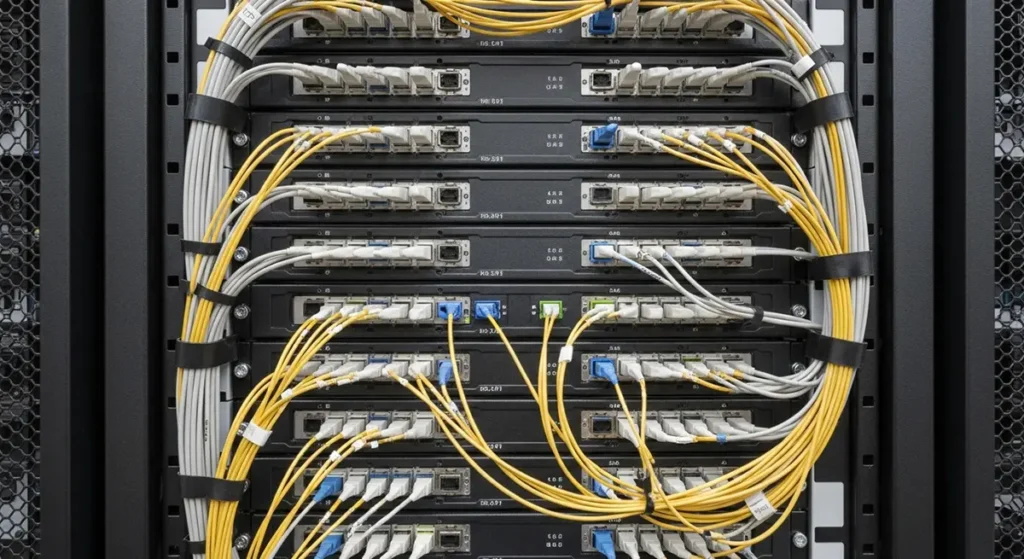
● Core Optical and Electrical Parameters: Compliant with international ITU-T G.652.D standards, stably supports 800G high-speed optical signal transmission within 2 kilometers with extremely small link loss fluctuation;
● Fixed Application Scenarios: Horizontal interconnection between cabinets under leaf-spine architecture, medium and long-distance backbone links inside AI supercomputing Pods;
● Engineer Selection Notes: OS2 single-mode optical fiber shall be adopted uniformly for all inter-cabinet links longer than 100 meters; this fiber is backward compatible with all commercial optical modules ranging from 100G to 800G with excellent network expansion compatibility.
G.654.E Ultra-low Loss Single-mode Optical Fiber
● Core Optical and Electrical Parameters: The line attenuation is as low as 0.17dB/km, reducing line loss by 30% compared with conventional OS2 single-mode optical fiber, and stably supports next-generation 1.6T ultra-high-speed optical signal long-distance transmission;
● Fixed Application Scenarios: Data center interconnection (DCI) links, backbone links of cross-building AI computing clusters, long-distance aggregation uplink links of spine switches;
● Engineer Selection Notes: Mandatory for 1.6T pilot data centers and large cross-building AI clusters; despite higher unit procurement cost, it greatly reduces the deployment quantity of optical amplifiers and cuts long-term operation and maintenance costs significantly.
MTP/MPO High-density Parallel Optical Fiber Backbone Cable
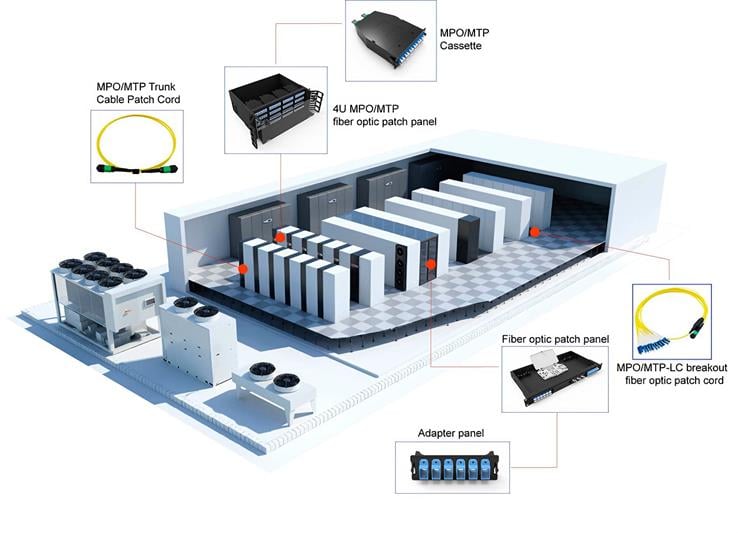
● Core Optical and Electrical Parameters: Integrated factory pre-terminated cables with 12-core, 16-core and 24-core specifications, supporting multi-channel parallel 100G optical signal aggregation transmission; unified factory endface grinding ensures controllable full-network link loss consistency;
● Fixed Application Scenarios: Direct interconnection links of GPU servers, AI full-mesh optical networks, high-density cabling areas in supercomputing Pods;
● Engineer Selection Notes: MTP-16 cables are preferred for 400G/800G GPU direct links; full-network equal-length cabling must be implemented during construction to eliminate link latency deviation; MTP-LC hybrid breakout cables are prioritized for hybrid networking projects of legacy data center renovation.
Unified Global Optical Fiber Selection Principles
● 0m - 100m intra-cabinet links: Adopt OM4 multimode optical fiber to balance hardware procurement cost and transmission performance;
● 100m - 2000m inter-cabinet links: Adopt OS2 standard single-mode optical fiber uniformly to guarantee full-network equipment compatibility;
● Links longer than 2000m across data centers: Mandatorily deploy G.654.E ultra-low loss single-mode optical fiber;
● Large-scale GPU full-mesh clusters: MTP/MPO high-density pre-terminated optical cables are the only solution meeting both high-density cabling and full-network latency consistency requirements.
Performance Quantitative Comparison
A small number of short-distance copper DAC cables are still in service in legacy data centers, yet such electrical transmission media can no longer meet the high-speed, high-density and ultra-low latency networking requirements of AI data centers. Based on the most widely deployed 400G network environment, the table below quantitatively compares four core indicators including transmission distance, operating power consumption, heat dissipation performance and latency jitter between copper and optical fiber media, objectively demonstrating the irreplaceable value of all-optical cabling in AI scenarios.
|
Test Indicator
|
25G Copper DAC Cable
|
400G OM4 Optical Fiber Link
|
Practical Engineering Value for AI Computing Clusters
|
|---|---|---|---|
|
Max Repeater-free Transmission Distance
|
5m - 7m
|
Over 200m
|
Reduce deployment of signal repeater amplifiers and lower the probability of network latency failures
|
|
Power Consumption per Gbps
|
1.8W
|
0.25W
|
86% reduction in single-link transmission power consumption, effectively optimizing overall data center PUE
|
|
Single-link Heat Generation
|
Extremely High
|
Extremely Low
|
Support higher-density GPU deployment in cabinets and eliminate local hotspots in data centers
|
|
Transmission Latency Jitter
|
Obvious Jitter
|
Ultra-low Jitter
|
Meet the mandatory nanosecond-level clock synchronization requirement for GPU cluster computing
|
Measured data from global ultra-large-scale computing parks shows that replacing all copper links with optical fiber links reduces the overall data center PUE by 0.07 to 0.10. For an AI computing park with 100MW installed capacity, hundreds of tons of carbon emissions can be reduced annually. Optical fiber cabling systems have become core infrastructure for AI data centers to balance high-performance computing output and low-carbon energy compliance requirements.
Optical Fiber Link on GPU Cluster Operation
● GPU Node Clock Synchronization Offset: Inconsistent loss values among interconnection links cause packet receiving time offset of each GPU node, leading to an overall effective computing power drop of 10% to 15%;
● Accelerated Aging of Commercial Optical Modules: Optical modules need to increase laser transmitting power actively to compensate extra line loss, resulting in continuous rise of equipment heat generation and a 30% reduction in overall hardware service life;
● Insufficient Network Forward Error Correction Margin: Extra link loss occupies native FEC margin of network equipment, sharply increasing the probability of random network packet loss during peak AI service traffic.
In view of the above risks, factory pre-inspected low-loss passive optical fiber components and full-network unified equal-length optical fiber routing planning are mandatory construction standards for AI data center cabling, rather than optional optimization measures.
FiberMart Solutions for AI Data Centers
Covering full-layer interconnection scenarios from GPU server ports to park backbone networks, FiberMart provides standardized and customized optical fiber cabling products adapted to 400G, 800G and 1.6T full-rate scenarios. All hardware undergoes 100% interferometer optical precision testing before delivery, with ferrule geometric tolerance controlled within ±0.5μm, meeting high-precision networking requirements of AI clusters.
● MTP/MPO Pre-terminated Backbone Optical Cables: Compatible with A/B/C three industry-standard polarities, typical insertion loss lower than 0.20dB, suitable for high-density full-mesh cabling of GPU clusters;
● Low-loss LC Duplex Jumpers: Endface return loss higher than 55dB, customized equal-length jumpers available for full-network latency consistency optimization;
● MMC/MDC Cable: Ultra-compact dual-core high-density optical interconnect cables with minimized occupancy of cabinet wiring space, typical insertion loss less than 0.18dB, perfectly compatible with 800G/1.6T high-speed optical modules for short-range internal interconnection of AI computing cabinets;
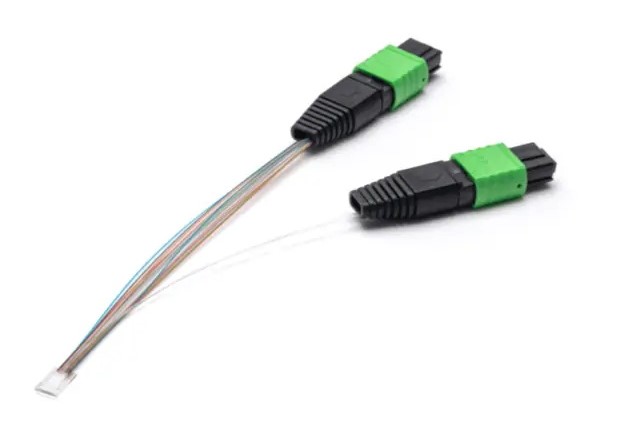
● Fiber Shuffle Cable: Customized disordered fiber rearrangement optical cables with extra zero additional link loss, supporting flexible port topology reconstruction, ideal for rapid network architecture adjustment and full-mesh link deployment of large-scale GPU supercomputing clusters without secondary rewiring;
● FAU (Fiber Array Unit): Featuring ultra-low crosstalk and stable optical coupling performance, customized for on-board optical interconnection and co-packaged optics, catering to next-generation high-speed AI optical transmission demands;
● Complete Optical Fiber Cleaning & Testing Toolkits: Compliant with IEC 61300 international operation and maintenance standards, meeting daily precision inspection requirements of high-performance AI optical links.
All FiberMart optical fiber hardware supports QR code full-life cycle traceability system, meeting unified operation and maintenance and rapid fault location demands for hundreds of thousands of optical fiber links in large-scale AI data centers.
Conclusion
GPU chips serve as the computing core of AI data centers, while full-range optical fiber infrastructure forms the signal transmission nerve of the entire AI computing network. The actual computing power ceiling of large-scale GPU clusters is never determined by front-end computing hardware performance, but by the overall transmission quality of underlying optical fiber interconnection links. With the gradual commercialization of 1.6T high-speed Ethernet and CPO co-packaged optics technologies, optical fiber infrastructure will cover all transmission links of AI computing interconnection.
For data center operators and field network engineers, standardized fiber selection, uniform low-loss link design and modular all-optical fabric deployment are indispensable to maximize GPU hardware performance. FiberMart will continue developing high-precision, low-loss and forward-compatible optical interconnect products, delivering reliable end-to-end optical network infrastructure for global AI computing center construction and iteration.
FAQs
Why cannot copper cabling be used for long-distance GPU cluster networking?
A: Copper electrical transmission has inherent bandwidth and distance limitations, accompanied by high latency and excessive heat generation, which fail to meet the nanosecond-level clock synchronization requirements and high-speed transmission demands above 400G for GPU clusters.
How to quickly select multimode or single-mode optical fibers for AI data centers?
A: Adopt OM4 multimode optical fibers for intra-cabinet short links within 100 meters; adopt OS2 single-mode optical fibers for inter-cabinet medium links ranging from 100 meters to 2 kilometers; deploy G.654.E ultra-lowloss single-mode optical fibers for long-distance backbone links over 2 kilometers.
What is the average ROI cycle for upgrading copper networks to all-optical networks?
A: The average static payback period for full all-optical renovation projects is 18 months, benefited from reduced transmission power consumption and decreased operation and maintenance downtime. The ROI cycle will be further shortened with rising global electricity prices.
Can legacy optical fiber cabling be directly upgraded to 800G and 1.6T networks?
A: MTP/MPO modular optical fiber backbone systems with standardized polarity management support network rate upgrade only by replacing front-end active devices without changing underlying cabling hardware, realizing one-time cabling deployment and multi-generation smooth network iteration.
Posted on 27 May, 2026, by Francisco, Fibermart, All Copy Right Reserved.





No comments have been posted yet.