


.webp)


The exponential growth of global data traffic has exposed critical limitations in traditional single-fiber, single-channel optical transmission. Fiber resource scarcity, high deployment costs, and lengthy construction cycles have become major bottlenecks for network capacity expansion. Wavelength Division Multiplexing (WDM) transceivers solve these challenges by enabling simultaneous transmission of multiple independent data streams over a single optical fiber through distinct optical wavelengths. This technology delivers exponential bandwidth scalability without physical fiber redeployment, serving as a core hardware component for modern metropolitan networks, backbone infrastructures, and data center interconnections.
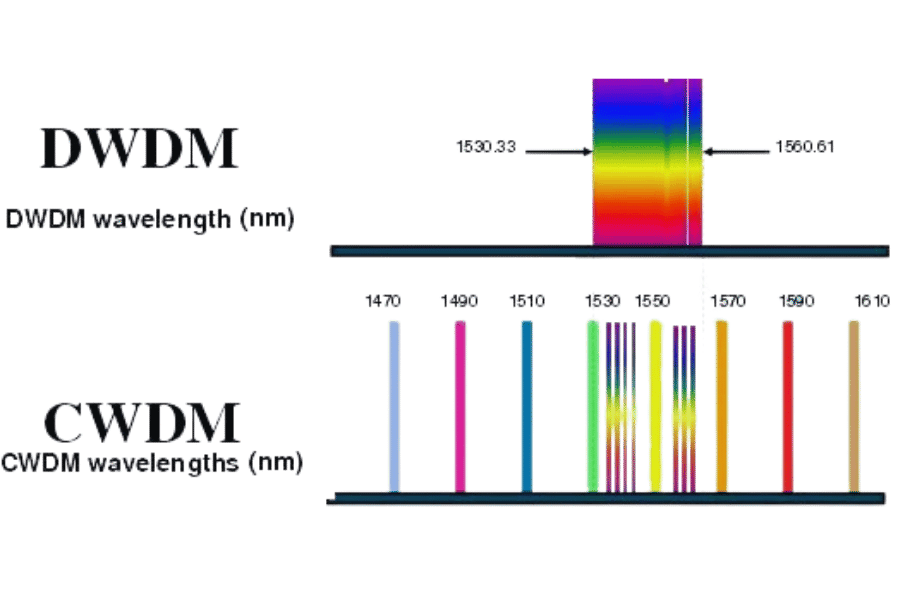
Operating on the principle of optical frequency division multiplexing, WDM transceivers are protocol-agnostic and support unified transmission of data, voice, video, and storage services, covering full network speed ranges from 1G to 100G+. The mainstream commercial WDM transceivers fall into two standardized categories: Coarse Wavelength Division Multiplexing (CWDM) and Dense Wavelength Division Multiplexing (DWDM) transceivers. Their fundamental differences in wavelength spacing, channel density, transmission reach, cost structure, and deployment complexity determine their differentiated application boundaries. Additionally, LWDM (LAN Wavelength Division Multiplexing) transceivers have emerged as a specialized solution for short-reach, high-density data center scenarios, forming a complete hierarchical WDM hardware ecosystem.
A straightforward analogy illustrates WDM functionality: a single optical fiber acts as a single-lane highway, while WDM transceivers divide this highway into multiple independent traffic lanes. This mechanism maximizes existing fiber utilization without physical infrastructure expansion. Accurate differentiation between CWDM and DWDM transceiver characteristics is essential for professional network planning, hardware selection, and standardized operation and maintenance.
Working Principles of CWDM and DWDM Transceivers
CWDM Transceiver Fundamentals
CWDM transceivers are lightweight, cost-optimized optical devices designed for short-to-medium reach and moderate-capacity network scenarios. Compliant with the international standard ITU-T G.694.2, CWDM transceivers operate across a full wavelength range of 1270nm to 1610nm, defined by three core technical attributes: wide wavelength spacing, low hardware complexity, and passive deployment compatibility.
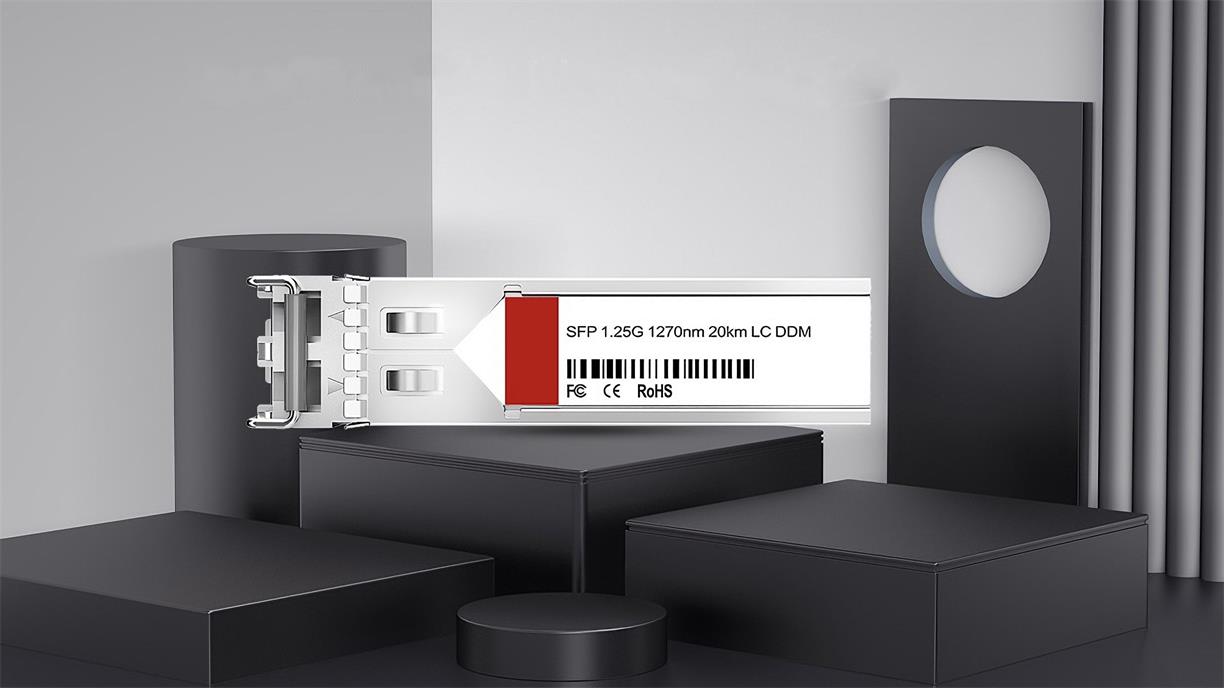
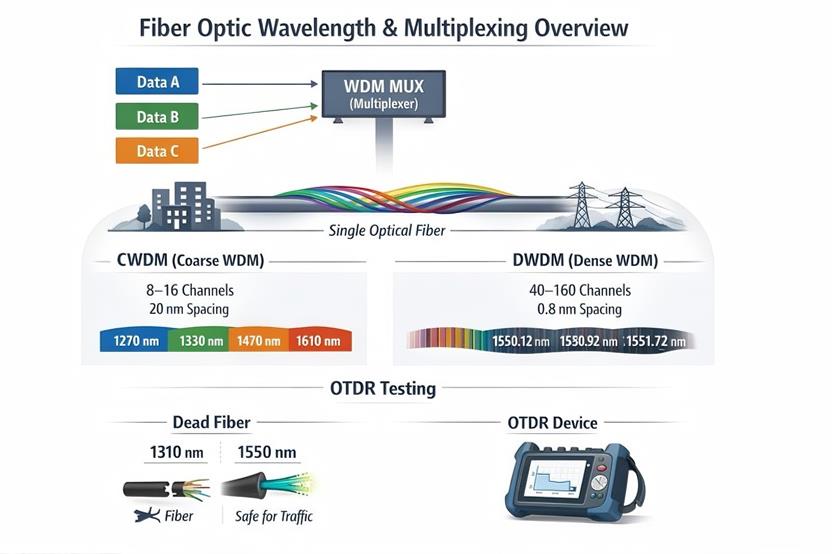
Equipped with uncooled laser diodes and passive optical chips, CWDM transceivers require no precise temperature control or real-time wavelength calibration. They feature a fixed 20nm channel spacing, which effectively suppresses crosstalk and simplifies overall network architecture. A standard CWDM-based transmission system supports up to 18 independent wavelength channels, with 8 mainstream channels concentrated in the low-loss 1310nm and 1550nm bands. Due to the fiber water peak attenuation effect, channels within the 1370nm–1430nm range suffer significant signal loss for transmission distances exceeding 40km, reducing the number of stable available channels in long-reach scenarios.
Thanks to their simplified hardware design, CWDM transceivers operate independently without auxiliary devices such as optical amplifiers or dispersion compensation modules. Their plug-and-play deployment and low maintenance requirements make them the preferred hardware solution for budget-constrained short-reach network expansion projects.
DWDM Transceiver Fundamentals
DWDM transceivers are high-performance optical hardware tailored for long-haul, ultra-high-capacity backbone networks. Following the ITU-T G.694.1 standard, DWDM transceivers primarily operate in the low-loss 1525nm–1565nm C-band, with expandable L-band coverage to double transmission capacity. The core technical advantages include ultra-dense wavelength arrangement, superior transmission stability, and outstanding long-term scalability.
Integrated with high-precision cooled lasers and active temperature control modules, DWDM transceivers achieve ultra-fine wavelength calibration. They support compact channel spacing of 0.4nm (50GHz) or 0.8nm (100GHz), far narrower than the 20nm spacing of CWDM devices. This dense wavelength packing enables a single optical fiber to carry 40–96 channels in the C-band, and up to 192 channels with combined C-band and L-band deployment, maximizing fiber resource utilization.
To eliminate signal attenuation and chromatic dispersion in long-haul transmission, DWDM transceiver systems can be paired with EDFA optical amplifiers and DCM dispersion compensation units. This configuration ensures lossless, low-distortion signal transmission across cross-city, cross-provincial, and intercontinental backbone links, establishing DWDM transceivers as the foundational hardware for high-bandwidth, scalable optical networks.
CWDM and DWDM transceiver Comprehensive Technical Parameter Comparison
The inherent hardware differences between CWDM and DWDM transceivers directly determine their performance boundaries, cost efficiency, and application suitability. The following table presents a standardized technical comparison of the two mainstream WDM transceiver types:
|
Comparison Item
|
CWDM Transceiver
|
DWDM Transceiver
|
|---|---|---|
|
Industry Standard
|
ITU-T G.694.2
|
ITU-T G.694.1
|
|
Channel Spacing
|
20nm (wide spacing)
|
0.4nm / 0.8nm (50GHz / 100GHz dense spacing)
|
|
Max Channel Quantity
|
Up to 18; 8 stable channels for long-reach scenarios
|
40–96 (C-band); up to 192 (C+L band)
|
|
Unamplified Reach
|
≤80km; obvious performance degradation beyond 40km
|
≤80km
|
|
Amplified Reach
|
Non-expandable
|
1000km+ for ultra-long-haul backbone transmission
|
|
Supported Data Rates
|
1G/10G mainstream; maximum 25G
|
10G/25G/40G/100G/400G/800G full coverage
|
|
Hardware Complexity
|
Low; passive design, no temperature control, no auxiliary devices
|
High; cooled laser, precise calibration, compatible with amplifiers/DCMs
|
|
Cost Characteristic
|
Low initial CapEx and minimal OpEx
|
High initial cost, lower long-term expansion cost
|
|
Scalability
|
Limited; fixed channel count restricts bandwidth upgrade
|
Excellent; wavelength stacking supports continuous bandwidth growth
|
|
Primary Applications
|
Metro networks, access networks, enterprise short-reach private lines
|
Backbone networks, long-haul transmission, large-scale data center interconnection
|
Cost, Operation & Maintenance Analysis of CWDM and DWDM Transceiver
Capital and Operational Cost Structure
CWDM transceivers feature uncooled laser chips and fully passive hardware architecture, resulting in low manufacturing and deployment barriers. They deliver significant capital expenditure (CapEx) savings for short-term, small-scale network upgrades. With a simple mechanical structure and low failure rate, CWDM devices require no professional fine-tuning, minimizing ongoing operational expenditure (OpEx). This makes them a cost-effective choice for small and medium-sized enterprise networks and regional access infrastructures. However, the fixed channel limitation forces fiber addition or full hardware replacement for bandwidth expansion, leading to higher comprehensive costs in long-term iterative upgrades.
DWDM transceivers adopt high-precision optical chips and active temperature control systems, requiring supporting auxiliary devices, which raises initial procurement and deployment costs. Nevertheless, their ultra-high fiber utilization and wavelength-level scalability eliminate the need for physical fiber reconstruction. Bandwidth expansion can be achieved simply by stacking wavelength channels, delivering superior long-term cost efficiency for carrier-grade and cross-regional enterprise networks. The iteration of compact DWDM transceiver designs has effectively reduced the traditional drawbacks of large size and complex operation, continuously improving overall cost-performance.
Operational Characteristics and Fault Profiles
CWDM transceivers feature ultra-low operation and maintenance complexity. No routine parameter calibration is required during service. Most common faults are basic hardware anomalies including fiber contamination, link disconnection, and poor port contact, which can be resolved through standard physical inspection, port cleaning, and re-plugging. This suitability makes CWDM devices ideal for scenarios without dedicated professional optical network operation teams.
DWDM transceivers adopt high-precision integrated hardware with complex internal logic. Typical faults include inter-channel crosstalk, wavelength drift, and abnormal optical power attenuation. Wavelength deviation and adjacent-channel interference are the most frequent failure causes, requiring real-time monitoring of transceiver optical power and wavelength parameters via network management systems. Regular firmware updates and wavelength calibration are mandatory to maintain optimal performance. Despite higher professional maintenance requirements, DWDM transceivers provide superior stability and fault tolerance, meeting the high-reliability demands of core backbone networks.
Scenario-Based Selection Guidelines for CWDM and DWDM Transceiver
CWDM Transceiver Application
CWDM transceivers are the optimal selection for four typical scenarios. First, short-reach transmission within 80km, including enterprise campus networks, regional access nodes, and metro edge networks. Second, budget-sensitive short-term capacity expansion projects with no demand for long-term large-scale bandwidth iteration. Third, simple point-to-point link deployment with single-type, stable services and low network complexity requirements. Fourth, incremental renovation of legacy networks, enabling rapid capacity upgrade by retrofitting CWDM transceivers and reusing existing fiber resources without large-scale construction.
DWDM Transceiver Application
DWDM transceivers apply to high-end and long-scenario networking requirements. First, long-haul backbone transmission exceeding 80km, supporting cross-city and cross-provincial data transmission with amplifier-assisted lossless signal delivery. Second, ultra-high-bandwidth multi-service bearing scenarios, supporting 40G/100G and higher-rate transmission and converging massive voice, data, and cloud services via multi-channel stacking. Third, networks with long-term expansion planning, avoiding repeated hardware investment through DWDM’s iterative scalability. Fourth, large-scale data center interconnection and carrier core networks that require ultra-stable, low-latency, high-reliability transmission performance.
Supplementary LWDM Transceiver Application
As an emerging WDM hardware solution, LWDM (LAN WDM) transceivers are specially optimized for short-reach, high-density data center interconnection scenarios. Featuring dense wavelength arrangement comparable to DWDM transceivers, LWDM devices deliver outstanding space and power efficiency while avoiding the environmental adaptation limitations of traditional WDM hardware. They have become the mainstream transceiver choice for high-speed data center wiring, forming a complementary high-density short-reach solution to traditional CWDM and DWDM devices.
Standard Troubleshooting and Maintenance Specifications for CWDM and DWDM Transceiver
Standardized daily maintenance is critical to extending the service life and ensuring stable operation of both CWDM and DWDM transceivers. All operation procedures focus on preventing typical transceiver faults and eliminating link anomalies.
Four core maintenance protocols apply universally. First, avoid inter-channel crosstalk by configuring transceiver wavelengths strictly in accordance with factory specifications and prohibiting random channel mismatching, which prevents data loss and link distortion. Second, implement periodic optical power detection to troubleshoot over-power and under-power anomalies that cause signal distortion. Third, execute routine physical inspection and port cleaning to eliminate signal attenuation caused by fiber end-face contamination and transceiver port dust accumulation. Fourth, maintain up-to-date transceiver firmware to fix known vulnerabilities and optimize transmission algorithms continuously.
For high-precision DWDM transceivers, additional targeted maintenance is required, including regular laser wavelength calibration and built-in temperature control system inspection to prevent performance degradation caused by wavelength drift and temperature anomalies. CWDM transceivers only require quarterly basic physical inspection due to their simple structure and stable performance.
FiberMart CWDM and DWDM Optical Transceiver Solutions
FiberMart delivers specialized CWDM and DWDM optical transceiver portfolios tailored for scalable metro access, enterprise fiber expansion, and carrier-grade long-haul backbone networking. The product lineup covers full-spectrum WDM solutions, ranging from cost-effective low-speed 1G/10G CWDM modules for edge network access to high-precision 40G/100G dense-wavelength DWDM modules for ultra-large-capacity backbone transmission, supporting mainstream form factors including SFP, SFP+, and QSFP28 to match full-lifecycle optical networking upgrade demands. All FiberMart CWDM and DWDM modules strictly comply with ITU-T G.694.2/G.694.1, IEEE and MSA international industry standards, with complete standardized wavelength grids covering the full operational spectrum.
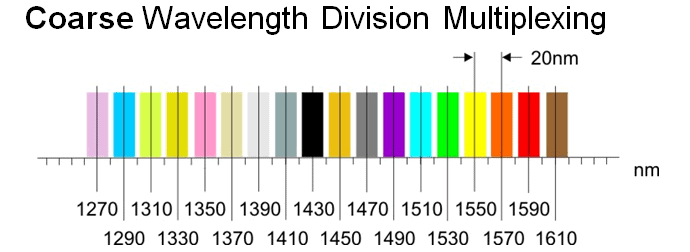
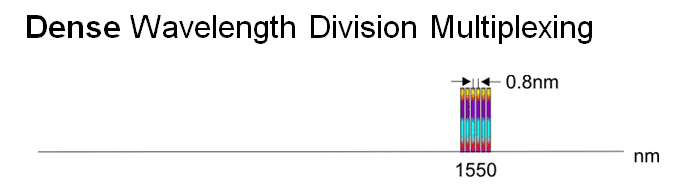
The product series features differentiated performance configurations, fully adapting to medium-reach enterprise building uplinks, metro edge multi-service aggregation, and long-haul cross-city inter-station backbone links. Every transceiver unit undergoes rigorous factory calibration on transmit optical power, receive sensitivity, wavelength accuracy, and signal stability. This precise performance control allows network engineers to formulate accurate fiber loss budgets during pre-deployment planning, effectively eliminating hidden risks such as wavelength drift, channel crosstalk, and intermittent link flapping in commercial production environments.
Fibermart CWDM & DWDM Product Lineup
● CWDM Transceiver Series: 1G/10G SFP/SFP+ CWDM modules with 20nm wide wavelength spacing, optimized for low-cost, medium-short reach network deployment
● DWDM Transceiver Series: 10G/40G/100G SFP+/QSFP28 DWDM modules with 50GHz/100GHz dense wavelength spacing, designed for long-haul, high-stability backbone transmission
● High-Capacity WDM Solution: Full-band wavelength-matched modules supporting multi-channel stacking, maximizing single-fiber bandwidth utilization for scalable network expansion
Conclusion
In early-stage optical network construction, CWDM transceivers dominated small-scale short-reach networking due to their low cost and easy deployment, widely applied in enterprise private lines and metro access layers. However, the rapid development of 5G, cloud computing, big data, and AI computing networks has driven explosive bandwidth growth, exposing the inherent limitations of CWDM transceivers, including insufficient scalability and fixed capacity ceilings.
Current industry hardware selection presents a clear developmental trend: DWDM transceivers have become the preferred solution for new medium and large-scale networks. The miniaturization and cost reduction iteration of modern DWDM transceivers has lowered deployment thresholds, enabling them to meet current ultra-high-bandwidth demands and adapt to future 1.6T and 3.2T ultra-high-speed transmission upgrades with excellent forward compatibility. Meanwhile, CWDM transceivers retain irreplaceable value in low-budget, small-scale edge network scenarios, forming a mature hierarchical hardware deployment pattern: CWDM for edge access, DWDM for core backbone, and LWDM for data center interconnection.
In summary, CWDM and DWDM transceivers have no absolute superiority; their value is reflected in scenario adaptation. Professional network hardware planning requires comprehensive evaluation of transmission distance, bandwidth demand, budget constraints, and long-term expansion goals. Reasonable collocation of CWDM and DWDM transceivers maximizes existing fiber resource utilization, balances transmission performance, construction cost, and long-term scalability, and provides stable, efficient, and sustainable hardware support for modern optical network infrastructure.
Frequently Asked Questions (FAQ)
Can CWDM and DWDM Transceivers Coexist on a Single Fiber?
Direct co-deployment of bare CWDM and DWDM transceivers on the same fiber is not recommended. The two transceiver types feature distinct wavelength spacing and operating mechanisms, and direct mixing causes severe inter-channel interference, resulting in packet loss or even full service outage. Hybrid networking is only feasible with dedicated wavelength division multiplexing equipment for physical wavelength isolation.
Do WDM Transceivers Require Specialized Optical Fiber?
Standard single-mode optical fiber is fully compatible with all basic application scenarios of CWDM and DWDM transceivers. For ultra-long-haul DWDM transmission scenarios, low-loss, dispersion-optimized dedicated fiber is recommended to reduce signal attenuation and chromatic dispersion, maximizing the long-distance and high-speed performance advantages of DWDM transceivers.
How to Confirm the Maximum Supported Channels of Network Devices?
The adaptive wavelength range and maximum channel capacity of network devices can be queried via official hardware datasheets or network management system interfaces. Pre-verification is necessary before transceiver selection and network design to avoid performance bottlenecks caused by parameter mismatch.
Differences Between LWDM and Traditional CWDM/DWDM Transceivers
LWDM transceivers are dedicated to high-density, short-reach data center interconnections, combining DWDM-level high channel density with lightweight, low-power advantages. CWDM transceivers target medium-short haul metro and access networks, while DWDM transceivers focus on long-haul backbone transmission. The three transceiver types feature clear scenario division with no functional substitution overlap.
Posted on 3 Jun, 2026, by Francisco, Fibermart, All Copy Right Reserved.





No comments have been posted yet.