


.webp)


The way fiber optic cables are connected to the system has a significant impact on the network's performance. Optical signals can pass via the link with little attenuation and return loss when this procedure is carried out properly. In 99% of single-mode applications, fiber optic pigtails offer the best way to join optical fibers.
Fiber Pigtail
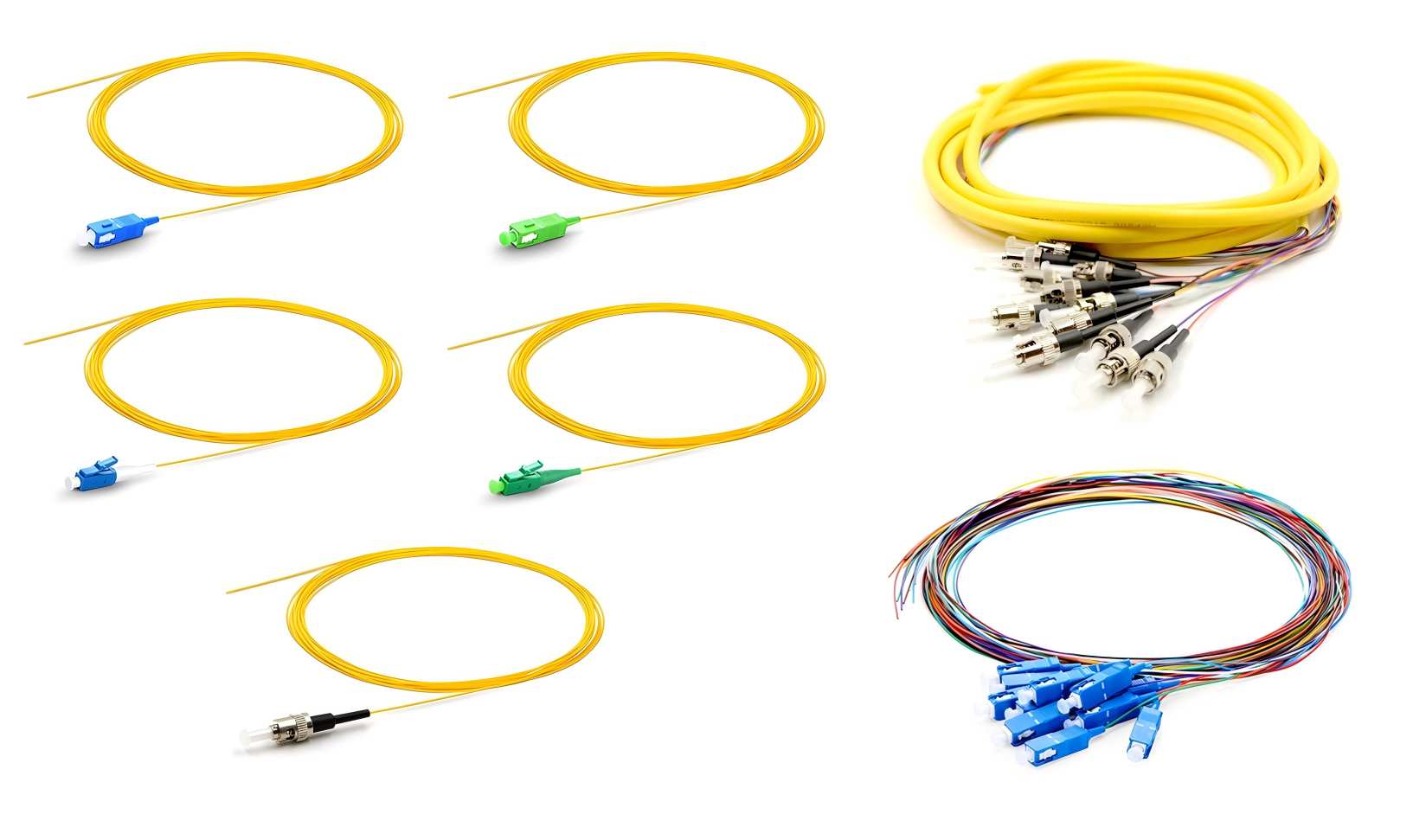
One end of a fiber optic cable has a pre-installed connection, but the other end is still unterminated. This form of cable is known as a fiber optic pigtail. While the opposite end can be fused or mechanically spliced with other optical fiber cables, this arrangement makes it simple to connect the connector side to equipment.
When utilising fusion or mechanical splicing techniques to terminate fiber optic cables, fiber optic pigtails are essential. High-quality pigtail cables provide the best performance for fiber optic cable terminations when paired with appropriate fusion splicing techniques. Fiber optic pigtails are frequently seen in fiber optic management devices.
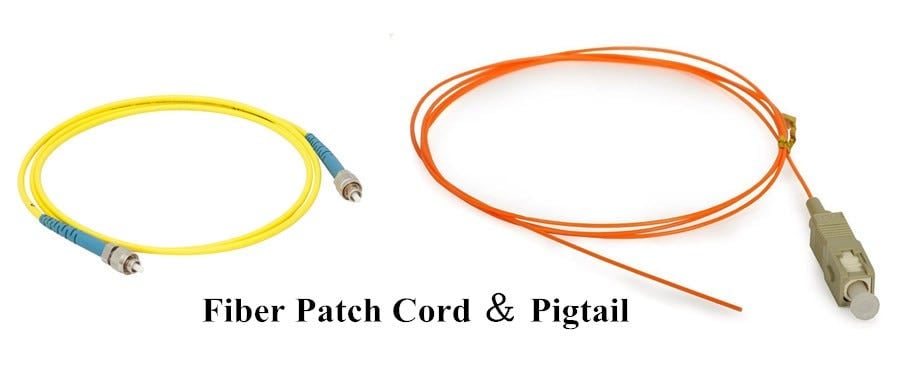
The Distinction between Fiber Patch Cord and Fiber Pigtail
A cable with a fiber connector attached to one end and the other unconnected is known as a fiber optic pigtail. Fiber optic connectors, on the other hand, terminate at both ends of a fiber patch cord. Fiber pigtail cables are often unjacketed since they are spliced and shielded by a fiber splice tray, whereas patch cord fibers are frequently jacketed. Two pigtails can be made by cutting a fiber patch cord in half. In order to avoid the difficulty of testing pigtail cables in the field, some installers use this method. Rather, they increase a fiber patch cord's performance and, if necessary, split it into two fiber pigtails.
How Can Various Fiber Pigtail Types Be Categorised?
There are various varieties of fiber optic bunches. They can be divided into LC fiber optic pigtails, SC fiber pigtails, and ST fiber pigtails according to the type of connector they have. Single-mode and multimode fiber optic pigtails are two more categories based on the kind of fiber. Pigtails can also have different fiber counts; the market offers options like 6 and 12 fibers.
By Type of Fiber
Single-mode (yellow) and multimode (orange) fiber are the two primary categories of fiber optic pigtails. Bulk multimode fiber cables with 62.5/125 micron or 50/125 micron specifications are used in multimode fiber optic pigtails. Multimode fiber optic connectors are used at one end of the cables. Furthermore, 10G multimode fiber cables (OM3 or OM4) come in fiber optic pigtails, which are typically identified by their aqua jacket colour.
Conversely, single-mode fiber pigtail cables are terminated with single-mode fiber connectors at one end and use 9/125 micron single-mode fiber cables.
-and-multimode-(orange)-Fiber-Pigtail-260130.jpg "Single mode (yellow) and multimode (orange) Fiber Pigtail")
By Type of Connector
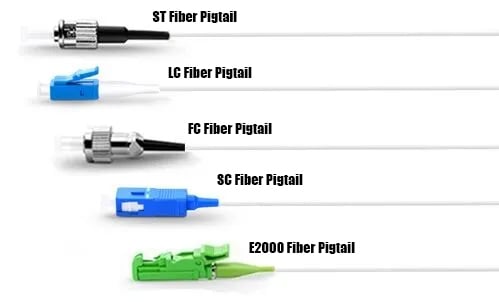
There are several different types of fiber optic bunches. Each had a distinct connector at the end. Pigtail cable connectors that are frequently used include LC, SC, ST, FC, MT-RJ, E2000, and other types of fiber. Every connector has benefits and works well with various systems and applications. The ones that are frequently utilised include:
● SC Fiber Optic Pigtail: The SC pigtail cable connector has a 2.5mm pre-radiused zirconia or stainless alloy ferrule and a non-optical disconnect design. SC fiber pigtail is widely used in CATV, LAN, WAN, test, and measurement applications due to its affordability.
● FC Fiber Optic Pigtail: The FC fiber pigtail has a screw-type structure with high-precision ceramic ferrules and makes use of the metallic body of FC optical connectors. In general fiber optic communications, FC fiber optic pigtails and similar devices are widely used.
● ST Fiber Optic Pigtail: For multimode fiber optic LAN applications, the ST pigtail connector is especially well-liked. It features an extended 2.5 mm diameter ferrule composed of plastic, stainless steel, or ceramic (zirconia). ST fiber pigtails are frequently used in sensor, industry, medical, and telecommunications applications.
Similar to fiber optic patch cords, fiber optic pigtails are available in both UPC and APC versions. SC/APC, FC/APC, and MU/UPC bunches are common varieties.
By Environment of Application
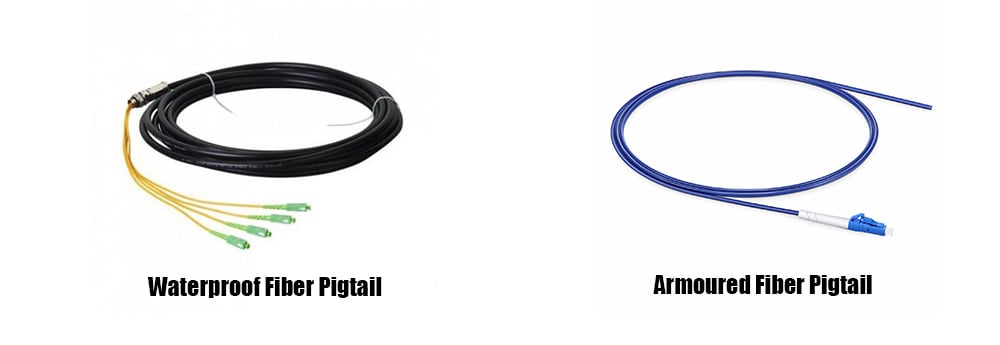
Specialised pigtail cables, such as waterproof fiber pigtails and armored fiber pigtails, are made to endure challenging conditions.
Armored Pigtail: The outer jacket of an armored fiber optic pigtail is made of a stainless steel tube or another sturdy steel material. This architecture improves network dependability overall and gives the fiber additional protection. Additionally, it aids in preventing damage from construction projects, rodents, and the weight of other cables.
Waterproof Pigtail: An armored outdoor PE (Poly Ethylene) jacket and a stainless steel enhanced waterproof unit are features of the waterproof fiber pigtail. This kind of pigtail works well in challenging settings including military applications, CATV installations, and communication towers. The waterproof pigtail cable is perfect for outdoor connections because of its exceptional durability, tensile strength, and dependable performance.
By Number of Fibers
There are several strand counts of fiber optic pigtails, including 1, 2, 4, 6, 8, 12, 24, and 48 strands. The number of fibers determines the pigtail's design:
One fiber and one connection on one end make up a simplex fiber optic pigtail.
Duplex Fiber Optic Pigtail: This type of pigtail has two fibers and two connections on one end. Each fiber is typically labelled "A" or "B," or polarity is indicated by different coloured connector boots.
Similar to this, pigtails with 4, 6, 8, 12, 24, 48, and even more than 48 fibers each have unique characteristics that meet the demands of different systems and applications.
Fiber pigtails come either male connectors that are directly inserted into optical transceivers to transmit signals, or female connectors that are used in patch panels for simple connections.
Fiber Optic Pigtail Splicing: Quick and Simple Fiber Termination
Compared to field-terminated cables, fiber pigtail offers superior performance since its linked end is factory-attached, guaranteeing more accuracy. Fusion or mechanical splicing techniques can be used to join this pigtail to optical fibers. Fusion splicing saves a lot of time and money in field termination by enabling rapid attachment, which takes only a minute or less when utilising a fusion splicer.
Light transmission between fibers is facilitated by mechanical fiber optic pigtail splicing, which accurately aligns a pigtail and fiber patch cable to create a temporary or permanent junction. It is preferable to acquire a slightly longer fiber pigtail assembly than required in order to accommodate for any splicing faults and provide more slack for adjustments. Additionally, the splicing operation is made simpler by selecting fiber pigtail assemblies of dependable quality.
The primary function of a fiber pigtail is to splice fibers in order to connect them to equipment or patch panels. They provide a reliable and workable option for streamlined fiber termination, saving a substantial amount of time and labour during installation.





No comments have been posted yet.