


.webp)


In today’s era of widespread fiber optic communication, transmission distance stands as one of the most core concerns across use cases — from enterprise data center backbone networks and campus cabling, to cross-city and transoceanic long-distance data transmission. Many engineering teams and technical practitioners face confusion during product selection: for fiber cables of the same category, why can some only transmit a few hundred meters, while others deliver signals thousands of kilometers across oceans? What exactly sets the limits of fiber optic transmission distance?
This article breaks down the core factors governing fiber optic transmission distance from its technical essence, provides product selection recommendations aligned with real-world application scenarios, and embeds highly compatible Fibermart products to help you address the core needs of fiber selection, distance calculation, and pitfall avoidance in one stop, with content accessible even for beginners.
Fiber Optic Transmission Distance Is Not a Fixed Value
First, it is critical to establish a key understanding: there is no universal standard for the transmission distance of fiber optic cables. It is fundamentally determined by four core factors: fiber type, transmission rate, light source quality, and the external environment. Even for the exact same fiber cable, transmission distance can vary significantly across different scenarios.
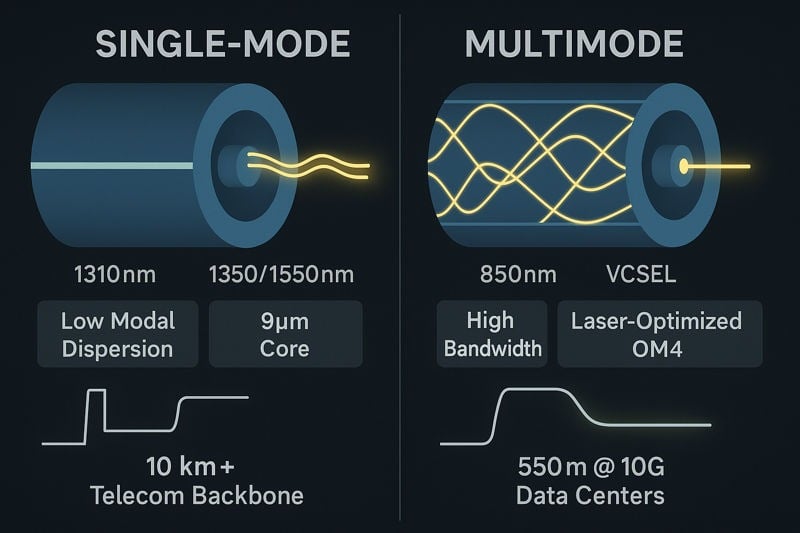
For an intuitive example: the multimode fiber commonly used in homes and offices typically has a maximum transmission distance of no more than 550 meters at a rate of 10 Gbps. By contrast, single-mode fiber used by carriers for cross-city transmission can achieve a repeaterless transmission distance of over 80 kilometers at 10 Gbps, and can even enable ultra-long-haul transmission of thousands of kilometers when paired with optical repeaters — this is the essential difference between different fiber types.
4 Factors Affecting Fiber Optic Transmission Distance (Must Read)
1. Fiber Type: The Root Cause of the Distance Gap Between Single-Mode and Multi-Mode Fiber
Fiber optic cables are classified into SingleMode Fiber (SMF) and Multi-Mode Fiber (MMF) by transmission mode. Their differences in structure and transmission principle directly define the upper limit of transmission distance, making this the primary criterion for product selection.
● Single-Mode Fiber: With an ultra-thin core diameter (approximately 9μm), it allows only one mode of optical signal to transmit, featuring extremely low dispersion and attenuation. It is the top choice for long-distance, high-rate transmission such as cross-city networks and backbone networks.
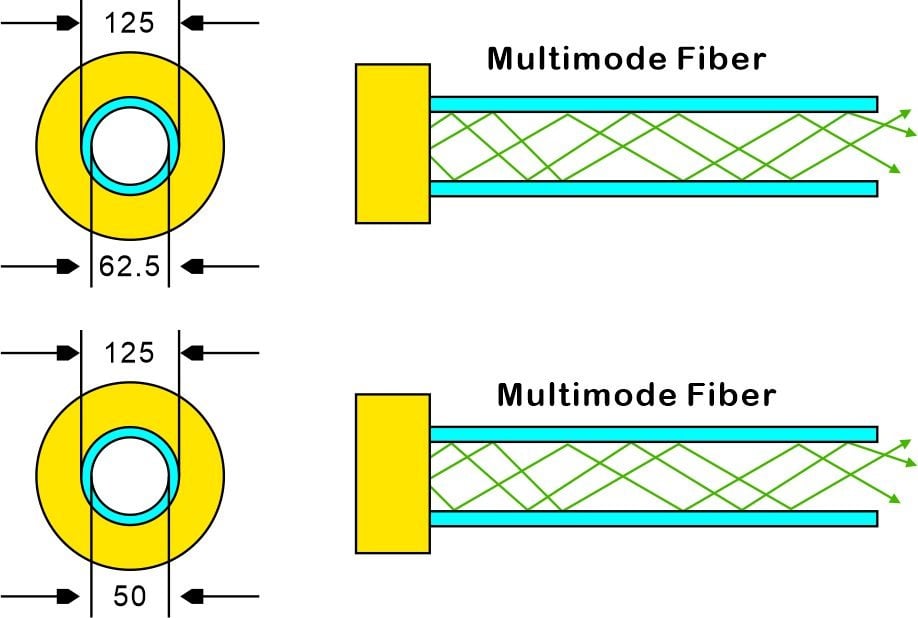
● Multi-Mode Fiber: With a larger core diameter (50μm or 62.5μm), it supports parallel transmission of multiple optical signal modes, with significant modal dispersion and higher attenuation than single-mode fiber. It is only suitable for short-distance transmission, such as inside data centers and campus cabling.
2. Transmission Rate: Higher Rate Equals Shorter Distance (Inverse Relationship)
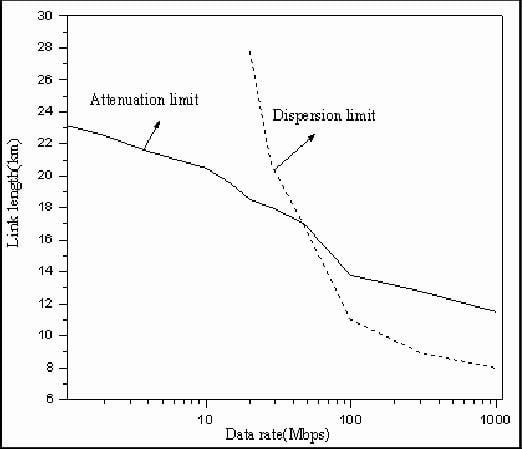
This is a critical rule that is easily overlooked: under the same fiber type and light source conditions, the higher the transmission rate, the more severe the attenuation and dispersion of the optical signal, and the shorter the transmission distance. For example, single-mode fiber can deliver a repeaterless transmission distance of over 100 kilometers at 1 Gbps; but when the rate is increased to 100 Gbps, the repeaterless distance drops to 40-80 kilometers — a 100-fold increase in rate nearly halves the transmission distance.
The reason is straightforward: during high-rate transmission, optical pulses have a narrower width and are more susceptible to dispersion, which causes signal distortion, prevents accurate identification at the receiving end, and ultimately limits transmission distance.
3. Light Source Quality: Transmit Power and Receive Sensitivity Define the Upper Distance Limit
The transmission process of optical signals is essentially a closed loop of "emission-transmission-reception". The transmit power of the light source and the sensitivity of the receiving end directly determine the maximum distance an optical signal can travel:
● Transmit Power: The higher the transmit power of the optical transmitter (such as Laser Diode, LD; Light Emitting Diode, LED), the higher the initial intensity of the optical signal, the more attenuation it can withstand, and the longer the transmission distance. However, excessive power will damage the fiber and components, so it must be controlled within a reasonable range.
● Receive Sensitivity: The higher the receive sensitivity of the optical receiver, the lower the minimum optical signal intensity it can detect. It can accurately identify optical signals even after long-distance attenuation, thereby extending the transmission distance.
4. External Loss: Construction and Environment, the Hidden "Killer" of Transmission Distance
In addition to the inherent characteristics of the fiber itself, on-site construction and the external environment can also cause additional loss and shorten transmission distance — this is the most common pitfall in engineering projects:
● Splicing Loss: Deviation during fiber fusion splicing and poor contact of movable connectors will cause optical signal leakage. Each fusion splice introduces approximately 0.02-0.05dB of loss, and total loss increases with the number of connectors.
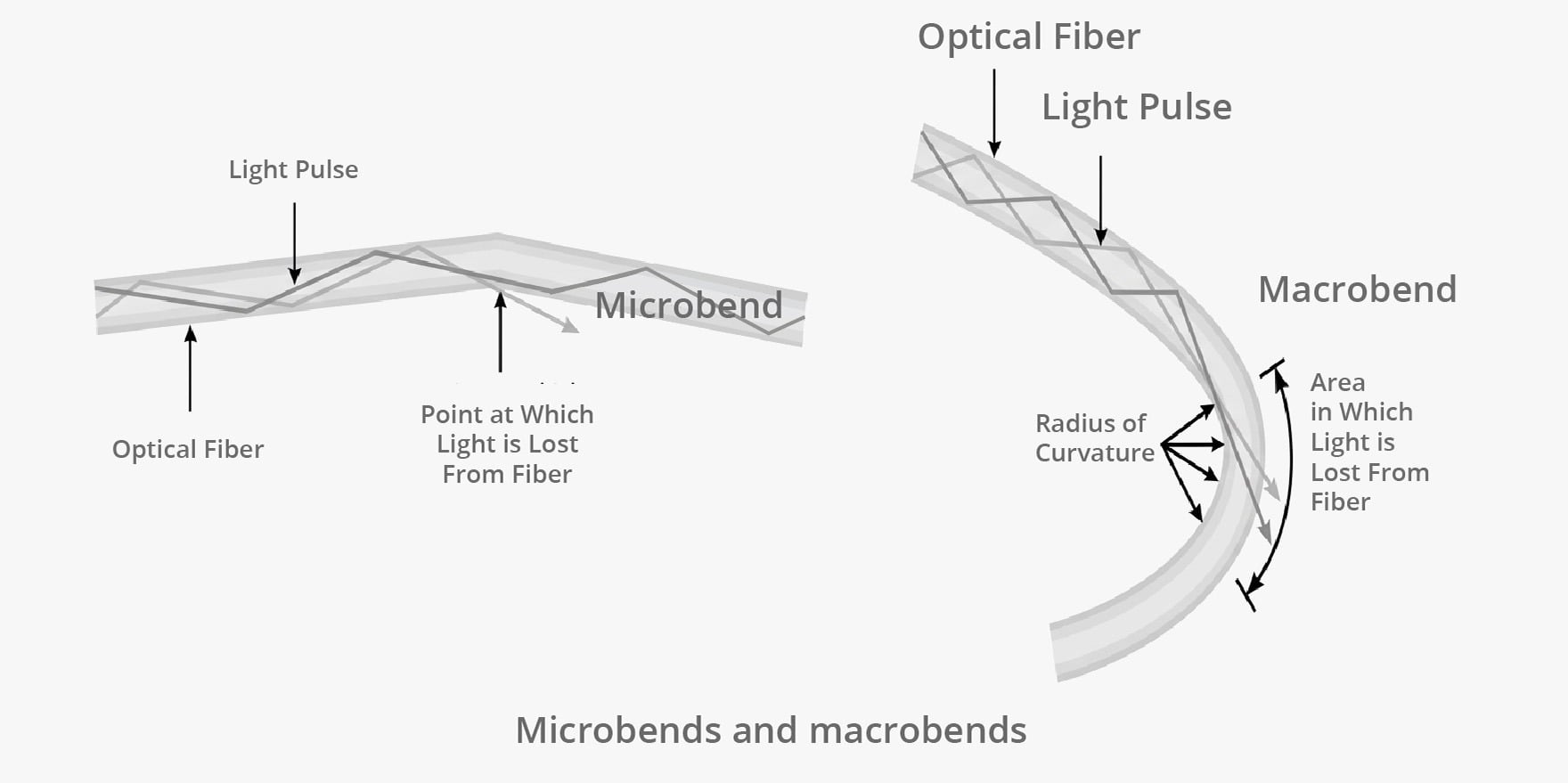
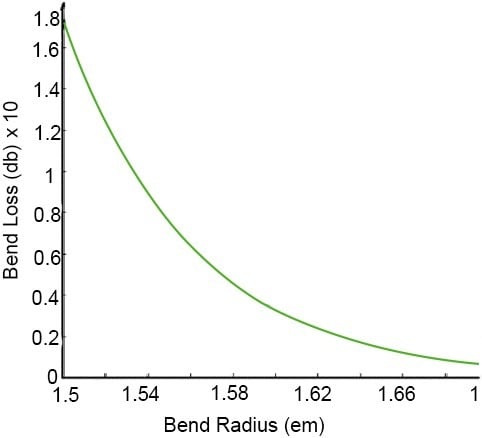
● Bending Loss: Excessive bending of the fiber (especially small-radius bending) will cause optical signals to overflow from the core, resulting in loss. Single-mode fiber is more sensitive to bending, and the bending radius must be no less than 10 times the outer diameter of the fiber during construction.
● Environmental Loss: Outdoor fiber exposed to high temperature, low temperature, and humid environments for long periods will accelerate fiber aging and increase attenuation. For this reason, armored, waterproof fiber cables must be selected for outdoor scenarios.
Fiber Optic Transmission Distance Comparison Table for Different Scenarios (Save for Later)
Aligned with real-world application scenarios, we have compiled the corresponding relationship between the most commonly used fiber types, transmission rates, and transmission distances, covering short-distance (data center/campus), medium-distance (cross-regional), and long-distance (backbone network/transoceanic) use cases. You can directly refer to this table during product selection to avoid common pitfalls.
|
Fiber Type |
Common Specification |
Transmission Rate |
Repeaterless Transmission Distance |
Typical Application Scenarios |
Compatible Fibermart Products |
|---|---|---|---|---|---|
|
MultiMode Fiber |
OM3 (50/125μm) |
10 Gbps |
300 meters |
Internal data center cabling, server clusters, short-distance campus cabling |
Fibermart OM3 10G Multi-Mode Fiber Patch Cord |
|
MultiMode Fiber |
OM4 (50/125μm) |
10 Gbps |
550 meters |
Large-scale campuses, data center interconnection, short-distance high-speed transmission |
Fibermart OM4 Indoor Multi-Mode Fiber Optic Cable |
|
SingleMode Fiber |
G.652D (9/125μm) |
1 Gbps |
100-150 kilometers |
Enterprise cross-regional cabling, metropolitan area network backbone links |
Fibermart G.652D Outdoor Armored Single-Mode Fiber Optic Cable |
|
SingleMode Fiber |
G.652D (9/125μm) |
10 Gbps |
40-80 kilometers |
Carrier backbone networks, cross-city data transmission |
Fibermart 10G Single-Mode Optical Transceiver + G.652D Fiber Bundle |
|
SingleMode Fiber |
G.654E (9/125μm) |
100 Gbps |
100-200 kilometers |
Transoceanic communication, ultra-long-haul backbone networks |
Fibermart G.654E Low-Loss Single-Mode Fiber Optic Cable |
Note: The distances listed in the table are for repeaterless transmission. To extend transmission distance, you can deploy optical repeaters. Each additional repeater can extend the transmission distance by 80-100 kilometers, with specific adjustments required based on the transmission rate and fiber type.
Scenario-Based Product Selection: Fibermart Product Recommendations, Precisely Matched to Your Needs
With an understanding of the factors affecting transmission distance and the reference table above, we recommend highly compatible Fibermart fiber products based on real-world scenarios. Each product is tailored to a specific use case to help you make fast, accurate product selections, avoiding overspending or choosing the wrong solution.
Scenario 1: Internal Data Center/Server Clusters (Short-Distance, High-Rate)
Demand Characteristics: Transmission distance ≤ 550 meters, rate above 10 Gbps, requiring low loss and easy cabling, suitable for interconnection of servers and switches inside data centers, or small-scale campus cabling.
Recommended Product: Fibermart OM4 MultiMode Fiber Patch Cord (LC-LC, 50/125μm)

Product Highlights: Designed specifically for 100G high-speed transmission, with a 50/125μm core that delivers a transmission distance of up to 550 meters at 10 Gbps, meeting the needs of high-density cabling in data centers. It adopts high-quality ceramic ferrules, with insertion loss ≤ 0.3dB and return loss ≥ 50dB, ensuring stable signal transmission with minimal packet loss and distortion. The jacket is made of low-smoke zero-halogen (LSZH) material, which is flame-retardant and environmentally friendly, ideal for enclosed data center environments. It also supports hot swapping for easy installation, with no professional fusion splicing tools required, making it easy for beginners to use.
Matching Recommendation: Can be paired with Fibermart OM4 indoor ribbon multi-mode fiber optic cable to build a high-speed transmission link inside the data center, compatible with 10G/25G optical transceivers, perfectly matching the interface requirements of servers and switches.
Scenario 2: Enterprise Cross-Regional/Metropolitan Area Networks (Medium-Distance, High Stability)
Demand Characteristics: Transmission distance of 10-100 kilometers, rate of 1 Gbps/10 Gbps, requiring anti-interference performance and environmental resistance, suitable for interconnection between enterprise headquarters and branch offices, and metropolitan area network backbone links.
Recommended Product: Fibermart G.652D Single-Mode Armored Fiber Optic Cable (4-Core/12-Core)

Product Highlights: Adopts G.652D single-mode fiber with a 9μm core, featuring attenuation as low as 0.3dB/km at 1310nm wavelength and 0.2dB/km at 1550nm wavelength, with a repeaterless transmission distance of up to 100 kilometers at 1 Gbps. The outer layer adopts double steel tape armor + PE outer sheath, with exceptional lateral pressure resistance, tensile strength, waterproof performance, and rodent resistance. It can adapt to various laying methods including outdoor aerial, pipeline, and direct burial, and withstands extreme high temperature, low temperature, and humid environments, with a service life of up to 30 years. It supports flexible core counts from 2 to 96, which can be adjusted based on transmission capacity requirements, adapting to various enterprise medium-distance transmission scenarios, and is compatible with mainstream optical transceivers for strong versatility.
Matching Recommendation: Paired with Fibermart 10G single-mode optical transceivers (SFP+, 1310nm), it achieves 40-80 kilometers of transmission at 10 Gbps. For extended distance, you can deploy Fibermart optical repeaters to easily enable cross-regional long-distance interconnection.
Scenario 3: Ultra-Long-Haul Backbone Networks/Transoceanic Communication (Long-Distance, Ultra-Low Loss)
Demand Characteristics: Transmission distance ≥ 100 kilometers, rate above 100 Gbps, requiring ultra-low loss and high reliability, suitable for carrier backbone networks, transoceanic communication, and large-scale data center interconnection.
Recommended Product: Fibermart Low-Loss Single-Mode Fiber Optic Cable
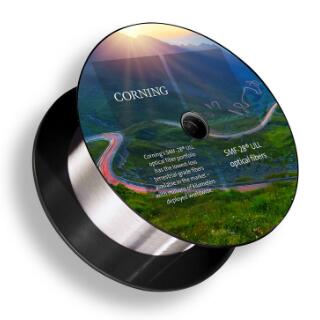
Product Highlights: Designed specifically for ultra-long-haul transmission, it adopts a low-loss core material with attenuation as low as 0.18dB/km at 1550nm wavelength and a low dispersion coefficient, achieving a repeaterless transmission distance of 150-200 kilometers at 100 Gbps. It eliminates the need for frequent repeater installation, greatly reducing construction and maintenance costs. It has excellent bending resistance, with a bending radius as low as 7.5mm, enabling flexible laying in complex terrain. It supports Wavelength Division Multiplexing (WDM) technology, which can transmit multiple signals on a single fiber, drastically increasing transmission capacity to meet the large-capacity, long-distance transmission needs of backbone networks, making it the core choice for transoceanic communication and national-level backbone networks.
Pitfall Avoidance Guide: Common Mistakes for Beginners (Must Read)
Many technical beginners fall into the misconception of "only focusing on distance, not the scenario" during product selection, resulting in wasted products or unmet needs. We have compiled the 3 most common mistakes to help you avoid pitfalls:
● Mistake 1: Pursuing "the longer the better" — Blindly selecting long-distance single-mode fiber while ignoring cost. For example, using single-mode fiber instead of multi-mode for internal data center cabling will not only double the cost, but also require more expensive laser light sources, which is completely unnecessary.
● Mistake 2: Ignoring the relationship between rate and distance — Assuming single-mode fiber can transmit infinitely, without recognizing that distance drops sharply as rate increases. For example, at 100 Gbps, the repeaterless distance of single-mode fiber is only around 100 kilometers, so repeater placement must be planned in advance.
● Mistake 3: Overlooking construction loss — Only focusing on the inherent transmission distance of the fiber itself, while ignoring additional loss caused by fusion splicing and bending, resulting in actual transmission distance falling short of expectations. It is recommended to hire a professional team for construction, reduce the number of connectors, and avoid excessive fiber bending.
Conclusion: Select on Demand for Efficient Transmission
The core limitations of fiber optic transmission distance are essentially attenuation and dispersion. Fiber type, transmission rate, light source quality, and construction environment jointly determine the final transmission performance. There is no "best" fiber optic cable, only the most suitable one: choose multi-mode for short distances, single-mode for medium and long distances. Combining your rate requirements and application scenarios with compatible Fibermart products allows you to meet your transmission needs while controlling costs.
If you have specific transmission distance and rate requirements for your project and need support with product selection, you can directly consult the Fibermart technical team for one-on-one guidance. Fibermart also provides a full range of fiber optic products, optical transceivers, and repeaters to solve all your fiber optic transmission needs in one stop, with guaranteed quality and maximum cost performance.
Frequently Asked Questions FAQs
My data center cabling is only 200 meters long. Should I choose OM3 or OM4 multimode fiber?
For 10G transmission within 200 meters, OM3 is the preferred choice due to its higher cost-effectiveness. If you plan to upgrade to 25G/40G later, choose OM4 directly. It can be paired with Fibermart OM3/OM4 fiber patch cords to accommodate high-density cabling in the data center.
Singlemode fiber transmission distance is insufficient. Besides adding repeaters, are there other solutions?
Two core solutions: ① Replace with Fibermart G.654E low-loss single-mode fiber to reduce link attenuation; ② Pair with high-power, high-sensitivity optical modules to improve signal transmission and reception capabilities.
I want to achieve 150km transmission at 100Gbps. Which fiber should I choose?
Fibermart G.654E low-loss singlemode fiber is the first choice. At 100G speeds, it can achieve 150-200km of transmission without repeaters, significantly reducing construction costs.
Will fiber optic splicing loss affect transmission distance? How can it be controlled?
Yes, the more splices, the greater the loss, directly shortening the effective transmission distance. Key control measures: reduce the number of splices, ensure standardized and professional splicing, and test for loss after installation; re-splice promptly if unsatisfactory.
What is the maximum transmission distance of OS2 singlemode fiber?
OS2 corresponds to the G.652D standard single-mode fiber. The transmission distance without repeaters depends on the speed: up to 150 km at 1Gbps, 80 km at 10Gbps, and 40 km at 100Gbps. Using Fibermart low-loss OS2 singlemode fiber and high-sensitivity optical modules can further extend the transmission distance.
What is the maximum transmission distance of OM4 singlemode fiber?
First, let's correct a core misconception: OM4 is 10 Gigabit multimode fiber, not single-mode fiber. At 10Gbps speeds, the maximum transmission distance without repeaters is 550 meters; at 40G/100Gbps speeds, the transmission distance is 150 meters. It is suitable for short-distance, high-speed cabling in data centers and campuses, and can be used with Fibermart OM4 multimode fiber patch cords/cables.
How far can OM5 single-mode fiber transmit?
First, let's correct a key misconception: OM5 is broadband multimode fiber, not single-mode fiber. It supports wavelength division multiplexing (WDM) technology, achieving a maximum transmission distance of 300 meters without repeaters at 100Gbps speeds, twice that of OM4 at the same speed. It is suitable for high-density, short-distance, high-speed transmission scenarios in data centers, and Fibermart OM5 multimode fiber series products are recommended.





No comments have been posted yet.