


.webp)


In the rapidly evolving landscape of high-density optical networking, the demand for reliable, high-performance connectivity solutions has never been greater. Two prominent options that often come into consideration are MPO to LC cable and MTP to LC cable. While they may appear similar at first glance, a deeper dive reveals distinct characteristics that make each suitable for specific networking scenarios. This article aims to explore the key differences between these two cables, shedding light on their design, functionality, and practical applications to help industry professionals make informed decisions.
Fundamental Definitions and Design Distinctions of MPO/MTP to LC Cable
MPO to LC Cable: A Versatile High-Density Solution
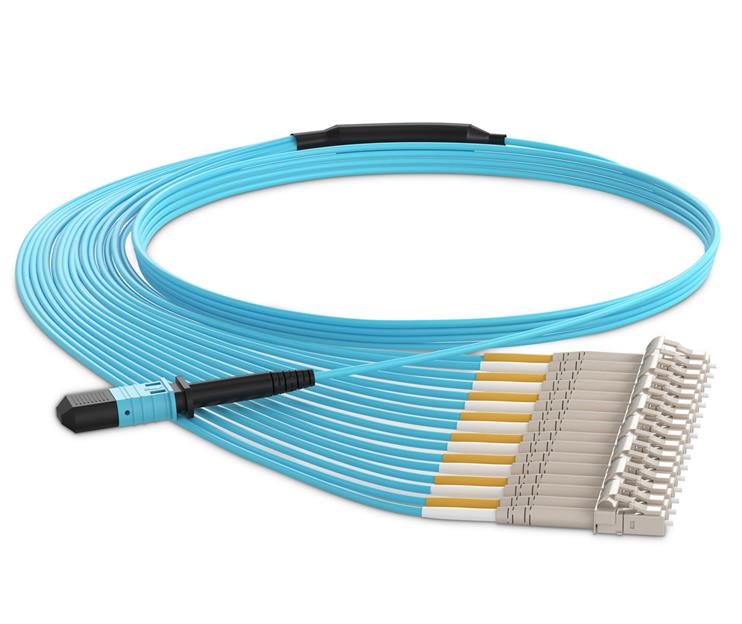
MPO (Multi-Fiber Push-On) to LC cable is a factory-terminated optical cable assembly engineered to bridge high-capacity MPO backbone systems with individual equipment ports. Characterized by a single MPO connector on one end and multiple standard LC connectors on the other, this cable is also known as an MPO breakout cable or fanout cable. The MPO connector, available in configurations ranging from 8 to 144 fibers, aggregates multiple optical channels into a single interface. On the opposite end, the cable breaks out into duplex or simplex LC connectors, which are widely used in data centers, servers, and storage devices due to their compact size and reliable performance.
The core design of MPO to LC cable focuses on versatility and rapid deployment. It eliminates the need for on-site splicing, allowing for quick integration into existing network infrastructures. The cable utilizes high-quality Corning fiber, with options for single-mode (SM) and multimode (OM1, OM2, OM3, OM4, OM5) fiber types to support various bandwidth and distance requirements. Additionally, it features LSZH or PVC jackets, ensuring compliance with safety standards and reliable performance in congested cable management environments.
MTP to LC Cable: Precision-Engineered for High-Performance Networks
MTP (Multi-Fiber Termination Push-on) to LC cable, on the other hand, is built around the MTP connector—a high-precision, high-density connector developed by US Conec. Similar to the MPO to LC cable, it features an MTP connector on one end and LC connectors on the other, but the MTP connector’s advanced design sets it apart. The MTP connector incorporates a floating ferrule design, ensuring precise fiber alignment and reducing insertion loss. It is available in fiber counts ranging from 8 to 576, making it ideal for large-scale data center and enterprise network applications.
The MTP to LC cable is designed for high-performance networking, supporting 10G, 40G, 100G, and even 400G Ethernet applications. It offers configurable polarity options (Type A, B, and C) to ensure correct transmit/receive channel alignment, a critical factor in maintaining network integrity. The cable’s double-jacket structure, available in round or ribbon configurations, provides enhanced mechanical protection and flexibility, while its low insertion loss (≤0.35 dB) and high return loss (≥65 dB) guarantee optimal signal transmission.
Key Performance and Functional Differences
Insertion Loss and Signal Integrity
One of the primary differences between MPO to LC cable and MTP to LC cable lies in their insertion loss performance. The MPO to LC cable typically has an insertion loss of ≤0.35 dB (0.15 dB typical) on the MPO/LC port, ensuring reliable signal transmission for most data center and enterprise applications. However, the MTP to LC cable, with its precision-engineered MTP connector, offers even lower insertion loss, often as low as 0.15 dB typical, making it suitable for high-bandwidth, long-distance applications where signal integrity is paramount.

Fiber Count and Scalability
Both cables support a wide range of fiber counts, but the MTP to LC cable offers greater scalability. With fiber counts up to 576, it can handle the growing bandwidth demands of modern data centers and enterprise networks. The MPO to LC cable, while supporting fiber counts up to 144, is more commonly used in medium-scale applications where lower fiber counts are sufficient. This makes the MTP to LC cable a preferred choice for large-scale data centers, telecommunications central offices, and other high-density networking environments.
Polarity Configuration
Polarity configuration is another critical difference between the two cables. The MPO to LC cable offers customizable polarity (Type A/B/C) to ensure correct channel alignment in structured cabling systems. However, the MTP to LC cable’s polarity options are more advanced, with support for TIA-standard polarity methods. This allows for greater flexibility in network design and ensures compatibility with a wide range of equipment.
Mechanical Durability and Installation
In terms of mechanical durability, the MTP to LC cable has an edge. Its double-jacket structure and reinforced pulling eye option provide enhanced protection against physical damage during installation and maintenance. The MPO to LC cable, while durable, features a single jacket design, making it more suitable for less demanding installation environments. Additionally, the MTP connector’s push-pull latching mechanism simplifies installation and removal, reducing the risk of fiber damage.
Practical Applications and Use Cases
MPO to LC Cable: Ideal for Medium-Scale Data Centers and Enterprise Networks
The MPO to LC cable is well-suited for medium-scale data centers, enterprise networks, and storage area networks (SANs). Its versatility and cost-effectiveness make it a popular choice for connecting 40G/100G QSFP+ switches to 10G/25G SFP+ servers, as well as for interfacing high-capacity MPO backbone trunks to LC-based patch panels. It is also widely used in modular system integration, such as pre-configured cabling harnesses for OEM equipment and blade servers.
MTP to LC Cable: Preferred for Large-Scale Data Centers and High-Performance Networks
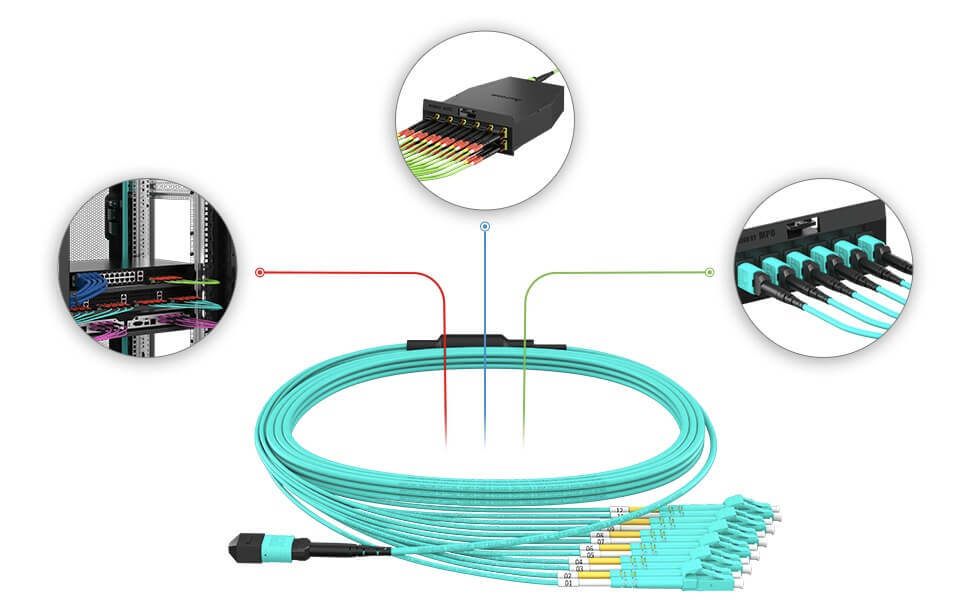
The MTP to LC cable is the preferred choice for large-scale data centers, telecommunications central offices, and high-performance computing environments. Its high fiber count, low insertion loss, and advanced polarity options make it ideal for connecting core switches to distribution frames, as well as for high-speed equipment interconnection (e.g., 400G switches and routers). It is also commonly used in data center upgrades and migrations, allowing organizations to leverage existing cable pathways while increasing bandwidth capacity.
Choosing the Right Cable for Your Network
When selecting between MPO to LC cable and MTP to LC cable, several factors must be considered, including network size, bandwidth requirements, distance, and budget. For medium-scale networks with moderate bandwidth needs, the MPO to LC cable offers a cost-effective, reliable solution. It is easy to install, supports a wide range of fiber types, and is compatible with most standard networking equipment.
For large-scale networks with high bandwidth and long-distance requirements, the MTP to LC cable is the better choice. Its precision design, low insertion loss, and high scalability make it suitable for 400G and beyond Ethernet applications, ensuring that your network can keep up with the growing demands of digital transformation. Additionally, its advanced polarity options and mechanical durability make it a reliable choice for mission-critical environments.

Conclusion
In conclusion, while MPO to LC cable and MTP to LC cable share some similarities, their distinct design, performance, and functional characteristics make them suitable for different networking scenarios. By understanding these differences, industry professionals can make informed decisions that align with their network’s unique requirements, ensuring optimal performance, scalability, and reliability. Whether you choose the versatile MPO to LC cable or the high-performance MTP to LC cable, both offer robust solutions for modern optical networking.





No comments have been posted yet.