


.webp)


Traditional dual-fiber patch cables, such as LC cables, are no longer able to satisfy the demand as data centres manage ever-increasing bandwidths and network connections. MTP/MPO fiber optic cables, which are a viable alternative for 40G/100G/400G high-density cabling in data centres, have entered the market to address this issue. These cables can accommodate more fibers in a single multi-conductor MTP/MPO connector. The various MTP/MPO cable types including MTP 16 Cable and their uses will be covered in this article.
MTP/MPO Cable
The first generation of clamp-on multi-conductor fiber optic connectors is called MPO (Multi-Fiber Push-on). MTP, an improved variant of MPO with superior mechanical and optical qualities, is a registered brand of Conec Ltd. in the United States. They are completely compatible and intermateable, and they have a similar appearance. MTP/MPO trunk cable, MTP/MPO harness cable, and MTP/MPO conversion cable are the three varieties of MTP/MPO cables.
Fiber optics and MTP/MPO connectors make up MTP/MPO fiber optic cable. There are two types of mtp/mpo connectors: male (pinned) and female (pinless). In addition to saving circuit cards and rack space, mtp/mpo connectors significantly boost cable density and are perfect for both present 40g/100g cabling and upcoming network speed improvements.
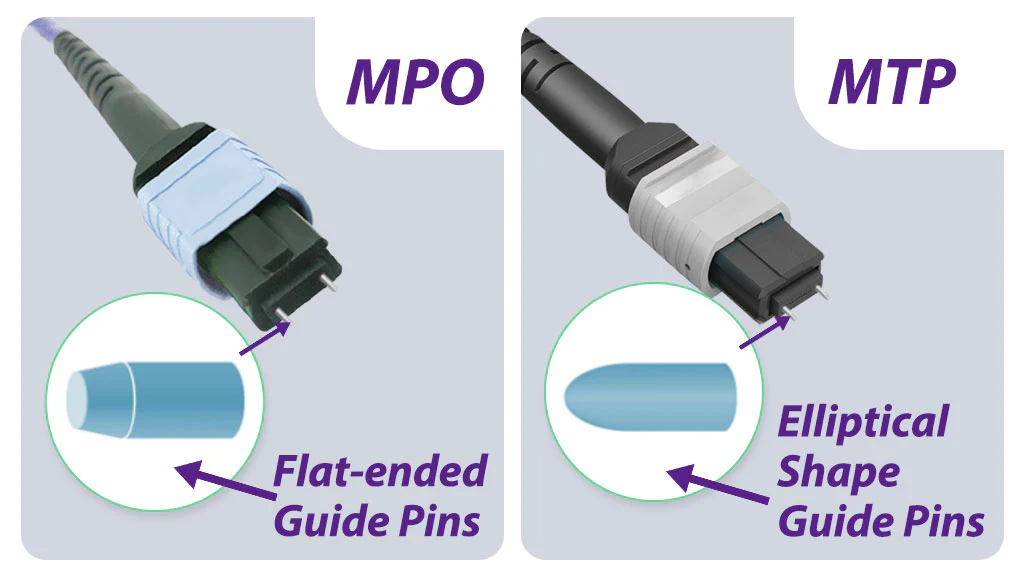
Five Gigabytes of MTP/MPO Cable Types
Five primary characteristics—function, polarity, number of fibers, fiber mode, and jacket grade—determine the varieties of MTP/MPO cables. For various application conditions and needs, a range of MTP/MPO cables are available.
By Purpose
For high-density cabling networks, the three MTP/MPO cable types—trunk cable, MTP/MPO branch cable, and MTP/MPO conversion cable—are perfect because they offer greater network capacity and flexibility.
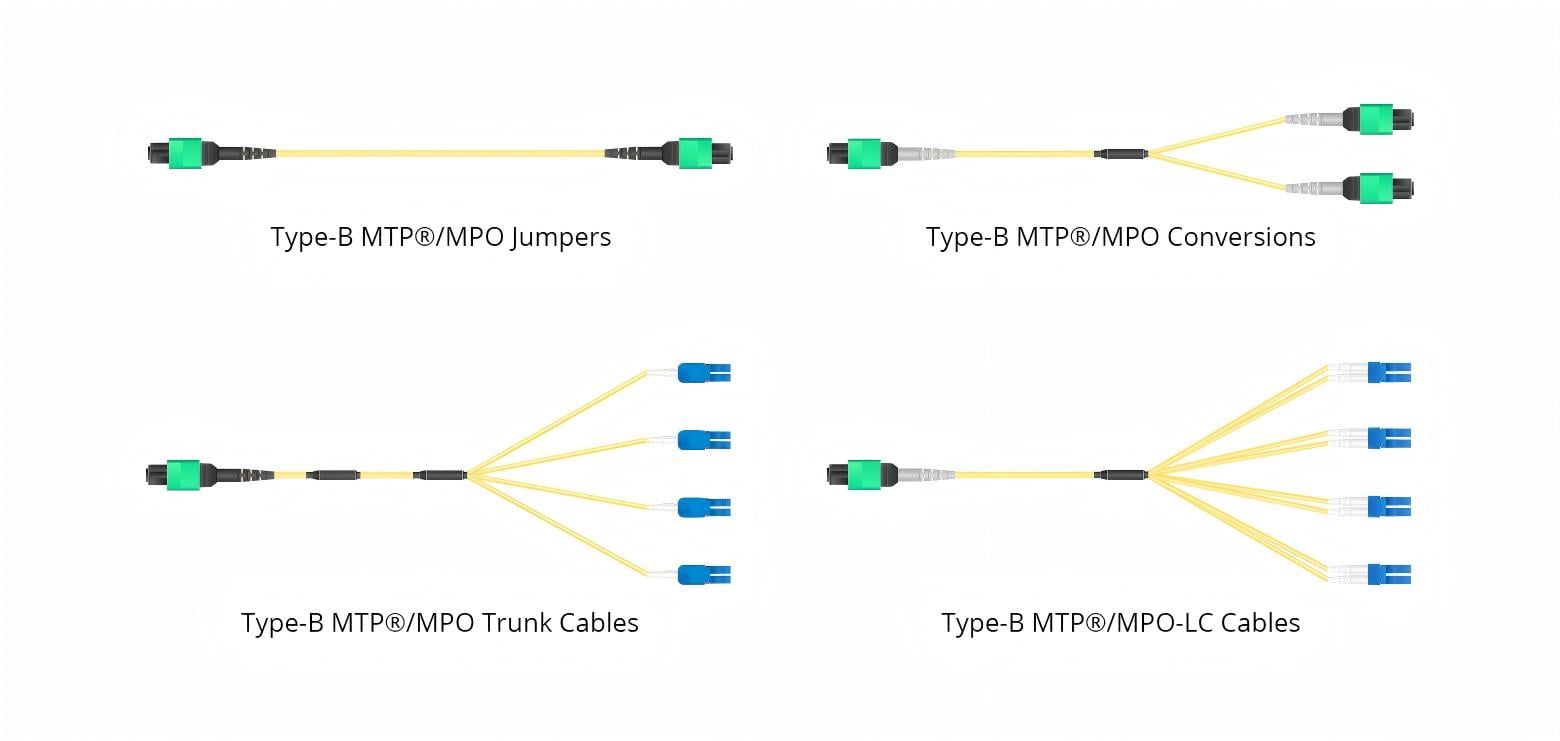
MTP/MPO Trunk Cable
MTP/MPO trunk cables come in 8–144 cores and are terminated at both ends by MTP/MPO connectors (male or female). These multi-fiber MTP/MPO trunk cables are generally perfect for building structured cabling systems, such as backbone and horizontal interconnects like 40G-40G and 100G-100G direct connections.
Branch Cables for MTP/MPO
MTP/MPO branch cables, sometimes referred to as harness cables or fan-out cables, finish with a 4/6/8/12 duplex LC/FC/SC/ST connection on one end and a female/male MTP/MPO connector on the other. Examples of these cables are 8-conductor MTP/MPO to 4 LC harness cables and 12-conductor MTP/MPO to 6 LC harness cables. These branch cables are often best suited for high density backbone cabling, which connects backbone components to rack systems, or for short-distance 10G–40G and 25G–100G direct connections.
Cables for MTP/MPO Conversion
MTP/MPO conversion cables differ in the quantity and kind of fibers they include, but they have the same fan-out architecture as MTP/MPO branch cables. MTP/MPO connections are included on both ends.
In particular, 24-fiber to 2×12-fiber, 24-fiber to 3×8-fiber, and 2×12-fiber to 3×8-fiber are the often utilised MTP/MPO conversion cables. They work particularly well with 10G-40G, 40G-40G, 40G-100G, and 40G-120G connections, which can reduce fiber waste and significantly increase MTP/MPO cabling systems' flexibility.
Through Polarity
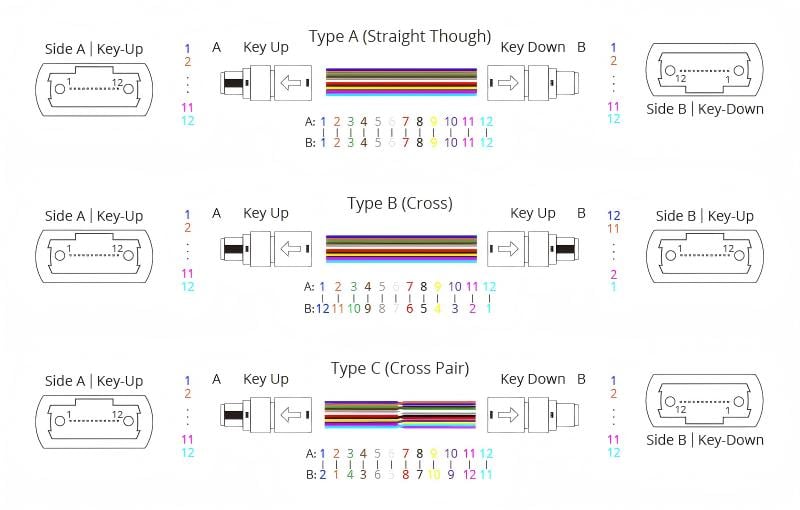
The difference between the optical transmitter and receiver at each end of the fiber link is referred to as the MTP/MPO cable type by polarity. High-density MTP/MPO cabling systems need to manage polarity because of the unique architecture of MTP/MPO connectors.
Three types of connections—Type A, Type B, and Type C—are defined by the TIA 568 standard to guarantee the proper polarity of the optical route. The cable designs of these three MTP/MPO connector types differ.
By number of fibers
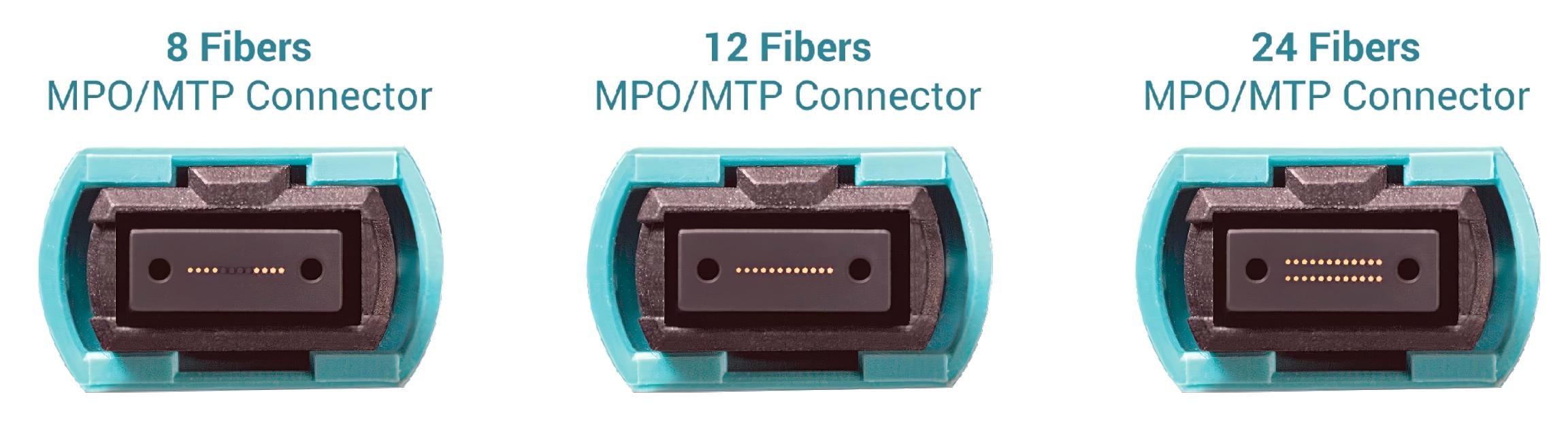
MTP/MPO cables come in three distinct core counts: 8, 12, and 24, which are typically used for 40G and 100G. In hyperscale data centres, the newest 16 core fiber optic cables are intended for short-distance 400G cabling.
The 8-conductor MTP/MPO cable system is more economical than 12-conductor cable because it can transfer data at the same pace while having a lower cost and insertion loss.
The first and most popular solution for 10G-40G and 40G-100G connections was the 12 core MTP/MPO cable. Low fiber utilisation occurs when four fibers are left unused in 40G QSFP+ or 100G QSFP28 transceivers.
100GBASE-SR10 communications between CFP to CFP transceivers are commonly established using 24 core MTP/MPO cables.
16-cell MTP/MPO cables aggregate several 8-cell parallel transceivers and couple directly to newly developed 16-cell parallel fiber links like 400G QSFP-DD and OSFP, using the same external dimensions as conventional 12-cell MT (mechanically transferable) inserts.
Through Fiber Mode
Multimode OM3/OM4 and single-mode OS2 cables are examples of MTP/MPO cable types, according to Fiber Mode. With a maximum transmission distance of 100 or 150 meters at 40 Git/s, multimode OM3/OM4 MTP/MPO cables are appropriate for short-distance transmission. For long-distance transmission, such as in PONs (Passive Optical Networks) and Metropolitan Area Networks (MANs), single-mode OS2 MTP/MPO cables are appropriate. OS2 has a larger bandwidth than OM3/OM4 because it has less modal dispersion.
By Jacket Score
The jackets of MTP/MPO cable types are categorised as LSZH (Low Smoke Zero Halogen), OFNP (Optical Fiber Nonconductive, Plenum), CMP (Communications Multipurpose Cable, Plenum), etc. based on various fire rating standards.
Because LSZH MTP/MPO cables don't include halogenated compounds, which are toxic and corrosive when they burn, they can better protect people and equipment during fires and are appropriate for enclosed spaces.
Installable in ducts, plenums and other areas for building airflow, OFNP MTP/MPO cables have the highest fire rating and no electrically conductive components.
CMP MTP/MPO cables, which are appropriate for plenum spaces where air circulation for heating and air conditioning systems is enabled, can limit flame propagation and smoke exhaust rate during a fire. MTP/MPO fiber optic cables, which are a viable alternative for 40G/100G/400G high-density cabling in data centres, have entered the market to address this issue.
It is simpler to select the network connection option that best meets certain requirements thanks to the characteristics that set different MTP/MPO cable types including MTP 16 Cable apart. Because MTP/MPO cables can accommodate several fibers inside a single interface, which significantly enhances network capacity, saves a significant amount of space, and provides ease of cable management, they are well-received for high-density cabling in data centres. MTP/MPO trunk cable, MTP/MPO harness cable, and MTP/MPO conversion cable are the three varieties of MTP/MPO cables.
Edited by Fibermart (Fiber-Mart.com)





No comments have been posted yet.