


.webp)


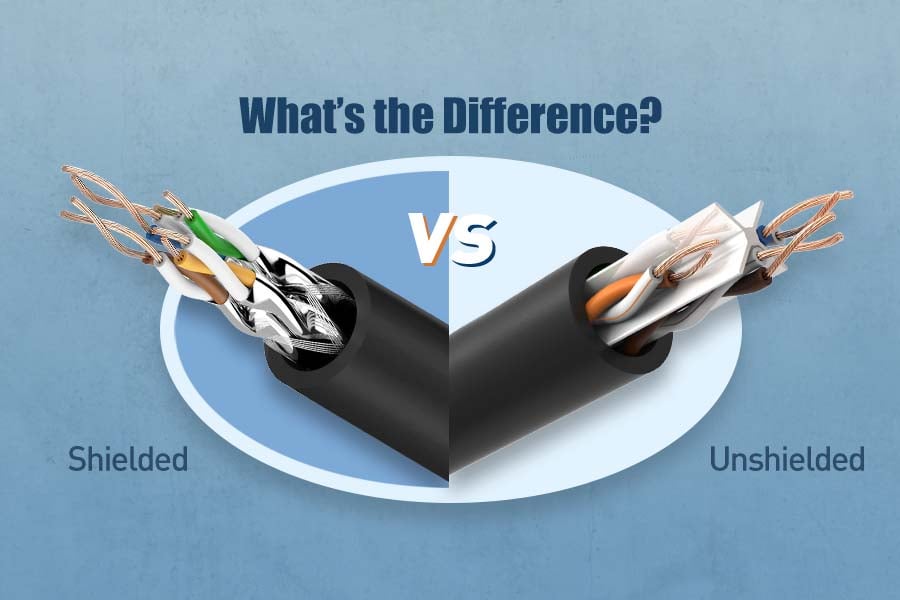
The growing popularity of Cat6a twisted-pair copper cabling is driven by several factors, including support for 10GbE networks, the widespread adoption of Power over Ethernet (PoE) technology, and the use of Wireless Access Points (APs). As user demand for higher bandwidth and better performance continues to increase, Cat6a cable is becoming increasingly popular. How do you choose between Shielded and Unshielded Cat6a cable? What are the differences between them?
Cat6a Cable: The Present and Future of 10G Cabling
Cat6a cable, also known as Category 6a, can support data transmission rates of up to 10Gbps with a maximum bandwidth of 500MHz. Cat6a patch cables utilize more and tighter twists and often include additional insulation to reduce crosstalk. They are backward compatible with Cat6 and Cat5e cables (though the speed will be limited by the lowest category cable or connector installed in the link).
Cat6a cable is gradually becoming a cost-effective solution as it is considered a future-proof cabling solution. If a new cabling system is expected to have a service life of five years or more, a Cat6a solution should be considered. For a service life of ten years or more, Cat6a is undoubtedly the superior choice, highly recommended for new installations in sectors like education and healthcare to support 10G-dependent wireless systems and to provide better performance for PoE.
Shielded vs. Unshielded Cat6a: What's the Difference?
Based on shielding type, Cat6a cables can be broadly divided into two categories: Shielded Twisted Pair (STP) and Unshielded Twisted Pair (UTP). Both Unshielded and Shielded Cat6a cables are designed to provide reliable connections for electronic devices, but they differ in design, construction, and performance.
Cat6a Unshielded Cable
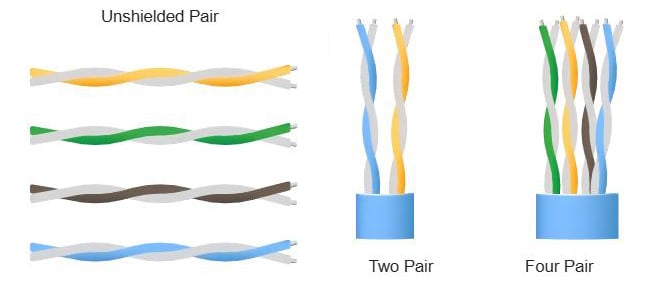
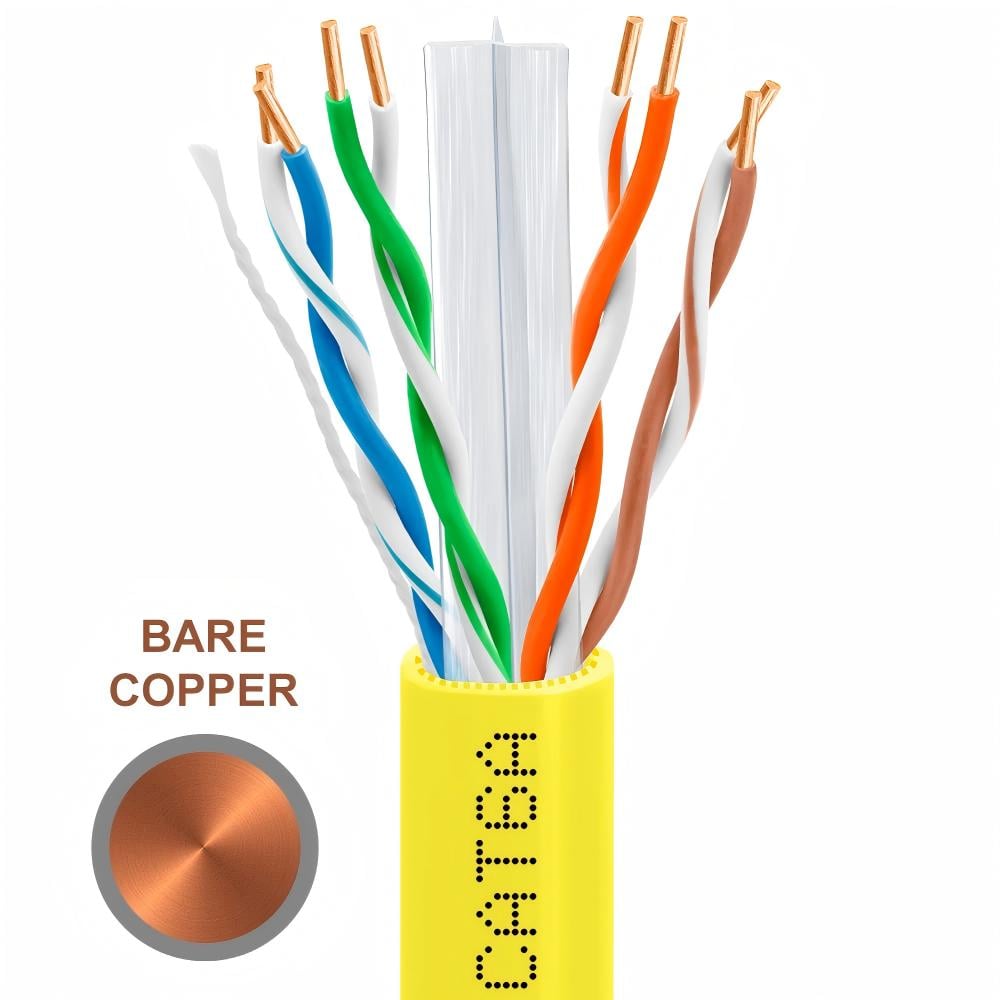
Cat6a Unshielded Twisted Pair cable consists of 4 twisted pairs. Each bare copper conductor is insulated and color-coded. The entire bundle of Cat6a unshielded cable is enclosed in an outer jacket, typically made of PVC, and the pairs are twisted at different rates to minimize internal crosstalk. Because they lack shielding and a drain wire, terminating Cat6a UTP cables is very straightforward, which can reduce termination time and cost.
Cat6a Shielded Cable
Cat6a Shielded Twisted Pair cable incorporates a shield within the cable to prevent Electromagnetic Interference (EMI) or Radio Frequency Interference (RFI) from affecting cable performance. It also prevents the cable's signals from interfering with nearby cables and equipment. A properly installed Cat6a shielded cable effectively suppresses EMI and crosstalk, helping to ensure data integrity and high-speed performance. Cat6a shielded cable must be grounded to function correctly.
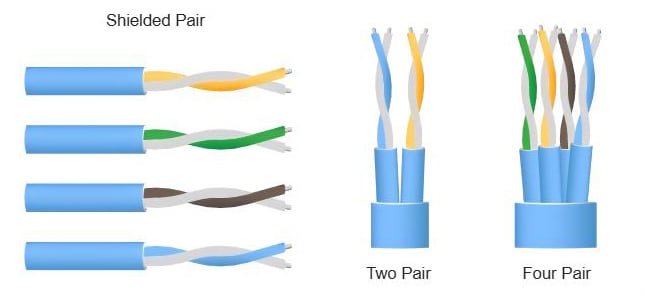
Note: If you choose shielded cabling, you cannot mix and match; all components connected to a shielded cable must also be shielded and grounded (e.g., couplers, outlets, even network cards). Shielded and unshielded cabling cannot be mixed.
For reference, here are some common abbreviations used to describe Cat6a cable shielding:
U = Unshielded
F = Foil Shield
S = Braided Shield
TP = Twisted Pair
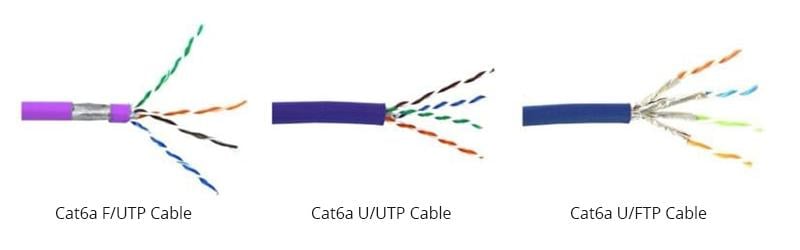
According to the ISO/IEC standard, the first letter indicates the overall shield type, and the second letter indicates the shielding for individual pairs. For example, in F/UTP, "F" represents the overall shield, "U" indicates no shielding for the individual pairs, and "TP" stands for Twisted Pair. Please refer to the table below for more information on Cat6a shielding types:
| Abbreviation | Description | Overall Cable Shield | Pair Shield |
|---|---|---|---|
| UTP or U/UTP | Unshielded Twisted Pair | None | None |
| F/UTP | Overall Foil Shield | Foil | None |
| U/FTP | Individually Shielded Pairs | None | Foil |
| S/FTP | Individually Shielded Pairs + Overall Braided Shield | Braided Screen | Foil |
| SF/UTP | Overall Foil & Braid Shield | Foil + Braided Screen | None |
| F/FTP | Overall Foil Shield + Individually Shielded Pairs | Foil | Foil |
Shielded vs. Unshielded Cat6a Cable: How to Choose?
When selecting Ethernet cable for a home or business network, evaluate the environment and cost to choose the appropriate shielded or unshielded cable that meets your network needs.
In a home or small business, unshielded Cat6a cable will typically work fine unless your home or office is near power lines or contains a high concentration of electrical devices. Generally, interference in home or small business environments is not significant enough to require shielded Ethernet cable. However, in more complex environments like large enterprises—for instance, those with heavy machinery, elevators, fluorescent lighting, and other equipment that can generate stronger Electromagnetic Interference (EMI)—using shielded Cat6a cable is recommended to avoid reduced transmission speeds and data quality. Generators, air conditioning units, and printers can also generate EMI. Therefore, shielded twisted pair cable suitable for these complex environments is often considered ideal for industrial settings and medical facilities.
Cost cannot be ignored when weighing shielded vs. unshielded Cat6a cable. Shielded Cat6a cable is more expensive than unshielded cable and is more complex to install; it is also stiffer and less flexible. On the other hand, unshielded Cat6a cable is less expensive, more flexible, easier to install, and does not require grounding. Cost isn't just about the price of the cable itself—it can also be reflected in the value of network speed and security, which can make shielded cable seem more cost-effective.
Do I need STP Cat6a cable? The use of shielded cable is recommended if one or more of the following common scenarios apply:
-
Outdoor installation
-
Proximity to high-voltage lines or electrical panels
-
Within a few feet of generators or electric motors
-
Running alongside or parallel to standard AC wiring, especially inside walls
-
Critical backbone connections, e.g., switch-to-switch, switch-to-server, or when the connection must operate at the highest speed supported by the equipment on both ends.
In summary, the choice between shielded and unshielded Cat6a cable should be based on your specific cabling environment and budget. Installing high-quality Cat6a cable can extend the life of your cabling system and reduce long-term replacement and labor costs.





No comments have been posted yet.