


.webp)


What is UTP Cable?
UTP is defined as Unshielded Twisted Pair cable. UTP cable is characterized as a 100 ohm copper cable that is constructed with 2 to 1800 unshielded twisted pairs, all of which are surrounded by an outer jacket. No metallic shield is employed in these cables. As a result, the cable is made small in diameter, but it is left unprotected against electrical interference. The twisting of the pairs is utilized to improve immunity to electrical noise and EMI.
(Cat 5e and Cat 6 UTP Patch Cables can be obtained from us)
(Cat 5e and Cat 6 UTP Patch Cables can be obtained from us)
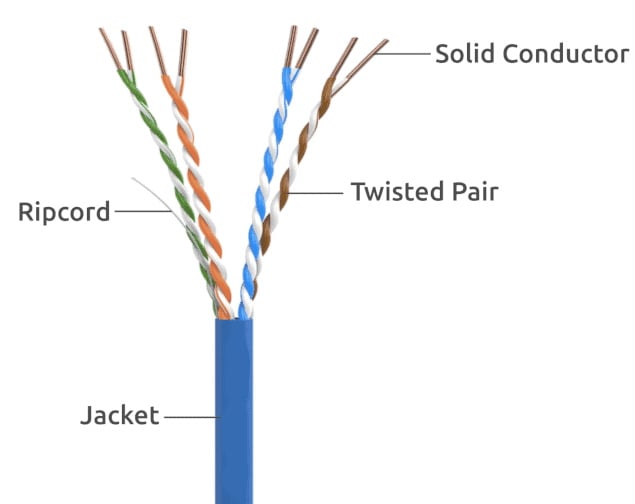
For horizontal cabling, four-pair construction is typically used, as is illustrated below.
Backbone cables are generally constructed with pair counts that are incremented in multiples of 25, since multi-pair UTP cables are built around 25-pair binder groups. A backbone UTP cable is demonstrated in the following illustration.
UTP Copper Cable Conductor Size
The copper conductor used in both horizontal and backbone UTP cables is sized as either 22 AWG or 24 AWG. The 24 AWG size is most commonly encountered; however, for higher-performance requirements, such as those met by Category 6 UTP, the larger 23 AWG copper wire is often employed to ensure enhanced signal integrity and performance.
Solid Conductor UTP Cable and Stranded Conductor UTP Cable
Solid Conductor UTP Cable
As indicated by its name, the solid conductor UTP cable is constructed with a single, solid copper wire for each conductor. This design is valued not only for the physical strength and ease of handling it provides but also for its superior electrical characteristics, which are maintained stably across a wider range of frequencies. Solid conductors are characterized by lower DC resistance and reduced susceptibility to high-frequency effects, attributes that are afforded by their larger diameters. Consequently, solid conductor cables are enabled to support longer transmission distances and higher data rates when compared to their stranded counterparts. It is for these reasons that solid conductor cables are specified for permanent installations in both horizontal and backbone cabling subsystems.
Stranded Conductor UTP Cable
In contrast, stranded-conductor UTP cables are predominantly utilized as patch cables within work areas or telecommunication rooms. These are the cables that are most frequently handled directly by personnel. In a stranded cable, each conductor is composed not of a single wire, but of a bundle of smaller-gauge wire strands. These strands are arranged helically around a central wire through a manufacturing process known as stranding. The resulting conductor possesses an overall diameter comparable to that of a solid conductor but with a smaller total conducting area, a consequence of the gaps between the strands. The primary advantage conferred by this stranding process is exceptional flexibility, making these cables ideal for applications requiring frequent movement and bending; however, this flexibility is accompanied by a trade-off of marginally higher signal attenuation over extended lengths.
UTP Cable Applications
UTP cables are extensively deployed in LAN networks. They are commonly used for a diverse array of systems, including voice communications, low-speed and high-speed data transmission, audio and paging systems, as well as building automation and control systems. UTP cable can be effectively implemented in both the horizontal and backbone cabling subsystems, providing a versatile and cost-effective connectivity solution.
UTP Cable Categories and Performance Specifications
UTP cables were originally developed for analog voice applications, which are inherently robust and less susceptible to corruption by electrical noise. However, as the demand for digital data transmission grew, UTP cables were required to be engineered to higher performance standards. This evolution led to the creation of distinct categories, or grades, of UTP cables over the years. Lower categories are referred to as voice grade, while higher categories are designated as data grade. The progression of these standards is detailed in the following table, which outlines the various UTP categories, their associated business applications, and corresponding performance specifications.
Note:
It should be noted that the TIA/EIA-568 standard officially recognized only cables of Category 3 ratings and above. The terms Category 1 and Category 2 are considered misnomers, likely adopted from the "Levels" grading system originally defined by the distributor Anixter International. Category 1 cable was used exclusively for basic voice-grade telephone networks. Anixter Level 2 (often called Cat 2) was an early UTP grade capable of transmitting data at up to 4 Mbit/s, and it was used in networks like ARCnet and 4 Mbit/s token ring, though it is now considered obsolete.
It should be noted that the TIA/EIA-568 standard officially recognized only cables of Category 3 ratings and above. The terms Category 1 and Category 2 are considered misnomers, likely adopted from the "Levels" grading system originally defined by the distributor Anixter International. Category 1 cable was used exclusively for basic voice-grade telephone networks. Anixter Level 2 (often called Cat 2) was an early UTP grade capable of transmitting data at up to 4 Mbit/s, and it was used in networks like ARCnet and 4 Mbit/s token ring, though it is now considered obsolete.
|
Category
|
Grade
|
Business Application
|
Frequency Range
|
|---|---|---|---|
|
Category 1
|
voice grade
|
Used exclusively for voice-grade telephone networks; not suited for data transmissions.
|
750 kHz
|
|
Category 2
|
voice grade
|
Utilized for telephone networks and early IBM dumb-terminal connections to mainframe computers.
|
1 MHz
|
|
Category 3
|
data grade
|
Deployed for 10Mbps Ethernet, 4Mbps Token Ring, 100BaseT4 Fast Ethernet, and 100VG Any LAN networks.
|
16 MHz
|
|
Category 4
|
data grade
|
Employed in 16Mbps Token Ring networks.
|
20 MHz
|
|
Category 5
|
data grade
|
Used for 100BaseTX Fast Ethernet, SONET, and OC-3 ATM networks.
|
100 MHz
|
|
Category 5e
|
data grade
|
Designed to support Gigabit (1000Mbps) Ethernet.
|
100 MHz
|
|
Category 6
|
data grade
|
Also utilized for Gigabit (1000Mbps) Ethernet, with improved performance and headroom.
|
250 MHz
|
|
Category 6A
|
data grade
|
Specified for both Gigabit (1000Mbps) and 10 Gigabit Ethernet applications.
|
500 MHz
|
UTP Cable Color Codes
UTP Horizontal Cable Color Code
Standard horizontal UTP cable is comprised of four pairs. A standardized color code is used to identify each pair and its individual conductors. One conductor in the pair is designated with a solid color, while the other is a white insulator with a stripe of the pair's color. The color code for a standard four-pair cable is defined in the table below.
|
Wire Number
|
Pair Number
|
Color
|
|---|---|---|
|
1
|
1
|
white/blue
|
|
2
|
1
|
blue
|
|
3
|
2
|
white/orange
|
|
4
|
2
|
orange
|
|
5
|
3
|
white/green
|
|
6
|
3
|
green
|
|
7
|
4
|
white/brown
|
|
8
|
4
|
brown
|
UTP Backbone Cable Color Code
UTP backbone cables, which contain a larger number of pairs, are organized around 25-pair binder groups. A systematic two-level color code is applied: one sequence is used to identify the binder groups themselves, and another is used to identify each pair within a group.
(a) 25-pair Binder Group Color Code
A standard 25-pair binder group is subdivided into five major color-coded groups, each containing five pairs:
White – pairs 1 to 5
Red – pairs 6 to 10
Black – pairs 11 to 15
Yellow – pairs 16 to 20
Violet – pairs 21 to 25
Within each of these five major groups, the individual pairs are distinguished by a secondary color code:
Blue – 1st pair
Orange – 2nd pair
Green – 3rd pair
Brown – 4th pair
Slate – 5th pair
The complete color code for a 25-pair binder group, which results from combining the major group color and the pair color, is systematically presented in the following table and is clearly depicted in the accompanying diagram.
|
Wire Number
|
Pair Number
|
Group Color Code
|
Pair Color Code
|
Color
|
|---|---|---|---|---|
|
1
|
1
|
white
|
blue
|
white/blue stripe
|
|
2
|
1
|
|
|
blue/white stripe
|
|
3
|
2
|
|
orange
|
white/orange stripe
|
|
4
|
2
|
|
|
orange/white stripe
|
|
5
|
3
|
|
green
|
white/green stripe
|
|
6
|
3
|
|
|
green/white stripe
|
|
7
|
4
|
|
brown
|
white/brown stripe
|
|
8
|
4
|
|
|
brown/white stripe
|
|
9
|
5
|
|
slate
|
white/slate stripe
|
|
10
|
5
|
|
|
slate/white stripe
|
|
11
|
6
|
red
|
blue
|
red/blue stripe
|
|
12
|
6
|
|
|
blue/red stripe
|
|
13
|
7
|
|
orange
|
red/orange stripe
|
|
14
|
7
|
|
|
orange/red stripe
|
|
15
|
8
|
|
green
|
red/green stripe
|
|
16
|
8
|
|
|
green/red stripe
|
|
17
|
9
|
|
brown
|
red/brown stripe
|
|
18
|
9
|
|
|
brown/red stripe
|
|
19
|
10
|
|
slate
|
red/slate stripe
|
|
20
|
10
|
|
|
slate/red stripe
|
|
21
|
11
|
black
|
blue
|
black/blue stripe
|
|
22
|
11
|
|
|
blue/black stripe
|
|
23
|
12
|
|
orange
|
black/orange stripe
|
|
24
|
12
|
|
|
orange/black stripe
|
|
25
|
13
|
|
green
|
black/green stripe
|
|
26
|
13
|
|
|
green/black stripe
|
|
27
|
14
|
|
brown
|
black/brown stripe
|
|
28
|
14
|
|
|
brown/black stripe
|
|
29
|
15
|
|
slate
|
black/slate stripe
|
|
30
|
15
|
|
|
slate/black stripe
|
|
31
|
16
|
yellow
|
blue
|
yellow/blue stripe
|
|
32
|
16
|
|
|
blue/yellow stripe
|
|
33
|
17
|
|
orange
|
yellow/orange stripe
|
|
34
|
17
|
|
|
orange/yellow stripe
|
|
35
|
18
|
|
green
|
yellow/green stripe
|
|
36
|
18
|
|
|
green/yellow stripe
|
|
37
|
19
|
|
brown
|
yellow/brown stripe
|
|
38
|
19
|
|
|
brown/yellow stripe
|
|
39
|
20
|
|
slate
|
yellow/slate stripe
|
|
40
|
20
|
|
|
slate/yellow stripe
|
|
41
|
21
|
violet
|
blue
|
violet/blue stripe
|
|
42
|
21
|
|
|
blue/violet stripe
|
|
43
|
22
|
|
orange
|
violet/orange stripe
|
|
44
|
22
|
|
|
orange/violet stripe
|
|
45
|
23
|
|
green
|
violet/green stripe
|
|
46
|
23
|
|
|
green/violet stripe
|
|
47
|
24
|
|
brown
|
violet/brown stripe
|
|
48
|
24
|
|
|
brown/violet stripe
|
|
49
|
25
|
|
slate
|
violet/slate stripe
|
|
50
|
25
|
|
|
slate/violet stripe
|
As shown clearly below

(b) More than 25-pair binder groups
For UTP cables that contain more than 25 pairs, additional binder groups are color-coded by repeating the same sequence of major group colors in conjunction with a binder group identifier. The scheme for the first several binder groups is shown below.
|
Pair Count
|
Binder Group Color
|
|---|---|
|
1—25
|
White—blue
|
|
26—50
|
White—orange
|
|
51—75
|
White—green
|
|
76—100
|
White—brown
|
|
101—125
|
White—slate
|
|
126—150
|
Red–blue
|
|
151—175
|
Red—orange
|
|
176—200
|
Red—green
|
|
201—225
|
Red—brown
|
|
226—250
|
Red—Slate
|
|
251—275
|
Black—blue
|
|
276—300
|
Black—orange
|
|
301—325
|
Black—green
|
|
326—350
|
Black—brown
|
|
351—375
|
Black—slate
|
|
376—400
|
Yellow-blue
|
UTP Cable Connectors
RJ45 Jack and Plug
Four-pair UTP horizontal cables are terminated with an 8-position modular connector, commonly known as an RJ45 connector, at the work area outlet. The RJ45 jack is an 8-conductor modular interface that is engineered to match the specific performance requirements (Category 5e, 6, 6A, etc.) of the UTP cable being terminated, thereby ensuring that the channel's performance specifications are maintained.
568A and 568B Wiring Standards
When a jack or a patch panel is wired, one of two standardized wiring schemes is followed: T568A or T568B. These standards define the pin-pair assignments that are used for terminating the wires of UTP cable onto the pins of the 8P8C modular connectors. In UTP cable, each of the four pairs is represented by a specific color: Pair 1 is blue, Pair 2 is orange, Pair 3 is green, and Pair 4 is brown.
The fundamental difference between the two standards is that the positions of the orange and green pairs (pairs 2 and 3) are swapped. Both configurations are wired in a "straight-through" manner, meaning pin 1 is connected to pin 1, pin 2 to pin 2, and so on, across the cable. Either configuration can be used within a network installation; however, it is critically important that the same configuration is used consistently on both ends of a given cable run. Mixing the two standards on a single cable will result in a wiring error.
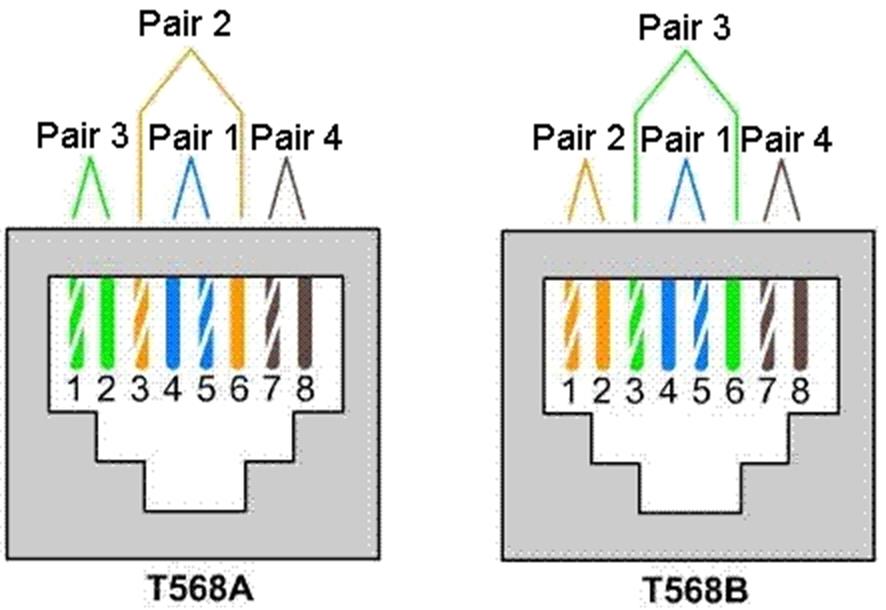
The pinout and color assignments for both T568A and T568B are detailed in the following chart.
|
Pin
|
T568A Pair
|
T568B Pair
|
Wire
|
T568A Color
|
T568B Color
|
Pins on plug face (socket is reversed)
|
|---|---|---|---|---|---|---|
|
1
|
3
|
2
|
tip
|
white/green stripe
|
white/orange stripe
|
|
|
2
|
3
|
2
|
ring
|
green solid
|
orange solid
|
|
|
3
|
2
|
3
|
tip
|
white/orange stripe
|
white/green stripe
|
|
|
4
|
1
|
1
|
ring
|
blue solid
|
blue solid
|
|
|
5
|
1
|
1
|
tip
|
white/blue stripe
|
white/blue stripe
|
|
|
6
|
2
|
3
|
ring
|
orange solid
|
green solid
|
|
|
7
|
4
|
4
|
tip
|
white/brown stripe
|
white/brown stripe
|
|
|
8
|
4
|
4
|
ring
|
brown solid
|
brown solid
|
|





No comments have been posted yet.