 Товар добавлен в корзину...


.webp)


With the increasing adoption of 10 Gigabit Ethernet (10GBASE-T), selecting the right cable type is crucial for ensuring network performance. Faced with the two main choices—Unshielded Twisted Pair (UTP) and Shielded Twisted Pair (STP)—many network engineers and IT decision-makers find themselves uncertain. This article provides an in-depth technical analysis of the strengths and weaknesses of these two cable types in 10GBASE-T environments to help you make an informed decision.
10GBASE-T 10G Ethernet Overview
10GBASE-T is a 10 Gigabit Ethernet standard that uses twisted-pair cabling as the transmission medium, providing 10 Gbit/s bandwidth connections over distances of up to 100 meters.
This technology offers high-speed networking solutions for local uplinks, aggregation links, and inter-switch links, and is widely used in data centers, enterprise server clusters, and high-performance computing environments.
Difference Between UTP and STP Cable
Unshielded Twisted Pair (UTP)
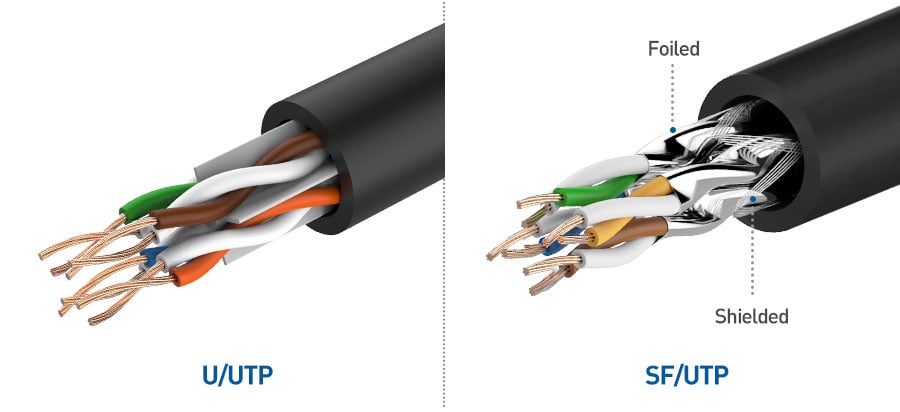
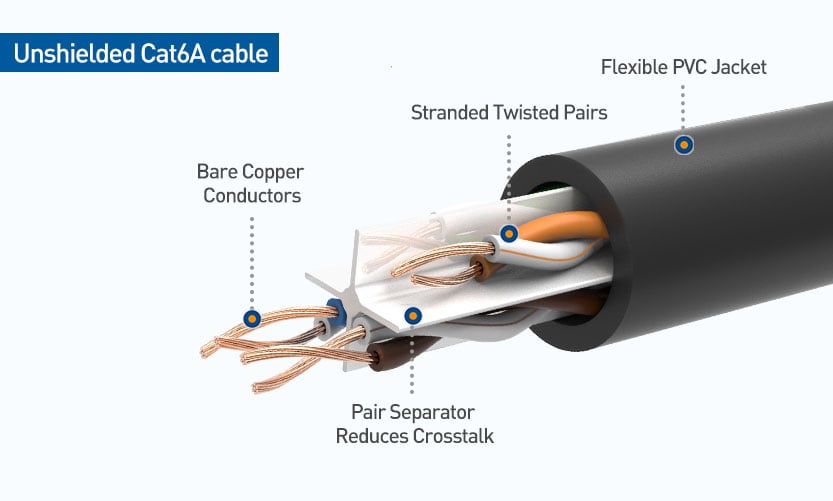
UTP cable consists of color-coded copper wires but contains no foil or braiding as insulation to prevent interference. Inside the cable jacket are four pairs of wires, each twisted at a different number of twists per inch to help cancel out interference from adjacent pairs and other electrical devices.
UTP cables are primarily suited for office and home environments. They are less expensive than STP cables. If interference or crosstalk is not a primary concern, choosing UTP can save on cabling costs.
Shielded Twisted Pair (STP)
STP cable contains an additional foil wrap or copper braid sheath designed to shield the cable's signals from interference. This added shielding in STP cables prevents electromagnetic interference (EMI) from leaking out of or into the cable.
STP cables are typically used in situations where electromagnetic interference (EMI) is caused by nearby equipment, such as in airports, medical centers, and factories where many interference-generating machines are present.

Key Factors for Cable Selection in 10GBASE-T Ethernet
1. Alien Crosstalk (ANEXT)
In 10GBASE-T applications, Alien Crosstalk is the largest noise source limiting the transmission capability of copper cabling systems. This interfering signal cannot be eliminated effectively through encoding/decoding at the signal receiver.
Compared to UTP cabling systems, STP cabling systems can provide superior Alien Near-End Crosstalk performance. For properly installed and bonded STP cables, the foil shield within the cable prevents signals from coupling out, reducing ANEXT below the required performance level.
In UTP copper cabling, Alien Crosstalk increases when adjacent cables are in close proximity. STP systems, however, have better external crosstalk performance and, after a proper installation, eliminate the need for troublesome, time-consuming alien crosstalk field testing.
2. Electromagnetic Interference (EMI) and Radio Frequency Interference (RFI) Suppression
Shielded cabling systems offer excellent EMI and RFI suppression performance. EMI and RFI from common sources like wireless LANs, mobile phones, and TV or radio broadcasts can degrade network transmission performance. A properly grounded STP system has strong immunity to these radiations.
In noisy environments or areas where equipment is particularly sensitive to EMI, STP systems are the best choice.
3. Installation and Termination Complexity
STP cables have a shield around each individual pair, making them more difficult to terminate and leading to more challenging cable management. The foil and drain wire in STP cables must be pulled back and wrapped around the cable end before termination, and any unused foil should be trimmed.
In contrast, UTP cables are designed to be unshielded, saving termination time. On average, terminating an STP jack module takes about 30 seconds longer than terminating a UTP jack module.
4. Grounding Requirements
For STP cabling systems, bonding the cable shield to connecting components is a necessary condition for ensuring proper performance.
Separation of communication cables from power cables also requires special attention. If installed or implemented incorrectly, instantaneous or potential differences in electrical potential can lead to surge or ground loop currents, which may cause bit errors during signal transmission.
For UTP systems, full system grounding is not required; however, the grounding integrity of patch panels and racks to a common ground point should be considered to protect the infrastructure.
5. Cost Considerations
Overall, STP cabling systems are more expensive than UTP systems.
The design of STP cables includes shielding materials, which adds cost. Furthermore, STP cabling solutions take longer to terminate jack modules and connect properly within the structured cabling system, increasing installation costs.
While UTP systems have lower product and installation costs, it's important to note that UTP systems require field testing for alien crosstalk performance, which can take 20 to 40 minutes per link to test, adding to the overall cost.
UTP vs. STP Performance Comparison Summary
| Parameter | UTP | STP |
|---|---|---|
| Alien Crosstalk | Higher Crosstalk | Lower Crosstalk |
| Termination | Easier, Saves Time | More Complex, Takes Longer |
| Connection/Grounding | Not Required | Necessary |
| EMI/RFI Suppression | Fair | Excellent |
| Cost | Less Expensive | More Expensive |
| Maintenance | Requires Less Maintenance | Requires Professional Maintenance |
How to Choose the Right Cable for Your 10GBASE-T Ethernet
When to Choose STP Cable:
-
In high-EMI environments (e.g., factories, medical centers).
-
When you want to avoid time-consuming alien crosstalk testing.
-
In scenarios demanding the highest signal integrity, such as high-performance data centers.
-
When the budget allows and you have a professional installation team.
When to Choose UTP Cable:
-
In relatively clean electromagnetic environments like offices or homes.
-
When working with a limited budget and needing to control project costs.
-
When the installation team is not highly familiar with STP termination and grounding procedures.
-
For small business or standard office network applications.
Fibermart's 10GBASE-T Ethernet Cable Solutions
At Fibermart, we understand that every network environment is unique. Therefore, we offer comprehensive 10GBASE-T cabling solutions, including:
-
High-Performance Cat6A UTP Cable: Suitable for most office and enterprise environments, providing a cost-effective 10GbE solution.
-
Industrial-Grade Cat6A STP Cable: Designed for high-interference environments, offering superior signal integrity.
-
Professional Termination Tools and Accessories: Ensuring installation quality and maximizing network performance.
-
On-site Consultation and Testing Services: Helping you select and validate the appropriate cabling solution.
Our technical team can help you assess your specific environment to make the choice that best fits your needs and budget. Whether you ultimately choose UTP or STP, we provide professionally certified products and technical support to ensure your 10GBASE-T network achieves optimal performance.

Conclusion
There is no one-size-fits-all answer for choosing between UTP and STP cable for a 10GBASE-T network. UTP cables have advantages in cost and ease of installation, while STP cables perform better in interference suppression and signal integrity.
Considering the specific application environment, future needs, and total cost of ownership is essential for making the most suitable choice. When performance is the key factor, installing an STP cabling system is recommended due to its excellent alien crosstalk suppression capabilities in 10GBASE-T applications. If the goal is to support 10 Gigabit Ethernet at the lowest possible cost, then a UTP system is the best choice.
Visit Fiber-Mart.com to learn more about our 10GBASE-T cabling solutions, or contact our team of technical experts for personalized advice!





No comments have been posted yet.