


.webp)


Fiber polarity refers to the correct alignment of the optical signal path in a fiber-optic link so that the transmit (Tx) signal from one device connects to the receive (Rx) port of another device, and vice versa. In other words, it ensures that light signals travel in the correct direction from one end of the fiber link to the other. Without this alignment, even the most expensive transceivers and switches will remain stubbornly dark, because photons cannot “turn around” on their own.
The Basics of Fiber Optic Polarity
Fiber polarity is the foundational principle that governs the precise and intentional alignment of optical signal paths from transmitter to receiver across a fiber optic link. At its core, it is the systematic management of signal direction to ensure that light emitted from a Tx (Transmit) port on one end of a communication channel is accurately delivered to an Rx (Receive) port on the opposing end. This creates a functional, bidirectional communication circuit. The integrity of this Tx-to-Rx pathway is paramount and must be maintained through every physical component in the channel, including patch cords, trunk cables, patch panels, and connectors. A failure in polarity—where a Tx port is connected to another Tx port—results in a complete and non-negotiable link failure, as no data can be exchanged between the two devices. This is analogous to two people trying to hold a conversation by both speaking into the mouthpiece of their phones; without one listening to the other's speaker, communication is impossible.
The Importance of Fiber Polarity Management
The absolute requirement for polarity management stems from the fundamental physics of optical fiber communication. Unlike electrical signals in copper cables, which can be modulated to carry bidirectional traffic on a single wire, light signals in a fiber strand travel in one direction only. Therefore, a full-duplex communication link, which allows for simultaneous transmission and reception, necessitates two separate and distinct physical paths: one fiber dedicated to sending data and another dedicated to receiving it. Active network equipment, such as switches, routers, and media converters, are designed with this architecture in mind, featuring physically separate Tx and Rx ports. The entire physical layer infrastructure must be deployed to honor this design. The challenge arises because a simple fiber strand is symmetric; without a standardized method for connectorizing and connecting fibers, it is exceptionally easy to accidentally reverse the signal path during installation or maintenance. This risk is magnified in modern high-speed applications using parallel optics (e.g., 40G, 100G, 400G Ethernet), where a single multi-fiber connector simultaneously manages multiple Tx and Rx channels, making manual correction impractical.

Standard MPO Polarity Methods (TIA-568)
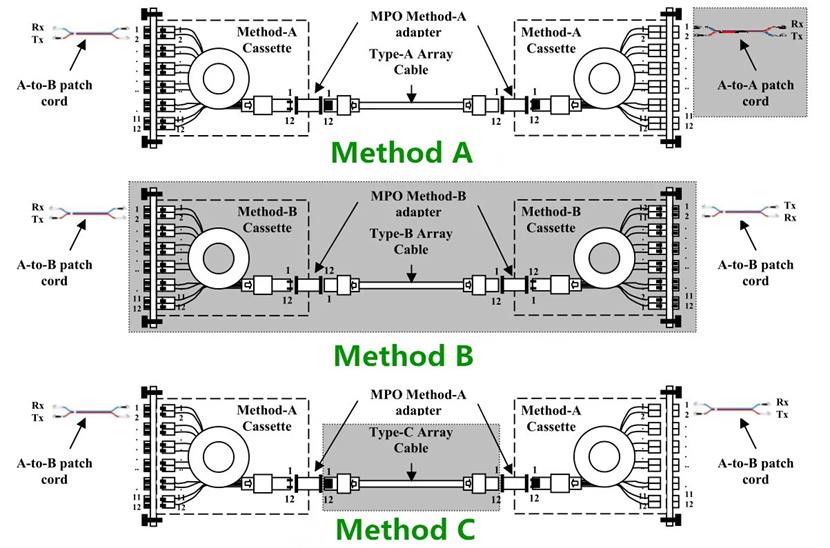
To eliminate ambiguity and ensure interoperability, the Telecommunications Industry Association (TIA) standards (ANSI/TIA-568) define three distinct methods for managing polarity. These methods provide a structured framework for manufacturing cables and organizing patch panels to guarantee an end-to-end connection without requiring installers to guess or manually cross wires.
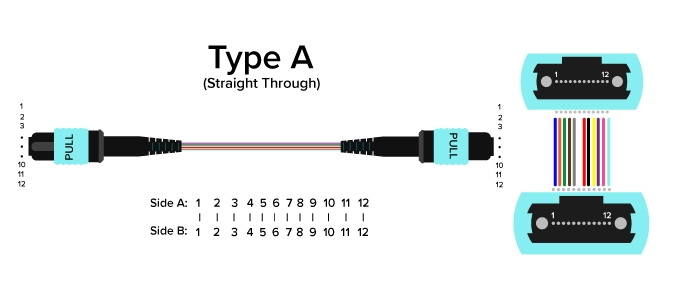
Polarity Type A (Straight-Through Method)
The Type A method is characterized by a "key-up to key-down" orientation in the channel. In this approach, the fiber positions run straight-through from one end of a trunk cable to the other. The polarity reversal is achieved by flipping the entire connector at one end. For example, in an MPO connector, Position 1 (Tx) on the key-up side will connect to Position 1 on the key-down side. However, because the connector is reversed, that physical position now aligns with the Rx port on the equipment. This method often requires the use of different patch cord types at each end (e.g., a key-up to key-up cord on one side and a key-up to key-down cord on the other) and is implemented using Type A MPO adapters and trunk cables.
Polarity Type B (Reversed Method)
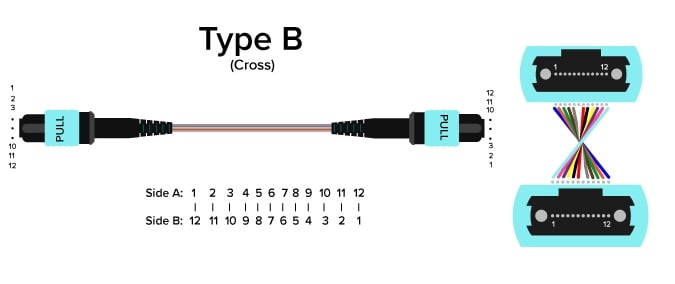
Type B is one of the most intuitive and commonly deployed methods. It achieves the required Tx-to-Rx crossover internally within the trunk cable itself. The connectors on both ends of a Type B cable are oriented identically (key-up to key-up). The internal wiring of the cable is reversed, meaning a signal transmitted into Position 1 (Tx) on one end will emerge from Position 2 (Rx) on the opposite end, and vice versa. This allows for the use of identical, standard patch cords (e.g., key-up to key-up) at both ends of the link, simplifying inventory and reducing the potential for error. Type B is the default method for many pre-terminated MPO trunk cable systems.
Polarity Type C (Pair-Swapped Method)
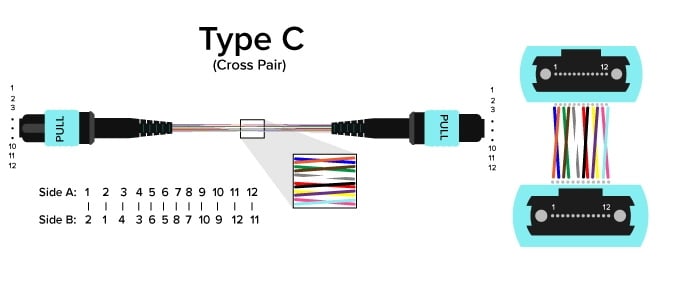
Type C is a more complex variant that performs a crossover within the trunk cable, but it does so by swapping adjacent pairs of fibers. For instance, within a 12-fiber MPO cable, Fiber 1 might be crossed with Fiber 2, Fiber 3 with Fiber 4, and so on. Like Type B, it uses key-up to key-up connectors on the trunk, but the internal mapping is different. This method is less common and is typically specified for specific applications or proprietary high-density systems where a unique fiber mapping is required.
Polarity Applications in Fiber Optic Products
| Polarity Method |
Duplex Patch Cord
(e.g., LC) |
MPO Trunk Cable |
MPO Adapter / Cassette |
Key Application Consideration |
|---|---|---|---|---|
|
Method A (Straight-Through) |
A-to-B (KeyUp-to-KeyUp) crossover cord |
Type A
(KeyUp-to-KeyDown), straight-through fiber positions |
Type A (KeyUp-to-KeyDown) |
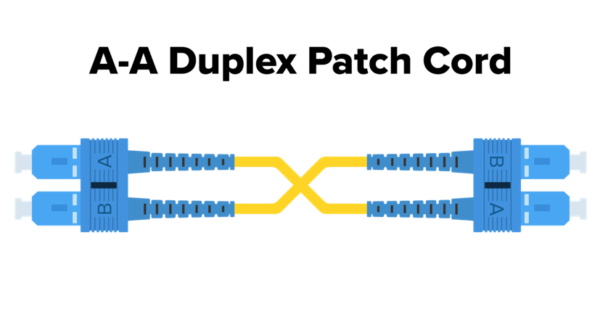
Requires a different patch cord type (A-to-A) at one end of the channel to achieve correct polarity. |
|
Method B (Reversed) |
A-to-B
(KeyUp-to-KeyUp) crossover cord |
Type B
(KeyUp-to-KeyUp), with an internal fiber reversal (e.g., fiber 1 at one end connects to fiber 12 at the other) |
Type B
(KeyUp-to-KeyUp) |
Allows use of the same A-to-B patch cords at both ends, simplifying inventory. Cassettes must be flipped at one end. |
|
Method C (Pair-Swapped) |
A-to-B (KeyUp-to-KeyUp) crossover cord |
Type C (KeyUp-to-KeyDown), with an internal pair flip (e.g., fiber 1 connects to 2, 3 to 4, etc.) |
Type A (KeyUp-to-KeyDown) |
A variant of Method A with the crossover in the trunk cable. It allows for the same patch cords at both ends but is less common. |
Fiber Cables:
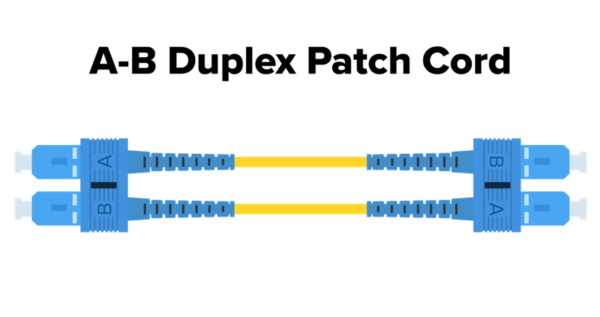
Duplex Patch Cables: These are the simplest application. The two fibers are typically bonded together and color-coded with blue (Tx) and green (Rx) connector boots. A standard duplex patch cable is inherently a Type B component, as it crosses the signal path internally—the transmitter on one end connects to the receiver on the other.
MPO Trunk Cables: These are the backbone of high-density data centers. A 12-fiber or 24-fiber MPO trunk cable is manufactured to a specific polarity type (A, B, or C). The product is clearly labeled, and its internal construction (straight, reversed, or pair-swapped) dictates how it must be integrated into the overall system to maintain correct polarity from the switch to the end device.
Fiber Patch Panels and Cassettes:
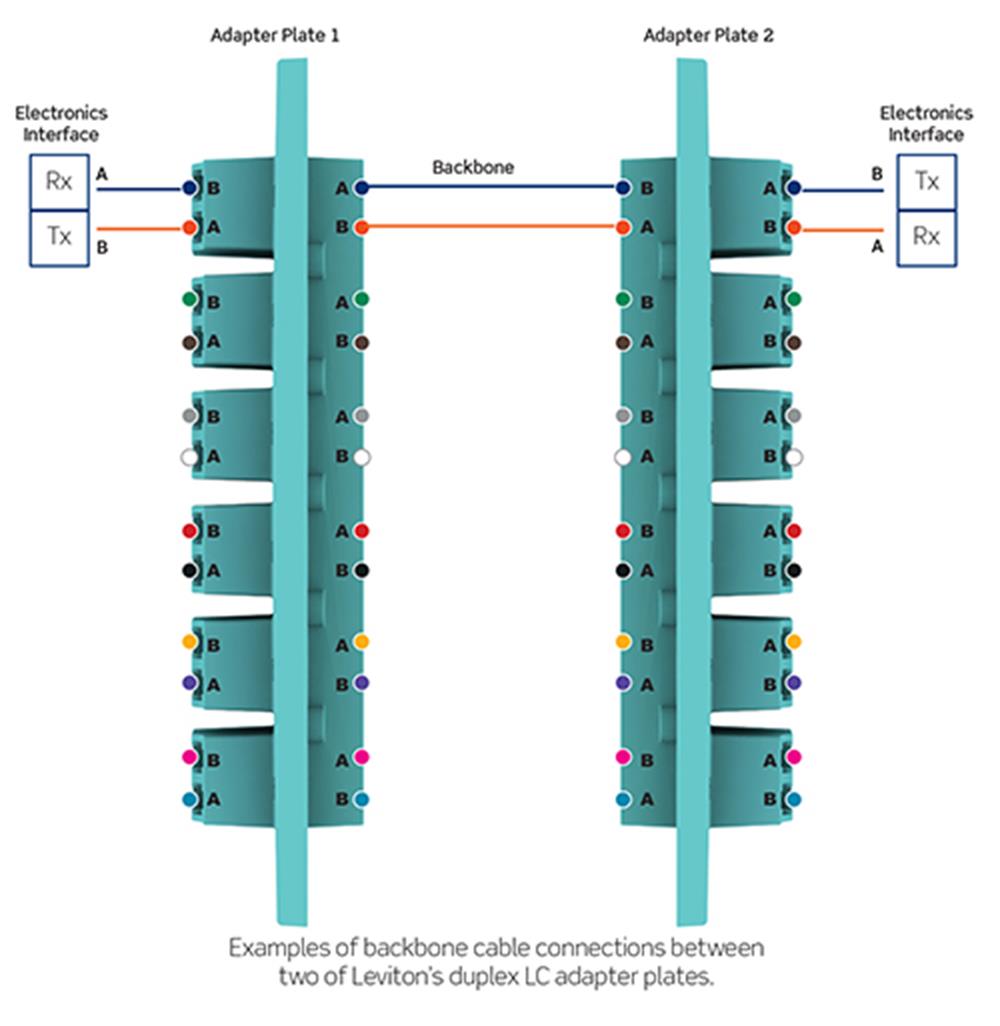
MPO-LC Cassettes (or Hydras): These are critical conversion points. A cassette takes a multi-fiber MPO connector from a trunk cable and breaks it out into individual LC duplex ports. The cassette itself is designed with a specific polarity method in mind. For example, a Type A cassette will have a different internal fiber routing map than a Type B cassette. Using the correct cassette type is essential to ensure the MPO trunk's polarity is correctly translated to the duplex patch cords connecting to the equipment.
MPO Adapters: These are the couplers mounted in patch panels that join two MPO connectors. They are also defined by their key orientation—Type A (KeyUp-KeyDown) or Type B (KeyUp-KeyUp). The adapter type must match the polarity method of the trunk cables and patch cords being used to ensure a continuous and correct signal path.
Active Fiber Optic Equipment:
QSFP/QSFP28 Transceivers (for 40G/100G): Transceivers that use MPO interfaces have a fixed internal fiber map. For example, a 40G-SR4 transceiver uses fibers 1-4 for transmission and fibers 9-12 for reception. The entire external cabling system (patch cords and trunk cables) must be designed with a consistent polarity method (typically Type B) to ensure the Tx fibers from one transceiver correctly arrive at the Rx fibers of the corresponding transceiver.

Fiber Polarity Testing, Troubleshooting, and Best Practices
Testing Methods for Polarity Verification
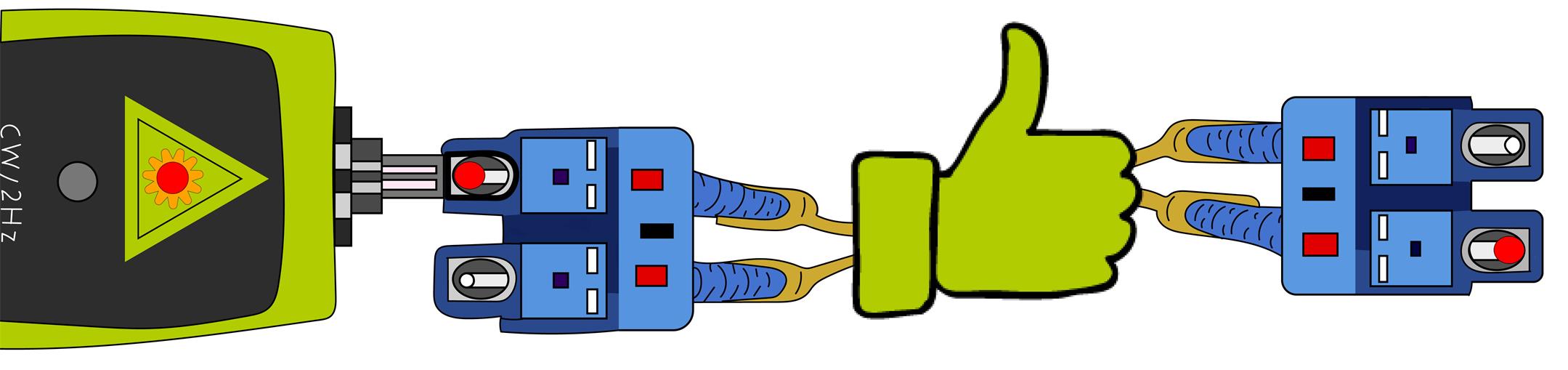
Principle: Injects high-intensity visible red laser light (650nm) into the fiber core.
Polarity Testing Procedure:
a. Connect the VFL to the Tx port at one end of the channel (e.g., an LC duplex port on a patch panel).
b. At the far end, observe which port emits the red light.
c. Correct Polarity: Light emerges from the corresponding Rx port.
d. Polarity Fault: Light emerges from the Tx port (indicating a straight-through error) or no light is visible (indicating a complete misalignment or break).
Advantages: Fast, inexpensive, and ideal for verifying polarity in duplex and simple MPO links. Can also trace macro-bends and breaks.
Limitations: Limited range (typically <5km). Not suitable for measuring loss.
B. Power Meter and Light Source
Principle: Measures the actual optical power loss across a link using standardized wavelengths (e.g., 850nm, 1300nm for multimode; 1310nm, 1550nm for single-mode).
Polarity Testing Procedure (Two-Person Method):
a. At Point A, connect the light source to the Tx port.
b. At Point B, connect the power meter to the corresponding Rx port.
c. Record the power level. A valid reading within the equipment's receiver sensitivity indicates correct polarity and acceptable loss.
d. Polarity Fault: If no reading is obtained, swap the power meter to the other port (the Tx port). A valid reading now confirms a polarity reversal.
Advantages: Provides quantitative loss data, which is required for Tier 1 certification per industry standards.
Limitations: Requires coordination between two technicians or an expensive loopback setup.
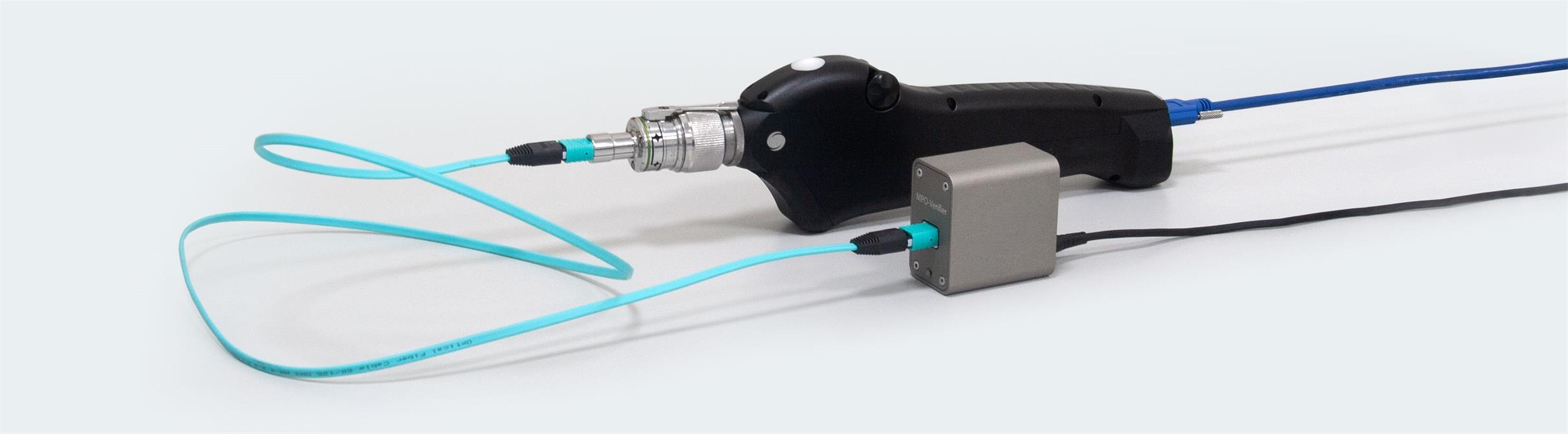
C. Dedicated MPO Polarity Test Kits
Principle: These are specialized sets containing male and female MPO reference cords with known polarity, allowing you to create a known-good reference for testing entire MPO trunks or channels.
Procedure: Involves setting a reference with the test kit and then connecting the device under test. The tester indicates pass/fail for each fiber position within the MPO connector.
Advantages: Essential for efficiently certifying complex parallel optic links (e.g., 40/100/400G) where all 12 or 24 fibers must be correctly mapped.
Troubleshooting of Fiber Polarity Faults
When a link fails, follow this logical escalation path to isolate and resolve the polarity issue.
Step 1: The "Swap" Test (For Duplex Links)
Action: At one end of the link (typically at the switch), simply flip the duplex LC patch cord. This physically swaps the Tx and Rx strands.
Interpretation:
a. If the link comes up: The issue was a simple polarity reversal in the patch cord or one segment of the channel. Document the correction.
b. If the link remains down: The problem is more complex and lies deeper within the permanent link (trunk cable, cassettes) or could be a non-polarity issue (e.g., high loss, dirty connectors).
Step 2: Segment Testing and Isolation
Goal: Isolate the faulty segment (patch cord, trunk cable, or cassette).
Action:
a. Use a VFL or power meter to test each patch cord individually. A standard A-to-B cord should show light going from Tx to Rx.
b. Test the permanent link (trunk cable between patch panels) by connecting the VFL to the MPO interface of a cassette and checking the corresponding LC ports on the other end. This verifies the cassette's internal mapping and the trunk's polarity.
Common Finding: A mislabeled or incorrectly manufactured Type A trunk cable is installed in a Type B system, or vice-versa.
Step 3: Advanced MPO-Specific Troubleshooting
Problem: "I've verified the polarity method, but my 40G link won't come up."
Potential Causes:
a. Incorrect Port Mapping: The cassette or patch panel may not be mapping the MPO fibers to the correct LC positions required by the transceiver's lane assignment. This requires checking the equipment's datasheet and the cassette's wiring diagram.
b. MPO Connector Key Orientation: A trunk cable or patch cord might have been forced into an adapter with the wrong key angle (e.g., key-up vs. key-down), physically flipping the polarity.
c. Fiber Alignment/Pinning Issues: Male MPO connectors have two alignment pins; female connectors have holes. A damaged or missing pin, or debris in the pin hole, can cause fiber misalignment within the connector, effectively creating a polarity error for specific fiber positions.
Fiber Optic Polarity Management Best Practices
Document the Polarity Method: Clearly label every trunk cable, patch panel, and cassette with its polarity type (A, B, or C). As-built drawings should reflect this.
Standardize on One Method: Choose Method B for its simplicity (uniform patch cords) and use it throughout the entire facility.
Inspect Before Connecting: Use a fiber inspection microscope to check for contamination on every MPO and LC connector end-face. A single speck of dust can block a lane, mimicking a polarity fault.
Certify the Installation: Use an Optical Loss Test Set (OLTS) or an MPO certification kit to test and document the loss and polarity of every link upon installation. This creates a baseline for future troubleshooting.
By adhering to these standardized methods and best practices, network professionals can design, install, and maintain robust fiber optic infrastructure that guarantees reliable, high-performance connectivity.
Maintaining correct fiber polarity is essential for signal integrity and network functionality. If polarity is incorrect, data transmission fails, as a transmitter may end up connected to another transmitter instead of a receiver. In live data centers the mistake is usually caught when the link refuses to come up; in passive DWDM muxes such as the Finisar 1G-8CH-OADM it is caught later, when every wavelength appears present yet none decode, because each channel’s circulator is feeding light back into itself.
FAQ
Q: Which Polarity Type Should I Choose?
A: ANSI/TIA 568-D.3 Methods A and B require different components, patch cables or cassettes respectively.
Method C allows for the use of singular patch cords and cassettes but is not flexible for migration or direct transceiver connect applications.
Universal polarity to be used at both ends of a Method B trunk reduces the complexity of a fiber network, ensuring consistent polarity, and streamlining network maintenance.
Q: Can Polarity Type Be Mixed?
A: While unique channel design requirements can be achieved by mixing different polarity types, it requires detailed planning, evaluation and validation. This mixing also requires detailed inventory and ordering control when additions or changes are made. The mixing of polarity types is not recommended without channel requirements and review.
Q: Which Trunk Does I Use With Universal Cassettes?
A: Universal cassettes are designed to work with Method B trunks that utilize 8/12 Fiber MTP® /MPO connectors.
Q: Which Product Type Should I Choose? MTP® Cassette or Harness Cable?
A: It depends on your connection scheme. If there are many links connected, they will cause difficulties in actual cabling and line management if harnesses are used (Figure 1). Using an MTP® cassette (Figure 2) will help the orderly management of cables.
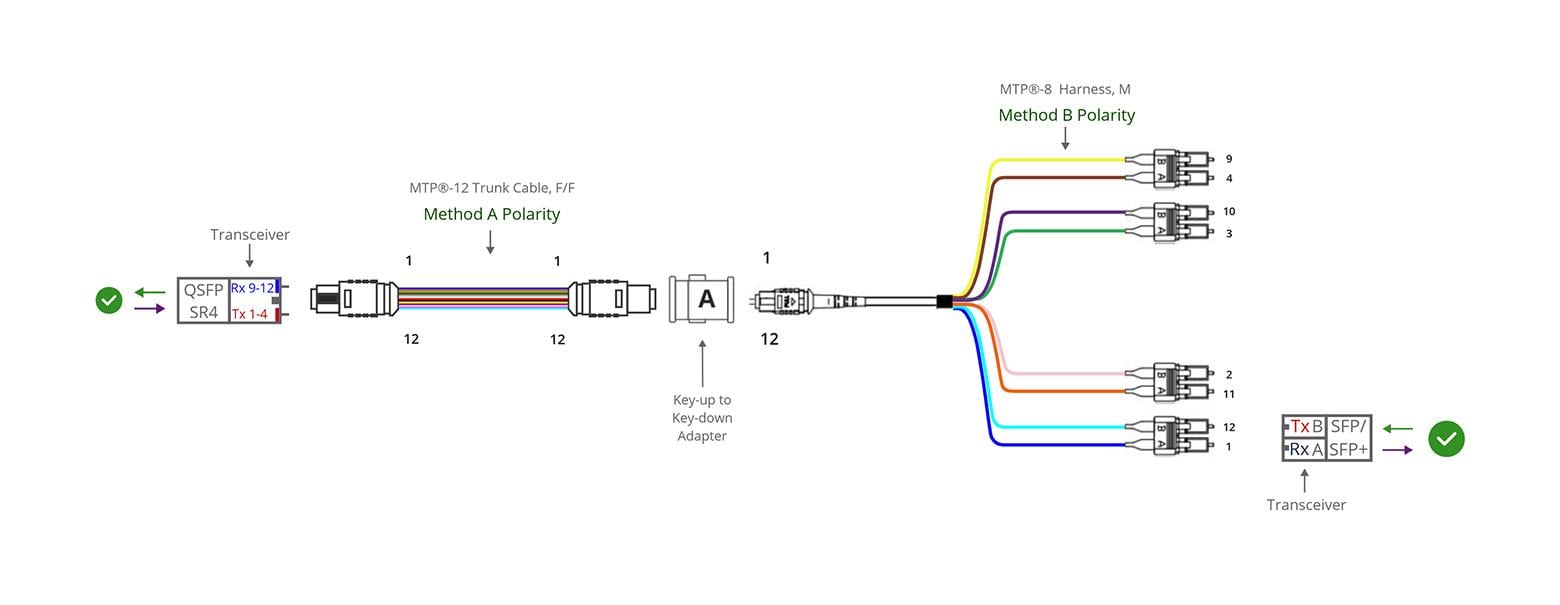
Figure 1
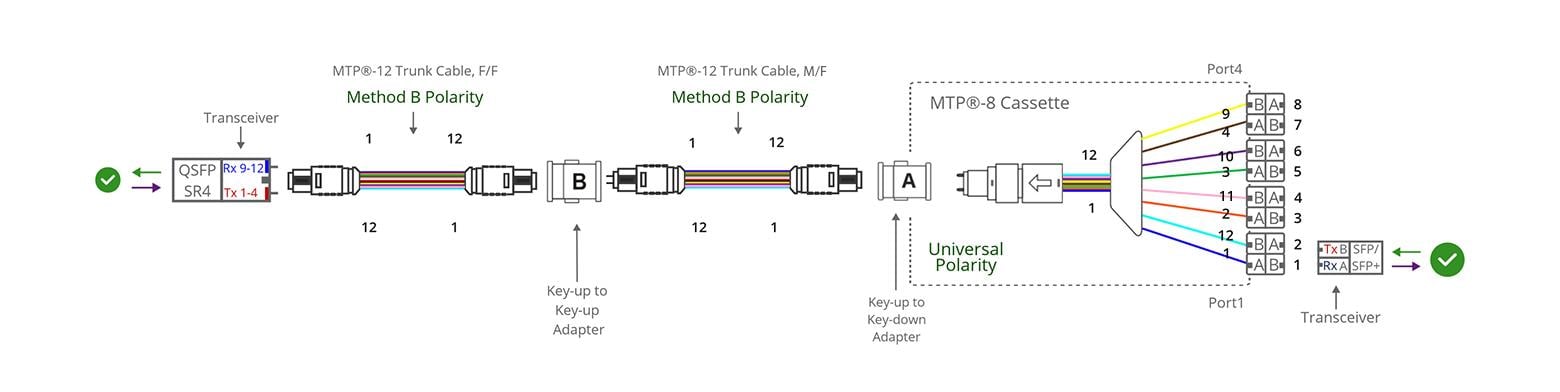
Figure 2


.jpg "DWDM vs CWDM: What is the difference?")





No comments have been posted yet.