


.webp)


MPO (Multi-fiber Push-On) cables are high-density fiber optic cables used for connecting multiple fibers in a single connector, commonly found in data centers and other high-bandwidth applications. MTP® (Multi-fiber Termination Push-on) is a brand name for a type of MPO connector, manufactured by US Conec, that offers enhanced features and performance. While all MTP connectors are MPO connectors, not all MPO connectors are MTPs.

Exponential data growth driven by 5G network densification, hyperscale cloud expansion, and latency-sensitive AI/ML workloads is overwhelming traditional cabling infrastructure's physical capacity. This surge creates an urgent, non-negotiable demand for high-density cabling solutions to overcome critical space constraints within data centers and telecom facilities, enable necessary scaling, maintain signal integrity for high-bandwidth/low-latency applications like AI clusters, and optimize airflow for cooling efficiency. Consequently, deploying ultra-high-density fiber optic systems – leveraging technologies like MPO connectors, high-fiber-count cables, and dense patch panels – has become a fundamental infrastructure necessity globally to support current and future data demands efficiently.
What Is A MPO Cable?
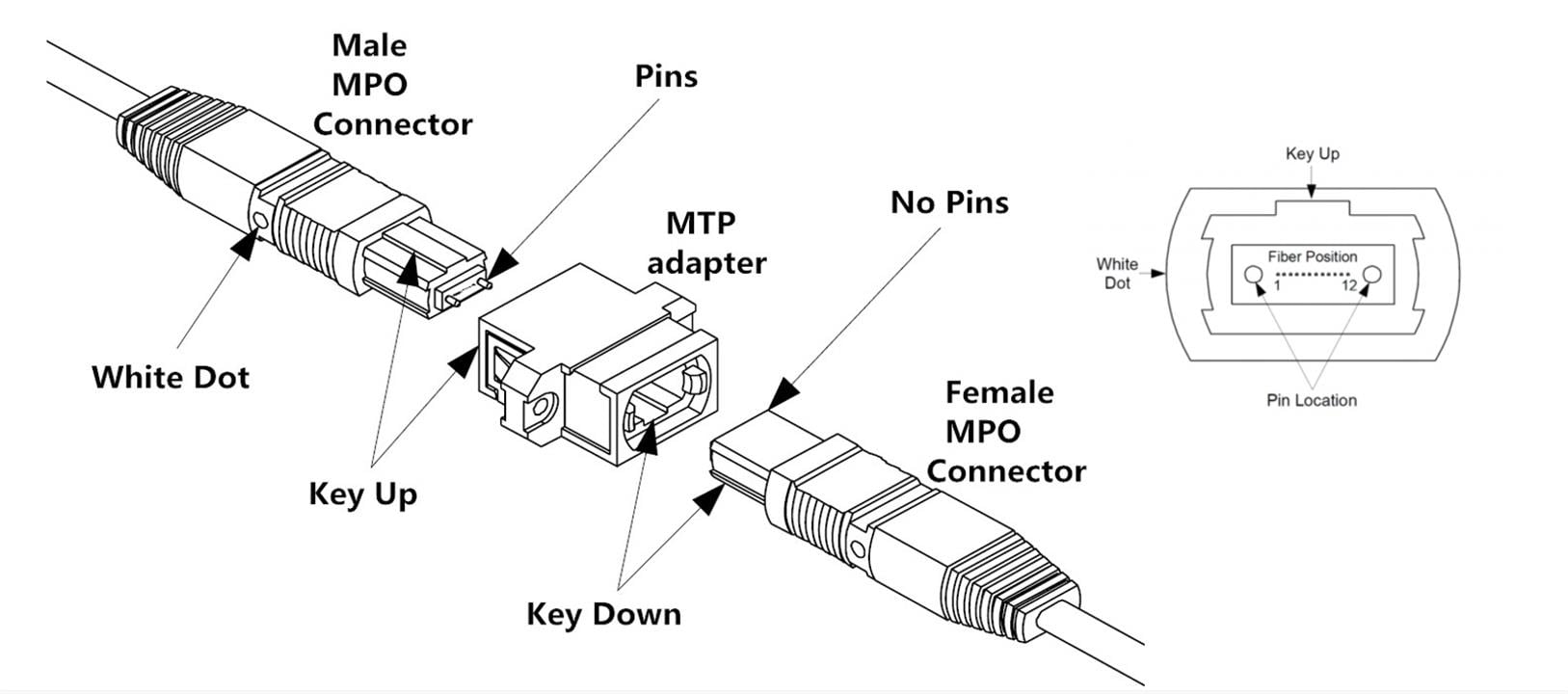
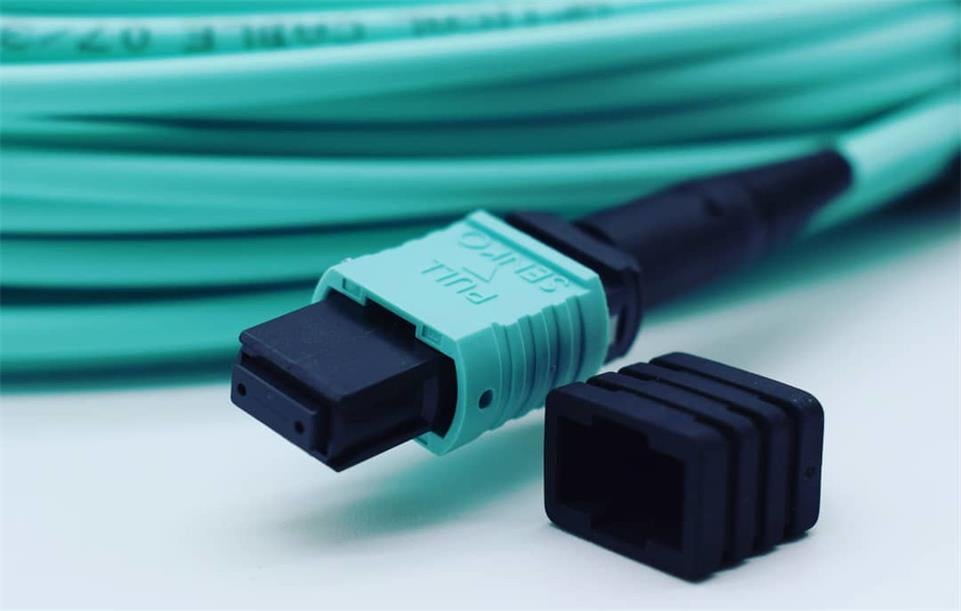
Core Component: The MPO Connector & Ferrule
MT Ferrule: The heart is a precision-molded thermoplastic ferrule (typically PPS or PBT) housing fibers in linear V-grooves with sub-micron accuracy, ensuring core alignment critical for low loss.
Alignment: Two precision guide pins (stainless steel or ceramic) and corresponding holes in mating ferrules provide passive mechanical alignment, achieving the required micron-level tolerances.
Housing & Latch: A robust outer housing protects the ferrule and integrates a push-pull latching mechanism for secure, high-density mating/unmating in confined spaces.
Polishing: Ferrules undergo strict angled physical contact (APC, typically 8°) or ultra-physical contact (UPC) polishing to minimize back reflection (critical for single-mode) and insertion loss; factory polishing ensures consistency.
Cable Construction & Termination
Fiber Types: Utilizes bend-insensitive single-mode (G.657.A1/A2/B3) or high-bandwidth multimode (OM4/OM5) fibers to handle tight bends in dense installations.
Cable Structure: Fibers are bundled within loose buffer tubes (for trunk cables) or directly tight-buffered (for shorter breakout cables), surrounded by aramid yarn strength members and an outer LSZH or riser-rated jacket.
Factory Termination: Fibers are epoxied into the ferrule's V-grooves under microscope alignment, heat-cured, cleaved flush, and polished to exacting flatness/angle specifications in controlled environments; pre-terminated ends ensure performance and speed deployment.
Key Technical Specifications & Performance
Insertion Loss (IL): Typically guaranteed < 0.35 dB (SM) / < 0.25 dB (MM) per mated pair for high-quality connectors.
Return Loss (RL): > 55 dB for UPC, > 65 dB for APC single-mode connectors.
Durability: Rated for ≥ 500 mating cycles without significant performance degradation.
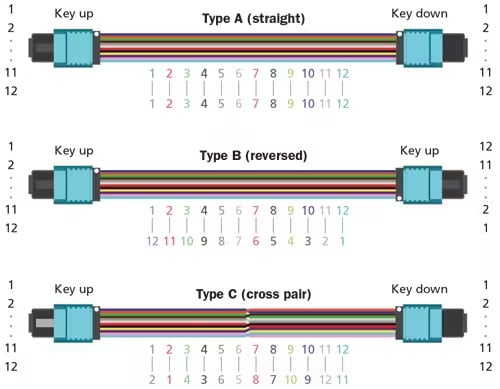
Polarity Management: Defined by Type A (straight), Type B (reversed), or Type C (pair flipped) pin/fiber arrangements to ensure correct transmit/receive paths across links.
Key Standards
Standardized Interconnect (IEC-61754-7 & TIA-604-5/FOCIS 5):
IEC-61754-7: Defines the essential physical interface dimensions, keying, and mating geometry of the MPO connector itself. This ensures mechanical compatibility – plugs from different manufacturers fit into adapters/receptacles universally.
TIA-604-5 (FOCIS 5): Builds upon the physical standard to define performance requirements (loss, reflectance), testing methods, polarity schemes (Methods A, B, C), and guidelines for implementing MPO systems within structured cabling. This guarantees reliable optical performance and consistent, interoperable system design across vendors.
Together: These standards ensure MPO connectors and cabling systems are multi-vendor interoperable, reliable, and predictable, forming the foundation for their widespread deployment.
Evolution
Evolutionary Role (Migrating Duplex LC/SC to 40G/100G+)
Duplex LC/SC Limitation: Traditional duplex connectors (LC/SC) use 2 fibers (1 Tx, 1 Rx) per connection. Scaling to 40G, 100G, 400G, etc., requires significantly more bandwidth than a single fiber pair can provide.
MPO Solution: MPO connectors solve this by integrating multiple fibers (typically 12 or 24) into a single, compact ferrule. This enables:
Parallel Optics: Transmitting multiple data streams simultaneously down separate fibers within the same cable/connector (e.g., 40G-SR4 uses 4 fibers Tx and 4 fibers Rx within a 12-fiber MPO).
Aggregation: Combining multiple lower-speed channels (e.g., 4x 25G lanes for 100G-SR4) within one connector.
High Density: Replacing many individual LC/SC duplex connections with a single MPO connection dramatically increases port density on patch panels and equipment.
Migration Path: MPO is the critical physical layer enabler for high-speed migration:
Backbone/Aggregation: MPO trunks efficiently aggregate traffic from many duplex LC/SC access ports to high-speed core switches.
Direct High-Speed Links: MPO patch cords directly connect 40G/100G+ switch ports to other switches or to MPO-terminated breakout cassettes/splitters.
Structured Cabling: Pre-terminated MPO trunk cables provide scalable, future-proof backbone infrastructure supporting multiple generations of speed upgrades.
MPO cables, governed by IEC-61754-7 and TIA-604-5/FOCIS 5 standards, provide a standardized, high-density, multi-fiber interconnect solution. They are essential for migrating from traditional duplex LC/SC systems to high-speed networks (40G, 100G, and beyond) by enabling parallel optics transmission within a single connector, drastically increasing bandwidth capacity and port density while simplifying cabling infrastructure.
Types of MPO Cables
By Fiber Count & Arrangement
12-Fiber: Industry standard configuration.
Arrangement: 1 row of 12 fibers (positions 1-12).
Key Applications: 40G-SR4 (4x10G Tx + 4x10G Rx), 100G-SR4 (4x25G Tx + 4x25G Rx), 100G-eSR4, 100G-PSM4 (Parallel SM), 100G-CWDM4, 400G-SR4.2/8 (BiDi/SR8), QSFP+/QSFP28/QSFP-DD/OSFP ports.
Standard Pitch: 250µm fiber, 0.25mm pitch (MT ferrule).
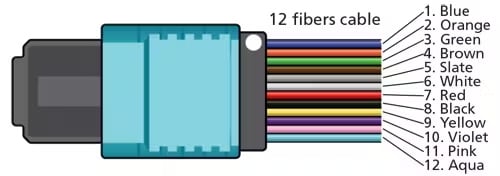
24-Fiber: High-density backbone standard.
Arrangement: 2 rows of 12 fibers (positions A1-A12, B1-B12).
Key Applications: 100G-SR4.2 (BiDi - 4x25G Tx/Rx pairs), 400G-SR8 (8x50G PAM4), 400G-DR4 (SM), 800G-SR8, aggregation for 100G/400G ports, high-density patching.
Standard Pitch: 250µm fiber, 0.25mm pitch (MT ferrule).
48-Fiber / 72-Fiber: Ultra-high density backbone.
Arrangement: 4 rows (48f) or 6 rows (72f) within a single connector footprint (requires miniaturized fibers).
Fiber Type: Typically 200µm bend-insensitive fiber (BIF) to maintain standard MPO housing size.
Pitch: Reduced fiber pitch (e.g., ~0.165mm for 48f/72f).
Key Applications: 800G-SR8/DR8/FR8, 1.6T aggregation, future-proofing spine-leaf/core backbones, maximizing pathway utilization (e.g., limited conduit space).
By Fiber Mode
Single-Mode (OS2):
Core/Cladding: 9µm / 125µm.
Attenuation: ≤ 0.4 dB/km @ 1310nm & 1550nm (typical max).
Bandwidth/Distance: Effectively unlimited bandwidth; distance limited by dispersion & transceiver power budget (e.g., 10km for 100G-LR4/PSM4, 2km for 400G-DR4/FR4, 500m for 400G-DR4+, 10km for 400G-LR4-6).
Applications: Long-reach inter-building/inter-DC links, DWDM/CWDM systems, 100G+/400G+ coherent optics, PSM4 links.
Color Code: Yellow jacket (TIA-598-D), Blue connector body (common).
Multimode (OM3/OM4/OM5):
Core/Cladding: 50µm / 125µm (OM3/OM4/OM5).
Attenuation:
OM3: ≤ 3.5 dB/km @ 850nm
OM4: ≤ 3.5 dB/km @ 850nm
OM5: ≤ 3.5 dB/km @ 850nm & 953nm
Modal Bandwidth (EMB - Effective Modal Bandwidth):
OM3: 2000 MHz·km @ 850nm
OM4: 4700 MHz·km @ 850nm
OM5: 4700 MHz·km @ 850nm + 2470 MHz·km @ 953nm (SWDM optimized)
Distance (Typical Max @ 850nm for SR optics):
OM3: 100m (40G-SR4), 70m (100G-SR4)
OM4: 150m (40G-SR4), 100m (100G-SR4), 100m (400G-SR8)
OM5: 150m (100G-SR4), 150m (400G-SR8), 440m (100G-SWDM4), 550m (400G-SWDM4 - using 4x100G lanes)
Applications: Short-reach intra-DC/server-to-TOR/TOR-to-Leaf links, cost-sensitive 40G/100G/400G deployments.
Color Code: Aqua jacket (OM3/OM4), Lime Green jacket (OM5), Beige connector body (common).
By Polarity Configuration (TIA-568.0-D / TIA-604-5)
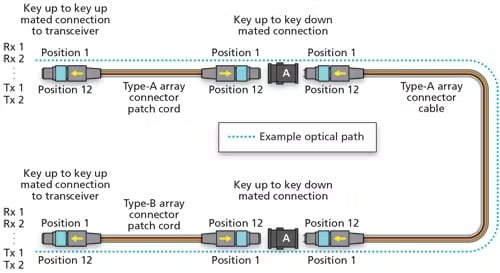
Type A (Key-Up to Key-Down):
Method: Straight-through physical fiber path. Fiber Position 1 (Tx) on one end connects to Position 1 (Rx) on the other end due to a flipped connector key orientation at one end. Requires one connector flipped 180° relative to the other.
Signal Flow: Position 1 (Tx) -> Position 1 (Rx) on opposite end.
Application: Primarily used with Method A polarity systems for parallel optics (e.g., 40G-SR4 direct connections). Requires careful key orientation management.
Type B (Key-Up to Key-Up):
Method: Fiber Position 1 (Tx) on one end connects to Fiber Position 12 (Rx) on the other end (or Position 24 for 24f). A straight, key-aligned connection physically reverses the fiber order.
Signal Flow: Position 1 (Tx) -> Position 12 (Rx) on opposite end (for 12f).
Application: Standard for Method B polarity systems, most common for direct MPO patch cords connecting parallel optic ports (e.g., switch port to another switch port). Simple key alignment.
Type C (Key-Up to Key-Down):
Method: Fiber pairs are flipped within the connector. Position 1 (Tx) connects to Position 2 (Rx), and Position 2 (Tx) connects to Position 1 (Rx) on the opposite end. Requires one connector flipped 180° relative to the other.
Signal Flow: Position 1 (Tx) -> Position 2 (Rx) on opposite end; Position 2 (Tx) -> Position 1 (Rx) on opposite end.
Application: Essential for Method C polarity systems using array-based transceivers with paired Tx/Rx assignments (e.g., BiDi transceivers like 100G-SR4.2, 400G-SR4.2). Ensures Tx talks to Rx on the correct pair within the same connector.
By Connector Style
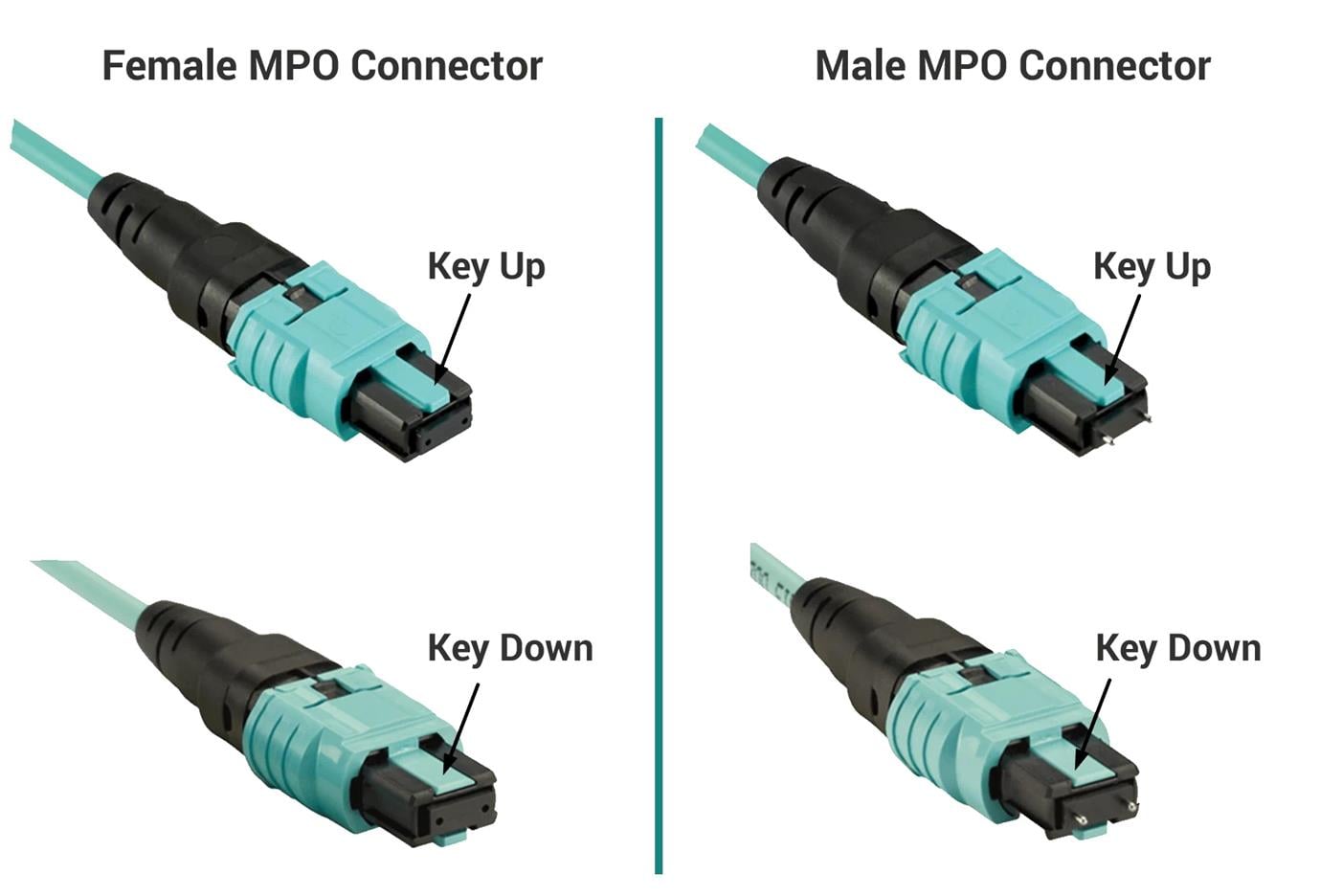
Male (Plug):
Feature: Contains two precision stainless steel alignment pins (Ø0.7mm) protruding from the ferrule.
Function: Pins engage with the holes in a Female connector to provide precise ferrule alignment critical for low IL/RL.
Application: Typically terminates patch cords connecting to equipment ports or cassettes. Always mates with a Female connector. Key orientation defines polarity.
Female (Receptacle):
Feature: Contains two precision alignment holes (Ø0.7mm) in the ferrule to accept the pins from a Male connector. No protruding pins.
Function: Receives the pins from the Male connector for alignment.
Application: Found on fixed equipment ports (switches, routers, servers), cassettes, adapters, and the opposite end of a trunk cable. Always mates with a Male connector. Key orientation defines polarity.
By Cable Construction & Application
Trunk Cables (MPO-MPO):
Structure: Factory-terminated with MPO connectors on both ends. Contains multiple fibers (12, 24, 48, 72) within a single cable jacket. Can be loose tube or tight buffered.
Lengths: Typically 1m to 300m+.
Applications: High-density backbone links between MPO patch panels in IDFs/EDFs, direct connections between high-density MPO equipment ports (e.g., switch-to-switch in same rack/adjacent racks), structured cabling horizontal/vertical runs. Enables quick deployment and reduced on-site labor.
Harness / Fan-Out Cables (Breakout Cables):
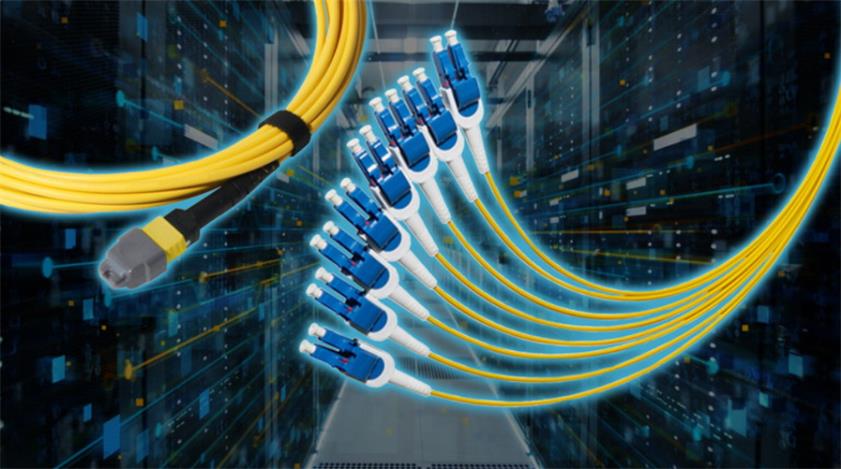
Structure: One end terminated with an MPO connector (Male or Female). The other end terminated with multiple discrete connectors (typically 6x, 8x, or 12x LC Duplex or SC Duplex connectors).
Ratio: Defines connectivity (e.g., 1x12f MPO to 6x LC Duplex, 1x24f MPO to 12x LC Duplex, 1x12f MPO to 12x SC Simplex). Polarity is factory-set.
Applications: Connecting MPO backbone infrastructure (patch panels, trunks) to legacy equipment with SFP+/SFP28/QSFP+ breakout ports requiring LC/SC connections. Provides migration path without re-termination. Commonly used at the TOR switch.
Cassette / Module (MPO-LC Conversion):
Structure: Not a cable itself, but a key component utilizing MPO trunks. Houses an MPO adapter on the rear and multiple LC/SC adapters on the front. Contains a factory-polished, protected MPO-LC/SC fan-out harness internally.
Applications: Mounts in standard patch panels. Provides the conversion point from MPO backbone trunks to LC/SC patching for end-device connectivity. Essential for structured cabling using MPO trunks. Offers modularity and easy reconfiguration.
Pros & Cons of MPO Cables, Advantages and Disadvantages
Advantages (Pros)
High Density & Space Savings:
Pro: A single MPO-12 connector replaces 6× LC duplex connections (12 fibers). MPO-24 replaces 12× LC.
Impact: Reduces rack space by up to 75%, optimizes cable tray/conduit fill, and increases port density on patch panels/switches.
Scalability for High-Speed Networks:
Pro: Native support for parallel optics (e.g., 40G-SR4, 100G-SR4, 400G-DR4/FR4/SR8) via 12/24/48-fiber variants.
Impact: Essential for migrating beyond 25G (40G/100G/400G/800G) without re-cabling backbones.
Pre-Terminated Deployment Efficiency:
Pro: Factory-terminated trunks/harnesses reduce on-site splicing/polishing.
Impact: Cuts installation time by >50%, ensures consistent IL/RL performance (≤0.35 dB typical), and lowers labor costs.
Structured Cabling Flexibility:
Pro: Modular architecture via MPO cassettes (converting MPO to LC/SC) and harness cables.
Impact: Simplifies migration from legacy LC/SC to high-speed MPO cores while preserving existing edge devices.
Bandwidth Efficiency:
Pro: Multimode MPO (OM4/OM5) supports SWDM/CWDM over fewer fibers (e.g., 100G-SWDM4 uses 4 fibers vs. 8 for SR4).
Impact: Extends reach to 440m (OM5) without single-mode costs.
Disadvantages (Cons)
Polarity Management Complexity:
Con: Requires strict adherence to TIA-568.0-D polarity methods (A/B/C). Misconfiguration causes complete link failure.
Impact: Adds planning overhead; incompatible polarity requires re-termination or costly patch cord swaps.
Connector Contamination Sensitivity:
Con: One contaminated MPO ferrule affects up to 72 fibers (vs. 2 for LC).
Impact: Mandates frequent inspection/cleaning with MPO-specific tools (e.g., interferometer probes). Dirty connectors cause BER degradation/outages.
Higher Initial Cost:
Con: MPO connectors cost 3–5× more than LC. Test equipment (inspection scopes, light sources) is also specialized.
Impact: CapEx increases for connectors, patch panels, and testing gear.
Limited Field Repairability:
Con: Field-terminating MPO connectors is impractical due to sub-micron alignment tolerances. Damaged connectors usually require complete cable replacement.
Impact: Higher MTTR (Mean Time to Repair); spares inventory is essential.
Bend Radius Challenges:
Con: Multi-fiber trunks (24f+) have thicker jackets (≥6mm). Tight bends cause micro/macrobends, increasing attenuation.
Impact: Requires careful pathway design (≥10× cable diameter bend radius).
Interoperability Risks:
Con: While IEC-61754-7 standardizes interfaces, performance variances exist between vendors (especially for IL/RL in SM applications).
Impact: Mixing vendors may degrade link budgets, particularly for 400G-DR4/FR4.

Key Application Scenarios
| Application | MPO Type | Fiber Count | Reach | Standard |
| Data Center Backbone | MPO-24 Trunk | 24f OS2/OM5 | ≤550m (OM5 SWDM) | TIA-568.0-D |
| 400G Spine-Leaf | MPO-16 AOC | 16f OM4 | ≤100m | IEEE 802.3cm |
| Hyperscale Core | MPO-72 HD | 72f OS2 | ≤2km (DR4) | OIF 400ZR |
| SAN Storage | MPO-12 Breakout | 12f OS2 | ≤10km | FC-PI-7 |
MPO cables are non-negotiable for >25G networks, providing the physical layer foundation for cloud, AI/ML, and 5G infrastructure. Their role evolves from 40G aggregation to 1.6T+ coherent transport, with density and pre-termination being irreplaceable advantages.
MPO cables critically enable high-density data center backbones and high-speed interconnects by consolidating multiple fibers into a single connector, directly supporting parallel optics for 40G to 800G+ networks. Their pre-terminated trunk cables streamline spine-leaf architectures and switch-to-switch links, while MPO cassettes and breakout harnesses provide seamless migration paths from legacy LC/SC duplex systems. This infrastructure is indispensable for scalable cloud, AI, and 5G deployments where space efficiency and future-ready bandwidth are paramount.
Conclusion
MPO cables from Fibermart address soaring data demands through high-density, multi-fiber connectors (12/24/48/72 fibers) in a single ferrule, governed by standards like IEC-61754-7. They are classified by fiber count (e.g., 12-fiber for 40G), mode (single-mode OS2 for ≤10km distances; multimode OM3/4/5 for cost-effective ≤550m links), polarity (Types A/B/C for signal integrity), connector gender (male/female), and cable type (trunk or harness/fan-out).
While MPO offers unmatched space savings (50%+ vs. duplex), plug-and-play scalability (40G → 800G), and rapid deployment, it demands precise handling due to alignment sensitivity, complex polarity management, higher initial costs, and rigidity. These cables excel in hyperscale data centers (e.g., 400G spine-leaf), 5G fronthaul, enterprise backbones, HPC clusters, and medical imaging—but require fiber/distance matching (e.g., OM5 for 150m 400G), rigorous testing, and pre-terminated solutions to mitigate risks. Future trends like 800G adoption and robotic maintenance further cement their role as strategic, albeit expertise-dependent, infrastructure.
MPO Cable FAQs
Q1: How many types of MPO connector? And what are they?
A: The primary types of MPO connectors are defined by fiber count, including MPO-8, MPO-12, MPO-16, MPO-24, and MPO-32, with MPO-12 and MPO-24 being the most common for high-density data center applications.
Q2: What are MPO male and female connectors and their mode types?
A: A male connector has guide pins and a female one has holes for the pins. MPO connectors also have a key (similar to single fibre connectors) and this only allows connection one way when connected through an MPO adaptor. Most multimode MPO connectors have a UPC end-face ferrule whereas all singlemode MPO connectors have an 8-degree angled APC end-face ferrule.
Q3: What is the MTP connector and who uses MTP?
A: At the time of writing, one brand of MPO connector has become dominant – the MTP® connector. This is manufactured by US Conec and is used across many major multinational structured cabling brands. Used by all the leading high density fibre manufacturers, the MTP® Connector is at the heart of the Complete Connect solution. The MTP connector is used by many other brands including: Corning EDGE and EDGE8, CommScope Instapatch, TYCO Amp Net Connect / ADC Krone, Panduit, Siemon.
Q4: How do we create duplex ports with an MPO-12 connector?.
A: For duplex networks that require LC port presentation the most common method is to combine MPO-LC cassettes with MPO trunk cables. The cassettes are typically housed in 19″ 1U, 2U or 4U housing panels. Backbone/trunk cables will have MPO-12 connectors and multiples of 12 fibre cores (12, 24 all the way up to 144). For example, a 12 fibre cable with have one MPO connector on each end whereas a 48 fibre cable will have 4 connectors on each end. The MPO-LC cassettes breakout the 12 fibres from the MPO-12 connector to six LC duplex.
Q5: What is the most common polarity?
A:Two common polarities are used. Network Method type C and the Universal method. Method C is the international standard and used Polarity C MPO backbone/trunk cables. The Universal method is not a ratified standard but is common as it enables the use of Polarity B backbone/trunk cables which are also used in Base-8 networking.
Q6: What is the most common use of MPO (MTP) Cables?
A: The most common use of MPO cables is for connecting 40G (QSFP+) and 100G (QSFP28) transceivers in data centers, typically using straight MPO-to-MPO multimode cables for direct links between switches. They are also widely used as MPO-to-LC breakout cables to connect a single 40G or 100G port to multiple 10G or 25G ports.
Q7: What MPO cable is used for QSFP+ 40G or QSFP28 100G transceivers?
A:The MPO cable type depends on the transceiver: QSFP+ SR4 (40G Multimode) & QSFP28 SR4 (100G Multimode): Use an 8-fiber MPO cable (OM3 or OM4). QSFP+ PSM4 (40G Singlemode): Use an 8-fiber singlemode MPO cable. For a direct connection between two transceivers, the cable must have female connectors on both ends with Polarity B.
Q8: What are the main benefits of MPO Fiber networks?
A: MPO networks offer significant financial and installation savings through simpler, faster, and less disruptive deployment, while their modular design allows you to add fiber only as needed. They also provide improved scalability for future network upgrades to higher data rates and enable higher port density by housing different connection types in the same space.





No comments have been posted yet.