


.webp)


The rapid evolution of data-intensive applications, such as artificial intelligence (AI), machine learning, and high-performance computing, demands innovative networking solutions that deliver high bandwidth, low latency, and energy efficiency. Optical Circuit Switching (OCS) is the perfect candidate to meet these needs within data centers and AI clusters. To accelerate its adoption and ensure seamless integration into modern network architectures, the OCP Community created of the OCS Subproject within the OCP Networking Project.
The mission of the OCS Subproject is to standardize and advance Optical Circuit Switching as an open, scalable, and efficient solution for next-generation networking. By creating open specifications, integrating OCS with Software-Defined Networking (SDN), and promoting interoperability, we aim to unlock the full potential of OCS for data centers, AI clusters, and beyond—aligned with the OCP vision of openness, scalability, efficiency, and community-driven innovation.
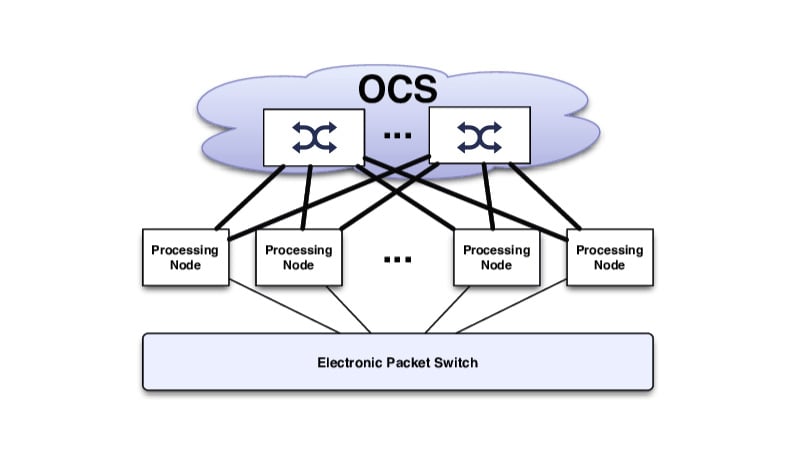
The Industry Demanding Optical Circuit Switching (OCS) Technology
The Open Compute Project Foundation (OCP), the nonprofit organization bringing hyperscale innovations to all, announced the formation of a new Optical Circuit Switching (OCS) Subproject. The OCS Subproject will facilitate collaboration of open OCS technologies to meet the escalating connectivity demands of high bandwidth, low latency, and energy efficiency in data-intensive applications like artificial intelligence. It will be co-led by volunteers from OCP members iPronics and Lumentum, and initial participants will include Coherent, Google, Lumotive, Microsoft, nEye, NVIDIA, Oriole Networks, and POLATIS (HUBER+SUHNER).
“Unlike traditional electrical switching, OCS leverages photonic technology to route data optically, reducing power consumption and enhancing reliability for large-scale AI workloads. As AI clusters scale to meet the computational demands of generative AI and large language models (LLM), OCS provides a scalable and sustainable solution to handle the massive data throughput required, ensuring seamless integration with any networking protocols while also lending itself to the same software-defined networking APIs and management frameworks,” said Peter Roorda, general manager of switching at Lumentum.
“AI data centers and modern infrastructure use a mix of electronic and hybrid optoelectronic interconnects, adapted to different workloads and regions. Adding compact, fast-reconfigurable Optical Circuit Switches to this toolbox boosts resource optimization, increasing performance and reducing costs. The Open Compute Project offers a unique chance to democratize access and drive the development of open, scalable solutions that meet evolving market needs and shape the future of computing,” said Daniel Pérez-López, cofounder and CTO at iPronics.
“Google extensively uses Optical Circuit Switching (OCS) technology in our data centers as part of our Jupiter/AI network architectures, through our Project Apollo initiative, within our TPU systems for superior performance and total cost of ownership. Google is pleased to partner with industry experts in OCP to define software interfaces (building on gNMI, gNOI, gNSI and OpenConfig) that enable OCS technology to further scale across the ecosystem in an interoperable manner,” said Ryohei Urata, Principal Engineer, Google Cloud.
The OCS Subproject will be presented for the first time at the OCP APAC Summit, August 5-6, 2025 in Taipei, Taiwan. This will happen in the Optical Communication Networks breakout track that is co-organized by OCP and IOWN Global Forum.
“IOWN Global Forum members are very excited about the formation of the OCP OCS Subproject. Not only does an optical infrastructure achieve high-bandwidth, low-latency, and energy-efficient data transmission, but it also extends the infrastructure lifetime and contributes to sustainability. Accomplishing this requires a strong ecosystem of product implementers, software developers, and adopters. OCP will be a strong partner for us to develop such an ecosystem,” said Masahisa Kawashima, Technology WG Chair, IOWN Global Forum.
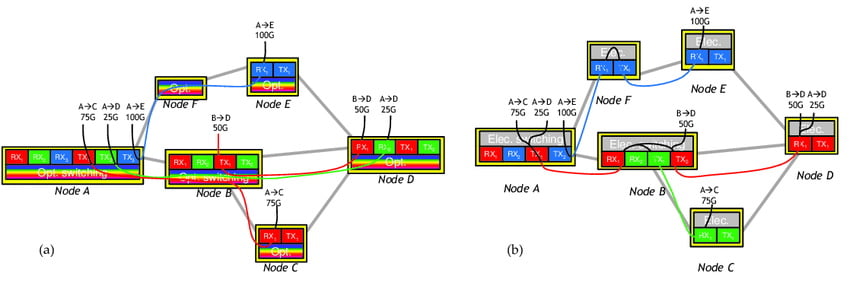
(a) Optical circuit switching (OCS) network. (b) Electronic packet switching (e.g., Ethernet) network
Optical Circuit Switching Technique Application
As Photonics is being seen as an alternative for AI data centres. As a result, there is a tranche of innovation in this space as companies ranging from major vendors to forward-thinking startups are looking to build. Here are a few interesting examples.
At the end of March, iPronics announced the launch of ONE-32, claimed as the first optical circuit switch (OCS) product based on silicon photonics. Optical circuit switching uses optical signals to establish direct communication paths between endpoints, eliminating the need for optical-to-electrical-to-optical conversions and reducing latency and power consumption.
iPronics says the ONE-32 leveraging a CMOS (complementary metal-oxide semiconductor) silicon photonics platform will cut switch power consumption by up to 50%. iPronics chief executive Christian Dupont said the ONE-32 ‘unlock[s] optical networking’s full potential for data centres.’
In the same week, Lumentum announced that its R300 OCS was being sampled by ‘multiple hyperscale customers’. The R300 is based on MEMS (micro-electro-mechanical systems) optical switching technology, with the company saying the product adds to its ‘broad portfolio of innovative photonic solutions that increase AI data centre scalability.’
NVIDIA, meanwhile, says it is ‘breaking new ground’ by integrating silicon photonics directly with its NVIDIA Quantum and Spectrum switch integrated circuits. The company’s silicon photonics switch systems, called co-packaged silicon photonics, offer 3.5x lower power consumption, lower latency and ‘dramatically’ improved network resiliency over more traditional pluggable optical transceivers. “This is the dawn of a new era where efficiency meets performance, accelerating AI breakthroughs and reshaping the data centre landscape for generations to come,” the company wrote a vision that aligns with ongoing industry discussions around silicon manufacturing, including an upcoming talk at Microelectronics UK on 24 - 25 September 2025, where experts will explore these emerging possibilities in depth.
On the same day as iPronics’ release, Lightmatter made two announcements. The company announced the release of Passage M1000 and L200. Designed for next-generation XPUs – a processing unit including various architectures – and switches, the latter looks to deliver the essential elements of co-packaged optics, integrating optics and electronics to reduce power and increase bandwidth in data networks.
“AI data centre interconnects face growing bandwidth and power challenges,” said Andrew Schmitt, founder and directing analyst at Cignal AI. “Co-packaged optics – integrating optics directly onto XPUs and switches – is the inevitable solution.”
At the end of March, iPronics announced the launch of ONE-32, claimed as the first optical circuit switch (OCS) product based on silicon photonics. Optical circuit switching uses optical signals to establish direct communication paths between endpoints, eliminating the need for optical-to-electrical-to-optical conversions and reducing latency and power consumption.
iPronics says the ONE-32 leveraging a CMOS (complementary metal-oxide semiconductor) silicon photonics platform will cut switch power consumption by up to 50%. iPronics chief executive Christian Dupont said the ONE-32 ‘unlock[s] optical networking’s full potential for data centres.’
In the same week, Lumentum announced that its R300 OCS was being sampled by ‘multiple hyperscale customers’. The R300 is based on MEMS (micro-electro-mechanical systems) optical switching technology, with the company saying the product adds to its ‘broad portfolio of innovative photonic solutions that increase AI data centre scalability.’
NVIDIA, meanwhile, says it is ‘breaking new ground’ by integrating silicon photonics directly with its NVIDIA Quantum and Spectrum switch integrated circuits. The company’s silicon photonics switch systems, called co-packaged silicon photonics, offer 3.5x lower power consumption, lower latency and ‘dramatically’ improved network resiliency over more traditional pluggable optical transceivers. “This is the dawn of a new era where efficiency meets performance, accelerating AI breakthroughs and reshaping the data centre landscape for generations to come,” the company wrote a vision that aligns with ongoing industry discussions around silicon manufacturing, including an upcoming talk at Microelectronics UK on 24 - 25 September 2025, where experts will explore these emerging possibilities in depth.
On the same day as iPronics’ release, Lightmatter made two announcements. The company announced the release of Passage M1000 and L200. Designed for next-generation XPUs – a processing unit including various architectures – and switches, the latter looks to deliver the essential elements of co-packaged optics, integrating optics and electronics to reduce power and increase bandwidth in data networks.
“AI data centre interconnects face growing bandwidth and power challenges,” said Andrew Schmitt, founder and directing analyst at Cignal AI. “Co-packaged optics – integrating optics directly onto XPUs and switches – is the inevitable solution.”
Relations of OCS to Conventional Techniques
Core Components of OCS
Optical Switches: Optical switches are the backbone of OCS. They are devices that can route optical signals from one port to another without converting them to electrical signals. There are different types of optical switches, including Micro-Electro-Mechanical Systems (MEMS) switches, liquid crystal switches, and thermo-optic switches. Each type has its own advantages and is chosen based on the specific requirements of the network.
Wavelength Division Multiplexing (WDM): WDM is a technique used to multiplex multiple optical signals onto a single fiber by using different wavelengths of light. This allows for the simultaneous transmission of multiple data streams over a single optical fiber, significantly increasing the network's capacity.
Optical Amplifiers: Optical amplifiers are used to boost the strength of optical signals as they travel through the network. This is crucial for maintaining signal integrity over long distances and ensuring that the data reaches its destination without degradation.
Fibermart focuses on researching, developing, designing, and manufacturing fiber connectivity products and services for private entities, companies, carriers, ISPs, and network providers. We are committed to high-performance and innovation, keeping pace with development to provide the latest technical and hardware support.
Advantages of OCS
Low Latency: By eliminating OEO conversions, OCS reduces the latency associated with data transmission, making it ideal for applications that require real-time data processing.
High Bandwidth: OCS can handle high-bandwidth data streams efficiently, making it suitable for applications such as video streaming, cloud computing, and data center interconnects.
Energy Efficiency: OCS consumes less power compared to electronic switching, as it eliminates the need for power-hungry OEO conversions. This makes it an environmentally friendly option for network operators.
Scalability: OCS networks can be easily scaled to accommodate increasing data traffic by adding more optical switches and fibers. This scalability is essential for meeting the growing demands of modern networks.
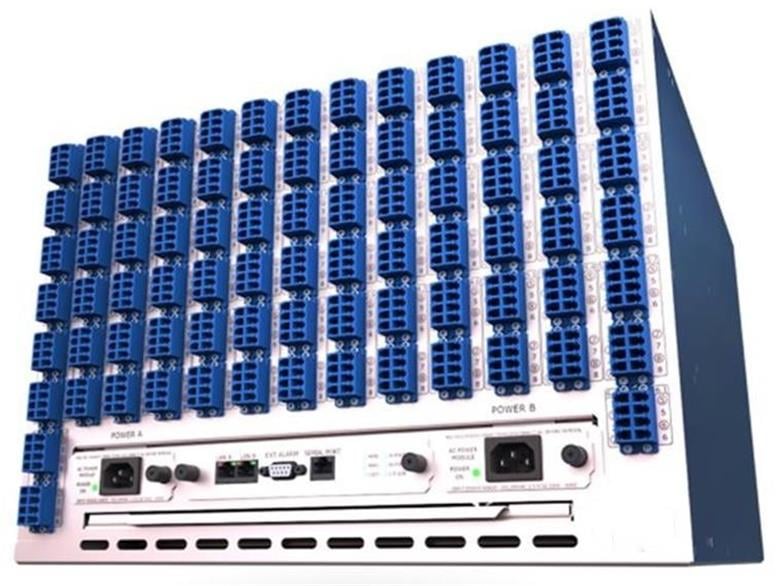
Summary
Optical Circuit Switching (OCS) is a revolutionary technology that enhances the performance and efficiency of optical networks. By enabling dynamic reconfiguration of optical circuits, OCS reduces latency, conserves energy, and supports high-bandwidth data transmission. As the demand for faster and more efficient networks continues to grow, OCS will play a crucial role in shaping the future of telecommunications.
(Sources from Open Computer Project, MICROELECTRONICS UK, organized by Fibermart, Fiber-Mart.com)





No comments have been posted yet.