


.webp)


In the domains of precision optical sensing, coherent optical communication, quantum information processing, and high-power laser transmission, the stability of the polarization state of light is a core indicator affecting system performance. Standard single-mode optical fibers cannot maintain stable polarization transmission under practical conditions due to random weak birefringence caused by manufacturing imperfections, mechanical stress, bending, and temperature fluctuations. Polarization Maintaining Fiber (PMF), as a specialized optical waveguide, is purpose-designed to suppress polarization disturbance and maintain linear polarization states. This paper systematically elaborates on the definition, fundamental working mechanism, structural classification, key performance characteristics, and typical engineering applications of Polarization Maintaining Fiber, aiming to provide a comprehensive and authoritative theoretical reference for researchers, engineers, and application practitioners in related fields.
Introduction to Polarization Maintaining Fiber
Definition and Basic Concept
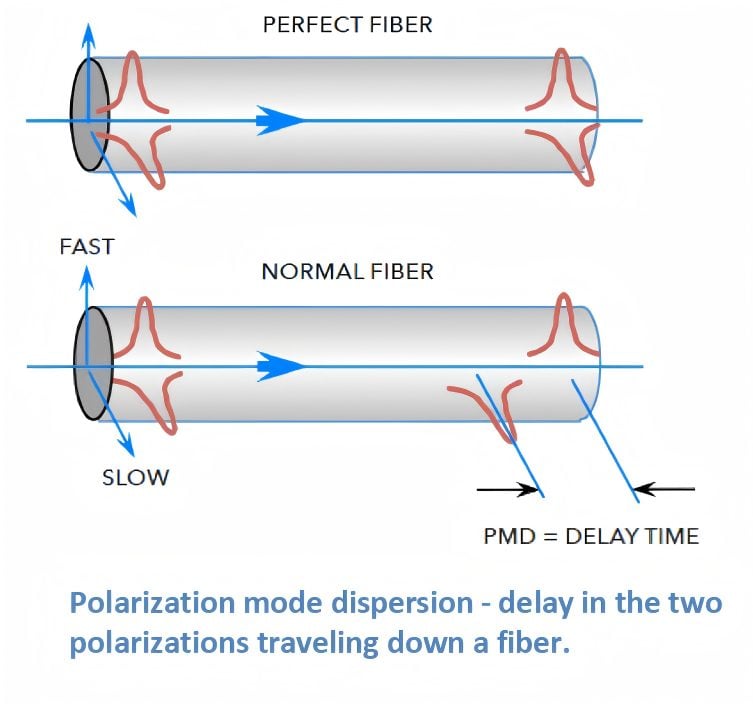
Polarization Maintaining Fiber is a specialized single-mode optical fiber that introduces strong and directionally fixed structural or stress-induced birefringence during manufacturing to lock the polarization state of transmitted light. Unlike conventional optical fibers that suffer from random polarization mode coupling and polarization mode dispersion (PMD), Polarization Maintaining Fiber can stably preserve the orientation and linearity of input polarized light during long-distance transmission, even under external disturbances such as stress, bending, and temperature changes.
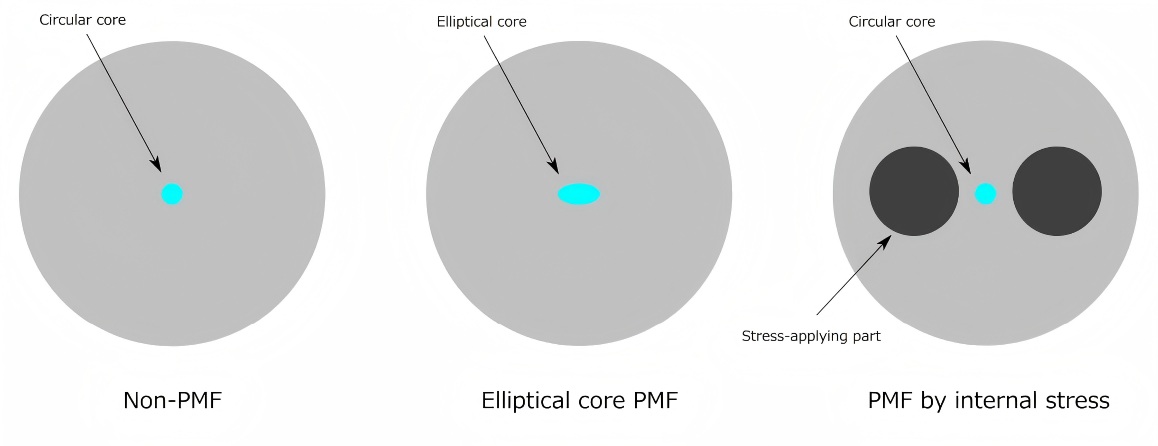
In ideal circular symmetric single-mode fibers, two orthogonal polarization modes (HE₁₁ˣ and HE₁₁ʸ) are theoretically degenerate and propagate at the same velocity. However, tiny geometric asymmetries and external perturbations in practice break this degeneracy, resulting in random drift of the polarization state. Polarization Maintaining Fiber overcomes this limitation by actively introducing strong, controllable birefringence, making it an indispensable core component in high-precision optical systems.
Necessity and Development Background
With the rapid development of coherent optical communication, fiber optic gyroscopes, quantum key distribution, fiber optic hydrophones, and high-precision lidar, the requirements for polarization stability have become increasingly stringent. In these systems, random changes in the polarization state will lead to signal fading, increased bit error rate, reduced measurement accuracy, and even system failure.
The emergence of Polarization Maintaining Fiber has effectively solved the problem of polarization instability in traditional optical fibers. Since its inception, it has evolved from early elliptical core structures to Panda-type, Bow-tie, and elliptical cladding structures, gradually improving performance in terms of birefringence magnitude, extinction ratio, loss, and environmental stability, and has become a cornerstone of modern high-end optical technology.
Working Principle of Polarization Maintaining Fiber
Core Mechanism: High Birefringence Effect
The working principle of Polarization Maintaining Fiber is based on high-level artificial birefringence, not the elimination of birefringence. Birefringence refers to the phenomenon where the refractive index of a medium varies with the polarization direction of light. In Polarization Maintaining Fiber, two orthogonal axes are formed inside the fiber:
● Fast Axis: Lower refractive index, higher light propagation speed.
● Slow Axis: Higher refractive index, lower light propagation speed.
This refractive index difference creates a large propagation constant difference between the two polarization modes, which strongly suppresses mode coupling between them. When linearly polarized light is accurately coupled along the fast or slow axis, its polarization state remains almost unchanged during transmission; only when the incident polarization is misaligned will the light decompose into two orthogonal components, leading to polarization state evolution.
Fast and Slow Axes and Polarization Alignment Requirements
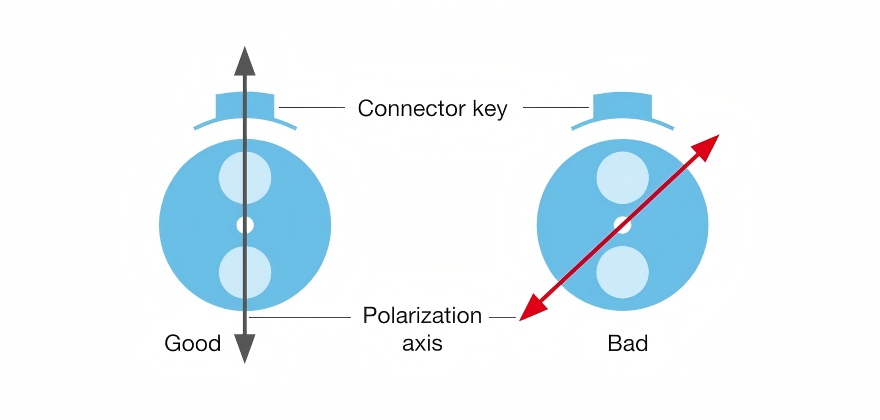
● The fast and slow axes are the two characteristic polarization axes of Polarization Maintaining Fiber, determined by internal stress or geometric asymmetry.
● The fast axis is usually perpendicular to the line connecting the centers of the two stress-applying parts.
● The slow axis usually passes through the two stress regions.
Polarization maintenance can only be achieved when the polarization direction of the input light coincides with one of the principal axes. If the incident light has a polarization direction at an angle to both axes, it will split into two orthogonal components propagating at different speeds, resulting in elliptically polarized light at the output and a significant decrease in the extinction ratio. Therefore, precise polarization axis alignment is a prerequisite for the effective application of Polarization Maintaining Fiber.
Beat Length and Polarization Coupling Suppression
Beat length (Lᵦ) is a key parameter reflecting the birefringence strength of Polarization Maintaining Fiber. It is defined as the fiber length required for two orthogonal polarization components to complete a full cycle of polarization state change (linear → elliptical → circular → elliptical → linear) due to phase difference accumulation.
The relationship between beat length and birefringence is:
Lᵦ = λ / Δn
where λ is the operating wavelength and Δn is the effective refractive index difference between the fast and slow axes.
Shorter beat length represents stronger birefringence and better polarization maintenance capability, as it is more difficult for external disturbances to induce effective coupling between the two polarization modes. High-performance Polarization Maintaining Fiber typically has a beat length on the order of millimeters, far smaller than that of conventional single-mode fibers.
Structural Classification of Polarization Maintaining Fiber
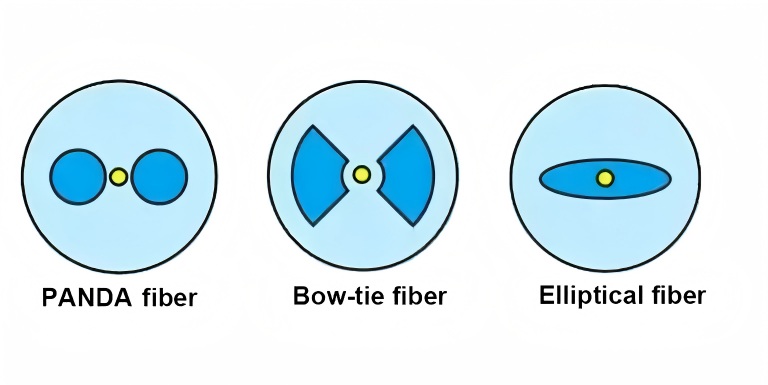
Panda-type Polarization Maintaining Fiber
Panda-type Polarization Maintaining Fiber is the most widely used structure at present. It introduces stress by embedding two circular stress rods symmetrically on both sides of the fiber core, usually made of boron-doped silica with a thermal expansion coefficient significantly different from that of the cladding. During the cooling process after fiber drawing, thermal stress is generated, resulting in asymmetric stress distribution around the core and forming a stable fast-slow axis structure.
Advantages: excellent polarization maintenance performance, mature manufacturing process, good compatibility with standard optical fiber devices, suitable for mass production.
Bow-tie Polarization Maintaining Fiber
The stress region of Bow-tie Polarization Maintaining Fiber is fan-shaped or bow-tie shaped, symmetrically distributed on both sides of the core. This structure can generate higher stress birefringence under the same geometric size, with a shorter beat length and strong resistance to environmental interference.
Advantages: high birefringence, good mechanical stability, suitable for applications with extreme requirements for polarization stability, such as high-precision fiber optic gyroscopes.
Elliptical Core / Elliptical Cladding Polarization Maintaining Fiber
This type of Polarization Maintaining Fiber forms birefringence through geometric shape asymmetry, including elliptical core or elliptical cladding structures, without relying on stress rods. The asymmetry of the waveguide structure itself leads to different mode field distributions and effective refractive indices in two orthogonal directions, achieving the polarization maintenance effect.
Advantages: simple structure, good temperature stability, low stress sensitivity, suitable for applications with high requirements for environmental adaptability.
Key Characteristics of Polarization Maintaining Fiber
High Polarization Extinction Ratio
Polarization Extinction Ratio (PER) is the core indicator for measuring the polarization maintenance performance of Polarization Maintaining Fiber. It is defined as the ratio of the optical power along the principal axis direction to the optical power in the orthogonal direction, usually expressed in decibels (dB).
High-quality Polarization Maintaining Fiber can achieve a PER higher than 20–30 dB after long-distance transmission, and even reach 35–40 dB in short-distance high-precision applications. The higher the extinction ratio, the purer the output polarization state and the smaller the polarization crosstalk.
Low Polarization Crosstalk
Polarization crosstalk refers to the power coupling degree from the principal axis to the orthogonal axis during transmission, usually expressed in negative dB form. Excellent Polarization Maintaining Fiber has crosstalk lower than −30 dB, and high-end products can reach −40 dB or lower, effectively suppressing polarization noise and signal distortion.
Stable Birefringence and Environmental Robustness
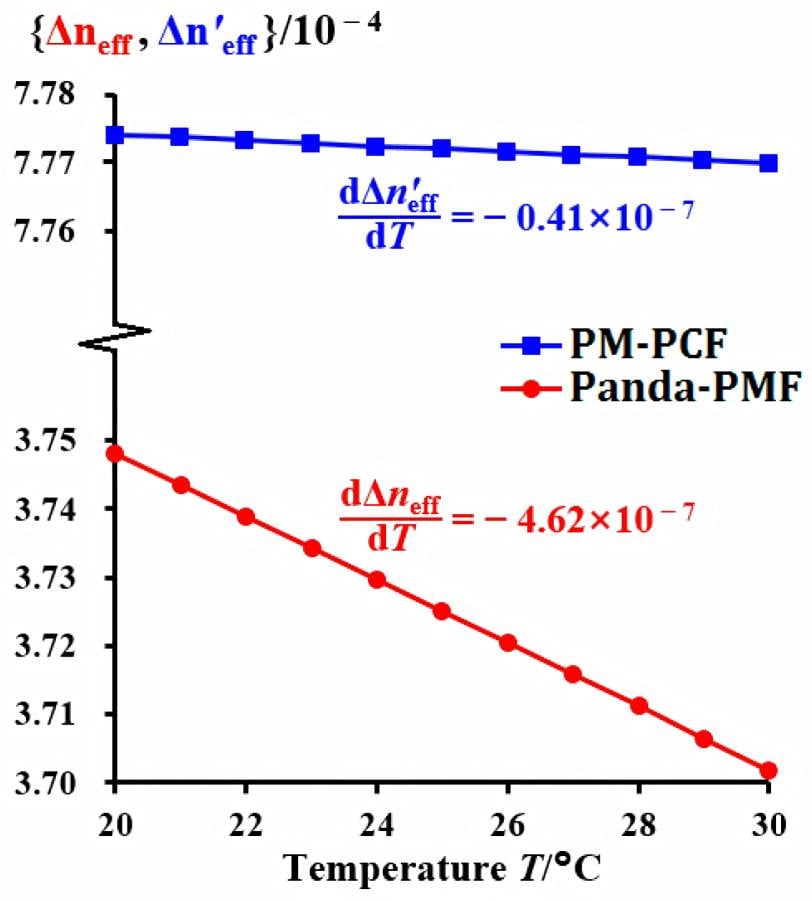
Polarization Maintaining Fiber has built-in high birefringence much stronger than the random birefringence caused by external disturbances, so it can maintain stable fast and slow axes under stress, bending, and temperature changes. Although it is more sensitive to bending than standard single-mode fibers, its internal design ensures that the polarization maintenance performance does not degrade sharply under conventional operating conditions.
Wavelength Compatibility and Low Transmission Loss
Modern Polarization Maintaining Fiber products cover commonly used communication windows such as 1310 nm and 1550 nm, with transmission loss close to that of standard single-mode fibers, generally between 0.15–0.3 dB/m at 1550 nm, meeting the requirements of long-distance and high-signal-to-noise ratio transmission.
Mechanical and Thermal Reliability
Polarization Maintaining Fiber adopts a high-strength quartz glass substrate and stress-matched doping design, with good tensile strength, bending resistance, and thermal stability. It can work stably in a wide temperature range (−40 °C to +85 °C or even wider), adapting to harsh environments such as aerospace, industrial control, and military applications.
Typical Engineering Applications of Polarization Maintaining Fiber
Coherent Optical Communication Systems
In coherent receivers, the mixing efficiency and signal-to-noise ratio directly depend on the polarization state consistency between the signal light and the local oscillator light. Polarization Maintaining Fiber is used to connect lasers, modulators, amplifiers, and detectors to ensure stable polarization of the optical path, reduce bit error rate, and improve the capacity and distance of optical communication systems.
Fiber Optic Gyroscopes and Inertial Navigation
Fiber optic gyroscopes detect angular velocity by using the Sagnac effect, and their measurement accuracy is extremely sensitive to polarization changes. Polarization Maintaining Fiber can eliminate polarization-dependent noise and drift, making the gyroscope have ultra-high precision and long-term stability, and is widely used in aerospace, navigation, and weapon systems.
Quantum Key Distribution (QKD)
Quantum communication systems based on polarization coding require strict maintenance of the polarization state of single photons. Polarization Maintaining Fiber provides a stable transmission channel for quantum signals, suppresses polarization disturbance and crosstalk, and is a key device for achieving long-distance and secure quantum communication.
-system-transmission-260521.jpg "Quantum key distribution (QKD) system transmission")
High-Power Fiber Lasers and Amplifiers
In high-power fiber lasers, the polarization state affects beam combining efficiency, thermal effects, and stimulated scattering characteristics.Polarization Maintaining Fiber is used in resonant cavities, transmission arms, and output ends to achieve stable polarized laser output and improve beam quality and energy efficiency.
High-Precision Optical Sensors
Including fiber optic hydrophones, current sensors, magnetic field sensors, and distributed acoustic sensors, Polarization Maintaining Fiber improves measurement sensitivity and stability by maintaining polarization consistency, and is used in underwater monitoring, smart grid, and structural health detection.
Comparison between Polarization Maintaining Fiber and Conventional Single-mode Fiber
Standard single-mode fibers (SMF) lack active polarization maintenance capability, with weak and random birefringence, high and uncontrollable polarization crosstalk, and low, unstable extinction ratio. Their simple circular symmetric structure makes them suitable for conventional communication and non-precision sensing scenarios. In contrast, Polarization Maintaining Fiber features strong fixed birefringence that enables stable polarization maintenance, with low polarization crosstalk (≤ −30 dB for excellent products) and high extinction ratio (20–40 dB). Its built-in stress rods or asymmetric structures make it ideal for polarization-sensitive applications such as coherent communication, quantum technology, and precision sensing. This comparison fully shows that Polarization Maintaining Fiber has irreplaceable advantages in polarization-sensitive scenarios, and is a necessary upgrade from conventional optical fibers to high-end optical systems.
Polarization Maintaining Fiber is a key optical component that uses artificial high birefringence to achieve stable polarization transmission. It solves the core problem of polarization state instability in conventional optical fibers and is widely used in cutting-edge fields such as coherent communication, quantum technology, inertial navigation, and precision sensing. Its working principle is based on forming orthogonal fast and slow axes through stress or geometric asymmetry, suppressing polarization mode coupling, and maintaining stable linear polarization output.
With the development of optical communication toward higher capacity, lower noise, and longer distances, and the rapid popularization of quantum information and optical sensing technologies, the demand for high-performance Polarization Maintaining Fiber will continue to grow. Future research and development will focus on achieving lower loss, higher extinction ratio, shorter beat length, stronger environmental adaptability, and easier integration, further promoting the innovation and application of polarization-dependent optical systems.
In engineering practice, correctly understanding the working principle and structural characteristics of Polarization Maintaining Fiber, strictly following polarization axis alignment specifications, and reasonably selecting fiber types and parameters according to application scenarios are crucial to giving full play to the performance advantages of Polarization Maintaining Fiber and improving the overall indicators of optical systems.





No comments have been posted yet.