


.webp)


Traditional fiber optic cables, while efficient in stable environments, often fall short when exposed to physical stress, extreme temperatures, or harsh outdoor elements. This is where armored fiber optic cable emerges as a game-changing solution. Designed to combine the high-speed performance of fiber optics with enhanced durability, armored fiber cables are engineered to deliver consistent, long-lasting connectivity even in light to medium-duty indoor and outdoor harsh environments.
1.What Is Armored Fiber Optic Cable?
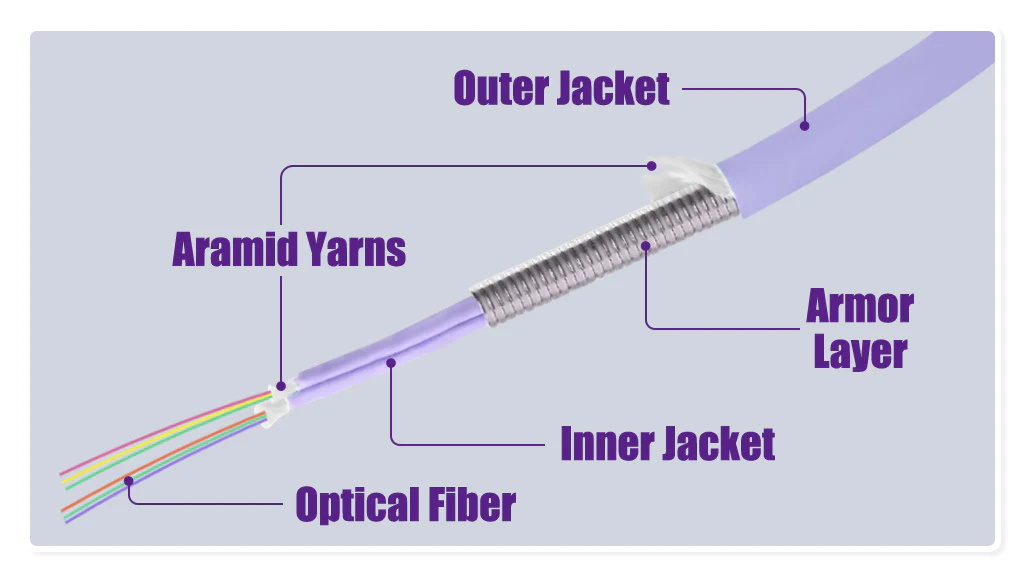
Armored fiber optic cable is a specialized type of fiber optic cable integrated with protective layers to reinforce its resistance to physical damage, environmental stress, and mechanical strain. Unlike standard fiber patch cords, which rely solely on a basic jacket for protection, armored variants incorporate a rugged structural design that includes two key components: an aluminum armor layer and Kevlar strands embedded within the outer jacket.
The aluminum armor serves as a rigid barrier against external impacts, crushing forces, and abrasion—common risks in industrial settings, construction zones, or outdoor installations where cables may come into contact with heavy equipment or environmental debris. Kevlar, a high-strength synthetic fiber renowned for its use in protective gear, adds tensile strength to the cable, preventing stretching or breakage when the cable is pulled during installation or exposed to tension. Together, these layers create a cable that is not only lightweight (to avoid complicating installation) but also exponentially more durable than conventional fiber optic cables, making it suitable for scenarios where reliability cannot be compromised.

2.Core Advantages of Armored Fiber Optic Cable
2.1 Exceptional Mechanical Strength
Armored fiber cables are 10 times stronger than regular fiber patch cords—a statistic that underscores their ability to withstand physical stress. The aluminum armor resists pressure and impact, ensuring the delicate fiber optic cores inside remain intact even if the cable is stepped on, bumped by machinery, or exposed to minor collisions. The Kevlar strands further enhance this strength by absorbing tension: during installation (e.g., pulling cables through conduit or across long distances), the Kevlar prevents the fiber cores from stretching, which could otherwise cause signal loss or permanent damage. This mechanical robustness makes armored cables ideal for high-traffic areas or environments where cables are not fully enclosed.
2.2 Wide Operating Temperature Range
Temperature fluctuations are a major threat to cable performance, as extreme heat or cold can degrade the outer jacket, weaken structural integrity, or disrupt signal transmission. Armored fiber optic cables address this challenge with a 40% higher rated operating temperature range compared to standard cables. While regular fiber cords may struggle in temperatures below -20°C (-4°F) or above 70°C (158°F), armored variants can operate reliably in a broader spectrum—often from -40°C (-40°F) to 85°C (185°F), depending on the specific product. This stability ensures consistent data transmission in environments like industrial factories (where machinery generates heat), outdoor utility poles (exposed to winter cold or summer sun), or data centers (with varying cooling zones). For industries that require 24/7 connectivity, this temperature resilience eliminates downtime caused by environmental extremes.
2.3 Versatile Indoor/Outdoor Adaptability
Unlike some cables that are limited to either indoor or outdoor use, armored fiber optic cables are engineered for dual-environment compatibility. The outer jacket (typically made of durable materials like PVC or LSZH—Low Smoke Zero Halogen) is resistant to UV radiation, moisture, and chemical exposure, making it suitable for outdoor installations such as campus networks, municipal communication links, or outdoor security systems. At the same time, the compact design and low smoke emission (in LSZH variants) make it safe for indoor use in data centers, server rooms, or commercial buildings where fire safety is a priority.
3.Key Product Variants: Fiber Types and Terminations
3.1 Fiber Type Options
Armored cables are offered in both singlemode and multimode variants, each optimized for distinct transmission scenarios:
Singlemode Armored Cable (9/125 μm): Designed for long-distance transmission (up to tens of kilometers), singlemode cables use a narrow core (9 μm) to minimize signal dispersion. They are ideal for outdoor applications like inter-city communication links, cellular tower connections, or campus-wide backbone networks where data needs to travel over extended distances without signal loss.
Multimode Armored Cable (OM1/OM2/OM3/OM4; 50/125 μm or 62.5/125 μm): Multimode cables have a larger core (50 μm or 62.5 μm) and support high bandwidth over shorter distances (up to a few kilometers). The OM1 and OM2 variants are suitable for legacy systems, while OM3 and OM4 (often used with 10G Ethernet) deliver higher bandwidth for modern applications like data centers, where high-speed connectivity between servers and storage devices is critical.
3.2 Termination Options
Terminations (the connectors at the end of the cable) determine how the armored cable interfaces with devices like switches, routers, or transceivers. Fibermart’s armored fiber patch cords and cables are available with a full range of industry-standard terminations, including:
Standard connectors: SC (push-pull design, easy to install), ST (twist-lock, ideal for industrial settings), FC (threaded, high stability for precision applications), and LC (small form factor, space-saving for dense data centers).
Miniature connectors: MU (ultra-compact, suitable for high-density equipment) and E2000 (dust-proof, ideal for harsh outdoor or industrial environments).
Low-loss variants: APC (Angled Physical Contact) versions of SC, ST, FC, LC, and E2000 connectors, which minimize signal reflection and are critical for high-performance applications like video surveillance or medical imaging.

4.Typical Applications of Armored Fiber Optic Cable
4.1 Data Centers
With high-density server racks and constant data flow, data centers require cables that can withstand frequent handling and temperature fluctuations. OM3/OM4 armored cables with LC connectors are ideal here, as they deliver high bandwidth and fit into tight spaces.
4.2 Industrial Environments
Factories, manufacturing plants, and oil refineries expose cables to vibration, extreme temperatures, and chemical spills. Singlemode or OM2 armored cables with ST or FC connectors (known for their ruggedness) resist these hazards, ensuring uninterrupted communication between machines and control systems.
4.3 Outdoor Communication Networks
Municipalities, telecom companies, and campus networks rely on outdoor armored cables to connect buildings, towers, or remote sites. These cables withstand UV radiation, rain, and temperature swings, maintaining signal integrity over long distances.
4.4 Security Systems
CCTV and surveillance networks often require long-distance, low-loss transmission. Singlemode armored cables with APC connectors deliver clear video signals across large areas (e.g., airports, parking lots) without interference.

Armored fiber optic cable is more than just a durable alternative to standard cables—it is a critical enabler of reliable connectivity in harsh environments where downtime is costly and performance is non-negotiable. Its combination of mechanical strength, wide temperature tolerance, and versatile design makes it suitable for industries ranging from data centers to manufacturing and outdoor telecom. With a range of fiber types, termination options, and custom solutions (like Fibermart’s 12F armored patch cables or custom breakout cables), businesses can tailor armored fiber cables to their unique needs.





No comments have been posted yet.