


.webp)


Before discussing the technologies used in Booster Amplifiers (BAs), Pre-Amplifiers (PAs), and Line Amplifiers (LAs), it is important to understand the role of amplifiers in general. Optical amplifiers accelerate visual signals without converting them to electrical signals, improving efficiency and reducing delays in fiber-optic communication systems. The main types of optical sensors are erbium-doped arrays (EDFA), Raman sensors, and solid state absorbers (SOA). EDFAs are gaining popularity due to their compatibility with the 1550 nm wavelength used in optical communications.
Sensors are strategically placed at various points in transmission systems to solve specific problems such as signal attenuation or noise cancellation over long distances. The location, structure, and characteristics of the Booster Amplifier (BA), Pre-Amplifier (PA), and Line Amplifier (LA) determine their effectiveness in these applications.
Sensors are strategically placed at various points in transmission systems to solve specific problems such as signal attenuation or noise cancellation over long distances. The location, structure, and characteristics of the Booster Amplifier (BA), Pre-Amplifier (PA), and Line Amplifier (LA) determine their effectiveness in these applications.
What is BA (Booster Amplifier)?
Definition and Core Purpose of Booster Amplifier
A Booster Amplifier (BA) is a specialized optical amplifier, predominantly based on Erbium-Doped Fiber (EDFA) technology, designed to function as the final power stage within an optical transmitter. Its singular, critical purpose is to elevate the optical signal to a very high power level immediately before it is launched into the long-haul transmission fiber. It acts as the powerhouse that gives the multi-wavelength signal its initial, robust "push" onto the information highway.
Specific Placement and Justification of Booster Amplifier
The BA is strategically and physically located directly after the Multiplexer (MUX) in the transmitter setup. This precise placement is fundamental to its role, addressing two key challenges:
Compensation for Insertion Loss: The Multiplexer, a component that combines numerous individual optical channels onto a single fiber, inherently introduces signal attenuation known as insertion loss. The BA is positioned to directly counteract this loss, ensuring the combined signal is not weakened at the very start of its journey.
Maximizing Launch Power: By being the last active component before the transmission fiber, the BA is responsible for setting the "launch power." A high launch power is crucial for enabling the signal to travel the maximum possible distance before it decays to a level that requires re-amplification.

Defining Technical Characteristics of Booster Amplifier
The operational demands placed on a BA shape its specific performance profile, which differs from other amplifier types. Its key characteristics are:
High Saturated Output Power: This is the most critical specification. BAs are engineered to produce a very high total output power, typically in the range of +17 dBm to +23 dBm or even higher. They are designed to operate in a saturated or deep-saturated state. In this regime, the amplifier provides a stable, high output power that is largely independent of minor fluctuations in the input power. This saturation also has the beneficial side-effect of helping to equalize the power levels among the different wavelengths being amplified.
Secondary Nature of Noise Figure and Gain: Unlike other amplifiers, the BA's Noise Figure (NF) is not a primary concern. This is because it amplifies a strong, pristine signal directly from the transmitter lasers, where the inherent Signal-to-Noise Ratio (SNR) is at its highest. The degradation caused by its own noise is relatively small compared to the immense signal power it produces. Similarly, while it provides gain, the absolute output power is a more critical metric than the gain value itself.
Impact on System Performance of Booster Amplifier
The primary contribution of a BA to the overall system is its direct impact on the received signal quality. By ensuring the signal begins its long journey with very high optical power, the BA guarantees that the signal remains robust against the cumulative attenuation of the fiber. This high launch power is the foundational factor in maintaining a high Signal-to-Noise Ratio (SNR) at the receiver, which is the ultimate determinant of transmission quality and bit-error rate.
In essence, the Booster Amplifier is the cornerstone of a powerful optical transmitter. It is a high-output, saturation-optimized device whose exclusive function is to overcome initial system losses and project a powerful, multi-wavelength signal into the fiber network, thereby dictating the system's initial reach and signal integrity.

What is PA (Pre-Amplifier)?
Definition and Core Purpose of Pre-Amplifier
A Pre-Amplifier (PA) is a specialized optical amplifier, fundamentally based on low-noise Erbium-Doped Fiber (EDFA) technology, designed to function as the first stage of signal processing within an optical receiver. Its singular, critical purpose is to elevate a weak and attenuated optical signal immediately before it reaches the optical receiver and photodetector. It acts as a "hearing aid" for the receiver, sensitizing it to detect signals that would otherwise be too faint to recognize accurately.
Specific Placement and Justification of Pre-Amplifier
The PA is strategically and physically located directly before the Demultiplexer (DEMUX) in the receiver setup. This precise placement is fundamental to its role, addressing a key challenge in long-haul transmission:
Amplification Before Final Processing: After traversing long distances of fiber, the optical signal is profoundly weakened. The PA is positioned to amplify this fragile composite signal before it is split by the DEMUX and sent to individual receivers. Amplifying at this point ensures that all subsequent channels benefit from the improved signal level and that the insertion loss of the DEMUX does not further degrade an already critically weak signal.
Defining Technical Characteristics of Pre-Amplifier
The operational demands placed on a PA shape its specific performance profile, which is distinctly different from a Booster Amplifier. Its key characteristics are:
Low Noise Figure (NF): This is the most critical specification for a PA. It is engineered to provide amplification while adding the absolute minimum amount of noise. Since the input signal is already very weak, any additional noise introduced by the amplifier itself would severely corrupt the signal. A low Noise Figure is paramount to preserving the signal's integrity and the Optical Signal-to-Noise Ratio (OSNR).
Secondary Nature of Output Power: Unlike a Booster Amplifier, the PA's output power is not a primary driver. It requires only enough gain to raise the signal well above the sensitivity threshold of the downstream receiver. Its design prioritizes the "cleanliness" of the amplification over its raw power.
Impact on System Performance of Pre-Amplifier
The primary contribution of a PA to the overall system is its direct impact on the receiver's sensitivity. The underlying principle is that for a given acceptable OSNR, a higher optical power at the input of the receiver can effectively "drown out" or suppress the receiver's internal electronic noise (e.g., thermal noise). By amplifying the weak incoming signal to an optimal level, the PA ensures that the signal power dominates over the receiver's noise floor. This directly translates to improved receiver sensitivity, allowing the system to correctly decode signals that were previously too weak, thereby extending the maximum achievable transmission distance and improving the system's bit-error-rate performance.
In essence, the Pre-Amplifier is the guardian of signal integrity at the receiving end. It is a low-noise, sensitivity-optimized device whose exclusive function is to provide a "clean boost" to a weakened signal, ensuring that the receiver can accurately detect and interpret the data, thus defining the final reach and reliability of the optical link.

What is LA (Line Amplifier)?
Definition and Core Purpose of Line Amplifier
A Line Amplifier (LA), also known as an In-Line Amplifier, is a specialized optical amplifier deployed within long-haul fiber optic spans. Its singular, critical purpose is to act as a "repeater" or "refresh station" along the transmission line. It periodically compensates for the cumulative signal attenuation incurred in the fiber, thereby artificially extending the total distance a signal can travel without requiring conversion back to an electrical signal.
Specific Placement and Justification of Line Amplifier
LAs are strategically and physically placed within Optical Line Amplifier (OLA) sites, typically spaced every 80 to 120 kilometers along the fiber route. This placement is dictated by the fiber's attenuation coefficient and the system's power budget. The LA is positioned directly in the path of the transmitted signal, where it receives the weakened signal from the preceding fiber span, amplifies it, and re-transmits it at a robust power level into the subsequent fiber span. This process effectively resets the signal's power level, allowing it to overcome the losses of the next segment.
Defining Technical Characteristics of Line Amplifier
The unique operational demands placed on an LA, situated in the middle of the link, shape its hybrid performance profile, combining the strengths of both BA and PA.
A Hybrid of Power and Low-Noise Performance: An LA must possess a dual character. It needs high gain (typically 35-45 dB) to compensate for the substantial loss of a long fiber span, similar to a BA's function. Simultaneously, because it amplifies a signal that has already accumulated noise from the previous spans, it must maintain a low Noise Figure to preserve the Optical Signal-to-Noise Ratio (OSNR), a key concern for PAs. Furthermore, it must provide high saturated output power to launch the signal strongly into the next span.
OSNR Guardian: The LA's performance, particularly its low Noise Figure, is critical for maintaining the end-to-end OSNR. Every amplification stage degrades the OSNR, and the LA's ability to amplify with minimal added noise is paramount to ensuring the signal remains decipherable at the final receiver.
Common Types and Technologies of Line Amplifier
The most prevalent technologies for implementing Line Amplifiers are:
Erbium-Doped Fiber Amplifier (EDFA-LA): This is the most common and mature technology. An EDFA configured as an LA provides robust, high-gain, and relatively low-noise amplification for the C-band and/or L-band, making it the workhorse for long-haul and submarine cable systems.
Raman Fiber Amplifier (RFA-LA): This technology uses the optical fiber itself as the gain medium via stimulated Raman scattering. Raman amplifiers can offer an even lower effective noise figure than EDFAs and can be designed to operate in any wavelength band, providing greater flexibility. They are often used in combination with EDFAs in ultra-high-capacity systems.
In essence, the Line Amplifier is the endurance engine of a long-haul optical network. It is a high-gain, high-power, and low-noise device whose exclusive function is to periodically regenerate the optical signal in the middle of its journey, directly determining the total achievable transmission distance between the transmitter and the receiver.
A Detailed Comparison of Optical Amplifiers: BA, LA, and PA
In a long-haul fiber optic communication system, Booster Amplifiers (BA), Line Amplifiers (LA), and Pre-Amplifiers (PA) work in concert to overcome signal attenuation. While all are typically based on Erbium-Doped Fiber Amplifier (EDFA) technology, their design priorities and operational characteristics are tailored to their specific locations in the link.
The following chart visualizes their typical placement and primary function in a simplified system:

Booster Amplifier (BA)
Detailed Role & Location: Positioned immediately after the transmitter, and crucially, after the Multiplexer (MUX) in a WDM system. Its primary role is to compensate for the insertion loss of the MUX and to launch a very high-power signal into the first length of transmission fiber.
Key Specifications & Design Philosophy:
High Saturated Output Power: This is the paramount specification. BAs are designed to operate in a deeply saturated state, producing high total output power (typically +17 dBm to +23 dBm or more). Saturation helps to level out power differences between individual channels.
Noise Figure (NF): Of secondary concern. Since it amplifies a strong, clean signal directly from the lasers, its contribution to the overall system noise is relatively low. Typical NF values range from 5-7 dB.
Gain: The gain is a consequence of achieving the desired high output power and is typically in the range of 13-20 dB.
Line Amplifier (LA)
Detailed Role & Location: Placed at intervals of 80-120 km along the fiber link, inside Optical Line Amplifier (OLA) sites. Its function is to periodically reset the optical power level, compensating for the cumulative loss of each preceding fiber span.
Key Specifications & Design Philosophy:
High Gain: This is the most critical parameter. LAs must provide enough gain to offset the loss of an entire fiber span, requiring typical gains of 30 dB to 45 dB.
Balanced Noise and Power Performance: An LA must be a hybrid. It needs a low Noise Figure (typically 4-6 dB) to preserve the OSNR of the already-weakened signal, while also providing sufficient output power (e.g., +15 to +20 dBm) to launch the signal into the next span. Its performance directly dictates the maximum distance between amplifier sites.
Technology: While EDFA is dominant, Raman Amplifiers are often used as LAs or in hybrid EDFA/Raman configurations to achieve a lower effective noise figure.
Pre-Amplifier (PA)
Detailed Role & Location: Positioned at the receiving end, just before the Demultiplexer (DEMUX). Its job is to elevate the extremely weak signal arriving from the final fiber span to a level that is above the sensitivity threshold of the optical receiver.
Key Specifications & Design Philosophy:
Low Noise Figure: This is the single most important specification for a PA. It is engineered to add as little noise as possible during amplification, with typical Noise Figure values being very low, often 4-5 dB or even less. This is crucial because it amplifies a signal that is both weak and has accumulated noise from all previous spans and amplifiers.
Output Power: Of secondary importance. The PA only needs to provide enough gain (typically 20-30 dB) to raise the signal for the receiver; it does not operate at the high output power levels of a BA.
Impact: By boosting the signal power immediately before detection, it effectively "drowns out" the receiver's internal electronic noise, thereby improving the receiver sensitivity and the overall Bit Error Rate (BER).
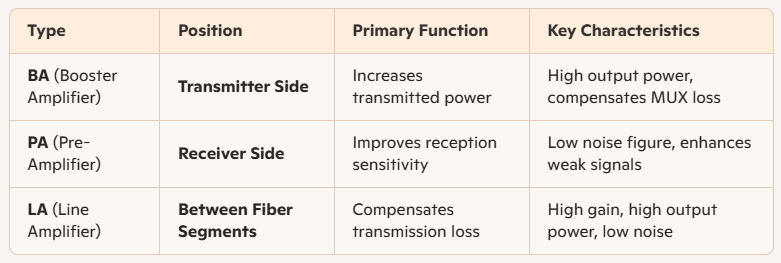
Summary and Interplay
In summary, these three amplifiers form a relay team for the optical signal:
The BA is the "Powerhouse" at the start, focused on high launch power.
The LA is the "Endurance Engine" in the middle, balancing high gain with low noise to cover long distances.
The PA is the "Signal Purifier" at the end, focused on low-noise amplification to ensure clean reception.
Their distinct performance characteristics are not arbitrary but are meticulously optimized for their specific positions, working together to overcome the fundamental challenge of signal loss in optical fiber.





No comments have been posted yet.