


.webp)


In modern optical communication and photonics systems, non-reciprocal passive optical components play an irreplaceable role in ensuring stable signal transmission, eliminating interference and optimizing system performance. Optical circulator and optical isolator are two core non-reciprocal devices based on the magneto-optic Faraday effect, yet they differ significantly in structural design, functional characteristics and application scenarios. Mastering their distinctions is crucial for the rational selection and deployment of components in optical network construction, optical sensing and laser system design. This article will elaborate on the core differences between the two devices from multiple dimensions, with a focus on the functional attributes of optical circulator.
Core Working Principles: Common Foundation with Distinct Implementations
Both optical circulator and optical isolator rely on the magneto-optic Faraday effect as their physical foundation, where the polarization direction of linearly polarized light is rotated by a fixed angle when passing through a magneto-optical medium under a magnetic field, and the rotation direction is only determined by the magnetic field direction rather than the light propagation direction—this non-reciprocal characteristic is the key to realizing one-way light transmission. However, the two devices differ greatly in how they utilize this effect to achieve signal control.
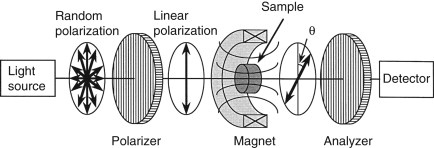
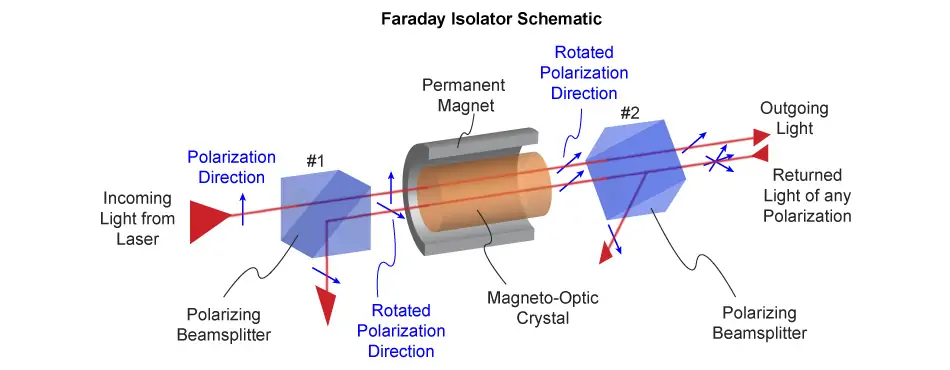
Working Principle of Optical Isolator
Optical isolator is a typical two-port non-reciprocal device, designed to achieve one-way unidirectional transmission of light signals. It is mainly composed of an input polarizer, a Faraday rotator and an output analyzer. The forward light signal passes through the input polarizer to form a fixed linearly polarized light, which is rotated by 45° after passing through the Faraday rotator and then perfectly matches the polarization direction of the output analyzer to achieve low-loss transmission. For the reverse reflected light, it is first polarized by the output analyzer, then rotated by another 45° in the same direction when passing through the Faraday rotator, resulting in a 90° deviation from the input polarizer’s polarization direction, thus being completely blocked. This structure enables the optical isolator to effectively suppress reverse reflected light and avoid its interference or damage to light sources such as lasers and optical amplifiers.
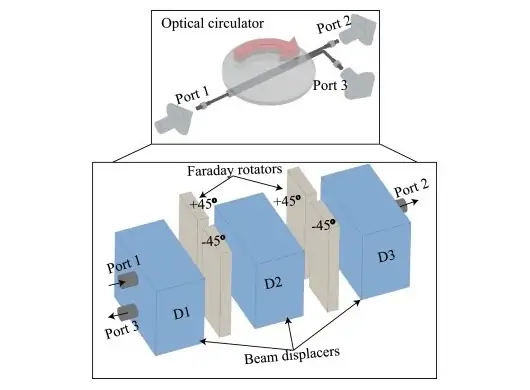
Working Principle of Optical Circulator
Optical circulator is an upgraded multi-port non-reciprocal device based on the Faraday effect, with mainstream configurations of 3-port and 4-port. Its core function is to realize one-way circular transmission of light signals between multiple ports—the light signal input from Port 1 is output from Port 2 with low loss, the light input from Port 2 is output from Port 3, and this circular transmission rule is followed for more ports. Unlike the optical isolator’s simple "pass/block" control, the optical circulator integrates multiple Faraday rotation units and beam splitting/combining structures, which can precisely route light signals to the designated port according to the preset direction while isolating cross-port signal interference. High-performance optical circulator can achieve isolation greater than 35dB between non-adjacent ports and insertion loss less than 0.9dB, ensuring high integrity of circularly transmitted signals.
Structural and Functional Characteristics: Port Configuration and Signal Control Differences
The most intuitive difference between optical circulator and optical isolator lies in structural design, which directly leads to fundamental disparities in their functional positioning and signal processing capabilities.
Optical Isolator: Dual-Port, Single-Direction Interference Suppression
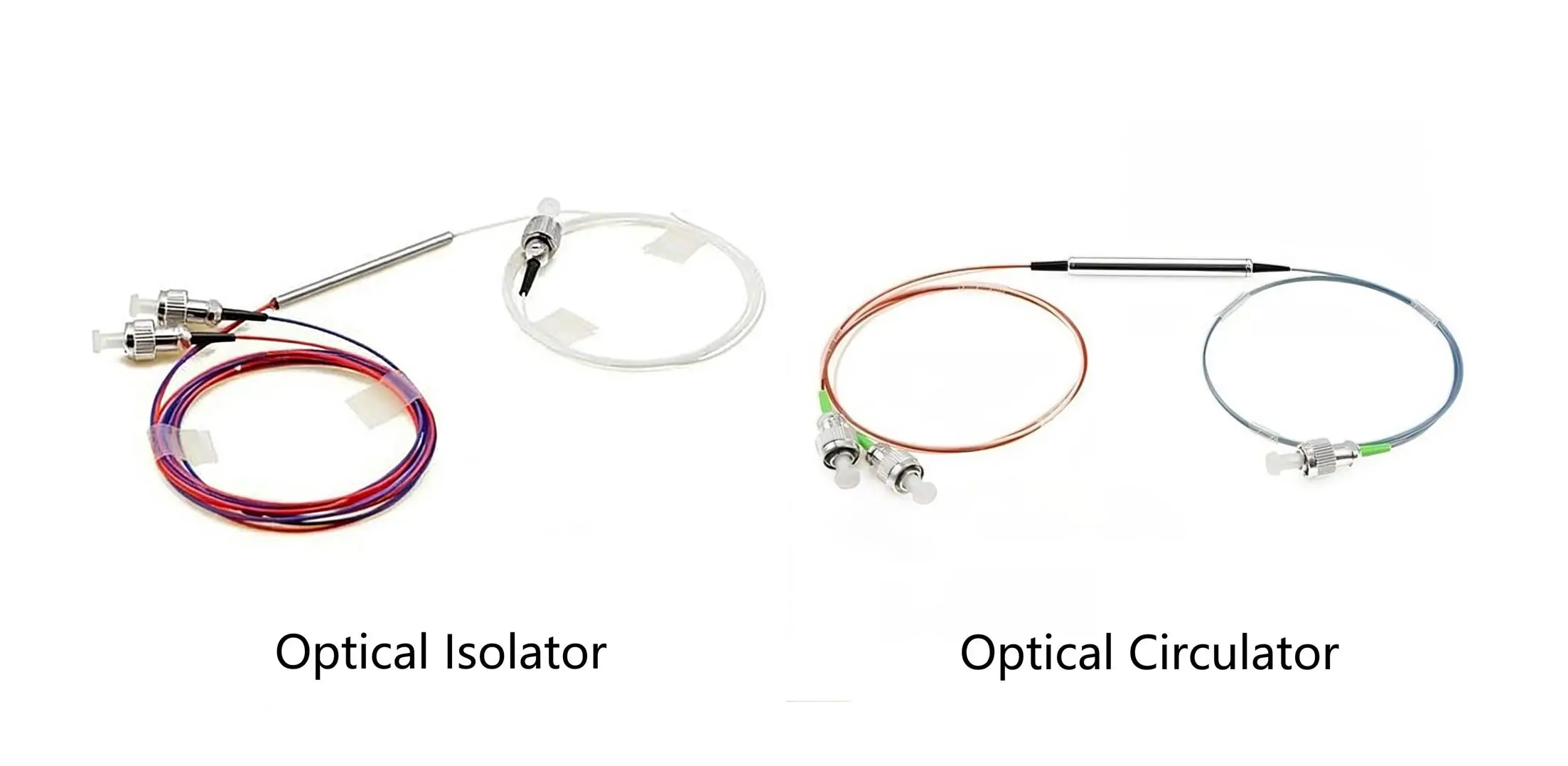
Optical isolator features a simple two-port (input/output) structure with a single functional goal: to maximize the suppression of reverse reflected light while ensuring low-loss forward transmission. Its key performance indicators focus on isolation (typically ≥30dB) and low insertion loss (≤1dB), and it is divided into polarization-dependent and polarization-insensitive types according to application requirements. It has no signal routing or distribution function, and only acts as a "one-way valve" in the optical system to protect sensitive light sources from reverse signal damage.
Optical Circulator: Multi-Port, Directional Signal Routing
Optical circulator adopts a 3/4-port modular structure, and its core value lies in precise directional routing and bidirectional transmission integration of light signals. In addition to the basic non-reciprocal transmission characteristic, the optical circulator can realize the separation and independent transmission of forward and reverse signals on a single optical fiber—for example, in WDM optical networks, the optical circulator can transmit the uplink signal from Port 1 to Port 2, and the downlink signal from Port 2 to Port 3, thus realizing bi-directional transmission on a single fiber and saving optical fiber resources. Moreover, optical circulator is available in polarization-maintaining (PM) and polarization-insensitive types, with low polarization-dependent loss (PDL as low as 0.05dB) and high environmental stability, capable of handling optical power up to 500mW and adapting to a wide temperature operating range. It also supports various connector types such as FC, SC and LC, making it highly compatible with different optical systems.

Application Scenarios: Specialized Protection vs. Comprehensive System Optimization
The functional differences between optical circulator and optical isolator determine their clear division of labor in practical applications. The former is a "specialized protector" for light sources, while the latter is a "comprehensive optimizer" for optical system signal transmission and routing.
Typical Applications of Optical Isolator
Optical isolator is mainly used for protecting core light source devices in optical systems. It is widely deployed in fiber lasers, erbium-doped fiber amplifiers (EDFAs), CATV networks and semiconductor laser systems to prevent reverse reflected light from causing self-oscillation of amplifiers, laser frequency jitter or even permanent damage to light source components. Its application scenario is relatively single, focusing on the interference suppression of two-port transmission links, and it is a necessary protective component in high-precision laser systems and short-distance optical transmission links.
Typical Applications of Optical Circulator
Optical circulator has a more extensive and diverse application scope, covering all aspects of modern optical communication, optical sensing and test measurement, relying on its multi-port routing and bidirectional transmission capabilities. In WDM optical networks, optical circulator is the core component of Optical Add-Drop Multiplexers (OADMs), realizing the selective routing of specific wavelength channels; in Dispersion Compensation Modules (DCMs), it facilitates the bi-directional transmission of signals through compensation fibers to achieve chromatic dispersion correction; in optical sensing and test systems such as Optical Time-Domain Reflectometers (OTDRs), it realizes signal separation and reflection analysis; in optical amplifier systems, it can isolate the active gain medium and recycle residual pump light to improve energy utilization efficiency. In addition, optical circulator is also a key component in coherent communication, quantum optics and high-power optical systems, especially the polarization-maintaining optical circulator, which can preserve the linear polarization state of light signals and is essential for high-precision optical sensing and quantum communication.
Conclusion
Optical circulator and optical isolator, as non-reciprocal passive optical components based on the Faraday effect, complement each other in optical systems but cannot be replaced by each other. The optical isolator, with its simple two-port structure and single one-way transmission function, is the optimal choice for light source protection and reverse interference suppression, with the advantages of low cost and easy deployment. The optical circulator, as a multi-port intelligent routing device, not only has the basic isolation function but also realizes circular signal transmission and bidirectional transmission on a single fiber, which is the core component for optimizing the structure of optical networks, improving resource utilization efficiency and realizing complex signal routing.
In actual engineering applications, if the only requirement is to protect the light source from reverse reflected light, the optical isolator is the first choice; if it is necessary to realize bi-directional transmission on a single fiber, multi-port signal routing or complex functions such as wavelength add/drop and dispersion compensation in the optical system, the optical circulator is an irreplaceable core component. With the development of optical communication towards high speed, large capacity and integration, the performance of optical circulator is continuously optimized—such as higher isolation, lower insertion loss and miniaturized packaging, which will further expand its application in 5G/6G optical access networks, optical fiber sensing and quantum information technology.





No comments have been posted yet.