


.webp)


Driven by the rapid growth of large-model training, distributed GPU clusters, and high-performance computing, AI compute networks impose extremely stringent requirements on Data Center Interconnect (DCI) links — lower latency, higher bandwidth, improved signal integrity, and more precise inter-cluster synchronization. For decades, traditional Single-Mode Fiber (SMF) has dominated data center networking thanks to its mature manufacturing, low cost, and comprehensive ecosystem, supporting massive-scale general data transmission across the internet.

However, AI workloads characterized by high concurrency, ultra-high speed, and microsecond-level latency sensitivity expose critical physical limitations of glass-based SMF transmission. Traditional fiber suffers from higher propagation latency, severe signal nonlinearity under high-power transmission, and restricted spectral scalability, making it difficult to support large-scale GPU cluster collaboration and cross-city compute resource pooling. As a revolutionary alternative, HCF effectively addresses these bottlenecks and emerges as a premium upgrade solution for high-end AI DCI scenarios. This article comprehensively compares HCF and SMF in terms of structural principles, quantified performance metrics, engineering deployment, application scenarios, and investment value, providing clear selection guidance for enterprise AI compute networking.
What is Hollow-Core Fiber (HCF)?
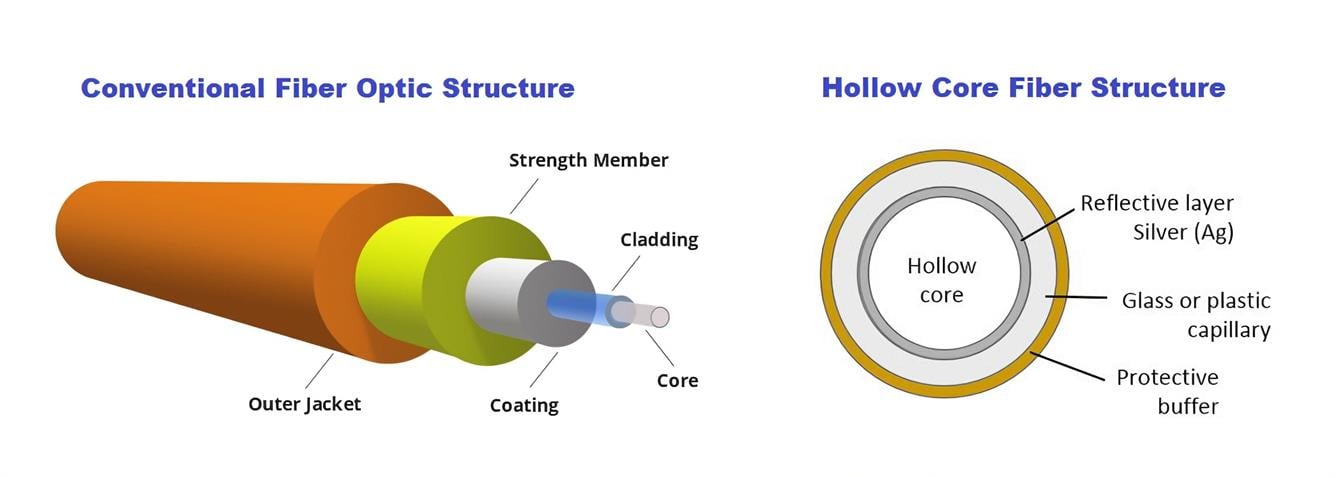
Hollow-Core Fiber (HCF) is a next-generation, disruptive optical transmission medium that redefines traditional fiber light-guiding principles. Unlike conventional single-mode fiber (SMF), which transmits light through solid silica glass, HCF features an air-filled hollow core and a precisely engineered anti-resonant microstructured cladding. More than 99% of light signals propagate through air rather than glass. Leveraging the inherent physical advantages of air-based transmission, HCF breaks the fundamental performance limits of traditional solid-core fiber, delivering ultra-low latency, negligible nonlinear distortion, and ultra-broadband spectrum capacity. It has become the ideal optical medium for high-speed, high-density AI compute transmission.
What is Single-Mode Fiber (SMF)?
Single-Mode Fiber (SMF) is the industry-standard, widely deployed optical transmission medium that forms the physical foundation of modern global telecom and data center networks. Unlike emerging hollow-core fiber (HCF), which guides light through an air-filled core, SMF relies on a solid silica glass core surrounded by a precision-matched refractive-index cladding structure. Optical signals travel entirely within the solid glass core via the principle of total internal reflection. Benefiting from decades of manufacturing refinement and a complete industrial ecosystem, SMF delivers exceptional signal consistency, ultra-low splice loss, and highly cost-effective large-scale deployment. It remains the universal workhorse for telecom backbones, general data center interconnects, and wide-area access networks worldwide.
Core Structural Differences: Transmission Medium Defines Performance Limits
Optical fiber performance is fundamentally determined by its light-guiding medium and physical structure. The performance gaps between HCF and SMF stem from their distinct core designs, which explain their vastly different adaptability to AI compute scenarios.
Traditional SMF: Mature and Universal with Inherent Physical Limitations
Commercial single-mode fiber adopts a solid silica glass core with a typical diameter of 8–10 μm. It confines and transmits light via total internal reflection generated by the refractive index difference between the glass core and cladding. During transmission, light continuously interacts with solid glass, resulting in unavoidable latency accumulation, chromatic dispersion, and pronounced nonlinear distortion caused by material impurities and medium characteristics.
After decades of industrial iteration, SMF’s production processes, construction standards, and supporting equipment are fully standardized, delivering low deployment costs and universal compatibility for general networking scenarios. Nevertheless, the inherent physical properties of solid glass create hard performance ceilings that cannot meet the ultra-low-latency and ultra-high-bandwidth demands of modern AI compute clusters.
Modern HCF: Air-Core Transmission Reinventing Optical Networking
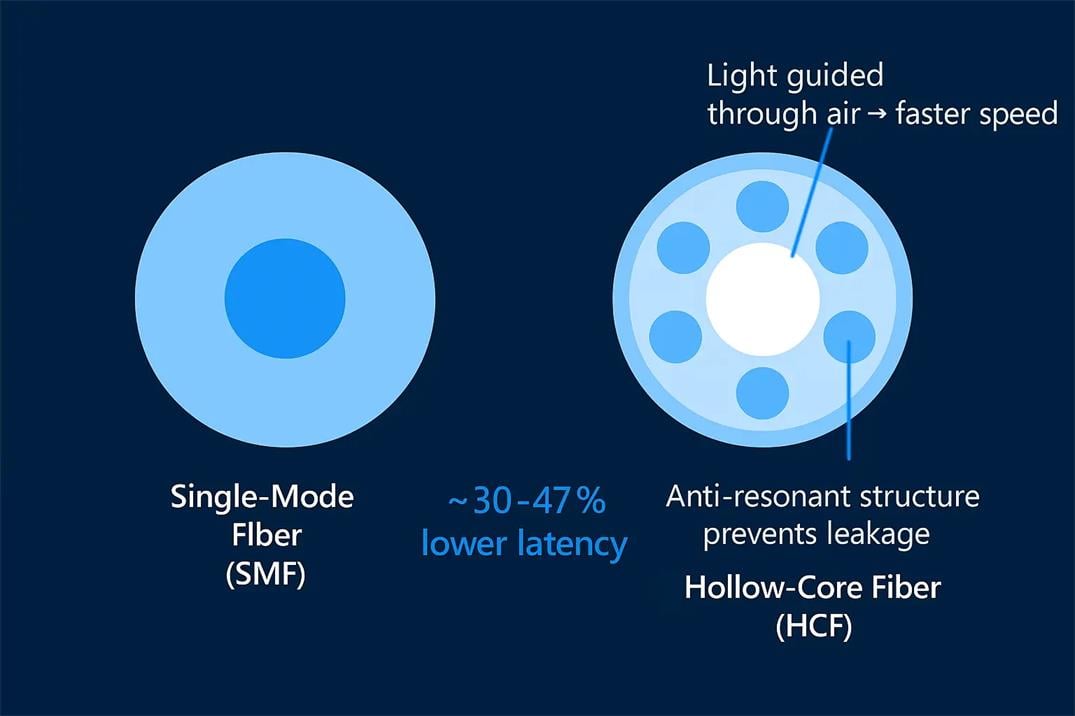
HCF completely abandons the traditional solid-glass core architecture and adopts an innovative structure consisting of an air-filled hollow core, anti-resonant glass lattice, and micro support struts. With air (refractive index n≈1) serving as the primary transmission medium, nearly all light propagates within the hollow channel, while precision-engineered thin-walled microstructures confine the optical field and prevent light leakage.
Notably, the tiny glass struts in HCF only provide mechanical support to stabilize the hollow structure and prevent core collapse during manufacturing. They do not participate in light transmission. This design almost completely isolates optical signals from glass interaction, fundamentally eliminating glass-induced latency, signal distortion, and dispersion interference. Current commercial anti-resonant HCF products integrate low loss, wide spectrum, and ultra-low nonlinearity, perfectly matching the requirements of AI high-speed, low-latency transmission.
Three Advantages of Air-Core Propagation
Compared with glass-based SMF transmission, HCF’s air-core design delivers transformative strengths:
significantly reduced propagation latency thanks to faster light speed in air;
minimized light-medium interaction that suppresses nonlinear signal distortion and stabilizes high-baud-rate transmission;
and higher spectral efficiency to support massive concurrent AI data streams, providing robust physical infrastructure for large-scale compute scheduling.
Quantitative Performance Comparison: HCF vs SMF for AI DCI
Based on commercially validated industry data, we quantitatively compare key performance indicators to evaluate how the two fiber types perform against the three core requirements of AI DCI: precise compute synchronization, ultra-high-speed transmission, and stable long-haul interconnection.
|
Performance Metric
|
Single-Mode Fiber (SMF)
|
Hollow-Core Fiber (HCF)
|
AI DCI Business Value
|
|---|---|---|---|
|
Core Structure & Medium
|
Solid glass core (≈9 μm)
|
Hollow air core with anti-resonant light confinement
|
Eliminates glass-induced transmission impairments and enables high-precision AI cluster synchronization
|
|
Propagation Latency
|
≈5 μs/km
|
≈3.3–3.5 μs/km (30%–47% reduction)
|
Reduces cross-node synchronization delay for GPU clusters and shortens AI model training cycles
|
|
Attenuation Coefficient
|
0.16–0.2 dB/km
|
≈0.091 dB/km (latest commercial grade)
|
Lower signal loss extends unrepeatered transmission reach for long-distance compute links
|
|
Splice & Connector Loss
|
<0.05 dB (mature and stable)
|
0.3–0.6 dB (specialized splicing required)
|
Negligible impact on short-haul links; mitigable via link budget optimization for long-haul DCI
|
|
Nonlinear Effects
|
Severe nonlinear distortion under high-power transmission
|
Extremely low medium nonlinearity
|
Stably supports 400G/800G/1.6T ultra-high-speed AI data transmission
|
|
Available Spectrum
|
Limited to conventional C-band
|
Extended C+L broadband support with higher spectral efficiency
|
Supports massive concurrent AI traffic and improves single-link throughput capacity
|
|
Long-Haul Transmission Feature
|
Requires dense inline amplifiers, increasing OPEX
|
Longer unrepeatered reach; 30%–50% fewer amplifier sites
|
Significantly reduces deployment and operational costs for cross-campus and cross-city AI cluster interconnection
|
|
Dispersion Performance
|
High chromatic dispersion requiring regular compensation
|
Minimal higher-order mode dispersion
|
Reduces DSP processing load, lowering device power consumption and packet loss
|
Overall, SMF excels in low cost, easy deployment, full compatibility, and long-term stability, making it ideal for universal data center traffic. HCF delivers unique advantages in ultra-low latency, minimal nonlinearity, ultra-broad spectrum, and long-haul low-loss transmission, specifically addressing the most critical pain points of AI compute networking. HCF’s current limitations, including higher splicing loss and stricter construction requirements, are continuously improved through ongoing technological upgrades.
Engineering Deployment Comparison: Hardware Compatibility & Field Implementation
The practical value of AI DCI solutions depends not only on theoretical performance but also on hardware compatibility, construction difficulty, and long-term operational costs. The deployment differences between HCF and SMF define their respective application boundaries in production AI networks.
Hardware Compatibility: HCF Requires No Hardware Overhaul
As the global industry standard, SMF offers plug-and-play compatibility with all commercial DWDM platforms, 400G/800G coherent transceivers, optical amplifiers, and testing instruments without additional calibration.
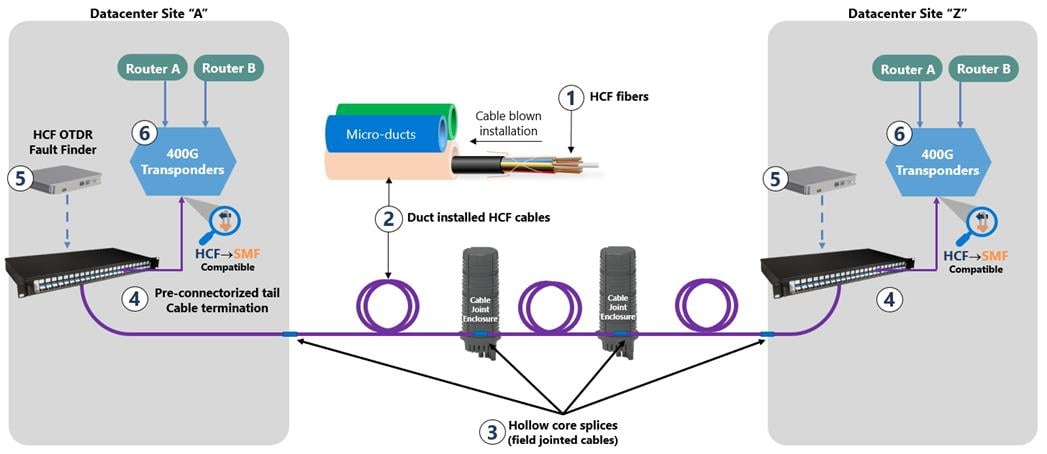
HCF maintains excellent compatibility with existing optical transport infrastructure and does not require enterprises to rebuild their hardware systems. Traditional DWDM devices, coherent optical modules, optical power meters, and spectrum analyzers all support HCF adaptation. Field trials have verified that HCF links can support up to 2 Tbps per wavelength and over 100 Tbps of total system capacity. Only minor DSP firmware tuning and parameter calibration are needed to match HCF’s unique dispersion and mode-field characteristics, resulting in extremely low upgrade barriers.
Field Construction: Standardized SMF vs Precision-Demanding HCF
Decades of industrial iteration have standardized SMF splicing, cabling, and termination workflows. General field crews can complete deployment efficiently. With excellent bending tolerance, SMF adapts well to dense cabling environments inside data centers, ensuring high construction efficiency.
HCF’s hollow microstructure requires more rigorous field handling. Excessive heat or mechanical pressure may cause core collapse, requiring dedicated splicing recipes and specialized termination tools. HCF also demands a larger minimum bending radius, requiring optimized routing in dense cabinet scenarios. For hybrid SMF–HCF networking, mode-field-matched connectors are necessary to mitigate coupling loss, back-reflection, and modal instability to guarantee link reliability.
Operational Costs: HCF Delivers Significant Long-Haul OPEX Savings
Due to relatively higher attenuation, SMF-based long-haul DCI links require optical amplifier deployment every 75–80 km, increasing capital expenditure (CAPEX) and ongoing operational costs for equipment, colocation, and power consumption.
The latest ultra-low-loss HCF technology greatly extends unrepeatered transmission distances, reducing the number of inline amplifier sites by 30%–50% on long-haul routes. This substantially reduces hardware investment, power consumption, and routine maintenance workloads, making HCF a cost-effective solution for cross-city and inter-campus AI compute cluster interconnection.
Scenario Selection Guide: When to Use HCF and When to Stick with SMF
In AI compute networking, HCF is not a full replacement for SMF but a high-performance complementary solution. The two fiber types serve differentiated scenarios, allowing enterprises to select the optimal medium based on business priority, latency sensitivity, and transmission distance.
High-Value AI Scenarios for Priority HCF Deployment
For latency-sensitive, high-value AI workloads that require extreme signal stability, HCF’s performance advantages directly translate into improved compute efficiency and commercial returns, delivering the fastest investment payback.
● Cross-Data Center Interconnection for Distributed AI Clusters: Large-model training relies on collaborative computing across massive GPU clusters, where inter-node parameter synchronization and gradient updates are highly latency-sensitive. HCF’s 30%+ latency reduction effectively lowers cluster synchronization delay, improves GPU utilization, and accelerates model training cycles. Microsoft Azure has deployed 1,200 km of commercial HCF links and is planning a 15,000 km global HCF backbone to support AI data center interconnection.
● HPC and High-Performance AI Private Networks: Supercomputing and large-scale parallel AI training require millisecond-level precise synchronization. HCF’s ultra-low nonlinearity ensures stable transmission of ultra-high-speed superchannels, eliminating packet loss and synchronization deviation in large-scale compute scheduling, making it ideal for multi-site and cross-city supercomputing cluster networking.
● Low-Latency Financial AI Links: Microsecond-level latency differences directly impact profitability and risk control accuracy for high-frequency trading, real-time risk analysis, and financial AI inference. euNetworks has deployed HCF ultra-low-latency links in London’s financial district to support latency-critical financial AI workloads.
● High-Security Quantum-AI Converged Networks: HCF features ultra-low backscatter, significantly increasing the difficulty of undetected fiber tapping and enhancing physical-layer security. It also natively supports Quantum Key Distribution (QKD), enabling encrypted and secure transmission for sensitive AI compute data in government, defense, and high-end enterprise scenarios.
General Scenarios Where SMF Remains the Optimal Choice
For short-reach, latency-tolerant, and low-priority baseline services, SMF’s cost efficiency and proven stability fully meet operational requirements.
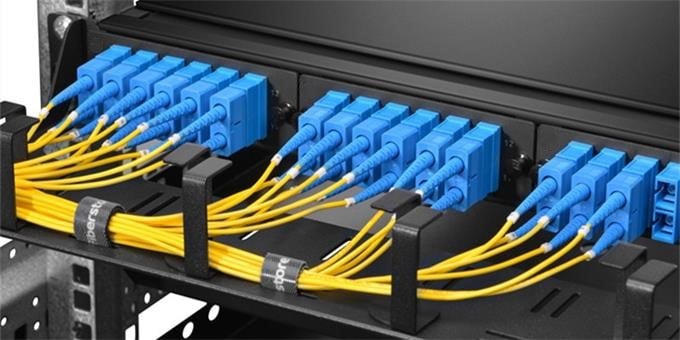
● Intra-Data Center Baseline Connectivity: SMF is sufficient for general rack-to-rack interconnection, data storage synchronization, log aggregation, and routine AI inference workloads, where HCF’s latency advantage is negligible over short distances.
● Edge AI Access Networks: For edge compute nodes, enterprise-level access links, and low-priority AI workloads without extreme bandwidth or latency requirements, SMF enables large-scale, cost-effective deployment.
● Short-Reach Redundant Backup Links: Non-critical backup and standby DCI links prioritize cost stability over ultimate performance, where SMF delivers superior cost-performance.
Industry Standard Architecture: Hybrid SMF + HCF Networking
Leading cloud providers and compute centers now adopt a hybrid networking model: SMF for baseline backbone traffic and HCF for high-value compute links. Cost-efficient SMF carries universal data services and basic interconnection, while high-performance HCF supports AI cluster synchronization, ultra-high-speed compute scheduling, low-latency financial services, and secure quantum communication. This balanced architecture optimizes both performance and total cost of ownership, representing the most mature and practical AI DCI solution available today.
ROI Analysis: Is HCF Worth Deploying?
Civil engineering, cabling, and labor costs are nearly identical for SMF and HCF. The core economic differences lie in fiber material pricing, specialized construction procedures, and long-term operational expenses, resulting in distinct scenario-based ROI performance.
SMF features mature mass production, extremely low material costs, and standardized deployment with no specialized overhead. It delivers fast returns for general networking scenarios and supports large-scale, cost-efficient infrastructure rollouts.
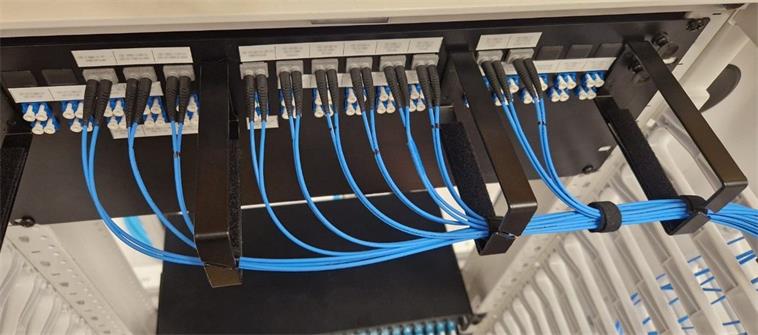
HCF requires higher upfront investment due to premium fiber materials and professional field training. However, in high-value AI DCI scenarios, long-term operational gains far exceed initial deployment premiums. Reduced latency improves GPU efficiency and shortens training cycles, lowering power consumption and hardware depreciation. Meanwhile, fewer amplifier sites cut ongoing expenditures on equipment, colocation, and maintenance. For 300–500 km cross-city AI compute links, HCF achieves rapid positive ROI.
In summary, HCF delivers high returns for high-value AI scenarios and steady iterative optimization for general use cases. As mass production matures and deployment scales up, HCF material costs will continue declining, driving broader adoption in mid-to-high-end AI networking infrastructure.
Summary & Industry Outlook
As the foundational optical medium for decades, SMF will continue dominating general-purpose data center interconnection thanks to its unrivaled cost advantages, complete industrial ecosystem, and stable transmission performance. It cannot be fully replaced in the short term.
By reinventing optical transmission with air-core propagation, HCF breaks the physical performance ceiling of traditional glass fiber. Its comprehensive strengths in ultra-low latency, suppressed nonlinearity, ultra-broad spectrum, and long-haul low-loss transmission precisely address the core challenges of distributed AI cluster synchronization, ultra-large-bandwidth data transport, and high-security compute networking, establishing HCF as the key upgrade technology for next-generation AI DCI infrastructure.
Current HCF limitations, including higher manufacturing costs, specialized construction workflows, and elevated short-reach splicing loss, remain temporary and are rapidly improving. With scaled production, pluggable HCF transceiver standardization, and unified field deployment procedures, HCF’s adoption barriers will continue to fall.
Looking ahead, the complementary architecture of SMF for basic networking and HCF for high-end compute networking will become the industry mainstream. HCF will evolve from exclusive low-latency financial and core compute scenarios toward broader applications, including premium data center interconnection, 5G/6G compute transport, and quantum-secure communication, becoming a critical pillar for future low-latency, high-bandwidth, and highly reliable AI compute infrastructure.
Frequently Asked Questions (FAQs)
What is the difference between HCF and traditional SMF?
The key difference is the transmission medium. SMF guides light through solid silica glass, with inherent latency, nonlinear distortion and bandwidth limits. HCF uses an air-filled hollow core, with over 99% of light propagating in air, delivering ultra-low latency, minimal nonlinearity and broader spectrum.
What performance benefits does HCF bring to AI DCI?
HCF cuts latency by 30%–47% vs. SMF, speeding up GPU cluster synchronization and shortening AI training cycles. It supports stable 400G/800G/1.6T transmission with low distortion, and reduces amplifier sites by 30%–50% on long-haul links to lower operating costs.
Can HCF work with existing data center optical hardware?
Yes. HCF is compatible with mainstream DWDM systems, coherent transceivers and test instruments. No full hardware replacement is needed — only minor DSP firmware calibration for mode field and dispersion characteristics, with very low upgrade barriers.
What are the current limitations of HCF vs. SMF?
HCF has higher splice/connector loss (0.3–0.6 dB vs. <0.05 dB for SMF), requires specialized splicing tools and stricter bend radius control. It also carries higher upfront material and deployment costs, making it less cost-effective for short-range, low-priority networks.
Which AI networking scenarios suit HCF and SMF respectively?
HCF fits high-value, latency-sensitive use cases: distributed AI cluster interconnection, HPC networks, low-latency financial AI and quantum-secure AI links. SMF works for cost-sensitive general scenarios: intra-DC baseline connectivity, edge AI access and backup links. The industry standard is a hybrid SMF+HCF deployment.
Is HCF a worthwhile investment?
HCF delivers strong ROI for medium-to-long-haul high-value AI DCI (e.g., 300–500 km cross-city clusters), via improved GPU efficiency and reduced amplifier OPEX. While upfront costs are higher, returns will grow as mass production matures and prices fall.
Posted on 15 Jun, 2026, by Francisco, Fibermart, All Copy Right Reserved.





No comments have been posted yet.