


.webp)


The core working principle of fiber-optic communication is to realize high-speed data transmission by utilizing the specific near-infrared spectral window of optical fibers with low loss and low dispersion. Silica optical fibers do not deliver favorable transmission performance for all light wavelengths. Only the range of 1260nm to 1625nm serves as a high-quality low-loss transmission window, which is standardized into five mainstream communication bands: O-band, E-band, S-band, C-band, and L-band. Among them, the O-band, C-band, and L-band have become the core bands of modern fiber-optic communication networks due to their unique optical properties and mature deployment scenarios, supporting full-scenario network construction including data center interconnection, 5G bearing, backbone network transmission, and submarine optical cable communication. This article focuses on the three core bands and elaborates on their technical principles, performance advantages and limitations, application scenarios, and industrial value.
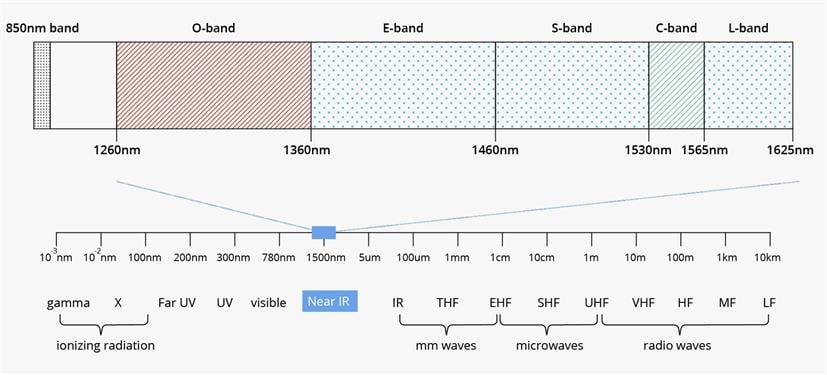
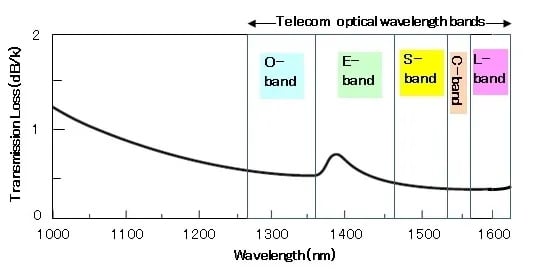
Overview of the Full Spectrum Wavelength for Fiber Optical Communication
|
Band
|
Wavelength Range
|
Notes
|
|---|---|---|
|
O-band
|
1260–1360 nm
|
Original band; minimal chromatic dispersion
|
|
E-band
|
1360–1460 nm
|
Extended band; historically limited by water peak
|
|
S-band
|
1460–1530 nm
|
Short wavelength band; moderate loss
|
|
C-band
|
1530–1565 nm
|
Conventional band; lowest attenuation
|
|
L-band
|
1565–1625 nm
|
Long band; used to extend C-band capacity
|
|
U-band
|
1625–1675 nm
|
Ultra-long band; dedicated for network monitoring
|
To adapt to diverse requirements for transmission distance, capacity, and cost, the telecom industry has standardized the 1260nm–1625nm low-loss spectral window into five fixed wavelength bands. Each band features exclusive wavelength ranges and distinct physical properties, forming the fundamental framework for optical network planning. In addition to the core O-, C-, and L-bands, the E-band and S-band undertake auxiliary transmission roles. Meanwhile, the 850nm multi-mode band and U-band are adopted for special scenarios:
● O-band (Original Band): 1260–1360nm, nearly zero fiber chromatic dispersion, the first commercially applied band for optical communication;
● E-band (Extended Band): 1360–1460nm, historically plagued by water peak loss caused by hydroxyl impurities in optical fibers. Although modern fiber manufacturing processes have optimized this defect, legacy optical cables installed in early years still restrict its large-scale deployment;
● S-band (Short Wavelength Band): 1460–1530nm, with lower transmission loss than the O-band. It is widely used for downstream transmission in Passive Optical Networks (PON) and is a key R&D direction for future ultra-high-bandwidth optical network expansion;
● C-band (Conventional Band): 1530–1565nm, featuring the lowest fiber transmission loss, serving as the core band for long-distance and high-capacity transmission;
● L-band (Long Band): 1565–1625nm, with the second-lowest transmission loss, mainly applied to supplement and expand network bandwidth.
● U-band (Ultra-long Wavelength Band): 1625–1675nm, reserved for specialized network monitoring and auxiliary system operation; rarely used for mainstream data service transmission.
Furthermore, the 850nm band is commonly used for short-distance transmission in multi-mode fiber systems, while the U-band (1625–1675nm) is dedicated to network monitoring and does not support mainstream data transmission. In the full spectral system, the O-, C-, and L-bands dominate the deployment of most commercial optical networks by virtue of their high technical maturity and scenario adaptability.
In-depth Technical Analysis of C Band, O Band, L Band
O-band: Optimal Choice for Zero-Dispersion Short-Reach Transmission
The O-band (Original Band) is the first commercialized standard band for single-mode fiber communication since the 1970s. Its core technical advantage lies in the near-zero chromatic dispersion at the central wavelength of 1310nm.
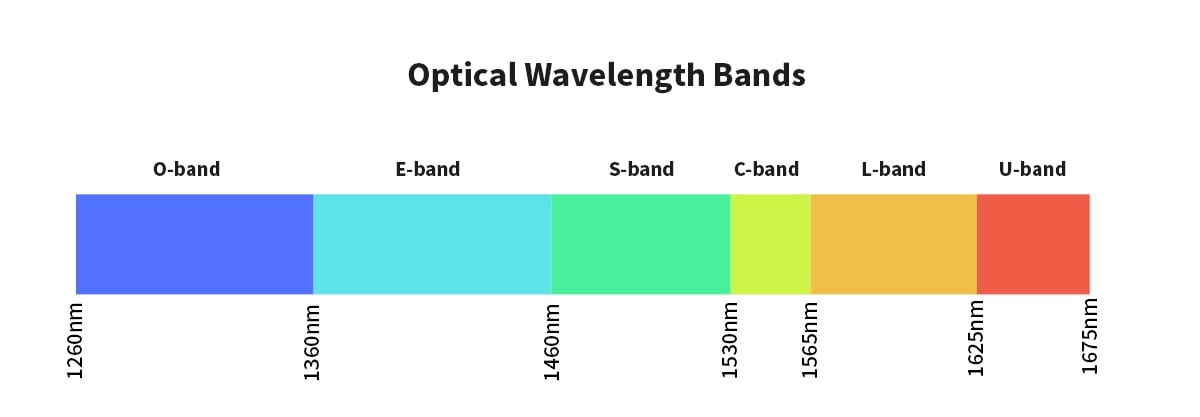
In terms of technical characteristics, optical signals transmitted in the O-band experience negligible pulse broadening and signal distortion, eliminating the need for complex dispersion compensation modules and Digital Signal Processing (DSP) units. This greatly simplifies the architecture of optical transceivers and transmission systems, reducing equipment power consumption and construction costs. However, the O-band has prominent performance limitations: its fiber transmission loss is approximately 0.35dB/km, higher than that of the C-band and L-band. Without mature dedicated optical amplification technologies, it only supports unamplified or electrical amplification transmission, limiting the maximum transmission distance within 20 kilometers.
Benefiting from low system complexity, low latency, and low power consumption, the O-band is perfectly tailored for short-distance high-speed transmission scenarios. It is widely deployed in Data Center Interconnect (DCI), 5G fronthaul/midhaul networks, campus LAN high-speed links, and Passive Optical Networks (PON), acting as a core support for short-reach optical transmission in computing power networks and edge computing scenarios.
C-band: The Backbone of Long-Haul and High-Capacity Transmission
The C-band (Conventional Band) is the most widely used and technologically mature core band in global optical communication networks, covering the wavelength range of 1530–1565nm. Its defining advantage is the ultra-low transmission loss of silica fiber (approximately 0.2dB/km), which minimizes signal attenuation during long-distance transmission.
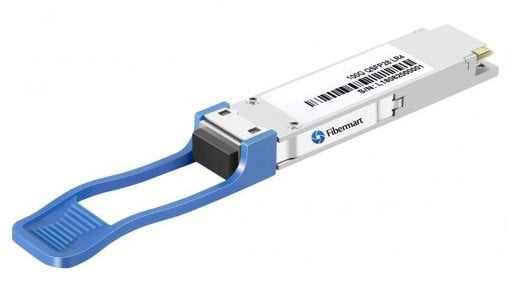
The C-band boasts excellent technical compatibility with Erbium-Doped Fiber Amplifiers (EDFAs), enabling low-noise and high-efficiency optical signal amplification and supporting repeater-free ultra-long-haul transmission of thousands of kilometers. In addition, it is highly compatible with Dense Wavelength Division Multiplexing (DWDM) technology, allowing a single fiber pair to carry 72 or more high-speed optical channels. This maximizes the bandwidth potential of optical fibers and meets the requirements for ultra-high-speed transmission from 100G to 800G and beyond.
Its main drawback is that chromatic dispersion increases quadratically with transmission distance and bit rate, requiring professional dispersion compensation systems for long-haul transmission, which raises system complexity and operation and maintenance costs. Thanks to its low loss, amplifiability, and high capacity, the C-band serves as the absolute core of metro networks, backbone networks, regional transmission networks, and transoceanic submarine cable systems. It underpins the global Internet backbone transmission and supports large-scale, high-bandwidth, and long-distance data interaction across the network.
L-band: Core Supplementary Band for C-band Bandwidth Expansion
The L-band (Long Band), ranging from 1565nm to 1625nm, is adjacent to the C-band with the second-lowest fiber transmission loss. It is specifically developed to address the bandwidth bottleneck of the C-band.
The L-band shares a highly consistent technical ecosystem with the C-band, enabling reuse of mature EDFA amplification and DWDM technologies without large-scale renovation of existing fiber infrastructure. Initially, the L-band was mainly applied in terrestrial DWDM optical networks. When C-band spectrum resources are exhausted and fail to meet surging bandwidth demands, superimposing the L-band can directly double the available optical spectrum of fibers and rapidly boost network capacity.
With the explosive growth of global Internet traffic, over 99% of intercontinental data transmission relies on submarine optical cables, and traditional C-band submarine systems are approaching their capacity limits. Currently, the L-band has been gradually deployed in submarine cable scenarios. By upgrading Submarine Line Termination Equipment (SLTE) to realize C+L dual-band multiplexing, it not only significantly improves the transmission capacity of submarine cables, but also enables spectrum sharing via spectrum virtualization technology. This provides exclusive virtual fiber links for different end-users, supports differentiated network services, and effectively enhances the scale efficiency and resource utilization of submarine networks.
Comparison of Parameters and Application Scenarios of O/C/L Bands
The performance differences among the three core bands lead to completely differentiated networking positioning. The detailed core parameters and application comparisons are as follows:
● Dispersion Characteristics: The O-band features near-zero dispersion with no dispersion compensation required; the C-band and L-band have relatively high dispersion, requiring professional dispersion compensation solutions for long-haul transmission, resulting in more complex system design.
● Transmission Loss: The C-band has the lowest loss (0.2dB/km), followed by the L-band, while the O-band has the highest loss (0.35dB/km), limiting it to short-distance transmission.
● Amplification Capability: The C-band and L-band support mature EDFA optical amplification for ultra-long-haul transmission; the O-band lacks mature optical amplification technology, resulting in limited transmission distance.
● System Cost and Complexity: The O-band features a simple architecture, low power consumption, and controllable costs; the C-band and L-band require supporting amplification and dispersion compensation equipment, leading to higher system complexity and operation and maintenance costs.
Application Scenarios: The O-band focuses on short-reach transmission within 20 kilometers, including data centers, 5G bearing networks, and local area networks; the C-band dominates long-distance high-capacity core networks such as metro, backbone, and submarine cable systems; the L-band acts as a C-band expansion supplement for ultra-high-bandwidth terrestrial networks and new-generation high-capacity submarine cable systems.
Wavelength Band Selection Logic and Industry Development Trends
There is no absolute superior or inferior among optical network bands. Band selection depends on the balance of transmission distance, bandwidth requirements, construction costs, and expansion potential. Driven by AI, cloud computing, and edge computing, modern optical networks present a development trend of simplified short-reach transmission and expanded long-haul capacity. Edge and access networks prefer the O-band to adapt to high-density short-reach computing interaction with low latency, low cost, and low complexity. Backbone and cross-border transmission networks rely on the C-band to guarantee basic capacity, while adopting the L-band to break spectrum bottlenecks. C+L dual-band converged networking maximizes the utilization of existing fiber resources.
In terms of industry evolution, single-band networking has been gradually replaced by multi-band converged networking. The O-band, C-band, and L-band perform their respective functions and complement each other, building a modern optical transmission system with efficient short-reach transmission, high-capacity long-haul transmission, and full-scale expandability, which continuously supports the iterative upgrading of global high-speed optical networks.
Conclusion
The O-band, C-band, and L-band are the core carriers of fiber-optic transmission technology. The O-band is the preferred solution for lightweight short-reach transmission due to its zero-dispersion property. The C-band anchors the core position of long-haul backbone networks with ultra-low loss and a mature industrial ecosystem. The L-band serves as a critical expansion solution to resolve global network bandwidth bottlenecks. Their technical differences shape the hierarchical and scenario-based networking architecture of modern optical networks, profoundly guiding network planning, equipment selection, and operation and maintenance upgrades. They are the core key to understanding the principles and architecture of fiber-optic communication networks.
Frequently Asked Questions (FAQ)
What are the applicable scenarios for O-band, C-band and L-band?
O-band applies to short-reach transmission within 20 km, such as data centers and 5G fronthaul. C-band is used for long-haul backbone, metro and submarine transmission. L-band serves as a C-band supplement for network capacity expansion.
Why is C-band dominant in long-distance optical transmission?
C-band features the lowest fiber attenuation (0.2 dB/km), supports mature EDFA amplification and high-density DWDM, enabling long-distance, high-capacity and low-noise stable transmission.
Why cannot O-band support long-haul transmission?
O-band has higher fiber loss (0.35 dB/km) and lacks mature optical amplification technology, resulting in severe signal attenuation over distance and a maximum transmission limit of 20 km.
What are the benefits of C+L band networking?
C-band and L-band are highly compatible. C+L dual-band networking doubles fiber spectrum resources, fully leverages existing infrastructure, and efficiently solves C-band bandwidth saturation at low cost.
Why do data centers prefer O-band transmission?
O-band has near-zero dispersion, requiring no complex compensation modules. It features simple system architecture, low latency, low power consumption and low cost, perfectly matching data center short-reach high-speed transmission demands.
Why does C-band long-haul transmission need dispersion compensation?
C-band dispersion increases with transmission distance and rate, causing signal pulse broadening and distortion. Dispersion compensation ensures signal integrity and transmission stability for long-haul links.
Posted on 8 Jun, 2026, by Francisco, Fibermart, All Copy Right Reserved.





No comments have been posted yet.