


.webp)


Optimize your PON with PLC splitters for scalability, efficiency, and future-proofing. Discover best practices for high-performance fiber networks with Fibermart.
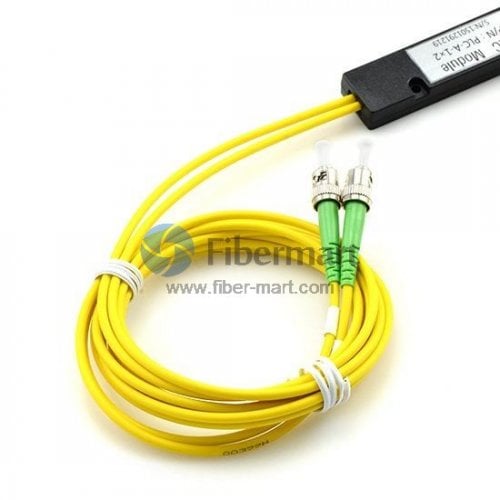
Building a future-proof broadband infrastructure requires a well-designed Passive Optical Network (PON) that balances scalability, cost efficiency, and performance. With the increasing demand for high-speed internet, network operators must optimize their PON architectures to handle higher bandwidth, support more subscribers, and ensure long-term sustainability. Planar Lightwave Circuit (PLC) splitters are critical to achieving these objectives, as they enable efficient optical signal distribution while maintaining network integrity.
What is Passive Optical Networks (PON)?
A Passive Optical Network is a telecommunications technology that delivers broadband network access by utilizing point-to-multipoint fiber to the premises. Unlike active networks, PONs employ passive components—such as optical splitters—that do not require electrical power to function. This passive nature reduces operational costs and enhances network reliability.
|
The Role of PLC Splitters in PON
A PLC splitter is a passive optical device that divides an incoming optical signal into multiple outputs while maintaining equal power distribution. These splitters are fundamental to GPON (Gigabit PON), XG-PON (10G PON), and XGS-PON (10G symmetric PON) deployments, allowing multiple end-users to share a single fiber strand efficiently.
Unlike Fused Biconic Taper (FBT) splitters, which are limited in scalability and wavelength uniformity, PLC splitters use silica waveguide technology to provide:
· Higher splitting ratios (1×2 to 1×64) with minimal signal loss
· Broad wavelength compatibility (1260 nm to 1650 nm) for multi-service applications
· Consistent performance across all output ports
Why PLC Splitters Are Essential for Scalable PON Design
A scalable PON architecture must accommodate increasing subscriber density without excessive infrastructure upgrades. PLC splitters optimize fiber usage and minimize operational costs by allowing service providers to:
· Extend network reach without additional active components
· Ensure uniform optical power distribution for reliable service quality
· Enable efficient Central Office (CO) or Optical Line Terminal (OLT) resource allocation
To achieve these advantages, network planners must strategically position PLC splitters across the distribution network.

Key Design Considerations for a Scalable PON with PLC Splitters
1. Optimizing Splitter Placement: Centralized vs. Cascaded Topologies
The effectiveness of a PON depends on how PLC splitters are deployed within the network. The two primary architectures used are:
Centralized Splitter Architecture
· A single-stage splitter (1×N) is placed near the OLT in the Central Office (CO).
· Optical signals are distributed directly to subscriber locations.
· Ideal for dense urban areas with short fiber runs.
· Easier maintenance but requires more fiber infrastructure.
Cascaded (Distributed) Splitter Architecture
· A two-stage splitting method using a 1×4 splitter at the CO and 1×8 splitters near end-users to form a 1×32 distribution.
· Reduces fiber consumption by allowing higher subscriber counts per OLT port.
· Improves network flexibility, making it suitable for suburban and rural deployments.
· More cost-effective for large-scale rollouts but requires careful loss management.
2. Balancing Splitting Ratios and Optical Budget
Selecting the correct splitting ratio is crucial for maintaining optimal signal strength across the network. Higher split ratios (1×32, 1×64) increase network reach but also introduce higher insertion loss.
|
Splitter Ratio |
Typical Insertion Loss (dB) |
Recommended Use Case |
|
1×2 |
3.5 dB |
High-performance, low-loss networks |
|
1×4 |
7.0 dB |
Small-scale urban deployments |
|
1×8 |
10.5 dB |
Medium-density residential areas |
|
1×16 |
13.5 dB |
Suburban rollouts |
|
1×32 |
16.5 dB |
Rural or long-distance networks |
|
1×64 |
20.5 dB |
Large-scale networks with amplification |
To maintain an optimal link budget, network designers must account for fiber attenuation, connector losses, and power penalties due to aging and repairs.
3. Future-Proofing PON for Next-Generation Technologies
With XGS-PON, NG-PON2 (Next-Generation PON 2), and WDM-PON gaining traction, scalable designs must accommodate:
· Higher bandwidth demands (10G, 25G, and beyond)
· Coexistence with legacy GPON infrastructure
· Wavelength tuning for multi-service applications (business, mobile backhaul, smart cities)
A scalable PLC splitter-based PON should support wavelength-division multiplexing (WDM) for seamless integration with 5G fronthaul networks, enterprise connectivity, and video distribution.
4. Reducing Network Complexity with Pre-terminated PLC Splitters
Traditional fiber splicing increases deployment time and maintenance costs. Pre-terminated PLC splitters simplify installation by offering:
· Factory-polished connectors for plug-and-play deployment
· Reduced fusion splicing requirements, minimizing field labor
· Improved reliability due to controlled assembly conditions
For large-scale PON rollouts, using pre-terminated splitters in sealed outdoor enclosures enhances network durability and reduces downtime.
5. Minimizing Signal Loss with High-Quality Splitters
The efficiency of a scalable PON depends on splitter insertion loss, polarization-dependent loss (PDL), and return loss. Selecting low-loss PLC splitters ensures:
· Better signal integrity over long distances
· Higher optical power margins for future expansion
· Reduced need for optical amplifiers, lowering CAPEX and OPEX
Premium PLC splitters with ≤ 10.5 dB loss for 1×8 configurations provide better long-term performance than budget alternatives with higher variability.

Deployment Strategies for Scalable PON Growth
1. Gradual Network Expansion with Modular Splitter Deployment
Instead of over-provisioning fiber infrastructure, service providers should deploy PLC splitters in phases. Using modular, rack-mounted splitters at aggregation points allows easy capacity scaling without major reconfiguration.
2. Hybrid PON Solutions for Diverse Service Requirements
To support enterprise, residential, and mobile backhaul services within the same infrastructure, a hybrid PON can integrate:
· GPON for residential FTTH
· XGS-PON for enterprise and high-speed users
· NG-PON2 for long-haul and 5G transport
3. Proactive Optical Power Monitoring for Long-Term Reliability
A scalable PON must include real-time optical power monitoring to detect signal degradation early. Deploying optical line monitoring systems (OLMS) at OLT sites enhances fault detection and reduces maintenance costs.
Build a Scalable PON for the Future
Designing a scalable PON with PLC splitters requires careful planning to balance capacity, cost, and network longevity. A well-structured architecture featuring strategic splitter placement, optimized split ratios, and future-proofed technology integration ensures seamless broadband expansion.
Fibermart offers high-performance PLC splitters designed to support GPON, XGS-PON, and NG-PON2 networks with low insertion loss, superior reliability, and cost-efficient scalability.
Enhance your PON deployment today with Fibermart’s industry-leading optical solutions. Schedule a consultation with us for our full range of PLC splitters and fiber network components.





No comments have been posted yet.