


.webp)


In high-density networking environments such as data centers and telecom facilities, MPO cable has emerged as a cornerstone solution for efficient, high-bandwidth data transmission. With its ability to support 8 to 576 fibers in a single connector, MPO cable streamlines cabling infrastructure, saves space, and reduces installation time. However, ensuring seamless signal transmission between devices hinges on one critical factor: polarity. Polarity defines the correct alignment of fiber strands in an MPO cable, ensuring that optical signals travel from the transmit (Tx) port of one device to the receive (Rx) port of another. This guide provides a detailed comparison of the three primary MPO cable polarity types—Type A, Type B, and Type C—explaining their design principles, applications, advantages, and limitations to help network engineers make informed decisions.
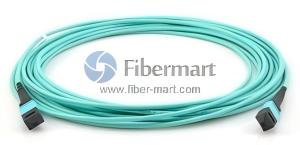
Understanding MPO Cable Polarity: The Foundation of Reliable Signal Transmission
Before delving into the specifics of each polarity type, it is essential to grasp why polarity matters for MPO cable and how it differs from traditional fiber optic cables. Unlike single-fiber or duplex fiber cables (which use separate connectors for Tx and Rx), MPO cable bundles multiple fibers into a single connector. Without proper polarity, signals may be sent to Tx ports instead of Rx ports, resulting in communication failures, data loss, or reduced transmission speeds.
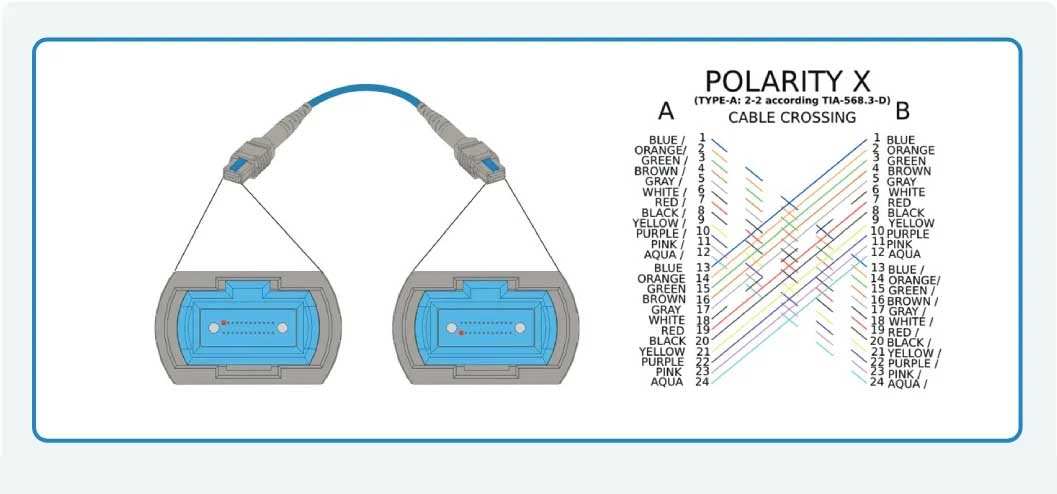
Key Role of Polarity in MPO Cable
Polarity ensures that each fiber strand in an MPO cable is mapped correctly between the transmitting and receiving devices. For example, in a 12-fiber MPO cable, the fiber carrying Tx signals from Device A must align with the fiber connected to the Rx port of Device B, and vice versa. This alignment is standardized by industry bodies such as TIA/EIA and ISO, which define three distinct polarity methods—Type A, Type B, and Type C—to accommodate different network topologies and device configurations.
Core Design Principles of MPO Cable Polarity
All three MPO cable polarity types rely on two core components to maintain alignment: Fiber Mapping (a predefined sequence that assigns each fiber strand in the MPO connector to a specific Tx/Rx role) and Connector Orientation (the way MPO connectors—male or female, UPC or APC polish—are installed on the cable ends to match the fiber mapping). The primary difference between Type A, Type B, and Type C lies in how these two components are combined to achieve Tx-Rx alignment. Below is a detailed breakdown of each type.
MPO Cable Polarity Type A: The "Straight-Through" Standard
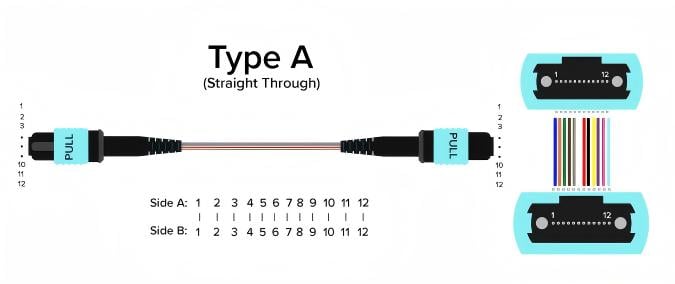
MPO cable Type A, also known as the "straight-through" polarity, is the most widely used type in data centers and enterprise networks. Its design follows a simple, direct fiber mapping, making it easy to install and troubleshoot.
Design and Fiber Mapping
Type A MPO cable uses a straight-through fiber sequence: the fiber in position 1 of the connector on one end of the cable aligns with position 1 on the other end, position 2 aligns with position 2, and so on. To ensure Tx-Rx alignment, devices (such as switches or transceivers) connected to Type A MPO cable are designed with "crossed" internal ports. For instance, Device A’s Tx signal is sent through fiber 1 of the MPO cable, and the cable’s straight-through mapping delivers fiber 1 to Device B’s Rx port—this works because Device B’s internal wiring swaps Tx and Rx positions. This design eliminates the need for cross-over in the cable itself, simplifying manufacturing and reducing the risk of polarity errors.
Advantages and Applications
Type A MPO cable offers three key advantages. First, its straight-through mapping makes it easy to test and maintain; technicians can quickly verify polarity using standard fiber testers without complex sequence checks. Second, it boasts broad compatibility—most modern networking devices (including 40G/100G transceivers and patch panels) are preconfigured to work with Type A polarity. Third, its straightforward design reduces manufacturing costs, making it the most affordable option for high-volume deployments.
This type is ideal for short-distance, high-density applications such as data center backbone connections between racks, enterprise network links for 10G/40G/100G Ethernet, and pre-terminated cabling systems (a common offering in Fibermart’s MPO cable lineup, which includes factory-tested Type A assemblies).
Limitations
Type A MPO cable has two notable limitations. It is highly device-dependent—relying on devices with crossed internal ports. If connected to devices with straight-through ports, it causes polarity reversal (Tx to Tx, Rx to Rx), leading to signal failure. Additionally, while it works well for short distances, it may require additional repeaters for long-haul transmissions (over 10km), as straight-through fiber paths can accumulate more signal attenuation.
MPO Cable Polarity Type B: The "Cross-Over" Alternative
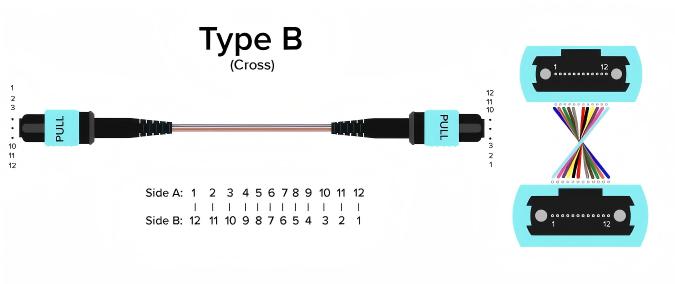
MPO cable Type B, or "cross-over" polarity, addresses the device dependence of Type A by incorporating a fiber cross-over directly in the cable. This design is commonly used in networks where devices have straight-through internal ports (e.g., older telecom equipment or legacy servers).
Design and Fiber Mapping
Type B MPO cable uses a reversed fiber sequence at one end of the cable. In a 12-fiber cable, for example, the fiber in position 1 of the first connector aligns with position 12 of the second connector, position 2 aligns with position 11, and so on. This cross-over ensures that Device A’s Tx signal (sent through fiber 1) maps to Device B’s Rx port (connected to fiber 12 of the second connector)—no additional internal cross-over is needed in the devices, as the cable itself handles the Tx-Rx swap. Fibermart’s Type B MPO cable assemblies often feature this reversed mapping, with test reports verifying the cross-over sequence to ensure compliance with TIA/EIA standards.
Advantages and Applications
Type B MPO cable offers distinct advantages for specific use cases. It provides device flexibility, working with devices that have straight-through ports and eliminating the need to replace or reconfigure legacy equipment. It is also suitable for long-distance links (over 10km); its cross-over design can reduce signal reflection, making it a preferred choice for telecom backbones and inter-building connections. Additionally, it minimizes human error during installation—by integrating the cross-over into the cable, technicians do not need to check device port configurations before deployment.
This type is well-suited for legacy telecom networks with straight-through port devices, long-haul connections between data centers or cities, and industrial networks where equipment upgrades are costly or disruptive.
Limitations
Type B MPO cable has two key limitations. It requires more complex testing than Type A; the reversed fiber sequence demands specialized testing tools to verify polarity, increasing maintenance time and costs. It also carries compatibility risks—connecting Type B MPO cable to devices with crossed ports causes double cross-over (Tx to Rx to Tx), resulting in signal failure. Careful device port inspection is required before installation.
MPO Cable Polarity Type C: The "Pair-Swapped" Innovation
MPO cable Type C, also called "pair-swapped" polarity, is the most versatile type, designed to support both straight-through and cross-over device ports. Its unique fiber mapping swaps adjacent fiber pairs, making it compatible with a wide range of network configurations.
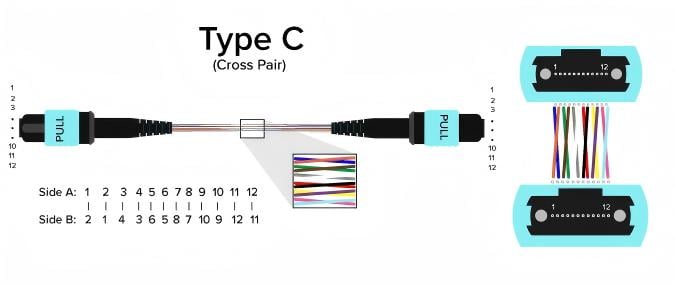
Design and Fiber Mapping
Type C MPO cable uses a pair-swapped sequence. In a 12-fiber cable, for example, fiber 1 aligns with fiber 2, fiber 2 aligns with fiber 1, fiber 3 aligns with fiber 4, fiber 4 aligns with fiber 3, and so on. This pair-wise swap allows the cable to adapt to both device port types: when connected to devices with crossed ports, the pair swap cancels out the device’s internal cross-over to ensure Tx-Rx alignment; when connected to devices with straight-through ports, the pair swap acts as a cross-over to achieve the same alignment. This flexibility makes Type C MPO cable a "universal" solution, reducing the need to stock multiple polarity types.
Advantages and Applications
Type C MPO cable’s greatest strength is its versatility—it works with all device port configurations, making it ideal for mixed-network environments (e.g., data centers with both modern and legacy equipment). It also supports future-proofing; as networks upgrade to higher speeds (200G/400G Ethernet), Type C’s pair-swapped design is compatible with emerging transceiver technologies that require flexible polarity. Additionally, it cuts inventory costs: by replacing Type A and Type B with a single Type C MPO cable, organizations simplify procurement (a key benefit of Fibermart’s customizable Type C offerings).
This type is recommended for mixed-technology data centers with diverse device port types, high-speed networks (200G/400G) requiring adaptable polarity, and cloud service providers that need to quickly reconfigure network links.
Limitations
Type C MPO cable has two main limitations. Its manufacturing process is more complex—the pair-swapped sequence requires precise fiber alignment, making it more expensive than Type A or Type B. It also demands more complex testing; verifying pair-swapped polarity requires advanced testing tools that can detect individual fiber pair alignment, increasing maintenance complexity.
Comparative Summary: Choosing the Right MPO Cable Polarity Type
To help network engineers select the appropriate MPO cable polarity type, it is critical to compare key attributes of Type A, Type B, and Type C based on real-world needs.
In terms of fiber mapping, Type A uses a straight sequence (1→1, 2→2, ...), Type B relies on a reversed sequence (1→12, 2→11, ... for 12-fiber cables), and Type C employs a pair-swapped sequence (1→2, 2→1, ...). For device port compatibility, Type A only works with devices that have crossed ports, Type B is limited to devices with straight-through ports, and Type C is the most flexible, supporting both port types.
Installation complexity varies too: Type A has low complexity due to simple testing, Type B has medium complexity (requiring port inspection before installation), and Type C has high complexity (needing advanced testing tools). Cost-wise, Type A is the most affordable, Type B falls in the medium range, and Type C is the most expensive.
When it comes to ideal applications, Type A shines in modern data centers and 10G/40G Ethernet links, Type B is better suited for legacy telecom and long-haul connections, and Type C excels in mixed-technology networks and 200G/400G high-speed environments.
MPO cable polarity—whether Type A, Type B, or Type C—plays a pivotal role in ensuring reliable, high-speed data transmission in high-density networks. Type A is the go-to choice for modern, cost-sensitive environments with crossed-port devices, while Type B excels in legacy telecom and long-haul applications. Type C, though more expensive, offers unmatched versatility for mixed-technology networks and future-proofing.
When selecting an MPO cable, it is critical to first inspect device port configurations (crossed or straight-through) to match the polarity type. Second, choose a reputable supplier like Fibermart, which offers factory-tested, ISO-compliant MPO cable assemblies with detailed polarity documentation. Third, consider future network upgrades (e.g., 200G/400G) to select a polarity type that supports evolving technologies.
By understanding the unique characteristics of each MPO cable polarity type, network professionals can build efficient, resilient infrastructure that meets current and future bandwidth demands.





No comments have been posted yet.