


.webp)


In the rapidly advancing field of optical communication, optical switch and optical circulator are two pivotal components that underpin the efficient transmission and management of light signals. Though both are integral to optical network operations, their design philosophies, functional capabilities, and application scenarios diverge significantly. This article delves into these core differences, providing clarity on how each component contributes to optimizing optical systems for varied operational requirements.
Core Definitions and Operational Principles
What is an Optical Switch?
An optical switch is a dynamic electro-optic device engineered to selectively route optical signals among multiple input and output ports. Its primary function is to reconfigure signal paths as needed, facilitating flexible signal management in intricate network setups. It operates across a wide wavelength spectrum and leverages diverse technologies such as mechanical actuation, MEMS (Micro-Electro-Mechanical Systems), and solid-state mechanisms to achieve signal routing.
Available in configurations like 1xN, 2x2, and NxN, and compatible with single-mode, multi-mode, and polarization-maintaining fibers, it offers versatility for different network architectures. With options for latching and non-latching operation modes, it can adapt to various system power requirements, making it a flexible solution for dynamic network environments.

What is an Optical Circulator?
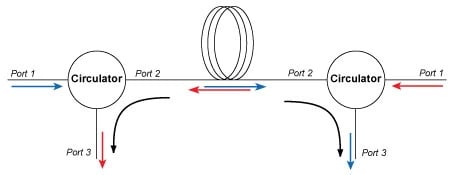
An optical circulator is a passive, non-reciprocal component designed to direct light signals sequentially through three or more ports in a unidirectional fashion. Unlike the reconfigurable nature of its counterpart, it operates without external control. Light entering Port 1 exits solely through Port 2, light entering Port 2 exits through Port 3, and this sequential flow continues, with minimal signal leakage between non-adjacent ports.
The unidirectional routing capability is achieved through Faraday rotation, a magnetic-optical effect that alters the polarization of light as it passes through a magnetized material. Valued for high isolation (typically ≥ 50dB) and low insertion loss, optical circulators are mainly used with single-mode fibers and operate within specific wavelength bands (e.g., 1310nm, 1550nm). Common configurations are 3-port and 4-port, and their passive design eliminates the need for a power supply or control interface, setting them apart from active components.
Key Differences in Design and Functionality
Operational Nature: Active vs. Passive
The fundamental distinction between the two lies in their operational nature. The optical switch is an active component that relies on external power and control signals (via interfaces like TTL, RS232, or USB) to reconfigure signal paths. This active control enables real-time adjustments, allowing network operators to reroute signals promptly for purposes such as network protection, testing, or load balancing.
On the other hand, the optical circulator is a passive component. It depends on the inherent properties of materials (Faraday rotation) to direct light, requiring no external power or control. Its routing behavior is fixed during manufacturing, and signal paths cannot be reconfigured afterward. This passivity ensures high reliability for long-term, static applications but lacks the flexibility offered by active components.
Routing Capability: Flexible vs. Fixed
When it comes to routing capability, the optical switch excels in flexible routing. Supporting multiple input/output ports, it can connect any input port to any output port, enabling non-blocking cross-connects, broadcast switching, or hybrid configurations (e.g., optical switch + WDM). This flexibility makes it suitable for scenarios where signal paths need frequent adjustments based on changing network demands.
In contrast, the optical circulator provides fixed, sequential routing. For example, a 3-port circulator only allows signal flow from Port 1→Port 2→Port 3→Port 1 (or in reverse for certain designs), with no option to skip ports or reassign paths. This fixed directionality is ideal for applications where signal paths are predetermined, such as separating transmit and receive signals in bidirectional communication systems.
Port Configuration and Scalability
In terms of port configuration and scalability, the optical switch offers high scalability. It is available in various form factors, including rackmount, benchtop, and module packaging, supporting configurations ranging from simple 1x2 setups to complex NxN directional matrices. This scalability makes it well-suited for large-scale networks like data centers or telecom backbones, where high port density and dynamic routing are essential.
Optical circulators, however, have limited scalability. Most commercial models are 3-port or 4-port devices, and higher port counts (e.g., 5-port) are rare and costly. Their fixed port configuration and unidirectional flow restrict their application to scenarios with specific, small-scale routing needs, and they cannot match the scalability of the optical switch in large network deployments.
Performance Metrics
While both components prioritize low insertion loss and high signal integrity, their performance metrics are tailored to their design objectives:
● Optical Switch: Key performance indicators include switching time, cycle lifetime, cross-talk, and polarization-dependent loss (PDL). These metrics ensure reliable, fast, and repeatable signal routing in dynamic network environments.
● Optical Circulator: Critical metrics include isolation (≥ 50dB between non-adjacent ports), insertion loss (< 0.5dB), and polarization mode dispersion (PMD). These metrics optimize signal separation and minimize distortion in unidirectional systems.

Application-Specific Use Cases
Where to Use an Optical Switch
The dynamic and configurable characteristics of the optical switch make it ideal for applications requiring real-time signal rerouting. It is widely used in network protection and restoration in telecom fiber rings, enabling quick rerouting to backup paths during network failures and minimizing downtime. In automated test equipment (ATE) for laboratories and manufacturing facilities, it facilitates sequential testing of multiple fiber components without manual reconnection. Additionally, it plays a crucial role in reconfigurable optical cross-connect (OXC) and optical add/drop multiplexer (OADM) systems, as well as optimizing traffic flow in data center networks and high-performance computing clusters.
Where to Use an Optical Circulator
The passive, unidirectional routing of optical circulators is critical for applications requiring signal separation. In fiber-to-the-home (FTTH) networks, they separate upstream (user-to-network) and downstream (network-to-user) signals on a single fiber, reducing infrastructure costs. In optical time-domain reflectometers (OTDR), circulators direct test signals into the fiber while isolating reflected signals for analysis, enabling fault detection in long-haul fibers. They are also used in wavelength-division multiplexing (WDM) networks to separate pump lasers from signal wavelengths in erbium-doped fiber amplifiers (EDFAs), preventing signal interference.
Choosing the Right Component for Your Network
Selecting between the two components depends on three key factors:
● Routing Flexibility: If your application demands dynamic, reconfigurable signal paths, the optical switch is the optimal choice. For fixed, unidirectional routing, the optical circulator is more suitable.
● Power and Control: In remote or power-constrained environments, the passive optical circulator is preferable. For applications requiring real-time control and adjustments, the active optical switch is necessary.
● Network Scale: Large-scale networks with high port counts, such as data centers and telecom backbones, benefit from the scalability of the optical switch. Small-scale, static systems like FTTH and OTDR testing are better served by optical circulators.

Summary
While both optical switch and optical circulator are indispensable to optical networking, their differences in design, functionality, and application are significant. The optical switch serves as a dynamic, configurable solution, enabling real-time signal rerouting, scalability, and active control for complex, evolving networks. The optical circulator, meanwhile, is a reliable, passive component that delivers fixed, unidirectional routing for applications requiring signal separation and low maintenance.
Understanding these differences is crucial for network designers and engineers to optimize system performance, reduce costs, and ensure seamless signal management. Whether deploying an optical switch for dynamic network protection or an optical circulator for bidirectional communication, each component plays a unique role in powering the next generation of optical systems. As optical networks continue to grow in complexity, the distinct strengths of these two components will remain essential to unlocking their full potential.





No comments have been posted yet.