


.webp)


In the rapidly evolving landscape of passive optical networks (PON), Planar Lightwave Circuit (PLC) splitters stand as indispensable components, responsible for the efficient and reliable distribution of optical signals. Whether deploying a Fiber-to-the-Home (FTTH) network, optimizing data center connectivity, or enhancing enterprise cabling systems, selecting the right PLC splitter is critical to ensuring network performance, stability, and long-term cost-effectiveness. With a wide range of options available in terms of configurations, specifications, and packaging, it is essential to prioritize key factors that align with your specific application requirements. Below are the top 5 factors to consider when purchasing a PLC splitter.
PLC Splitter Core Performance Specifications: The Foundation of Reliable Signal Distribution
Insertion Loss and Uniformity
Insertion loss refers to the amount of optical power lost as the signal passes through the splitter, and it is one of the most important metrics to consider. Lower insertion loss ensures that the maximum amount of signal power reaches the end devices, minimizing the need for additional amplification and reducing operational costs. For example, a high-quality 1x8 PLC splitter typically features an insertion loss of ≤10.5dB, which is optimal for most PON applications. Equally important is insertion loss uniformity, which measures the consistency of power distribution across all output channels. A uniformity of ≤0.6dB ensures that each end user or device receives a stable and consistent signal, preventing performance disparities that can disrupt services such as video streaming, voice calls, or data transfer.

Polarization-Dependent Loss (PDL) and Wavelength-Dependent Loss (WDL)
Polarization-dependent loss (PDL) occurs when the splitter’s performance varies based on the polarization state of the input light. In modern optical networks, where signals may travel long distances and encounter various polarization changes, a low PDL (≤0.2dB is ideal) is essential to maintain signal integrity. Similarly, wavelength-dependent loss (WDL) refers to variations in insertion loss across different operating wavelengths. Since PLC splitters are often used in multi-wavelength systems (supporting 1310nm, 1490nm, and 1550nm for triple-play services), a WDL of ≤0.5dB ensures consistent performance across all required transmission bands, avoiding signal degradation at specific wavelengths.
Return Loss and Directivity
Return loss measures the splitter’s ability to reflect unwanted signals back toward the source, with higher values indicating better performance. A return loss of ≥55dB minimizes signal reflection, which can cause interference and reduce network efficiency. Directivity, closely related to return loss, quantifies the splitter’s ability to isolate input and output ports, preventing cross-talk between channels. A directivity of ≥55dB ensures that signals from one output port do not leak into another, maintaining the purity and integrity of each optical channel.
PLC Splitter Configuration and Scalability: Aligning with Network Requirements
Basic Configuration Types: 1xN vs. 2xN
The two primary configuration types are 1xN and 2xN, where “N” represents the number of output ports. 1xN splitters feature a single input port and multiple output ports (ranging from 1x2 to 1x128), making them ideal for point-to-multipoint networks such as FTTH, where a single central office signal needs to be distributed to multiple end users. 2xN splitters, with two input ports and multiple output ports (up to 2x128), are designed for redundant or dual-fiber network architectures, providing backup connectivity in case one input fiber fails. This configuration is particularly valuable for mission-critical applications such as data centers or enterprise networks, where downtime must be minimized.

Port Count and Split Ratio
The number of output ports (port count) should be matched to the size of your network. For small-scale deployments (e.g., a small office or residential building), a 1x4 or 1x8 splitter may be sufficient. For large-scale FTTH networks or data centers, higher port counts (such as 1x32, 1x64, or 1x128) are necessary to support hundreds or thousands of end devices. Additionally, ensure that the split ratio is symmetrical (the standard for most PON applications), meaning that the optical power is evenly distributed across all output ports. Symmetrical split ratios guarantee consistent performance for all end users, avoiding situations where some ports receive weaker signals than others.
Scalability for Future Expansion
When selecting a PLC splitter, it is important to consider future network expansion. Investing in a splitter with a higher port count than your current needs (within reason) can save costs and reduce downtime later, as you will not need to replace the splitter when adding more end users or devices. For example, if you currently need to support 32 end users, a 1x64 splitter provides room for growth without requiring a complete network overhaul. Additionally, choose splitters that are compatible with industry standards, ensuring that they can be easily integrated with new network components as your system evolves.
PLC Fiber Splitter Packaging and Installation: Ensuring Compatibility and Ease of Deployment
Common Packaging Options
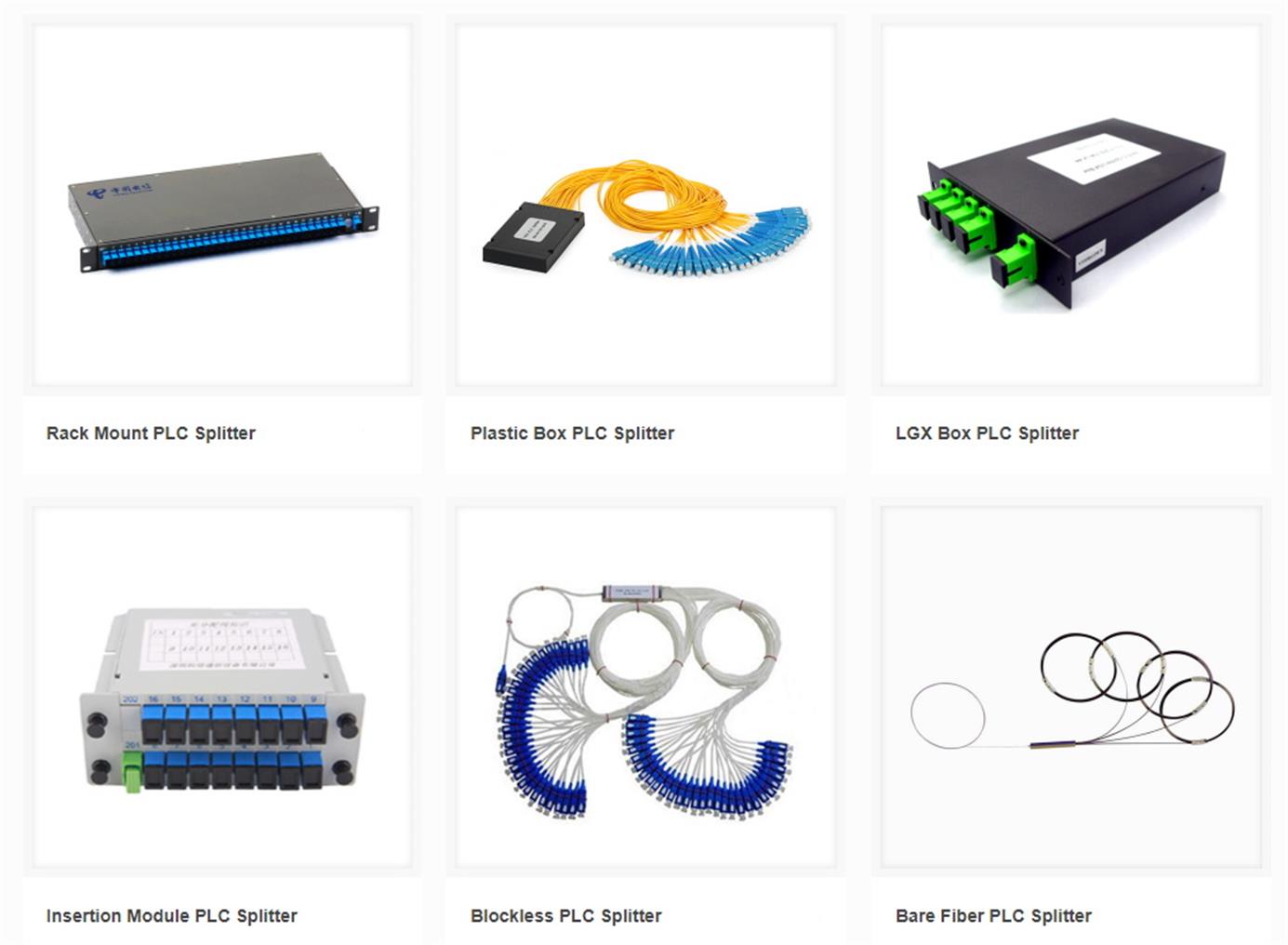
PLC splitters are available in several industry-standard packaging types:
● Bare Fiber (Blockless): These splitters feature no external housing, making them compact and lightweight. They are ideal for space-constrained environments such as inside fiber optic patch panels or cabinets, where minimal footprint is required.
● ABS Box: ABS (Acrylonitrile Butadiene Styrene) boxes provide physical protection for the splitter, shielding it from dust, moisture, and mechanical damage. They are easy to integrate into existing network infrastructure and are suitable for both indoor and outdoor deployments (when properly sealed).
● Rack-Mount: Rack-mount splitters (typically 1U 19-inch) are designed for high-density installations such as central offices or data centers. They can be mounted on standard server racks, maximizing space efficiency and simplifying cable management.
● LGX and Mini Plug-in Types: LGX packaging is compatible with LGX fiber optic enclosures, commonly used in enterprise and data center environments. Mini plug-in types are compact and designed for easy insertion into small enclosures or patch panels, ideal for applications where quick installation and replacement are needed.
Environmental Suitability
Consider the operating environment of the splitter when choosing packaging. If the splitter will be deployed outdoors or in harsh conditions (e.g., extreme temperatures, humidity, or dust), ensure that the packaging is rugged and weather-resistant. Most high-quality PLC splitters are rated for a wide temperature range (-40°C to +85°C for both operating and storage), making them suitable for outdoor and industrial environments. However, the packaging must provide adequate protection to ensure that the internal components remain intact and functional under these conditions.
Installation Ease and Cable Management
Ease of installation is another key factor, especially for large-scale deployments where time and labor costs are significant. Look for splitters with pre-terminated fiber pigtails (input/output fibers) of appropriate lengths (1m is standard, but customized lengths are often available). Pre-terminated fibers eliminate the need for on-site splicing, reducing installation time and the risk of human error. Additionally, consider the fiber diameter (250um, 0.9mm, 2.0mm, or 3.0mm) to ensure compatibility with your existing fiber optic cables and connectors. Proper cable management features, such as cable retention clips or labeling, can also simplify installation and maintenance.
PLC Fiber Splitter Material Quality and Reliability: Ensuring Long-Term Performance
Core Components: Fiber Array and PLC Chip
The heart of a PLC-optic splitter is the silica-based PLC chip, which contains integrated optical waveguides fabricated using photolithographic semiconductor manufacturing techniques. High-quality PLC chips ensure precise waveguide paths, resulting in consistent split ratios, low loss, and minimal signal distortion. The fiber array, which connects the input/output fibers to the PLC chip, should be manufactured using high-quality fiber (such as G.657A1 or polarization-maintaining (PM) fiber for specialized applications). G.657A1 fiber is bend-insensitive, making it ideal for installations where fibers may be routed around tight corners or bundled with other cables. PM fiber, used in Polarization Maintaining PLC splitters, preserves the linear polarization of the signal, critical for coherent detection systems and optical sensing applications.

Compliance with Industry Standards
To ensure material quality and performance, choose PLC splitters that comply with rigorous industry standards. Look for certifications such as Telcordia GR-1221-CORE, GR-1209-CORE (for reliability and performance), RoHS (for environmental safety), CE, FCC, and ISO9001 (for quality management systems). Compliance with these standards guarantees that the splitter has undergone rigorous testing and meets the highest quality and safety requirements. Additionally, 100% individual testing (with a detailed testing report for each unit) ensures that every splitter performs as specified, reducing the risk of receiving defective products.
Long-Term Reliability and Lifetime Warranty
A high-quality PLC splitter should be designed for long-term use, with a lifespan that matches the expected duration of your network infrastructure. Look for manufacturers that offer a lifetime warranty, as this indicates confidence in the product’s reliability. A lifetime warranty ensures that if the splitter fails due to manufacturing defects or normal wear and tear, it will be replaced free of charge, providing peace of mind and reducing long-term maintenance costs. Avoid low-quality splitters that offer short warranties or no warranties at all, as they may fail prematurely and require costly replacements.
Manufacturer Reputation and Support: Partnering for Success
Manufacturer Expertise and Experience
Choose a manufacturer with extensive experience in the fiber optic industry, particularly in the design and production of PLC splitters. Manufacturers with a deep understanding of planar lightwave circuit technology and PON architectures are more likely to produce splitters that meet the specific needs of your network. Look for manufacturers that invest in research and development, staying ahead of industry trends and technological advancements. This ensures that the splitter you purchase is based on the latest technology and will remain compatible with future network upgrades.
Customer Support and Technical Assistance
Technical support is essential, especially for complex network deployments. A reputable manufacturer should provide responsive customer support, including technical assistance during installation, troubleshooting, and maintenance. Look for manufacturers that offer multiple support channels (e.g., phone, email, online chat) and have a team of knowledgeable engineers who can answer your questions and resolve issues quickly. Additionally, consider whether the manufacturer provides documentation such as installation guides, technical specifications, and testing reports, which can simplify the deployment process.
Logistics and After-Sales Services
Logistics and after-sales services are also important considerations. Choose a manufacturer that offers free and reliable shipping, ensuring that the splitter arrives on time and in good condition. For international orders, verify that the manufacturer can handle customs clearance and provide tracking information. After-sales services such as product replacement, repair, and warranty claims should be straightforward and efficient. A manufacturer that prioritizes customer satisfaction will work with you to resolve any issues promptly, minimizing downtime and ensuring a smooth deployment.

Selecting the right PLC splitter requires a systematic evaluation of performance specifications, configuration, packaging, material quality, and manufacturer support. By prioritizing these top 5 factors, you can ensure that the splitter you choose aligns with your network requirements, delivers reliable performance, and provides long-term value.
Edited by Fibermart (Fiber-Mart.com)





No comments have been posted yet.