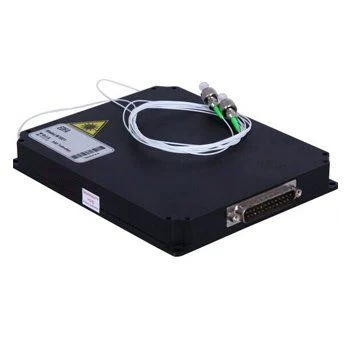

.webp)

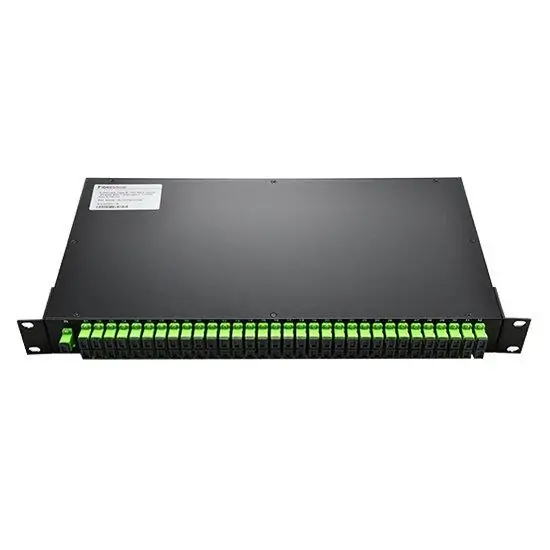
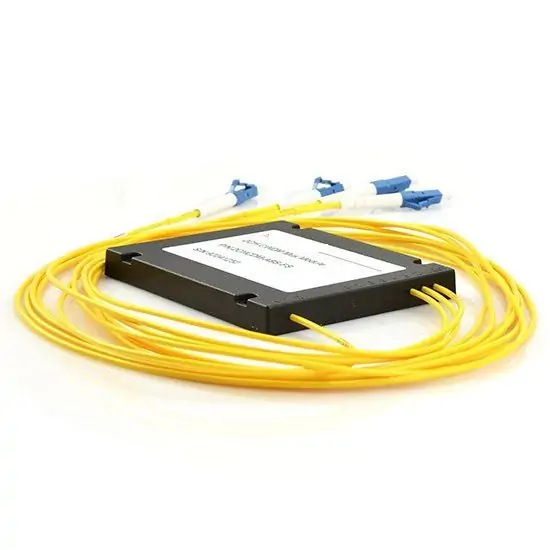

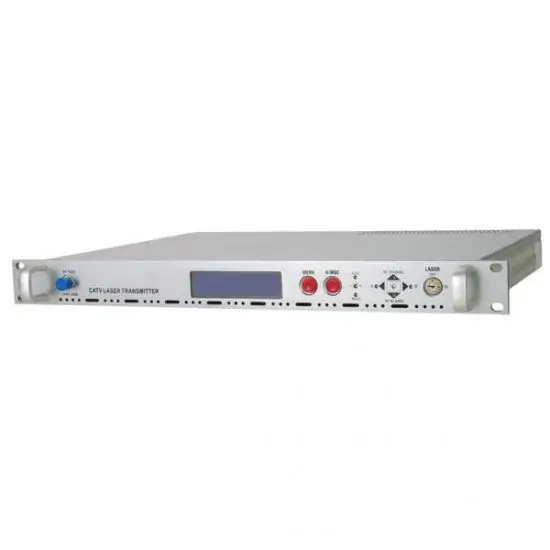












































|
Product FilterClear All
Recent Order
|
PM Fiber SplitterPolarization Maintaining Fiber Splitter, PM PLC Splitter & PM FBT Coupler Splitter, High PER and Uniformity, Low IL Loss w/ FREE Shipping to Global
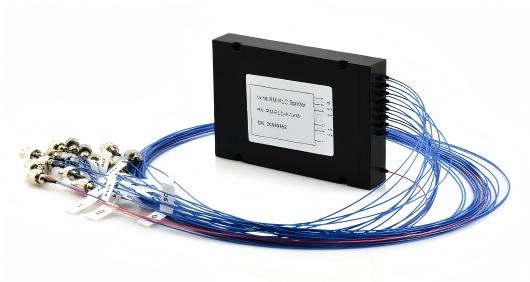
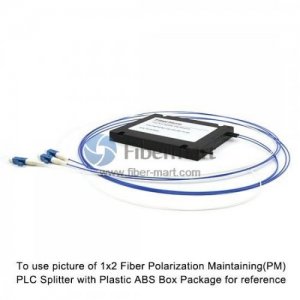
Fibermart Polarization Maintaining Fiber Planar Lightwave Circuit (PLC) Splitters allow a user to split a single input signal evenly into 2/4/8/16/32/64 output signals, which is ideal for high-channel-count applications. In contrast to FBT fused biconic taper fiber splitter couplers, where light is coupled from one fiber core to the other, these devices operate as a continuous waveguide that splits the propagating signals. Each splitter features a ±40 nm bandwidth around both 460nm, 630nm, 780nm, 980nm, 1310 nm and 1550 nm center wavelengths. Fibermart pm fiber splitter features low insertion loss, low polarization dependence and high polarization extinction ratio over a wide wavelength range. They cannot be used in reverse to combine light sources together into one output port.
Product Highlights
These splitters are using pm PANDA fiber. The stress rods run parallel to the fiber's core and apply stress that creates birefringence in the fiber's core, allowing polarization-maintaining operation. Linearly polarized light must be launched along the slow axis of the fiber to achieve the specified coupling ratio and maintain a high polarization extinction ratio (PER). Fibermart's PM Splitters provide a PER of ≥18.0 dB including connectors. They have a maximum power handling of 300 mW with connectors or bare fiber and a maximum power handling of 500 mW when spliced. They undergo extensive testing and verification of the PER; A sample data sheet for the 1310/1550 nm PM splitters can be viewed here.
PM PLC Splitter, PM Fiber Splitter, PM FBT Coupler, PM FBT Splitter, Polarization Maintaining Fiber Splitter, Polarization Maintaining Splitter, Polarization Maintaining Coupler, Polarization Maintaining FBT Splitter
Introduction
Fibermart Polarization Maintaining Fiber Splitter is a specialized optical passive device designed for Polarization Maintaining (PM) Fiber systems. Its core function is to distribute an input optical signal into specific power ratios while rigorously preserving the original polarization state of the light. It achieves this through precision manufacturing techniques such as FBT fused biconical tapering or planar waveguide PLC technology, ensuring precise alignment of the polarization axes (fast axis/slow axis) of the output light with those of the PM fibers. This component is a fundamental building block in PM fiber sensing systems, coherent communications, and high-precision interferometry, effectively preventing signal fading and system performance degradation caused by random polarization state fluctuations.
Features
● High Polarization Extinction Ratio (PER) : Minimal degradation of the Polarization Extinction Ratio (PER ≥ 23 dB typically), maintaining polarization state stability. ● Precision FC, LC, SC Connectors ultra-low insertion loss from SENKO, Customized Working Wavelengths like 460nm, 630nm, 780nm, 980nm, 1310/1550 nm ±40nm in Polarization Maintaining Fiber. ● 100% Tested with individual Testing Report, CE, RoHS, FCC, ISO9001 Certificated for each unit to ensure High performance and Zero Failure in Lifetime Warranty. ● Excellent Splitting Ratio Accuracy: Offers standard ratios (e.g., 50:50, 72:25, 90:10, 99:1) with customized available, featuring high accuracy and consistency. ● Precise Fiber Axis Alignment: Strict alignment of the PM fiber stress axis (fast/slow axis) during coupling guarantees accuracy in polarization axis orientation.
Working Principle
The core principle of PM Fiber Splitter is based on coupled-mode theory. The most common type, the fused biconical taper device, involves fusing and stretching the cores of two or more PM fibers under heat to form a coupling region. In this region, optical power from the input fiber periodically couples into the other fiber(s). By precisely controlling the length, speed, and temperature of the fuse-and-pull process, specific power splitting ratios are achieved. Critically, the entire process must maintain strict control over the relative angular alignment of the stress axes of the fibers (typically aligned at 0° or 90°), ensuring light propagates along the intended polarization axis without disturbance. The planar waveguide type utilizes photolithography to create Y-branch or other structured optical waveguides on a chip to achieve both splitting and polarization maintenance.
Applications
● Fiber Optic Sensing Systems: Interferometric sensors such as distributed fiber sensing, fiber optic gyroscopes, hydrophones, and current/voltage sensors. ● Coherent Optical Communications: Used for local oscillator signal distribution, balanced reception, etc., to ensure coherent detection performance. ● Scientific Research & Metrology: Quantum optics experiments, precision interferometry, laser frequency comb distribution, and other requiring stable polarizations. ● Instrumentation: Serves as a key beam-splitting component within PM optical circuits, integrated into various test & measurement equipment and lasers. ● Defense & Aerospace: Applied in navigation, guidance, and detection systems demanding exceptional environmental ruggedness and reliability.
Specifications
Package Style
ABS Module, Steel Tube and Rack Mount
Technology Type
Polarization Maintaining (PM) Splitter in Slow Axis/Fast Axis/Both Axis
Distribution Type
1x N (N=2,3,4,5,6,8,9,12,16,24,32,64,128)
2x N (N=2,4,8,16,32,64,128)
Connector Type
LC/SC/FC/ST/E2000
Input/Output Fiber Diameter
900 μm/2,0 mm/3,0 mm
Polish Type
UPC/APC
Input/Output Fiber Length
1.5m (default)/0.5m/1m/ Custom
Return Loss
≥ 50 dB
Directivity
≥ 55 dB
Operating wavelength
PM1310 or PM1550 or specify
Splitting ratio
Symmetrical
Power handling (mW)
500 or specify
PER
≥ 18dB(with connectors on)
Temperature
Operating -40 to 85°C (-40 to 185°F)
Storage -40 to 85°C (-40 to 185°F)
|