


.webp)


Discover how high-precision fiber pigtails minimize signal loss in dense networks by reducing insertion loss and enhancing alignment. Learn more from Fibermart.
Behind every seamless video call, lightning-fast file transfer, or real-time cloud application lies a labyrinth of fiber connections silently doing the heavy lifting. In this tangled world of ports, panels, and precision engineering, it’s not always the loudest components that make the biggest difference. In fact, one of the most vital players in high-density network performance often goes unnoticed—a small, unassuming segment of fiber with a big responsibility.
Enter the high-precision fiber pigtail—the unsung hero that ensures your optical signals stay strong, fast, and clean from origin to destination. Especially in environments where cables intertwine like spaghetti and every decibel of loss can mean downtime or degraded service, these precision-engineered connectors are indispensable.
This blog explores how high-precision fiber pigtails minimize signal loss in dense network environments by reducing insertion loss, improving alignment accuracy, and delivering reliable connectivity where it’s needed most.
What Are Fiber Pigtails and Why Precision Matters
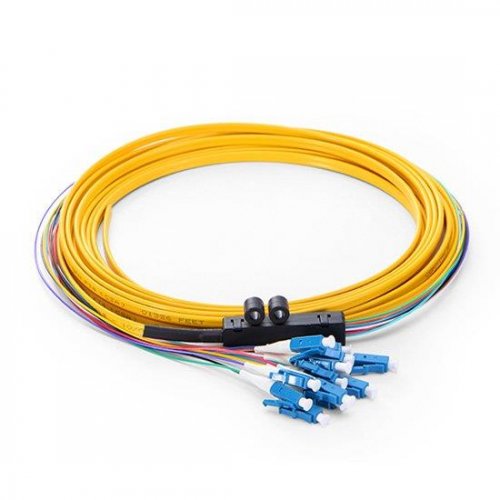
A fiber pigtail is a short length of optical fiber that has a connector pre-installed at one end and an exposed fiber at the other. It’s commonly used to connect optical fibers to network devices, fusion splicers, or patch panels. In high-density environments, where hundreds or even thousands of fiber connections coexist in tight quarters, maintaining consistent optical performance across every connection is crucial. This is where high-precision fiber pigtails stand out.
The “precision” in high-precision fiber pigtails refers to the tight tolerances in connector manufacturing and fiber core alignment. Any minor misalignment in these components can lead to insertion loss—a reduction in signal power caused by poor connection quality. In dense environments, where signal paths are long and complex, accumulated insertion loss from low-quality components can result in significant data degradation, dropped packets, and poor network performance.

To avoid this, fiber pigtails must be manufactured with exacting standards and aligned with sub-micron accuracy to ensure optimal light transmission.
Reducing Insertion Loss in Tight Spaces
Insertion loss is one of the biggest challenges in any optical network. It occurs when a signal passes through connectors, splices, or other discontinuities and loses a portion of its strength. In dense network environments, every connection matters. Multiple interconnections across patch panels, distribution frames, and active equipment increase the risk of cumulative signal degradation.
High-precision fiber pigtails minimize signal loss by ensuring extremely low insertion loss values—often less than 0.2 dB—thanks to superior polishing, core alignment, and ferrule concentricity. These characteristics help maintain optimal light transmission even in tightly packed and complex cabling infrastructures.
In data centers, where hundreds of links coexist, small savings in insertion loss at each junction can accumulate to a significant improvement in overall system performance. Moreover, less signal loss means that active components such as transceivers and amplifiers don't have to work as hard, reducing energy consumption and heat generation.
Ensuring Superior Connector Alignment
One of the main reasons why high-precision fiber pigtails perform better is their superior connector alignment. A typical fiber core is only about 9 microns in diameter (for single-mode), and any misalignment between two fibers can result in partial or complete signal loss. Precision pigtails are manufactured with tight tolerances to ensure perfect end-face geometry and concentricity.
This is especially important in environments where space is constrained and equipment is subject to frequent reconfiguration. In a crowded patch panel or multi-rack setup, bending, plugging, and unplugging of connectors can disturb the alignment of inferior connectors, resulting in performance variability. With high-precision fiber pigtails, consistent performance is maintained, even under repeated physical manipulation.
Connector types such as LC, SC, and ST benefit significantly from this high level of accuracy, particularly when used with fusion splicing, which requires a flawless core-to-core connection. That’s why LC pigtails and SC pigtails in high-precision designs are widely adopted in mission-critical applications.
Seamless Integration in Dense Patch Panels
In high-capacity networking environments like hyperscale data centers, physical space is at a premium. Cable management must be meticulous, and connectors must perform consistently across hundreds of terminations. High-precision fiber pigtails are designed with these constraints in mind.
Their compact, durable construction and precise geometry allow them to integrate seamlessly with fiber patch cables and modular hardware. The result is a neat, high-density deployment that’s not only aesthetically organized but also functionally optimized for performance.
In addition, these pigtails typically feature tight-buffered fibers with high bend resistance and durability, making them well-suited for installation in crowded cable trays or within MTP/MPO cable environments where tight radii and movement are common.
Enhancing Reliability in Critical Applications
Reliability is paramount in industries such as telecommunications, military communications, financial data centers, and medical imaging. Signal integrity in these sectors is not optional—it is foundational. A single poorly performing link can compromise an entire system’s reliability, leading to financial losses or even risks to human life.
High-precision fiber pigtails minimize signal loss and ensure that once a connection is established, it remains stable and predictable over time. This long-term reliability is achieved through robust mechanical construction, top-tier polishing techniques, and rigorous quality control testing—traits that come standard with trusted suppliers like Fibermart.
Using high-precision pigtails in conjunction with optical amplifiers, fiber splitters, and polarization maintaining cables ensures a more holistic and robust optical network infrastructure, especially in layered environments with complex transmission paths.

Choosing the Right Pigtail for the Job
Selecting the appropriate high-precision fiber pigtail for a given application involves understanding the fiber type, connector type, and environmental conditions. For example, single-mode pigtails are ideal for long-distance, high-bandwidth transmission, while multi-mode pigtails serve better in short-range, high-throughput environments.
Beyond that, specialized configurations such as 12 fiber pigtails can streamline installations by offering multiple termination points within a compact assembly. Choosing pigtails with factory-tested low insertion and return loss values ensures optimal system performance out of the box.
At Fibermart, a wide variety of pigtail configurations are available—whether you're building a 5G backhaul network, scaling a data center, or deploying FTTx infrastructure. The key is to prioritize quality, consistency, and the level of precision offered.
Conclusion
As digital infrastructure becomes more complex and capacity demands continue to rise, the quality of each component in the network stack becomes increasingly important. High-precision fiber pigtails minimize signal loss in dense network environments by ensuring low insertion loss, superior connector alignment, and seamless integration into high-density setups. Their role in preserving signal integrity cannot be overstated, especially in mission-critical applications where reliability is non-negotiable.
For network designers, engineers, and IT professionals looking to build reliable, high-performance systems, investing in top-quality components is essential. Fibermart offers an extensive selection of high-precision fiber pigtails along with other industry-grade products like QSFP cables, EDFA optical amplifiers, and PLC splitters to meet the most demanding connectivity needs. Explore Fibermart’s catalog to find the precision-engineered solutions that keep your network strong, fast, and future-ready.





No comments have been posted yet.