


.webp)


What is IP address?
The Internet Protocol (IP) is one of the most important communications protocols in the Internet Protocol Suite (IPS). It is primarily used for addressing and routing data packets between network devices (such as computers, Ethernet switches , or a single network or a series of interconnected networks ), forwarding them from one network to another. Currently, the IP protocol has two versions: IPv4 and IPv6. Many people are unfamiliar with these two versions, especially the differences between them. This article will provide a detailed introduction to IPv4 and IPv6, helping you make informed decisions about network equipment selection.
What is IPv4?
IPv4, the fourth version of the Internet Protocol, is the datagram transmission mechanism used in computer networks. It was the first widely deployed IP protocol. Every device connected to the internet (whether a switch, PC, or other device) is assigned a unique IP address, such as 192.149.252.76, as shown in the figure below. IPv4 uses 32-bit (4-byte) addresses, which can accommodate approximately 4.3 billion addresses. However, as more and more users access the internet, the global IPv4 address space was completely exhausted in November 2019. This is one of the reasons why the Internet Engineering Task Force (IEIF) subsequently proposed IPv6.

What is IPv6?
IPv6, the sixth version of the Internet Protocol proposed by the Internet Information and Communications Technology (IEIF), is the next-generation protocol designed to replace IPv4. Its introduction not only addresses the shortage of network address resources but also overcomes the barriers hindering internet access for various devices. IPv6 addresses are 128 bits long, supporting over 340 trillion addresses. As shown in the figure below, 3ffe:1900:fe21:4545:0000:0000:0000:0000 is an IPv6 address. IPv6 addresses are typically divided into eight groups of four hexadecimal numbers, separated by colons.

What is the difference between IPv4 and IPv6?
While both IPv4 and IPv6 are used to identify the addresses of devices connected to the Internet, and their principles are the same, they work differently. So, what are the differences between IPv4 and IPv6? You'll find the answer in the following aspects.
Performance
Compared to IPv4, IPv6 increases the address length from 32 bits to 128 bits, supporting a wider range of address needs. Industry experts even claim that there are 10^26 IPv6 addresses per square meter on Earth, indicating that IP address depletion will not occur in the foreseeable future. Furthermore, IPv6 addresses are encoded using a hierarchical structure similar to CIDR, simplifying and accelerating routing.
IP header
IPv4 has a variable length of 20 to 60 bytes, depending on the IP options provided; IPv6, on the other hand, has a fixed length of 40 bytes, resulting in a simpler header than IPv4. Furthermore, while the IPv4 header may include various options, the IPv6 header lacks options. Instead, it adds an optional extension header (including hop-by-hop extensions, routing, fragmentation, and destination information), significantly reducing packet processing overhead and header bandwidth.
Cybersecurity
For IPv4, the Internet Security Protocol (IPsec) is optional, but not necessarily free, and sometimes requires paid support. However, for IPv6, IPsec is mandatory. Furthermore, features like authentication, data integrity, and confidentiality are also incorporated into IPv6. This demonstrates that IPv6 is more secure than IPv4.
Application Areas
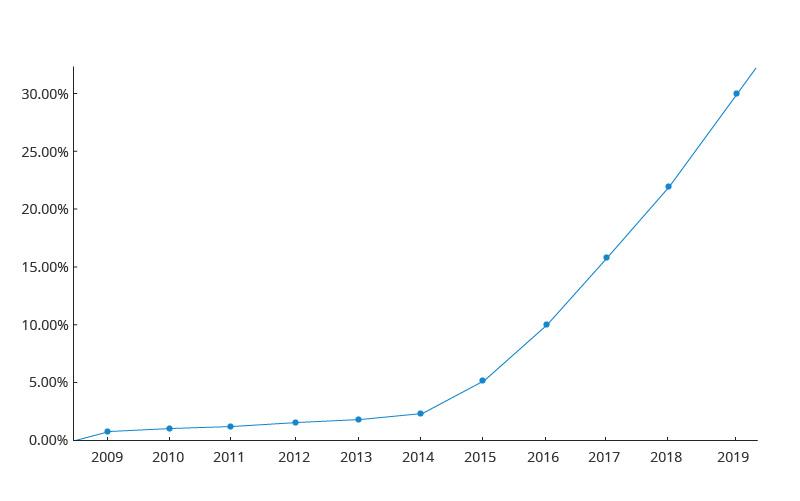
As shown in the figure below, the percentage of users accessing Google via IPv6 was small from 2009 to 2019, and IPv6 growth was slow in its early stages. Why is this? What exactly is the reason why IPv6 deployment is less widespread than IPv4? First, IPv4 was introduced before IPv6, giving it a head start in the market, while IPv6 deployment is a long, gradual process. Second, in the early stages of IPv6 deployment, due to its immaturity, many issues arose, such as incompatibility with existing infrastructure and difficulties in transitioning from IPv4 to IPv6.
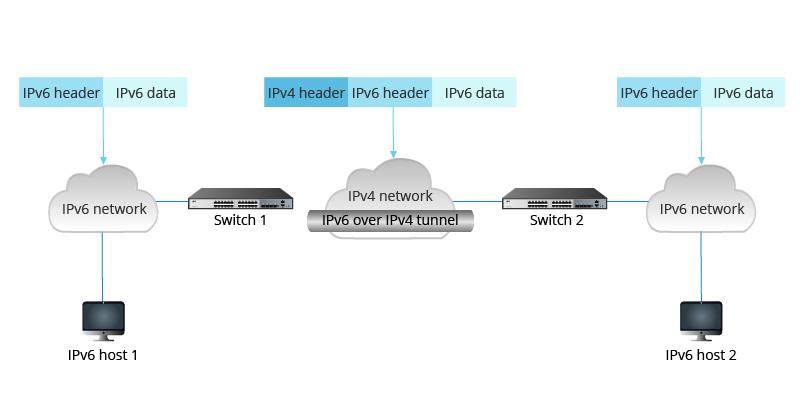
In most practical applications, IPv6 and IPv4 are used separately. However, tunneling technology can now be used to interconnect IPv6 and IPv4. In a tunnel between IPv6 and IPv4 networks, a router can encapsulate IPv6 packets within IPv4 packets. When the encapsulated IPv4 packets leave the IPv4 network (at the tunnel exit), the IPv6 packets are removed and forwarded to the destination node. It's important to note that the destination nodes of both tunnels must support both IPv4 and IPv6 protocols.
The differences between IPv4 and IPv6 are as follows:
|
Difference |
IPv4 |
IPv6 |
|
Address representation |
8 bits per byte, decimal value ranges from 0 to 255, with four segments, separated by "." |
16 bits are a double byte, and the decimal value ranges from 0 to 65535, with a total of eight segments, separated by ":" |
|
Address Type |
Unicast, multicast, and broadcast addresses |
Unicast, multicast, and anycast addresses |
|
Address mask |
Used for the host to specify the network |
Not used |
|
Number of header fields |
12 |
8 |
|
Header byte length |
20 |
40 |
|
Header Check |
have |
none |
|
Category assignment |
A to E category assignments |
No category assignment |
|
Configuration |
IP addresses and routing must be assigned |
Configuration optional, depending on the functionality required |
|
VLSM |
support |
Not supported |
|
snippet |
It is fragmented by the sender (host or router) |
Segmentation at the source node and reassembly at the target node |
|
Routing Information Protocol (RIP) |
Routing protocols supported by the routing daemon |
RIP is not supported, static routing is used |
|
Network Configuration |
Must be configured manually or via DHCP |
Automatic Configuration |
|
Simple Network Management Protocol (SNMP) |
Protocols for system management |
Also supports IPv6 |
|
Mobility and interoperability |
Capabilities are limited by network topology. |
Provides interoperability and mobility capabilities embedded in network equipment |
|
Domain Name System (DNS) |
The reverse lookup domain is inaddr.arpa |
The reverse lookup domain is ip6.arpa. If it is not found, ip6.int is used. |
|
IP address resolution |
Using Broadcast ARP |
Multicast Neighbor Solicitation |
|
Quality of Service (QoS) |
Allows TCP/IP applications to request message priority and bandwidth |
QoS implemented on IBM i does not support IPv6 |
Summarize
As we've seen above, IPv6 not only expands the address space, providing hundreds of trillions of addresses to meet the needs of the Internet for the foreseeable future, but also simplifies network configuration and reduces costs. Therefore, the global transition from IPv4 to IPv6 is inevitable. However, this does not mean that IPv4 will be replaced.





No comments have been posted yet.