


.webp)


The night shift had already rubbed grit into Omar’s eyes when the text landed—“Commissioning moved to 7 a.m.—make it work”—and suddenly the humming data hall felt colder. He stared at the patch panel where 576 fibers fanned out like a frozen deck of cards, each SC simplex plug fat as a marker pen, devouring four whole units of rack space until the door refused to close and the OTDR warned he had 0.2 dB left before the budget flat-lined. Reputation, he knew, is woven through glass; one extra decibel and the entire hall would whisper his name for months.
He speed-dialed the supply depot, half hoping for voicemail, but Jade picked up, voice husky with 2 a.m. coffee. “SCs won’t save you,” she said. “I’ve got LC gear in the cage—quads, pre-polished pigtails, even those cute 1.25 mm cleaners.” Omar hesitated; he’d always thought LC was for office closets, not 400 G long-haul, yet desperation is a fast teacher, so he told her to bring the cart.

By 04:30 the fusion splicer was purring like a happy cat, each LC duplex snapping home with a tick that sounded suspiciously like problem solved. The panel that once swallowed four units shrank to one, the door sliding shut with a soft metallic sigh while loss values tumbled—0.35 dB, 0.18 dB, 0.09 dB—numbers falling like coins from a slot machine paying out in light.
When the spectrum analyzer finally washed the rack in steady green, Omar didn’t cheer; he simply exhaled, shoulders dropping as if someone had cut loose a backpack full of lead. At 06:58 he sent the group chat a single photo: a lone LC quad adapter gleaming under fluorescent light. Caption: “576 fibers, 1 U, 0.18 dB. Breakfast?”
Intrigued by the case? From the previous story, you may feel curious about LC: its features, its derivative products, its advantages to other connecting forms in fiber optics. Then, let's take a deep dive into the realm of LC and the optical network world co-constructed by LC-derived fiber optic products.
What Is LC In Fiber Optics?
In fiber optics, LC stands for Lucent Connector, a miniature fiber-optic connector conceived by Lucent Technologies that shrinks the traditional 2.5 mm ferrule down to a 1.25 mm precision zirconia sleeve, thereby doubling port density on patch panels, switches, and transceivers; its rectangular, RJ-45-style housing incorporates a resilient, user-friendly push-pull latch that provides tactile feedback, ensures positive retention under vibration, and allows one-handed mating and unmating in crowded racks, while the ceramic ferrule’s micron-level concentricity and angled or ultra-physical contact end-face polishing yield typical insertion loss ≤ 0.10 dB and return loss ≥ 55 dB (UPC) or ≥ 65 dB (APC), making the LC suitable for both campus-length multimode Gigabit Ethernet and carrier-class single-mode 10 Gb/s, 40 Gb/s, 100 Gb/s, and coherent DWDM links.
Beyond its electrical-grade ergonomics and optical performance, the LC family spans color-coded simplex clips for discrete runs and integral duplex clips that maintain transmit/receive polarity in high-speed bi-directional optics; it is offered in OM1 through OM5 multimode and G.652D, G.657A1/B3, and bend-insensitive single-mode fiber types, with operating temperature ranges from –40 °C to +75 °C and 500–1 000 mating cycles rated durability, and it has become the de-facto interface for SFP, SFP+, XFP, QSFP, CFP, and pluggable coherent modules, enabling seamless migration from 1 Gb/s to 800 Gb/s systems, while standardized under TIA-604-10 (FOCIS 10) and IEC 61754-20, ensuring multi-vendor interoperability across global data-center, central-office, FTTx, and enterprise networks that demand ever-higher bandwidth in ever-smaller physical footprints.
LC Overview
Starting with the humble LC duplex patch cord, the LC bloodline has radiated outward until every layer of the optical network—cable, connector, adapter, panel, chassis, and even the software-defined fabric—now speaks the same 1.25 mm ferrule language, creating a self-reinforcing ecosystem that no competing interface has managed to dislodge.
At the physical origin sit LC fiber cables: tight-buffered or loose-tube constructions whose 900 µm buffered fibers terminate directly into LC Uniboot or duplex boots in the factory, eliminating craft-sensitivity and guaranteeing ≤ 0.10 dB end-to-end loss because the ferrule is polished on automated lines with interferometric feedback. These cables are offered in OM1-OM5 and G.657A2 bend-insensitive single-mode, with LSZH, plenum, or outdoor PE jackets, so the identical LC form-factor can be pulled under a raised floor in New York, strung through a –30 °C cell tower in Finland, or pre-terminated in a 40 °C Dubai warehouse without ever swapping connector style.
The connectors themselves have splintered into purpose-built variants—LC-HD with pull-tabs for 1RU ultra-density, LC-APC 8° green for 65 dB RL in analog CATV, LC-Uniboot with reversible polarity for 40 Gb/s BiDi—but every one still keys into the same ceramic split-sleeve adapter, itself only 10.5 mm wide. Those adapters snap into modular patch panels that start as 6-port LGX metal cassettes and scale to 144 fibers in 1RU using LC-QR quad-row adapters; each cassette contains factory-terminated MTP® legs fanning out to LC duplex, so a data-center tech can upgrade from 10 Gb/s to 400 Gb/s SR8 simply by swapping the transceiver, not the structured cabling.
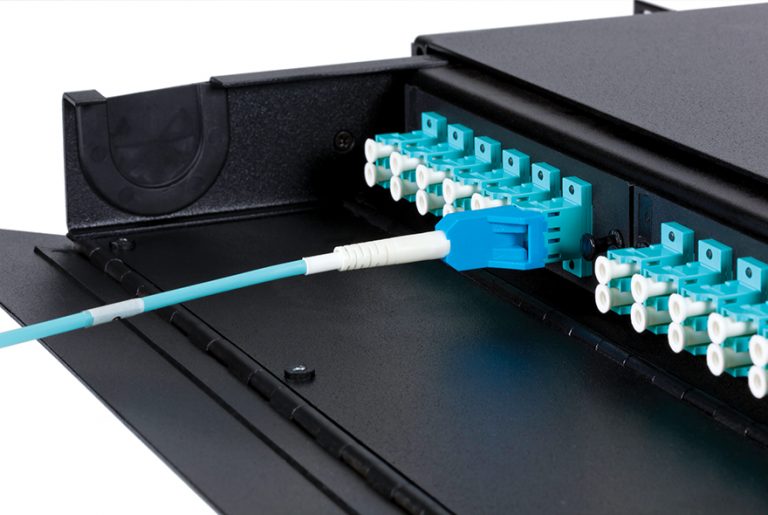
Above the panel, the LC ecosystem merges into integrated systems: pre-loaded 4U chassis holding 12 slide-out cassettes for 1 728 fibers, intelligent panels with RFID-tagged LC ports that report polarity, loss, and bend radius to DCIM dashboards, and factory-tested MPO-LC harnesses that land directly on QSFP-DD cages, cutting 75 % of field labor. Even the emerging co-packaged optics switches from Cisco, Intel, and Broadcom expose LC-compatible SN/CS ferrules on the face-plate, ensuring that the same LC test cords, cleaners, and inspection probes purchased for today’s 10 GbE links will still validate 51 Tb/s silicon-photonic engines a decade from now. Thus, from a single 1.25 mm ceramic sleeve in a polymer boot all the way up to AI-scale Clos fabrics, the LC lineage provides an unbroken, low-loss, tool-common path that lets operators evolve bandwidth without ever abandoning the connector they standardized on yesterday—an inertia no rival ferrule has yet overcome.
LC-derived products are highly diverse and crucial in modern optical networks. We will explore their dominance in the optical world by examining specific aspects in detail.
LC Connectors
LC connector (Lucent Connector) is a miniaturized fiber-optic termination whose key feature is a 1.25 mm precision zirconia ferrule—only half the diameter of traditional SC/FC ferrules—so panel density can be doubled. The rectangular thermoplastic housing uses an RJ-45-style push-pull latch that clicks in with a push and releases with a pull, eliminating threads or bayonets and allowing one-handed operation in crowded racks. Inside, a ceramic split-sleeve aligns the ferrules to yield typical insertion loss ≤ 0.10 dB and return loss ≥ 55 dB (UPC) or ≥ 65 dB (APC), while surviving > 500 mating cycles. Rated for –40 °C to +75 °C, it accepts 900 µm tight-buffer or 2.0 mm cordage in either single-mode or multimode, so the same interface serves data centers and 5G towers alike.
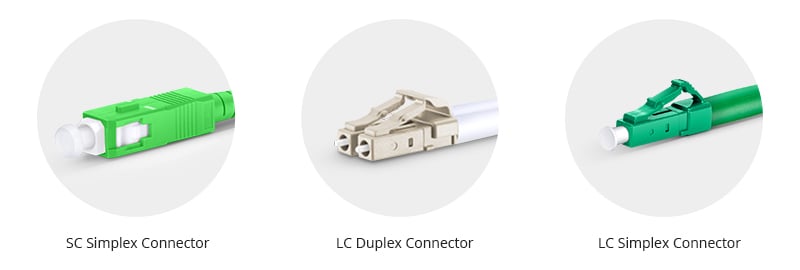
Structurally, LC starts with Simplex (single-fiber) and Duplex (two fibers clipped together) modules. Inside the LC connector family, the very first fork in the road is “one fiber or two.”
An LC Simplex Connector carries a single 1.25 mm zirconia ferrule in a solitary housing—half the width of a full clip—so it slides easily through tight ducts, costs a few cents less, and is the natural choice for PON drops, BiDi optics, or any path that needs only one glass strand.
LC Duplex Connector welds two of those simplex units together with a plastic bridge, giving you a unified RJ-45-style plug that keeps Tx/Rx polarity fixed and strain-relieved; the pair is still thinner than one SC simplex, yet you gain fool-proof pairing for 10 GbE SR, 25 GbE DR, or any optic that transmits and receives on separate fibers. Pick simplex when you want routing freedom, pick duplex when you want plug-and-play polarity—both share the same ferrule, the same ≤ 0.10 dB loss, and the same push-pull latch that made LC the default from switch to switch.
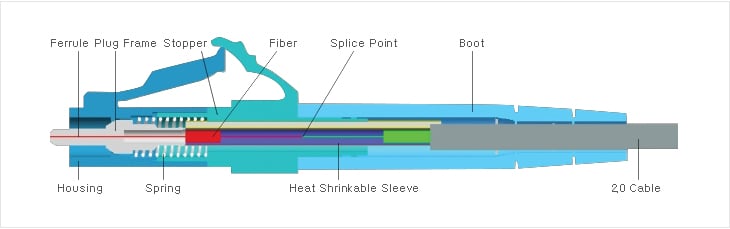
Besides Simplex and Duplex of LC Connectors, here are branches with the following:
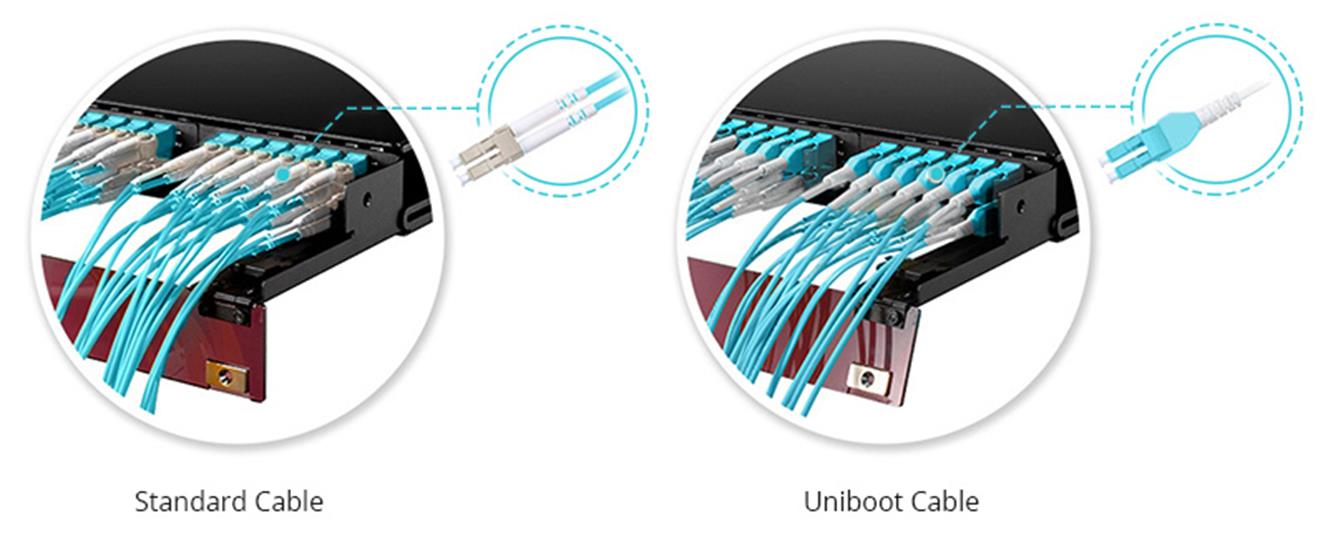
- LC Uniboot – both fibers merge into one oval jacket whose boot rotates for polarity reversal, cutting cable bulk by 50 %
- LC Push-Pull – a long tab on top lets operators extract connectors from 72-fiber 1RU panels without finger scrapes
- LC HD – ultra-slim boot and extended latch suit 6.0 mm center-to-center ultra-high-density cassettes
- LC APC – 8° angled end-face in a green housing for CATV or PON links that need ultra-low back-reflection
- LC BTW (Behind-the-Wall) – 0.9 mm bare fiber feeds directly into equipment backplanes via an elongated latch
- Outdoor types such as PDLC / FullAXS – standard LC ferrules inside IP68 metal/rubber shells withstand –40 °C, water, and 100 N pull loads while remaining fully mateable with indoor LC ports.
Together these variants make LC the universal connector from 10 GbE to 800 GbE, from patch panel to cell-site jumper.
LC Attenuators
Fiber-optic attenuators are passive components that introduce a controlled amount of loss into an optical link to protect receivers from overload, equalize power across channels, or meet system budget margins. They are specified by wavelength (e.g., 1310 nm, 1550 nm, 1625 nm), attenuation value (1 dB – 30 dB in 1 dB steps is common), and return-loss performance (≥ 50 dB UPC, ≥ 60 dPC APC). Broadly they fall into two construction principles:
Fixed attenuators – the loss value is set at the factory and cannot be changed.
Variable (or adjustable) attenuators – a screw, lever, or MEMS mechanism lets a technician tune the loss in the field, typically over a 0 – 60 dB range with 0.1 dB resolution.
Within these two groups the industry packages the attenuation function into four mainstream form-factors, each built around the same 1.25 mm LC ferrule geometry so they drop straight into existing LC patch panels, adapters, and cable assemblies without any tools or new tooling.
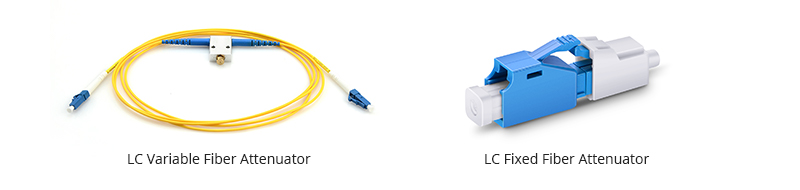
LC Fixed Plug-type Attenuator
Structure: a male LC plug on one end, a female LC jack on the other; inside, a precise air-gap or doped fiber block creates the rated loss.
Features: 0.6 dB typical added insertion loss, ±0.5 dB tolerance for 1–10 dB models, ±1 dB for 11–30 dB; full metal or plastic shroud protects ferrule; snap-in exactly like a patch cord so no extra rack space is consumed.
Use-case: plug directly in front of an SFP transceiver to drop a +2 dBm launch to –8 dBm for a short 300 m link.
LC Fixed In-line Attenuator
Structure: a 0.9 mm or 2.0 mm cordage with LC connectors on both ends; attenuation element is fusion-spliced inside a 30 mm protective sleeve.
Features: lowest reflection because the splice is index-matched; can be pulled through conduit like any patch cord; available in simplex, duplex, or Uniboot formats.
Use-case: permanent installation between two patch panels where front-panel accessibility is limited.
LC Variable In-line Attenuator (manual)
Structure: small cylindrical body (≈ 45 mm long) with female LC ports at each end; internal graded neutral-density filter or offset-core mechanism rotated by a thumb-wheel.
Features: 0 – 30 dB range, 0.1 dB click stops, < 0.05 dB polarization-dependent loss, repeatable to ±0.2 dB over 1 000 adjustments.
Use-case: commissioning DWDM nodes where per-channel power must be flattened to within 0.5 dB.
LC Variable Attenuator Module (motorized / MEMS)
Structure: 1RU or 2RU shelf holding up to 48 LC duplex ports; each port contains a MEMS shutter or thermo-optic chip driven by a 12-bit DAC.
Features: remote control via RS-485 or SNMP; 0 – 60 dB range, 0.05 dB resolution, < 5 ms switching time; same LC adapters accept standard patch cords so no special jumpers are required.
Use-case: dynamic channel power control in ROADM meshes or lab BER testing where automated margin scans are run overnight.
Across all four types the LC footprint dominates because the 1.25 mm ferrule delivers the same low insertion loss, the ceramic sleeve alignment is already present in every adapter, and network managers can use the same cleaners, inspection scopes, and patch cords they already stock. Whether a technician needs a static 10 dB pad on a 10 GbE SR link or a software-driven 0.1 dB step attenuator for 800 Gb/s coherent stress testing, the LC-based attenuator family provides a drop-in, tool-free solution that preserves density, interoperability, and sparing simplicity—key reasons it continues to outsell SC, FC, or MTP-style attenuators in modern optical networks.
LC Optic Cables
The workhorse of every data-center drawer: tight-buffered 0.9 mm fiber slipped into a 2.0 mm or 3.0 mm PVC/LSZH jacket, terminated with blue (UPC) or green (APC) LC duplex clips on both ends. Insertion loss is factory-polished to ≤ 0.2 dB, return-loss ≥ 50 dB, and the cord is offered in OM1–OM5 multimode (1–300 m) or OS2 single-mode (up to 10 km) so you can jump from switch to SFP, patch-panel to patch-panel, or rack to rack without thinking twice.
Application scene: Everyday patching inside server cabinets, Top-of-Rack (ToR) to leaf switch, or lab bench test leads—anywhere a quick, low-cost duplex link is needed.
LC Simplex Fiber Patch Cable
LC Simplex Fiber Patch Cable is the single-fiber member of the LC family: one 1.25 mm zirconia ferrule housed in a solitary square clip, terminated on a 0.9 mm, 2.0 mm or 3.0 mm jacket depending on ruggedness needs. It carries the same factory-polished ≤ 0.2 dB insertion loss and blue/green (UPC/APC) end-face as its duplex cousin, but because only one glass path is present you can route it through tight radius ducts, coil it around patch-tray corners, or pair two separate simplex cords for Bi-directional (BiDi) optics without forcing a fixed polarity. Colors follow fiber type (yellow OS2, aqua OM3/OM4, orange OM1), and the lone boot can be round or flat, plenum, LSZH or PE outdoor, making the simplex LC the cheapest, most flexible building block for PON drops, test leads, sensor loops, or any link that transmits and receives on the same strand.
Application scene: GPON drop from the curb to the home ONT, 10 km BiDi SFP linking two campus buildings on a single fiber, OTDR launch lead wrapped around a tech’s shoulder, or temporary reference jumper in a central-office test set—anywhere one strand does the job.
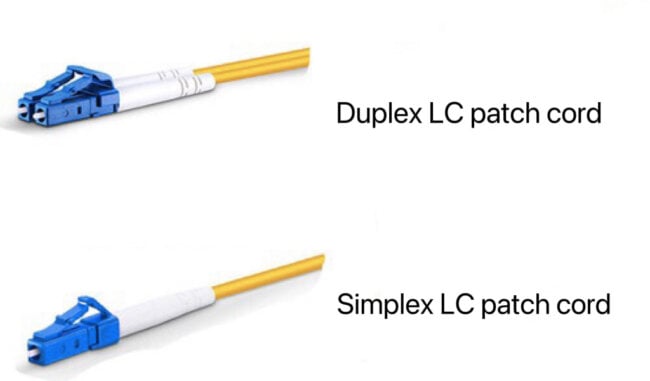
LC Duplex Fiber Patch Cable
Standard LC fiber patch cable—the workhorse jumper found in every data-center drawer—comes in two basic configurations: LC Simplex carries one 1.25 mm ferrule in a solitary jacket for single-strand BiDi, PON or test leads, while LC Duplex clips two of those ferrules together so the pair behaves like a single, polarity-locked RJ-45-style plug for 10 GbE, 25 GbE or any optic that needs separate Tx/Rx fibers; both variants share the same precision zirconia sleeve, the same ≤ 0.2 dB factory-polished loss and the same blue or green push-pull housing, so you can mix simplex and duplex runs on the same panel without swapping cleaners, adapters, or tools.
Application scene: 10 GbE/25 GbE switch-to-server links inside cabinets, 40 GbE/100 GbE SR4 spine-leaf hops up to 150 m, ceiling or under-floor data-center runs, and any SFP+/QSFP optic that needs separate transmit and receive fibers in one tidy cord
Uniboot LC Fiber Patch Cable
Two fibers, one oval jacket. A reversible polarity shroud lets you swap Tx/Rx by twisting the boot—no re-wiring, no ladder behind the rack. The round 2.0 mm outer diameter cuts cable congestion 50 %, while the shared strain-relief and slim ferrule housing allow 48 ports across 1RU. Available in OM3/OM4/OM5 for 40 GbE/100 GbE SR4 and in OS2 for long-wavelength BiDi, it’s the go-to when density matters more than distance.
Application scene: High-density fiber enclosures, hyperscale switch cages where side airflow is blocked by thick cords, or any cabinet where you need to reverse polarity on the fly without downtime.
Ultra Low Loss LC Fiber Patch Cable
Interferometer-grade ceramic ferrules are sorted to ≤ 1 µm eccentricity and polished to IEC “Grade B” geometry, yielding typical insertion loss 0.07 dB and return loss ≥ 65 dB (UPC) or ≥ 75 dB (APC). Used in 100 GbE/400 GbE cascaded spans, DWDM mux arrays, or anywhere a 0.1 dB saving buys an extra 2 km of link budget. Offered in -B1 bend-insensitive fiber so you can coil 30 mm radius without penalty.
Application scene: Long-haul DWDM chains, multiple patch points in broadcast studios, or financial-exchange fabrics where every decibel equals another kilometer of reach or another splitter stage.
Armored LC Fiber Patch Cable
A stainless-steel interlocked tube is extruded between the jacket and buffer, giving 1 000 N crush resistance and rodent protection while the outer diameter stays under 3.0 mm. The armored section is flexible enough for patch-tray routing, and the standard LC duplex clips still click into any adapter. Perfect for ceiling trays, factory floors, or tower base stations where a chair wheel or squirrel could end a link.
Application scene: Factory automation gantries, overhead cable trays in warehouses, campus trenches shared with power, or 5G rooftop runs where metal conduit is too bulky.
Mode-Conditioning LC Patch Cable
A short length of single-mode fiber is offset-spliced inside one leg of an OM2/OM3 cable, launching the 1310 nm laser away from the multimode center to suppress differential mode delay. The result is a 1 GbE reach extended from 220 m to 550 m on legacy 62.5 µm fiber, while the other leg remains standard OM2/OM3 for 850 nm VCSEL traffic. Both legs terminate in LC duplex clips so the cord drops into the same panel as ordinary multimode.
Application scene: Campus backbones still running FDDI-grade 62.5 µm fiber that need 1 Gb LX optics without installing new cable, or temporary links in heritage buildings where pulling fresh fiber is prohibited.
LC / MTP® / MPO / SC / FC / ST-LC Breakout Fiber Patch Cable
One high-count connector (MTP®/MPO 8-, 12-, 16-, 24-fiber, or SC/FC/ST fan-out) is fanned out to individual LC legs—typically 0.5 m breakout legs on a 3 m trunk. Used to migrate from parallel optics (40 GbE SR4, 100 GbE SR10, 400 GbE DR4) to duplex SFP+ or to break a 144-fiber backbone into discrete switch ports. All legs use the same 1.25 mm LC ferrule, so the same cleaners, adapters, and test cords work end-to-end.
Application scene: Data-center migration from 10 GbE duplex to 40/100 GbE parallel optics, central-office fiber distribution frames, or lab setups that need quick reconfiguration between parallel and duplex transceivers.
LC Patch Panels
Standard LC Patch Panel
A one-piece steel plate pre-loaded with blue or green LC duplex adapters, the standard panel gives installers a 19-inch rack drawer that turns up to 144 LC ports into a neat, labeled front while the rear stays open for field splice trays or pre-terminated pigtails; its fixed layout and screw-on ears make it the fastest, cheapest way to hand 24-, 48- or 72-fiber jumpers to switches, SFPs, or test gear in small server rooms where growth is modest and every minute counts.
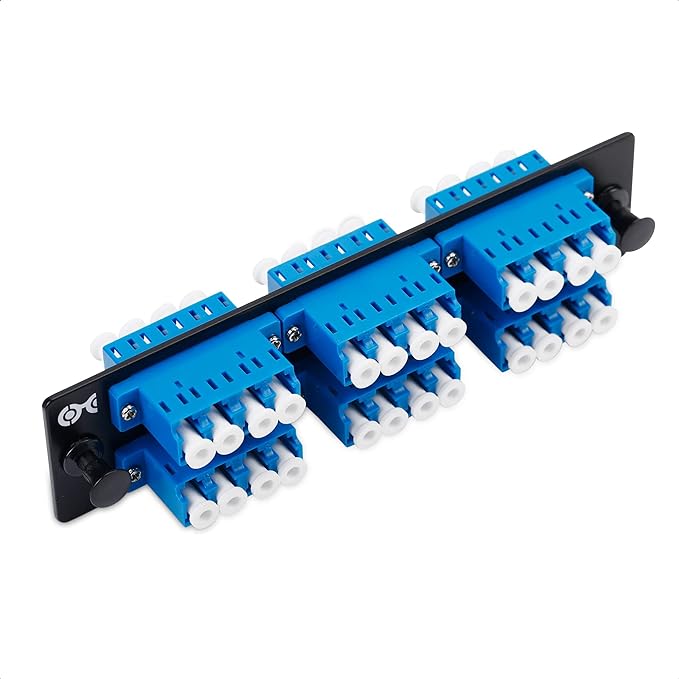
Modular LC Cassette Panel
Built as a 1RU or 2RU chassis that accepts slide-in LGX cassettes, the modular panel lets you start with one 12- or 24-port block and snap in extras as the spine-leaf fabric expands, so new fibers are activated in minutes without powering down neighbors; each cassette can carry MTP/MPO on the back or fusion-spliced pigtails inside, giving data centers a pay-as-you-grow path from 10 GbE today to 400 GbE tomorrow while keeping the same front-row LC footprint.
High-Density Quad-Row LC Panel
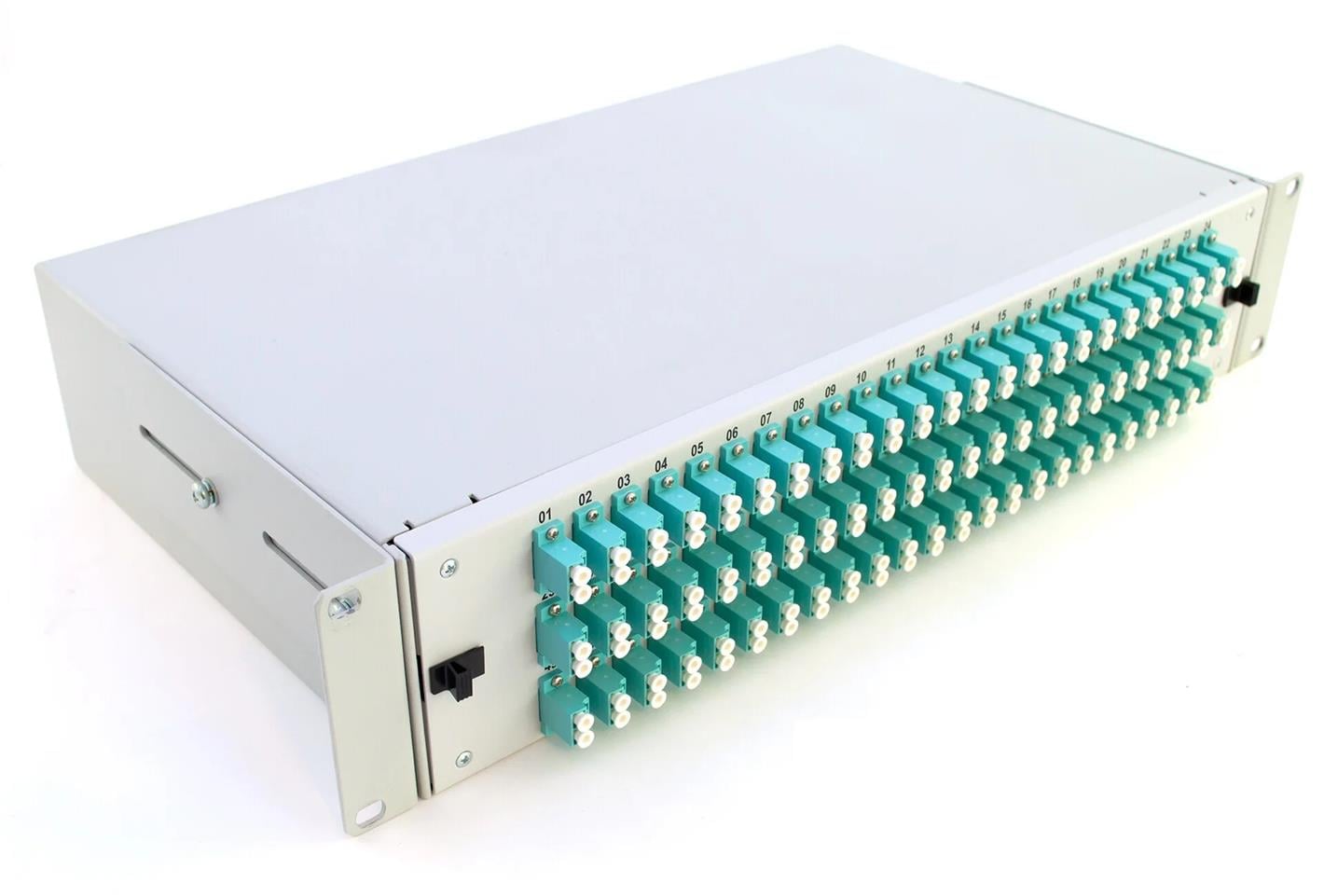
By staggering four rows of push-pull LC adapters inside the same 1RU height, the quad-row panel squeezes 72, 96 or even 144 ports into a hand-width strip, doubling face-plate utilization without adding rack space; ultra-slim ferrule boots and long pull-tabs let techs extract cords from the middle row even when panels touch above and below, making it the default choice for hyperscale halls and central offices where real estate is priced per rack unit and airflow is sacred.
Pre-Terminated LC Backbone Panel
Shipped with factory-polished MTP/MPO trunks already plugged into the rear bulkhead, the pre-terminated panel converts one click at the back into up to 96 LC duplex jacks at the front, slashing field labor from hours to minutes and arriving with a printed loss report that guarantees each mated pair stays under 0.15 dB; installers simply mount, label, and patch—no epoxy, no splicing, no uncertainty—ideal for rapid deployments of 40 GbE SR4, 100 GbE SR10, or 400 GbE DR4 pods.
Sliding/Draw-Out LC Panel
Mounted on ball-bearing rails, the sliding panel glides forward like a server drawer to expose the rear splice trays, allowing techs to add fibers, swap polarity, or replace pigtails without removing the chassis or kneeling in crowded aisles; a spring detent locks the tray in place for safety, giving broadcast trucks, central offices, and labs the luxury of front-access maintenance while live traffic continues on the unmoved front adapters.
Ruggedized LC Field Panel
Cast from die-cast aluminum with an IP65 gasket and rubber-sealed LC adapters, the ruggedized panel bolts to tower bases, stadium catwalks, or ship decks where rain, dust, and vibration are daily facts; inside, standard LC ferrules land on ceramic sleeves, so the same patch cords and cleaning tools that work in the office still click in outdoors—turning any harsh-environment fiber drop into a familiar, plug-and-play extension of the indoor network.
Fibermart Assures Your Optical Network
Fibermart, headquartered in Hong Kong and the United States, is a global manufacturer and supplier of fiber-optic solutions. We maintain large, ready-to-ship stocks of LC patch cords, adapters, attenuators and panels—all verified to IEC standards and backed by ISO 9001/14001 quality systems. From standard duplex to ultra-low-loss, Uniboot, armored and MTP-LC breakout versions, our LC products are tested for ≤ 0.2 dB insertion loss and are available for same- or next-day dispatch.
Whether you need a single LC cable for a lab bench or thousands of LC-APC harnesses for a 5G rollout, Fibermart’s integrated R&D, fusion-polish lines and worldwide warehouses let you order today and patch tomorrow. We deliver consistent LC performance, shorter lead times and the documentation carriers demand—so your network upgrades stay on schedule and on budget.
Conclusion
From the first snap of a duplex LC in a lab to the thousandth port glowing in a snow-caked tower, every 1.25 mm ferrule tells the same story: shrink the hardware, enlarge the possibility. LC and its children—Uniboot, APC, armored, attenuated, MTP break-outs, quad-row panels—have turned the once-bulky fiber plant into something as routine as an Ethernet cable, yet capable of carrying the planet’s phone calls, trades, films, and futures at the speed of light. In that slender ceramic sleeve lives the quiet revolution that lets a single rack breathe 576 fibers, lets a budget survive one more span, and lets a sleepless engineer close the door at dawn knowing the world will stay connected. LC did not just replace SC; it gave optical networking the same gift copper received decades ago—density without drama, reach without rework, and growth without guesswork—so the next text, stream, or swipe can travel thousands of kilometers on a connector smaller than a paperclip.
Frequently Asked Questions (FAQs)
Q: What is LC to LC Fiber optic patch cable?
A: An LC to LC fiber optic patch cable is a cable that has LC type connectors at both ends. It is predominantly employed in data networking systems aiming to reduce signal loss while boosting data exchange speed.
Q: What is the difference for LC single mode and multimode fibers?
A: LC single mode for instance, is a single mode fiber cable particularly useful for long distance communication due to the small core size which in effect reduces signal depletion. Much more speedy data transfer over short distances could employ OM3 cables, a type of multimode fiber patch cable that has a wider core diameter.
Q: LC to LC duplex patch cables may come in different lengths, but what is the common length?
A: In interconnections situated in a rack-mounted equipment for instance: closely spaced equipment’s, then the widely used tip is around 1m, 2m, 3m, 5m which allows for easily patching versatile LC to LC duplex fiber optic patch cables.
Q: What is the meaning of LC duplex connectors?
A: LC duplex connectors are compact set of connectors that permit the joining of two fibers end-in-end in a very limited space thus enhancing its usability in dense networks. It is common to see them mounted on patch panels and high density networking devices.
Q: Are LC connectors compatible with other fiber connectors?
A: LC connectors are not directly compatible with other connector types, but adapters can be used to connect LC connectors to other connector types, such as SC or ST connectors.
Q: What is the typical transmission speed of LC connector?
A: The transmission speed of an LC connector depends on the fiber optic cable it is terminated with. However, LC connectors are capable of transmitting data at speeds of up to 10 Gbps or higher.
Q: What fields commonly use LC connectors?
A: LC connectors are commonly used in industries that require high-speed data transmission, such as telecommunications, data centers, and cable TV providers.
Q: How to clean LC connector?
A: LC connectors should be cleaned regularly to ensure optimal performance. To clean an LC connector, use a lint-free cleaning cloth or alcohol wipe to gently wipe the end face of the connector. Be careful not to touch the end face with your fingers or any other object, as this can cause damage or scratches.
Q: What is the difference for UPC and APC LC connector?
A: Two different kinds of end faces are employed in LC connectors: UPC (Ultra Physical Contact) and APC (Angled Physical Contact). In contrast to APC connectors, UPC connectors have a flat end face. APC connectors are frequently used in high performance applications, like cable television or military ones.
Q: What is the difference of LC connector to other fiber connectors?
A: The size of the ferrule is one significant distinction between an LC connector and other fiber optic connectors. Other connectors, like SC and ST, use larger ferrules while LC connectors use a 1.25mm ferrule. Additionally, LC connectors are renowned for their small size, minimal insertion loss, and extremely precise alignment.





No comments have been posted yet.