


.webp)


A fiber splitter is a passive optical device that splits an input optical signal into multiple output optical signals and is widely used in passive optical fiber networks. Based on their operating principles, fiber splitter are categorized as PLC (planar waveguide) and FBT (fused-taper) splitters. How well do you know these two types of splitters? What are the differences between them? This article will provide a clearer understanding of them.
Brief description of PLC splitter and FBT splitter
First of all, before understanding the difference between PLC optical fiber splitter and FBT coupler splitters, let's take a brief look at these two types of fiber splitter.
Overview of PLC Splitter
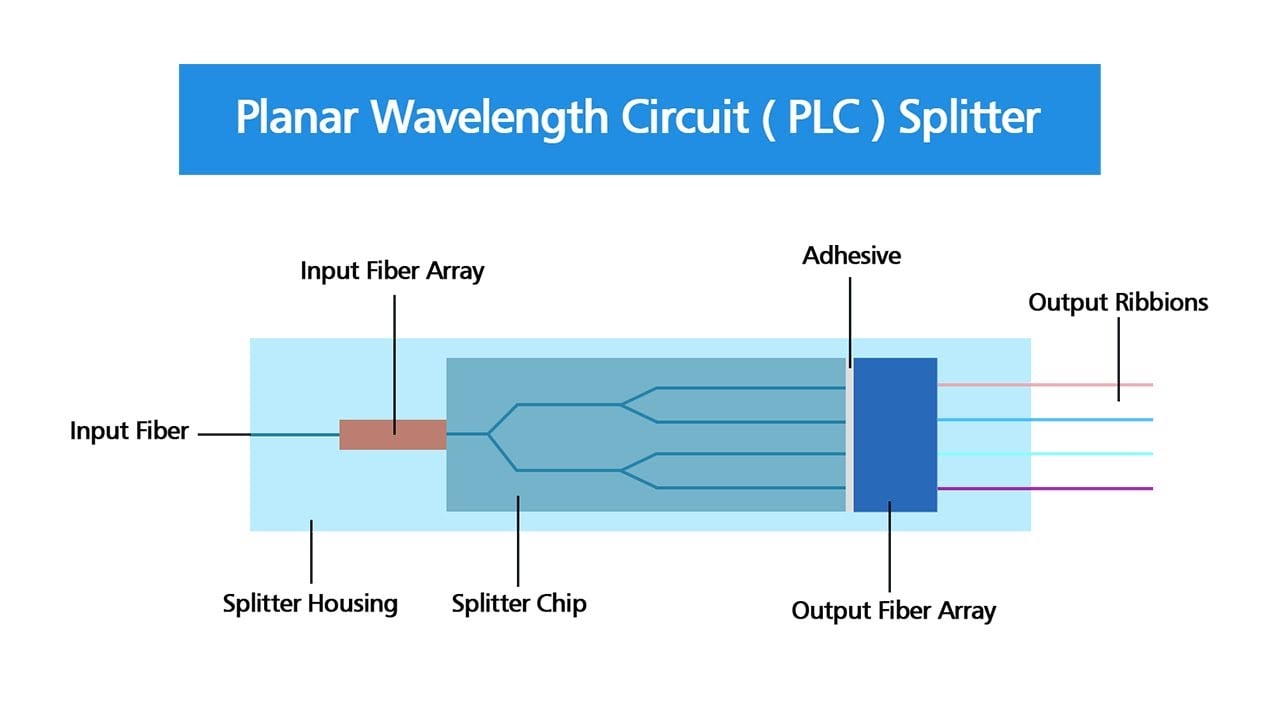
PLC fiber splitter are manufactured using semiconductor technology and offer an excellent solution for larger splitting configurations. PLC fiber splitter utilize photolithography to create waveguides on a quartz glass substrate, enabling them to route a specific percentage (or ratio) of light. Typically, PLC fiber splitter offer splitting ratios of 1:4, 1:8, 1:16, 1:32, or 1:64. They are available in various types, including bare fiber PLC splitters , miniature steel tube PLC splitters, ABS cassette PLC splitters , PLC splitters with splitters, tray-mount PLC splitters, rack-mount PLC splitters , LGX fiber splitter , and miniature plug-in PLC splitters.
FBT Splitter Overview
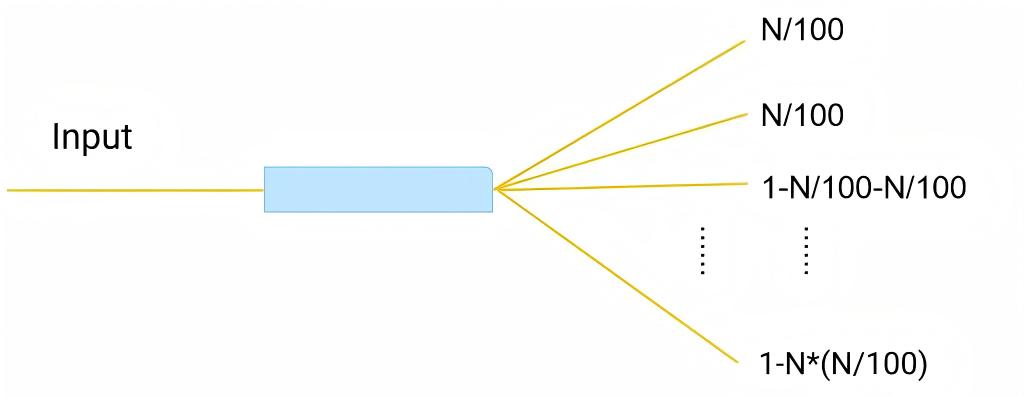
FBT fiber splitter utilize traditional passive component manufacturing technology, bundling two or more fibers together and then fusion-stretching them using a tapered drawing machine. Because fused fibers are relatively fragile, they are typically encased in a glass tube made of epoxy resin and silica. This glass tube is then encased in a stainless steel tube, which is then sealed with silicon. As the technology matures, FBT fiber splitter are becoming increasingly cost-effective.
PLC Fiber Splitter vs FBT Fiber Splitter: What's the Difference?
As can be seen from the above, the manufacturing processes of PLC fiber splitter and FBT coupler splitters are different. In addition, there are the following differences between these two fiber splitter:
Working wavelength
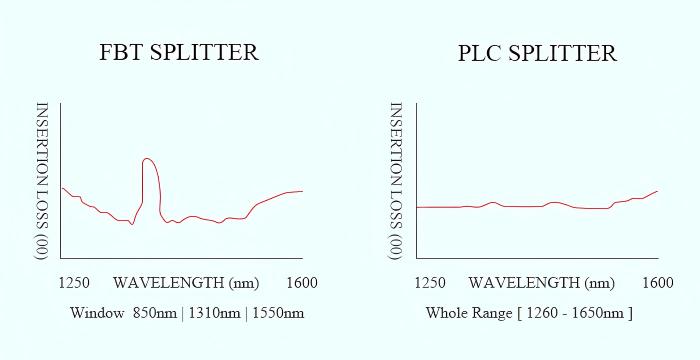
The PLC optical splitter operates at an adjustable wavelength between 1260nm and 1650nm, supporting a wider range of applications. The FBT optical splitter, on the other hand, only supports three wavelengths: 850nm, 1310nm, and 1550nm, and cannot operate at other wavelengths.
Splitting ratio
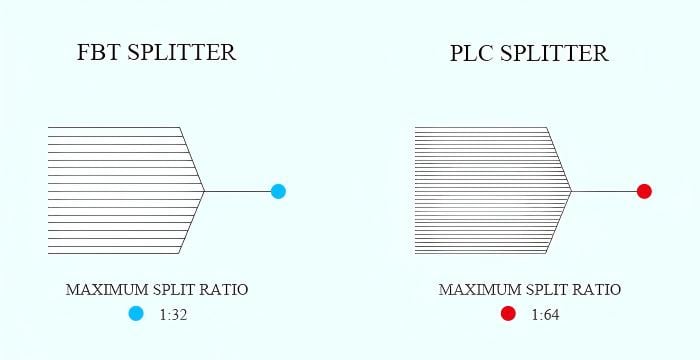
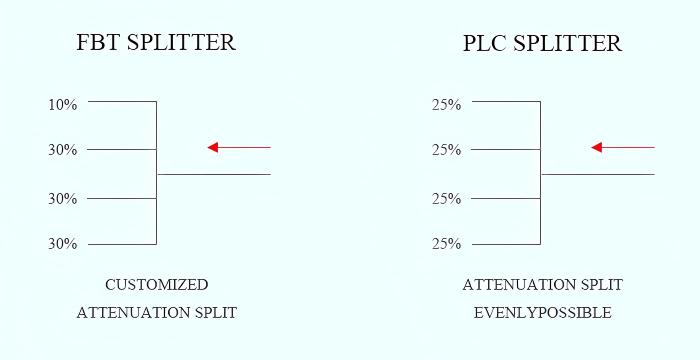
The splitting ratio refers to the ratio of the input optical signal to the output optical signal of an optical splitter. PLC fiber splitter offer a splitting ratio of up to 1:64, while FBT fiber splitter have a splitting ratio of 1:32. Relatively speaking, PLC fiber splitter offer higher reliability. However, FBT fiber splitter have variable splitting ratios and support customization, such as 1:3, 1:7, and 1:11, while PLC fiber splitter are limited to standard options of 1:2, 1:4, 1:8, 1:16, 1:32, and 1:64.
Spectral uniformity
The PLC optical splitter can achieve uniform light splitting with equal ratio, while the FBT optical splitter is composed of multiple 1x2 connection packages, lacks signal management, and cannot achieve uniform light splitting. Moreover, the larger the splitting ratio, the worse the uniformity, which affects the transmission distance.
Failure rate
Currently, mature taper processes can only produce tapers of less than 1x4 at a time. Therefore, when the splitting ratio exceeds 1:8, the FBT optical splitter requires more than seven 1x2 connectors, which is prone to errors and failures. In other words, the higher the splitting ratio of the FBT optical splitter, the greater the failure rate. However, the failure rate of PLC fiber splitter is much lower than that of FBT fiber splitter, as shown in the figure below.
Temperature
Temperature is a key factor affecting the insertion loss of optical devices. Therefore, temperature stability plays a vital role in device performance. PLC fiber splitter can operate stably in temperatures between -40°C and 85°C, while FBT fiber splitter operate in a temperature range of -5°C to 75°C. Relatively speaking, PLC fiber splitter have a wider operating temperature range and can maintain good performance even in extreme environments.
Cost
The manufacturing process of PLC fiber splitter is complex and the chip cost is high; while FBT fiber splitter are made of steel, heat shrink tubing and other materials. Due to the low material cost and simple device manufacturing technology, FBT fiber splitter are relatively cheaper.
Size
FBT splitters typically have a larger and bulkier design compared to PLC splitters. They demand more space and are better suited for applications where size is not a limiting factor. PLC splitters boast a compact form factor, making them easily integrable into small packages. They excel in applications with limited space, including inside patch panels or optical network terminals.
Summarize
In general, PLC and FBT fiber splitter differ in many aspects, beyond their similar appearance and size, such as manufacturing process, operating wavelength, and temperature. The advent of PLC fiber splitter demonstrates the significant advancements in optical splitter manufacturing technology in recent years. Compared to traditional FBT fiber splitter, PLC fiber splitter offer superior performance. If your network requires high performance, we recommend choosing PLC fiber splitter over FBT fiber splitter.





No comments have been posted yet.