


.webp)


Fiber optic patch cables, one of the most fundamental components of optical network cabling, are widely used in establishing fiber optic links. Fiber optic manufacturers offer numerous types of patch cables , including MPO/LC/SC/FC/ST, simplex/duplex, and single-mode/multimode, tailored to specific application scenarios. Each type has its own unique characteristics and is irreplaceable. This article will provide a detailed introduction to the different types of common patch cables to facilitate your selection and cabling.
Classification by fiber optic connector type
Fiber optic patch cables can be categorized as MPO, MTP, LC, SC, FC, ST, MTRJ, MU, E2000, or DIN based on their fiber optic connectors. While these different types of patch cables share similar components (connectors and optical cables) and functions, their differing characteristics and performance lead to varying application scenarios.
LC fiber optic patch cords
LC fiber optic patch cables are one of the most commonly used in optical networks. Their compact size, coupled with a 1.25mm ferrule diameter, makes them ideal for high-density cabling, making them widely used in computer rooms and data centers. To meet the high-density and high-performance requirements of data centers, many suppliers are introducing LC fiber optic patch cables with superior performance, such as ultra-low insertion loss LC fiber optic patch cables and single-tube duplex LC fiber optic patch cables.
Ultra-low insertion loss LC fiber optic patch cord: Compared with conventional LC fiber optic patch cords (insertion loss is generally 0.75dB), ultra-low insertion loss LC fiber optic patch cords use LL technology, with insertion loss as low as 0.12dB, making them more suitable for long-distance transmission.
Duplex LC Fiber Patch Cable : This duplex LC patch cable utilizes a specially designed LC uniboot connector, allowing bidirectional transmission of optical signals within a single fiber, expanding the possibilities for high-density cabling. Compared to standard LC patch cables, it effectively improves space utilization by 50%, saving time and costs while facilitating cabling, making it particularly suitable for locations with limited space.

Furthermore, to save cabling space, Fibermart recently launched a short-sleeved LC fiber optic patch cable . Compared to standard LC fiber optic patch cables, this short-sleeved LC patch cable utilizes a 12mm short-sleeved design, shortening the connector length by 30%, providing greater cabling flexibility. It is ideal for confined environments and can meet the high-density cabling requirements of MDAs (main distribution areas) and EDAs (equipment distribution areas). When space is limited, this short-sleeved LC patch cable is a good choice.

SC fiber optic patch cord
SC fiber optic patch cables utilize an SC connector with a 2.5mm ferrule diameter, which is twice the size of an LC connector. They are also known as large square connectors (large square fiber optic patch cables). These fiber optic patch cables utilize a push-pull design, are plug-and-play, and offer excellent performance, making them ideal for telecommunications and data network systems, including point-to-point passive optical networks.
MPO/MTP fiber optic patch cord
MPO/MTP fiber optic patch cables are commonly used in high-speed data communication systems, such as 40G/100G direct connections and interconnects. MPO/MTP fiber optic patch cables utilize multi-fiber connectors and can accommodate 6 to 144 fibers, making them the highest-capacity fiber optic patch cables currently available. MPO/MTP fiber optic patch cables consist of optical fibers, jackets, coupling components, ferrules, pins, and dust caps. They are categorized as polarity A/B/C male/female based on the number of fibers and the placement of the pins. Because different types of MPO/MTP fiber optic patch cables are suitable for different applications, selecting the appropriate MPO/MTP fiber optic patch cable is crucial based on the specific link requirements. For more information on MPO/MTP connectors, please visit "One Article: A Comprehensive Guide to MTP® Connectors . "
FC fiber optic patch cord
FC fiber optic patch cables were the first to utilize ceramic ferrule connectors. Unlike LC and SC fiber optic patch cables, they utilize a circular, screw-type connector made of nickel or stainless steel that requires a threaded clamp to secure it to an adapter or jack. While FC fiber optic patch cables are more complex to install, they remain a popular choice for connecting optical time domain reflectometers. Initially used in telecommunications and data network systems, FC fiber optic patch cables gradually withdrew from the market with the introduction of LC and SC fiber optic patch cables.
ST fiber optic patch cord
ST fiber optic patch cables were developed and manufactured by AT&T after the FC fiber optic patch cables. They utilize a bayonet connector with a spring-loaded ceramic ferrule (2.5mm diameter) and offer an insertion loss of approximately 0.25dB. They can be used in both long- and short-haul applications, such as campus and enterprise networks. However, the market share of both ST and FC fiber optic patch cables has been declining in recent years.
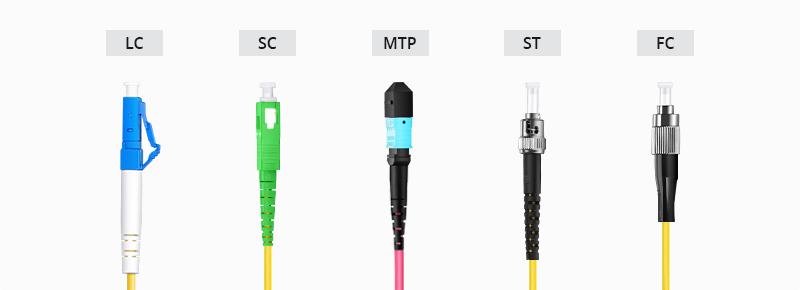
The above are the five most common types of fiber optic patch cables, each with different connectors and popularity. The following will introduce four fiber optic patch cables that are less commonly used in today's optical networks.
MTRJ fiber optic patch cable - The connector of the MTRJ fiber optic patch cable is made of precision plastic and is divided into male and female connectors due to different pins.
MU fiber optic patch cord - MU fiber optic patch cord is similar to SC fiber optic patch cord, but uses a 1.25mm diameter sleeve and a connector with a self-retaining mechanism. It has a compact structure and is suitable for high-density installation and can be used in DWDM networks.
DIN fiber optic patch cord - Although the structural dimensions of the connector pin and coupling sleeve of the DIN fiber optic patch cord are the same as those of the FC fiber optic patch cord, the internal metal structure of the connector contains a spring to control the pressure. The structure is more complex and the mechanical precision is higher, so the loss is small.
E2000 Fiber Optic Patch Cord - The connector of the E2000 fiber optic patch cord adopts a push-pull connection mechanism. The connector is equipped with an automatic metal gate and laser beam protection device. The one-piece design can quickly achieve terminal connection.
According to the composition structure
Fiber optic patch cables can be categorized as ribbon and bundle types based on their structure. Ribbon fiber optic patch cables utilize a flat, ribbon-like cable composed of optical fiber ribbons. Their higher fiber density allows them to accommodate more fiber cores, significantly saving cabling costs and space. Bundle fiber optic patch cables, on the other hand, utilize a bundled cable, typically composed of 0.9mm loose tube or loose-tube fibers. These cables are typically round and primarily used for indoor structured cabling. Learn more about ribbon and bundle fiber optic patch cables: "What is the Difference Between Ribbon and Bundle Fiber Patch Cables? "

Divided by application environment
Depending on the application environment, fiber optic patch cables are divided into conventional fiber optic patch cables and reinforced fiber optic patch cables. Conventional fiber optic patch cables are characterized by being relatively lightweight and low-cost, meeting the needs of most indoor transmission equipment and the high-density cabling requirements of data centers. Therefore, conventional fiber optic patch cables are also commonly used in daily life. Reinforced fiber optic patch cables are generally used in harsh outdoor environments such as underground tunnels and base station construction. Therefore, they usually need to be insect-proof, waterproof, and heat-resistant to prevent damage that affects normal communication. To cope with harsh environments, people have designed and developed different types of reinforced fiber optic patch cables based on the usage scenarios , such as armored fiber optic patch cables, IP67 waterproof fiber optic patch cables, and FTTA remote patch cables.
This article introduces the above-mentioned reinforced fiber optic patch cords in detail: "Ruggedized fiber optic patch cords - the ideal solution for harsh environments" .
Classification by sheath type
PVC and LSZH are commonly used jacket materials for fiber optic patch cables. PVC patch cables are relatively flexible and pliable at normal temperatures and are often used indoors, such as in horizontal sub-wiring systems. Compared to PVC patch cables, LSZH (low-smoke zero-halogen) patch cables contain flame-retardant compounds that do not release toxic fumes when burned. They are often used in unventilated areas exposed to public spaces, such as subways and tunnels.
Classification by number of optical fiber cores
Fiber optic patch cables can be divided into simplex (single-core) and duplex (dual-core) types based on the number of optical fibers. As shown in Figure 2, simplex patch cables typically consist of one optical fiber and one connector, meaning signals can only be sent in one direction. For example, a signal can be transmitted from A to B via a simplex patch cable, but it cannot be transmitted back from B to A. A duplex patch cable, on the other hand, consists of two optical fibers and two connectors. It allows signals to be transmitted in opposite directions, for example, signals can be transmitted from A to B and vice versa.

According to the optical transmission mode
Fiber optic patch cables are categorized as single-mode and multimode based on the optical transmission mode. Single-mode fiber optic patch cables can only transmit a single mode of light, resulting in low intermodal dispersion, making them suitable for long-distance communications. Multimode fiber optic patch cables, on the other hand, can transmit multiple modes of light at once. Intermodal dispersion is high, and this increases with increasing transmission distance, making them more suitable for short-distance transmission.
Classification by polishing type
Fiber optic patch cables are categorized into three types based on the type of connector polish: PC, UPC, and APC. PC patch cables utilize a micro-spherical polished connector and are black; APC patch cables utilize an 8° bevel polished connector and are green; and UPC patch cables, based on PC patch cables, offer improved end-face polish and surface finish and are blue. Fiber optic patch cables with these three polishing methods differ in structure and performance, primarily in insertion loss and return loss. APC is currently the most popular polishing method. To learn more about the differences between PC, UPC, and APC, visit "Which Connector to Choose: PC vs. UPC vs. APC? "

According to production and processing technology
Depending on the production and processing technology (i.e., whether or not the fiber optic connector is terminated), fiber optic patch cords can be divided into field-terminated connector fiber optic patch cords and factory-terminated connector fiber optic patch cords. Field-terminated connector fiber optic patch cords refer to fiber optic connectors that are terminated at the network construction site. The termination process includes stripping the buffer layer, cleaning, polishing, splicing, testing, etc. This not only requires a large number of termination tools, but also requires network administrators to have proficient termination technology. Factory-terminated connector fiber optic patch cords (i.e., pre-terminated fiber optic patch cords) refer to fiber optic connectors and optical fibers that have been terminated by the factory during production and processing. Before selecting this type of fiber optic patch cord, it is necessary to understand the interface type of the devices at both ends and measure the link length in advance. Because of its convenient and fast installation (plug and play) and low user requirements, it is very popular among users.
|
|
Field-terminated connector fiber optic patch cords |
Factory terminated connector fiber optic patch cords |
|
advantage |
Flexible configuration of optical cable length |
The polishing process is guaranteed; the testing conditions and equipment are available, and the performance is guaranteed; |
|
shortcoming |
Time-consuming and time-consuming; Performance cannot be guaranteed; |
The length needs to be measured in advance, which is inconvenient for rail transportation |
Summarize
In addition to the aforementioned fiber optic patch cables, there's also a specialized type—the mode-modulating patch cable—that can connect single-mode and multimode links by changing the light transmission mode. As networks increasingly adopt higher speeds, higher density, and higher performance, MTP/MPO pre-terminated patch cables are becoming increasingly popular in 40G/100G high-density data centers, while LC patch cables are primarily used for 1G/10G enterprise networks and computer room cabling. With the diverse fiber optic patch cables available on the market (e.g., varying in application environment, composition, and material), choose the right one based on your actual transmission needs. If you're unsure about your choice, seek professional assistance to minimize unnecessary losses.





No comments have been posted yet.