


.webp)


Laser Diodes: Tiny Devices Powering a Global Technology Revolution
In 2025, scientists from the University of Rochester and the University of California, Santa Barbara successfully developed a microlaser so small it can fit on a penny. This laser can change its optical frequency at a rate of 2 quintillion times per second and boasts an extremely narrow linewidth of just 167 Hertz, representing a technological marvel.
This breakthrough technology will power the next generation of autonomous vehicles, space science instruments, and high-precision clocks, showcasing the immense potential of laser diode technology.
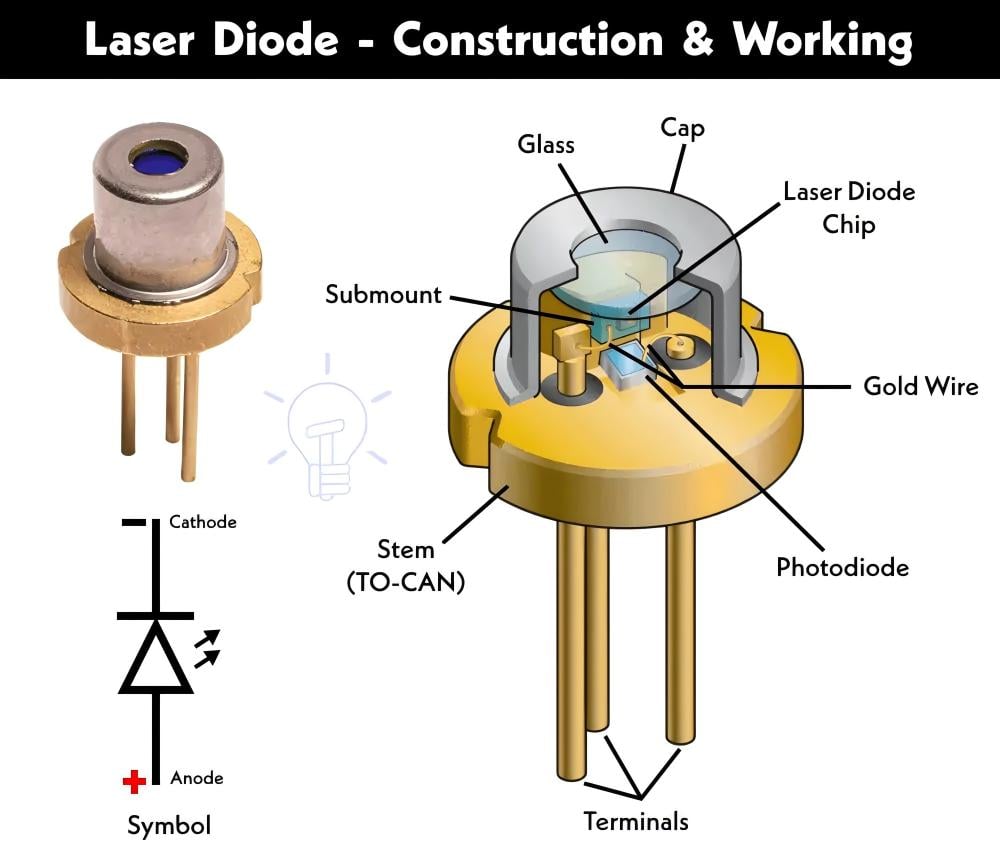
What is Laser Diodes?
A Laser Diode (LD) is a device that uses semiconductor material as the gain medium to generate laser light through stimulated emission. Unlike conventional light sources, light emitted by a laser diode exhibits high coherence, directionality, and monochromaticity.
Its operating principle is based on the "stimulated emission" theory proposed by Einstein in 1917. When a laser diode is forward-biased, electrons and holes recombine within the PN junction, releasing photons. These photons reflect back and forth between the reflective surfaces, striking other atoms and causing the emission of more photons, eventually forming an intense laser beam that exits through the partially reflective surface. The core of a laser diode lies in carrier injection and the stimulated emission of photons. When current passes through the semiconductor material, electrons are excited to a higher energy level (conduction band), while holes remain in the lower energy level (valence band).
Energy is released when electrons recombine with holes, emitted in the form of photons. These photons are reflected back and forth within the resonant cavity and amplified multiple times, ultimately forming the laser output.
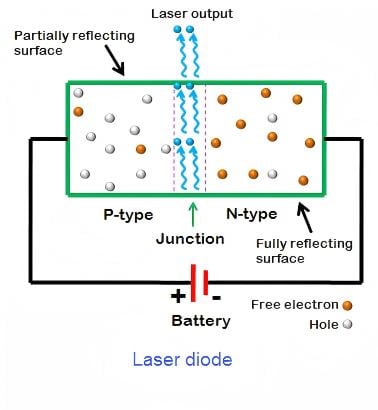
Structure of Laser Diodes
Laser diodes consist of several key components: Semiconductor material provides the band structure enabling carrier injection and recombination; the P-N junction facilitates current injection, creating a carrier concentration difference; the resonant cavity provides optical feedback via mirrors; current injection supplies the energy for electrons to jump from the valence band to the conduction band.
Optical components play a crucial role in laser diodes: The Optical Window acts as a protective barrier at the laser output end, requiring both high transmittance and resistance to environmental erosion. High-power Edge-Emitting Lasers (EEL) often use diamond windows, which have a thermal conductivity as high as 2000 W/m·K, offering excellent heat dissipation.
The Mirror is another key component. Integrated mirrors like Distributed Bragg Reflectors (DBR), composed of dozens of alternating layers of AlGaAs/GaAs, can achieve reflectivities above 99.9% and are central to Vertical-Cavity Surface-Emitting Lasers (VCSELs).
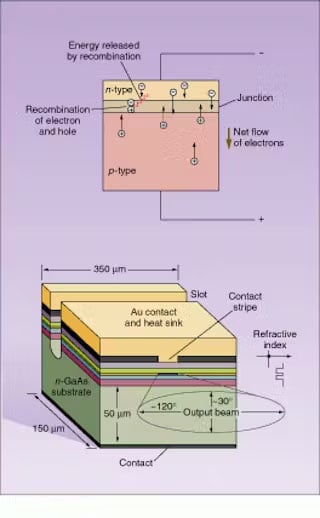
Types of Laser Diodes
Based on structure and application scenarios, laser diodes can be divided into several types:
Edge-Emitting Lasers (EEL)
Edge-Emitting Lasers (EEL) emit light from the cleaved facet at the chip edge, producing an elliptical beam (divergence angle approx. 30°×10°). Typical wavelengths include 808 nm (pumping), 980 nm (communications), and 1550 nm (fiber optic communications). They are widely used in high-power industrial cutting, fiber laser pump sources, and optical communication backbone networks.
Vertical-Cavity Surface-Emitting Lasers (VCSEL)
Vertical-Cavity Surface-Emitting Lasers (VCSEL) emit light perpendicular to the chip surface, with a circularly symmetric beam (divergence angle <15°). They integrate Distributed Bragg Reflectors (DBR) and require no external mirrors. They are extensively used in 3D sensing (e.g., smartphone facial recognition), short-range optical communications (data centers), and LiDAR.
Quantum Cascade Lasers (QCL)
Quantum Cascade Lasers (QCL) operate based on electron cascading transitions between quantum wells, covering mid- to far-infrared wavelengths (3–30 μm) and do not require population inversion. They are primarily used for gas sensing (e.g., CO₂ detection), terahertz imaging, and environmental monitoring.
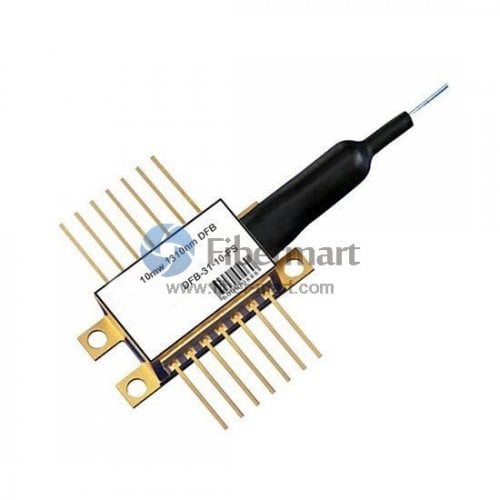
DFB Butterfly Laser Diodes(DFB)
DFB Butterfly Laser Diodes use a standard butterfly package, integrating a Thermoelectric Cooler (TEC), thermistor, and back-facet monitor photodiode (PD), with standard 14-pin or 7-pin layouts. These DFB laser diodes offer high frequency stability (wavelength drift <1 pm/°C) and low noise characteristics (Relative Intensity Noise < -150 dB/Hz). They are mainly used in Dense Wavelength Division Multiplexing (DWDM) communication systems, coherent optical transmission, and high-speed modulation (28 Gb/s and above) scenarios. Their hermetically sealed package ensures long-term reliability even in harsh environments.
Tunable Lasers
Tunable Lasers employ an external cavity design (grating/prism/MEMS mirror), offering a wavelength tuning range of up to ±50 nm, narrow linewidth (<100 kHz), and high Side Mode Suppression Ratio (>50 dB). They are commonly used in Dense Wavelength Division Multiplexing (DWDM) communications, spectroscopic analysis, and biomedical imaging applications.
Parameters of Laser Diodes
Key performance parameters for laser diodes:
| Parameter | Description | Typical Value/Range |
| Threshold Current | Minimum operating current for lasing to begin | Lower is more efficient |
| Operating Voltage | Voltage at rated current | 1.5V to 5V |
| Output Power | Output optical power | Milliwatts (mW) to Watts (W) |
| Wavelength | Center wavelength of emitted light | 650nm (red) to 1550nm (comms) |
| Spectral Width | Width of the emission spectrum | Narrower means better coherence |
| Modulation Rate | Maximum supported modulation rate | Up to tens of GHz |
| Operating Temp. | Stable operating temperature range | -40°C to 85°C |
| Lifetime | Operational lifespan | Up to 100,000 hours for high-quality LDs |
Technological Advantages of Laser Diodes
Laser diodes offer several significant advantages compared to traditional light sources:
Laser diodes have high electro-optical conversion efficiency, reaching 30%-50%. They are small in size and lightweight, typically on the millimeter scale, allowing for integration into various miniature devices.
Laser diodes also offer advantages such as low operating voltage (requiring only a few volts to operate), fast modulation speed (supporting modulation rates up to tens of GHz), and long lifetime (capable of stable operation for tens of thousands of hours with adequate heat dissipation).
The laser beam can be focused into a very small spot, enabling efficient transmission of light energy and maintaining its original brightness over extremely long distances. Due to the highly collimated nature of the laser beam, its energy is very concentrated, making it suitable for high-power applications.
Cutting-Edge Research Progress of Laser Diode
International research teams continue to make breakthroughs in laser diode technology. In 2025, an international research team led by Nanyang Technological University (NTU) in Singapore successfully developed a new type of ultra-compact laser, micron-sized and smaller than a grain of sand.
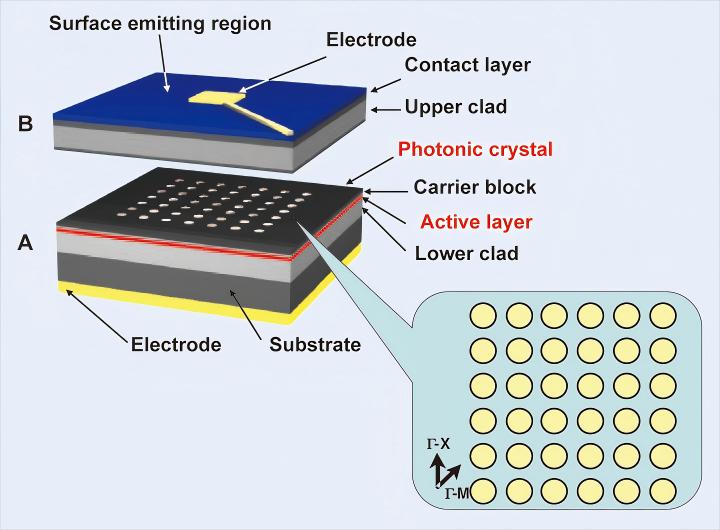
This laser uses a special design that significantly reduces light leakage problems, resulting in lower optical loss and significantly reduced operating energy consumption compared to other ultra-compact lasers.
The research team cleverly combined two physical mechanisms: flatband and bound states in the continuum (BIC). The flatband structure in a photonic crystal allows the group velocity of light waves at specific energy bands to approach zero, effectively confining light energy within the laser cavity.
The BIC mechanism uses light wave interference to cancel out the escape component, achieving effective confinement of light in three-dimensional space.
Based on these two mechanisms, researchers designed a new laser cavity structure: a periodic array of daisy-shaped microholes within a semiconductor photonic crystal sandwiched between two gold films.
This unique design can simultaneously suppress leakage, scattering, and radiation losses, hailed as the "ultimate solution for 3D light leakage suppression."
Also in 2025, the chip-scale laser created by scientists from the University of Rochester and the University of California, Santa Barbara, used a synthetic crystal called lithium niobate.
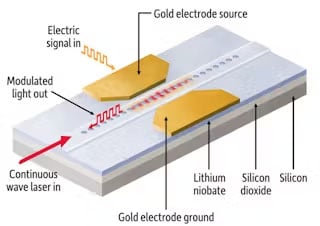
When voltage is applied, this material changes how light propagates within it (Pockels effect), which is key to the laser's exceptional performance.
This laser can change its optical frequency at a rate of 2 quintillion times per second and has an extremely narrow linewidth of just 167 Hertz. It can tune over a 24 gigahertz frequency range without skipping any frequencies, performing more than 10 times better than many existing systems.
Applications of Laser Diodes and DFB Laser Diodes
Laser diode applications have permeated all aspects of modern technology:
In optical communications, the 1310nm and 1550nm DFB laser diodes used in fiber optic communication systems are core components of the light source. The high frequency and efficiency of lasers are fundamental to the proper operation of fiber optic communications.
In industrial processing, high-power laser diodes are used for laser cutting, welding, and marking. Laser cutting technology can precisely cut various materials like metals and plastics, while laser welding provides high-quality, high-strength welds.
In the medical field, laser diodes are used in laser surgery, photodynamic therapy (PDT), and various diagnostic devices. Laser eye surgery has become a common method for treating issues like nearsightedness, farsightedness, and astigmatism. Using precise laser cutting techniques, doctors can reshape the eye to correct vision without damaging surrounding tissue.
In sensing and ranging, LiDAR is widely used for autonomous driving and environmental perception. The most advanced versions of LiDAR—frequency-modulated continuous-wave (FMCW) LiDAR—require a laser that can change frequency rapidly and smoothly, which is exactly what the latest chip lasers can do.
In data storage, laser diodes are used as the read/write light source in CD/DVD/Blu-ray devices.
Frequently Asked Questions (FAQs)
Q: What is the difference between DFB and DBR laser?
A: The core distinction lies in the integration of the diffraction grating relative to the gain medium. In a Distributed Feedback (DFB) laser, the Bragg grating is uniformly etched directly into the active gain region along the entire cavity, providing distributed feedback and ensuring stable single-mode operation. In contrast, a Distributed Bragg Reflector (DBR) laser physically separates the functions: distinct grating sections act as mirrors at the ends of the cavity, while a central section provides the optical gain, enabling wider wavelength tunability.
Q: What is the difference between FP laser and DFB laser?
A: An FP (Fabry-Perot) laser relies on the natural cleaved facets of the semiconductor chip to form a Fabry-Perot cavity resonator, which results in multi-longitudinal mode emission with a broad spectral width. In contrast, a DFB (Distributed Feedback) laser incorporates a periodic Bragg grating directly within the laser cavity to provide distributed feedback, enabling highly stable, single-longitudinal mode operation with a narrow linewidth, which is essential for long-haul and high-bit-rate transmission.
Q: What is the working principle of DFB laser?
A: A DFB laser's operation is based on distributed feedback from a permanent Bragg grating corrugated directly above the active layer, which provides wavelength-selective reflection throughout the cavity length.
Q: What is Distributed Feedback Laser?
A: A distributed feedback (DFB) laser is a type of semiconductor laser that achieves stable, single-frequency emission by incorporating a periodic Bragg grating structure directly within its active cavity to provide wavelength-selective distributed feedback, effectively suppressing all but one longitudinal mode for a narrow linewidth output.
Q: What is the Structure of DFB Laser?
A: The core structure of a DFB laser features a Bragg grating—a periodic corrugation—etched directly into the waveguide layer adjacent to the active gain region, forming a monolithic cavity where the grating provides distributed feedback along the entire length of the gain medium rather than relying on discrete mirrors.
Q: What are gain chips?
A: Gain chips are semiconductor device that provides optical amplification, but it is not a complete laser by itself. Often, gain chips are used in systems where an external cavity provides feedback for laser oscillation. This enables precise wavelength tuning and control.
Q: How can I improve the power stability of a laser diode?
A: The power stability of semiconductor lasers is significantly affected by laser temperature, laser current, and back-reflections. Variations in temperature influence the bandgap and carrier density, leading to changes in the laser’s output power and wavelength. Laser current fluctuations directly impact the number of injected carriers, causing power instability. Additionally, back-reflections from external surfaces or optics can interfere with the laser cavity, introducing feedback that disturbs the lasing process, resulting in intensity noise or even mode hopping. Maintaining stable temperature, precise current control, and minimizing back-reflections are essential for ensuring stable power output in semiconductor lasers.





No comments have been posted yet.