


.webp)


What Is A Polarization Maintaining Fiber Patch Cable
A Polarization Maintaining Fiber Patch Cable (often abbreviated as PM Fiber Patch Cable or PM Patchcord) is a specialized type of single-mode optical fiber cable designed to preserve the linear polarization state of the light propagating through it.
In standard single-mode fibers, the polarization of light is not constrained and can vary randomly due to bends, twists, or imperfections in the fiber. This is acceptable for many applications like telecommunications. However, for applications where the polarization state is critical (e.g., in interferometry, electro-optic modulation, or quantum optics), this random variation is problematic.
How It Works?
The fundamental operation of a Polarization Maintaining (PM) fiber is based on intentionally creating and managing birefringence within the fiber to "lock" the polarization state of light. Here’s a step-by-step breakdown of how it works:
The Core Problem
In a perfect, perfectly circular symmetric single-mode fiber, the polarization state of light would be preserved. However, in reality, microscopic imperfections, bends, and twists act as random coupling points. These points cause energy from one polarization mode to transfer to the orthogonal mode, scrambling the polarization state. This is known as random polarization coupling.
The PM Fiber Solution
Instead of trying to eliminate all asymmetry, PM fiber is designed with a strong, controlled, and permanent asymmetry. This creates a large, deliberate birefringence.
Birefringence is the property of a material that has a different refractive index depending on the polarization direction of light passing through it. In a PM fiber, this means light polarized along one specific axis sees a different refractive index than light polarized along the perpendicular axis.
The Mechanism
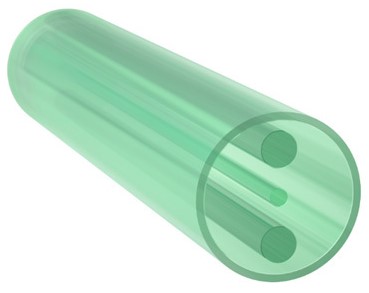
The most common method to create this birefringence is via stress-induced birefringence. This is achieved by incorporating two Stress-Applying Parts (SAPs) made of a glass with a different thermal expansion coefficient (e.g., borosilicate glass) than the pure silica cladding. These SAPs are placed symmetrically on opposite sides of the core during the fiber preform manufacturing.
The Cooling Process
After the preform is melted and drawn into a fiber, it cools down. The SAPs, designed to contract more than the surrounding silica cladding during cooling, create permanent, asymmetric mechanical stress "frozen" into the fiber. This stress field directly affects the core, changing its refractive index via the photo-elastic effect.

Defining the Axes
The asymmetric stress field creates two distinct, perpendicular optical axes for light to travel along:
Slow Axis: The axis parallel to the line connecting the two SAPs. The compressive stress increases the refractive index along this axis. Since the speed of light in a medium is v = c/n, a higher refractive index (n) means a slower speed of light. Light polarized along this axis travels slower.
Fast Axis: The axis perpendicular to the line connecting the SAPs. The stress here results in a lower refractive index. Light polarized along this axis experiences a higher speed of light.
How Polarization is Maintained:
When linearly polarized light is launched into the fiber and precisely aligned with one of these axes (e.g., the slow axis), the fundamental principle takes effect:
The large, intentional birefringence creates a significant phase velocity mismatch between the two axes. For light to couple power from one axis to the other, a "perturbation" (like a bend) must provide the exact amount of momentum to compensate for this velocity mismatch. Because the built-in birefringence is so strong, the random bends and twists in the fiber are too weak to provide the necessary coupling. Therefore, the light remains strongly confined to its original axis of propagation.
Why Do We Use It?
A Polarization Maintaining Fiber Patch Cable is not used for general signal transmission. It is a specialized component employed in specific scenarios where controlling the polarization state of light is not just beneficial, but essential for the system's core functionality. Its use is mandated by the need for precision and stability.
Here are the reasons why a PM fiber patch cable is preferred:
To Eliminate Polarization-Dependent Fading (PDF) in Interferometric Systems
In applications like fiber optic gyroscopes (FOGs) and interferometric sensors, light waves travel along two paths and then interfere with each other. The interference contrast (visibility) is maximized only if the polarization states of the two waves are identical. Standard fiber causes random polarization drift, leading to a fluctuating interference signal that can fade entirely—a phenomenon known as Polarization-Dependent Fading. This destroys the measurement signal. Using PM fiber ensures that the polarization state is identical in both paths of the interferometer, maintaining a strong and stable interference signal, which is the basis for accurate rotation or sensing measurements.
To Ensure Maximum Efficiency in Polarization-Sensitive Devices
Many photonic components have performance that is intrinsically tied to the input light's polarization. For example:
Electro-Optic Modulators (EOMs) / Acousto-Optic Modulators (AOMs): Their modulation efficiency is highest when the input light is polarized along a specific crystal axis. Uncontrolled polarization leads to inconsistent and reduced modulation depth.
Non-linear Crystals (e.g., for Second Harmonic Generation - SHG): The frequency doubling process is highly polarization-dependent. Only light with the correct polarization will be converted efficiently.
A PM patch cable delivers light with a stable, known polarization state directly aligned to the device's preferred axis, ensuring peak and consistent performance.

To Preserve Quantum Information in Quantum Applications
In quantum key distribution (QKD) and quantum computing experiments, quantum bits (qubits) are often encoded into the polarization states of single photons (e.g., |0> for horizontal, |1> for vertical). If the photon's polarization randomly rotates as it travels through a standard fiber, the quantum information is lost, causing errors and security vulnerabilities. A PM fiber acts as a "waveguide" for the polarization state, ensuring that a photon prepared in a specific quantum state arrives at the detector with that same state intact, preserving the fidelity of the quantum information.

To Enable Preciple of Operation in Specialized Lasers
Some fiber laser and amplifier designs require a polarized pump source or generate a polarized output to avoid unwanted nonlinear effects or to be used in combination with other polarization-sensitive components. PM fiber is used within the laser cavity itself to force the laser to operate in a single polarization mode, resulting in a highly stable polarized output beam.
The key trade-off is cost and handling; PM fiber and its components are significantly more expensive and require careful rotational alignment during connection, which is unnecessary for standard telecommunications.
The Differentiation Of Types
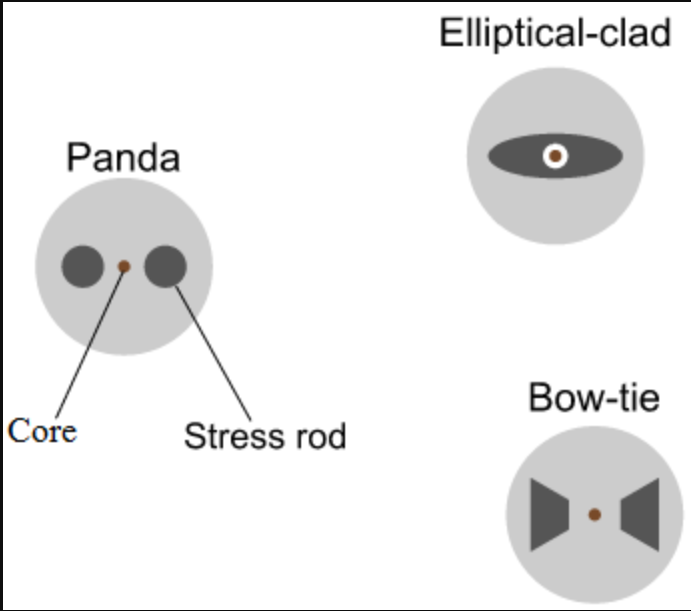
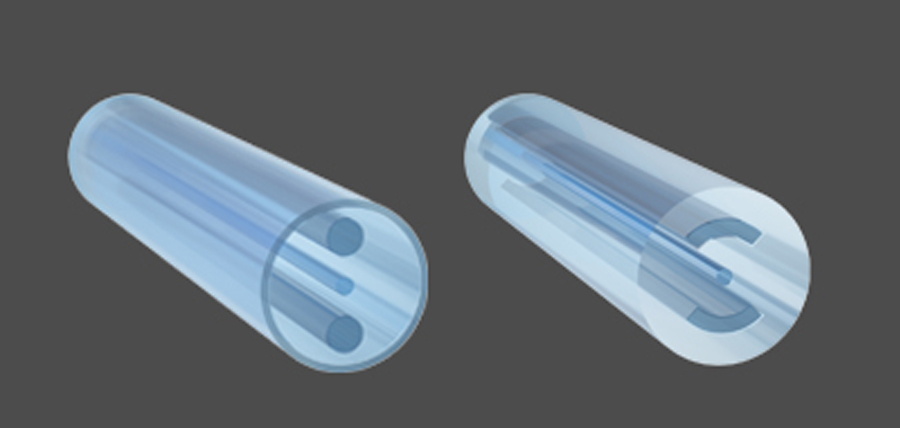
Polarization Maintaining (PM) fiber patch cables are differentiated primarily by their internal fiber design and their connector types, each suited for specific application demands. The most common internal designs are PANDA, Bow-Tie, and Elliptical Clad fibers, which all create the necessary asymmetric stress to preserve polarization but through distinct geometric structures. PANDA fiber, the most prevalent type, utilizes two symmetrical, circular stress-applying parts on either side of the core, offering an excellent balance of high polarization extinction ratio (PER) and low attenuation for widespread use in telecommunications and sensing. Bow-Tie fiber, recognized for its wedge-shaped stress regions, often achieves a superior PER performance, making it the preferred choice for highly sensitive applications like fiber optic gyroscopes. The less common Elliptical Clad fiber employs an overall elliptical cladding to induce stress, representing an older design philosophy.
Beyond the fiber itself, the connector type is paramount for maintaining the critical rotational alignment of the fiber's slow axis. Unlike standard connectors, PM variants are always keyed to prevent mating misalignment. FC/APC connectors are the most traditional and widely used, valued for their robust keyed design and angled polish that minimizes back reflections. SC/APC and the smaller LC/APC connectors provide keyed functionality in push-pull form factors, catering to high-density patch panels and datacom environments. For high-power systems or enhanced safety, E2000/APC connectors are frequently employed, as they integrate a protective shutter. These cables are also categorized by their performance grade, such as standard versions for common lab use and specialized high-power versions engineered with unique fiber compositions and connector terminations to withstand intense laser power without degradation.
Conclusion
In summary, a Polarization Maintaining (PM) Fiber Patch Cable is a highly specialized optical component engineered not for general data transmission, but for precision applications where the stability of light's polarization state is paramount. Its core function is to overcome the inherent limitations of standard fiber by employing a deliberately created, strong internal birefringence—typically through stress-applying parts—to "lock" light into a single polarization axis. This prevents the random polarization drift that would otherwise corrupt sensitive systems.
The critical importance of PM fiber is evident in its essential role across advanced technologies: it ensures accuracy in fiber optic gyroscopes and interferometric sensors by eliminating signal fading, maximizes efficiency in polarization-dependent devices like modulators and lasers, and is indispensable for preserving the integrity of quantum information in photonic quantum computing. While it comes with trade-offs in cost and complexity, requiring careful rotational alignment during use, its ability to provide unparalleled polarization stability makes it an irreplaceable tool in the forefront of photonic research, sensing, and communication.





No comments have been posted yet.