


.webp)


Have you ever encountered signal interruptions and video lag while operating a drone? To address the signal interference and transmission delay issues in remote drone operation, a solution based on fiber optic communication technology is quietly emerging.
This technology is not just a pipe dream—fiber optic communication utilizes the principle of total internal reflection of light, allowing light to propagate through glass or plastic fibers thinner than a human hair. This technology is changing the way drones are remotely operated, providing a stable, high-speed, and secure data channel for demanding civilian applications.
This technology is not just a pipe dream—fiber optic communication utilizes the principle of total internal reflection of light, allowing light to propagate through glass or plastic fibers thinner than a human hair. This technology is changing the way drones are remotely operated, providing a stable, high-speed, and secure data channel for demanding civilian applications.
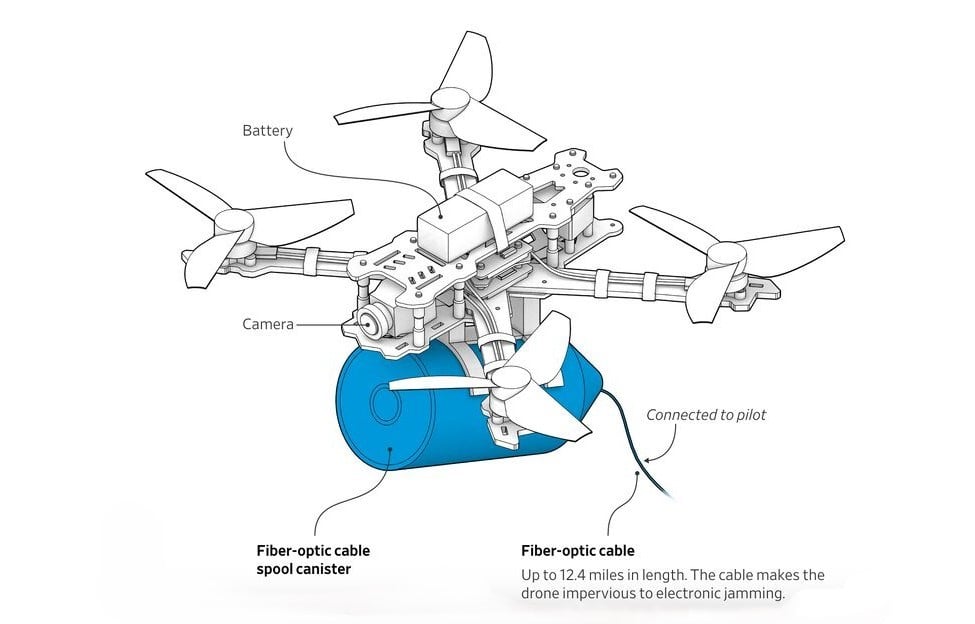
Fiber Optic UAV Drone Cornerstone of Technique
Fiber optic communication systems consist of three main parts: the optical fiber itself, the light source, and the photodetector. The secret to signal transmission within the fiber lies in the principle of total internal reflection: when light travels from a high-refractive-index medium to a low-refractive-index medium, if the angle of incidence is greater than the critical angle, the light will be completely reflected back into the original medium.
This principle is cleverly applied in fiber optic design: the fiber consists of a core and a cladding, with the core having a higher refractive index than the cladding. This allows light to undergo repeated total internal reflection within the core, ensuring stable signal transmission even when the fiber is bent. Compared to traditional radio communication, fiber optic communication offers significant advantages: large communication capacity, low transmission loss, and strong resistance to electromagnetic interference. For example, after an optical signal travels 100 kilometers in an optical fiber, its signal strength only decreases from 1 to 0.99, while an electrical signal might attenuate by half after only 1 kilometer.
This principle is cleverly applied in fiber optic design: the fiber consists of a core and a cladding, with the core having a higher refractive index than the cladding. This allows light to undergo repeated total internal reflection within the core, ensuring stable signal transmission even when the fiber is bent. Compared to traditional radio communication, fiber optic communication offers significant advantages: large communication capacity, low transmission loss, and strong resistance to electromagnetic interference. For example, after an optical signal travels 100 kilometers in an optical fiber, its signal strength only decreases from 1 to 0.99, while an electrical signal might attenuate by half after only 1 kilometer.
Different Application on Fiber Optical UAVs
Fiber optic communication is not a new technology; its core principle is to transmit signals using total internal reflection of light within extremely thin glass or plastic fibers. When this technology is combined with drones, it typically manifests in two forms:
● First, tethered drone systems, where the drone connects to the ground via a composite cable (containing power copper wires and communication fiber optics), achieving near-unlimited endurance and ultra-high bandwidth data backhaul.
● Second, fiber-optic guided drones, where the drone releases or tows a lightweight, high-strength dedicated fiber optic cable during flight, serving as a pure data transmission channel.

The outstanding advantages of Fiber Optical Cable lie in their physical characteristics: they are immune to any form of electromagnetic interference, maintaining signal purity even in complex electromagnetic environments; their bandwidth potential is enormous, with a single fiber easily carrying multiple ultra-high-definition video and sensor data streams with extremely low and stable latency; simultaneously, fiber optic communication does not radiate signals outwards, possessing inherent physical confidentiality and greatly enhancing data security. These characteristics precisely address the shortcomings of traditional wireless communication.
UAV/FPV Drone Optical Fiber Features
Singlemode Design
The special optical fibers used in guided fiber optic drones typically employ a single-mode design at their core. Single-mode fiber has an extremely fine core, only about 8 to 10 micrometers in diameter, and its physical structure dictates that it allows light to propagate in only a single fundamental mode. This characteristic fundamentally eliminates the "modal dispersion" problem caused by the difference in the speeds of different modes of light in multimode fibers, ensuring that the optical signal undergoes almost no pulse broadening during transmission. Therefore, single-mode fiber possesses extremely high bandwidth potential and extremely low signal distortion, becoming the physical foundation for drones to transmit ultra-high-definition video and massive amounts of sensor data back in real time and without loss, even at distances of tens of kilometers.
Bending Insensitivity
To adapt to the dynamic environment of drone flight, such optical fibers must possess excellent bending insensitivity. This means that the signal transmission must remain highly stable when the fiber is wound, unwound, or bent by airflow disturbances. By employing unique waveguide structure designs (such as recessed cladding or microstructured fibers), special optical fibers can more tightly confine the optical field within the core, significantly reducing light leakage caused by bending. Its key technical specification allows for extremely small bending radii; some products can operate with bending radii as low as 5 millimeters, while the additional optical signal loss is almost negligible. This characteristic directly ensures that the "information lifeline" behind the drone is not interrupted due to physical deformation during maneuvers.

Long-distance Transmission
Low-loss characteristics in long-distance transmission are crucial for extending the drone's operational radius. High-quality single-mode optical fiber can achieve transmission losses of less than 0.2 dB per kilometer within a communication window such as 1550 nanometers. This means that after 10 kilometers of signal transmission, its intensity can still maintain approximately 63% of its initial value; after 50 kilometers, approximately 10% of the power is still available for high-quality reception. This ultra-low attenuation characteristic, combined with the extremely light weight of the optical fiber itself, allows the system to extend its operational distance without the need for additional repeaters or significant power compensation devices for the communication link. It enables the drone's "line of sight" to break through the constraints of wireless signals, allowing for stable and persistent data reconnaissance and communication relay in vast spaces.
Optical Fiber in Civilian UAV Usages
In the field of civilian drones, fiber optic communication is opening up entirely new application scenarios, overcoming technical obstacles that traditional wireless communication struggles to overcome.
Infrastructure Inspection
is a typical application scenario for fiber optic drones. Through the collaboration between drones and fiber optic networks, intelligent monitoring of external intrusions, hidden dangers, and faults in fiber optic networks is achieved. When a hidden danger occurs, the system can dispatch a drone to the scene within 5 minutes to transmit real-time images, significantly improving emergency response efficiency.
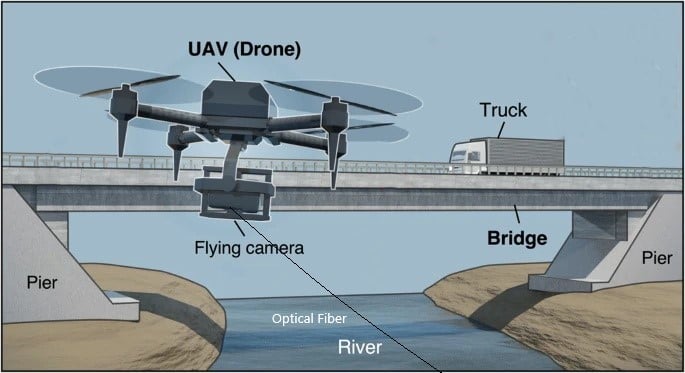
Emergency Communication and Rescue
is another important application direction. In situations where natural disasters cause traditional communication disruptions, drones equipped with fiber optics can quickly establish temporary communication links. By releasing or carrying fiber optic cables, drones form stable data transmission channels, unaffected by complex electromagnetic environments, ensuring smooth rescue command.
Precision Agriculture and Environmental Monitoring
also benefit from fiber optic drone technology. In large farmlands or nature reserves, drones can transmit high-definition multispectral images in real time via fiber optic connections, providing data support for precision fertilization and pest and disease monitoring. Compared to wireless transmission, fiber optics ensure the stability and real-time performance of large-volume image transmission, avoiding monitoring gaps caused by signal loss.
It is worth noting that civilian fiber optic drone technology is also constantly innovating. For example, the lightweight UAV optical communication system released by a company achieves 100Mbps high-speed wireless data transmission while keeping the total weight of the core communication pod under 6.1 kg. This lightweight design makes the widespread application of fiber optic UAVs in the civilian sector possible.
It is worth noting that civilian fiber optic drone technology is also constantly innovating. For example, the lightweight UAV optical communication system released by a company achieves 100Mbps high-speed wireless data transmission while keeping the total weight of the core communication pod under 6.1 kg. This lightweight design makes the widespread application of fiber optic UAVs in the civilian sector possible.
Pros and Cons of Fiber Optic UAV/FPV Drone
Pros
The core advantages of fiber optic drones lie first and foremost in their anti-jamming capabilities. Unlike drones that rely on radio signals, fiber optic drones transmit signals via physical cables, making them largely immune to external electromagnetic interference. This characteristic is particularly important in strong electromagnetic environments or electronic warfare.
Secondly, there is the stability and security of transmission. Fiber optic communication provides a reliable data channel, making signals difficult to intercept or interfere with. Simultaneously, fiber optics support high-speed data transmission, ensuring real-time transmission of high-definition video and sensor data.
Stealth is another major advantage of fiber optic drones. Drone operation does not generate radio frequency signals, reducing the risk of detection. The diameter of the fiber itself is typically less than 0.5 millimeters, making it extremely difficult to detect in the air.
Secondly, there is the stability and security of transmission. Fiber optic communication provides a reliable data channel, making signals difficult to intercept or interfere with. Simultaneously, fiber optics support high-speed data transmission, ensuring real-time transmission of high-definition video and sensor data.
Stealth is another major advantage of fiber optic drones. Drone operation does not generate radio frequency signals, reducing the risk of detection. The diameter of the fiber itself is typically less than 0.5 millimeters, making it extremely difficult to detect in the air.

Cons
However, the technological challenges are equally significant. The most obvious are limitations on flight distance and maneuverability. The operational radius of a drone is limited by the length of the fiber, typically within the range of 5 to 10 kilometers. Furthermore, to avoid fiber breakage, the drone's flight speed and maneuverability are restricted.
Payload is another challenge. The fiber optic cable and its release mechanism increase the drone's weight, reducing the payload space available for mission equipment. Taking a 0.5 mm diameter optical fiber as an example, the total weight, including the casing, can exceed 2 kg.
Environmental adaptability is also a significant concern. In complex environments such as forests and urban buildings, the fiber optic cable is easily snapped, leading to the drone going out of control. Furthermore, the operation is highly complex, requiring skilled operators.
The Oversighted Environmental Costs for Optical Fiber UAV Drone
While discussing the technological effectiveness, we must also consider its entire lifecycle, particularly its potential environmental impact, especially in scenarios involving disposable or abandoned cables after malfunctions. Unlike consumer drones, professional fiber optic drones use thin optical fibers, but their materials (typically special glass, reflective coatings, etc.) are extremely difficult to degrade in the natural environment.
On the battlefields of Ukraine, both sides extensively used fiber optic guided drones, resulting in frontline areas being covered with a "spider web" of white cables, with fields, forests, and villages crisscrossed by cables. These abandoned fiber optic cables, primarily made of glass and plastic, are lightweight and highly resilient, but their durability is most worrying—they could remain in the environment for over 600 years.
On the battlefields of Ukraine, both sides extensively used fiber optic guided drones, resulting in frontline areas being covered with a "spider web" of white cables, with fields, forests, and villages crisscrossed by cables. These abandoned fiber optic cables, primarily made of glass and plastic, are lightweight and highly resilient, but their durability is most worrying—they could remain in the environment for over 600 years.
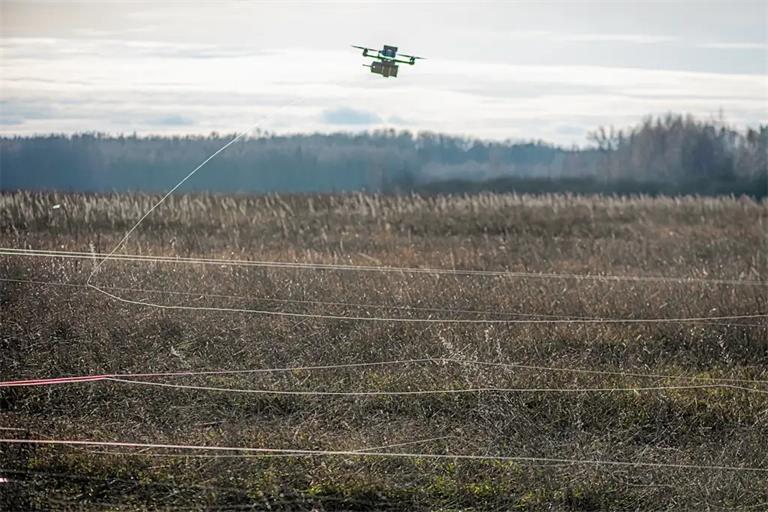
If fiber optic cables are lost during field operations, especially in the wild, forested areas, or over water, due to operational errors, equipment failures, or emergency abandonment, these thin yet resilient remnants will become persistent environmental pollutants. These cables can become entangled in tree branches, damaging the natural landscape; more seriously, they pose a direct threat to wildlife, with birds and small mammals easily becoming entangled and suffering injury or death. Cables scattered in soil or water may release microplastics or other chemicals during their slow decomposition, causing long-term, insidious damage to local ecosystems.
Therefore, when promoting and applying such technologies, it is essential to establish strict operating procedures and cable recycling mechanisms, and to actively develop new environmentally degradable or more easily recyclable cable materials, making environmental friendliness a necessary consideration in technological development.
Summary
In summary, fiber optic systems for drones are a specialized technology developed to address specific long-range, high-reliability communication needs. They fill the wireless communication gap in the civilian market and provide powerful tools for critical areas such as public safety and infrastructure maintenance. However, the sacrifices in mobility, operational complexity, and significant potential environmental risks associated with physical cables mean that it is not the ultimate communication solution for drones. Instead, it complements high-speed wireless communication (such as 5G, microwave, and laser communication), together forming a diverse and adaptable communication landscape for future drones. Technological advancements are always accompanied by trade-offs and responsibilities. While enjoying the clear vision and stable connections offered by fiber optic drones, how to use them prudently and manage their byproducts is a challenge we must all face together.
Find more infos about UAV/FPV drone G657A2 fiber cable at Fibermart





No comments have been posted yet.