


.webp)


In photonic systems where the control of light's polarization state is critical, the Polarization Extinction Ratio (PER) serves as a fundamental performance metric. It quantifies the efficacy of a device or system in maintaining a pure, linear polarization, directly impacting the integrity and signal-to-noise ratio of the transmitted optical signal. The following sections detail the definition, significance, and methodologies for accurately measuring PER across a range of applications and device complexities.
What is Polarization Extinction Ratio?
The Polarization Extinction Ratio (PER) is a key metric that quantifies the purity of a light's linear polarization. It is defined as the ratio of the optical power in the desired, principal polarization state to the residual power in the orthogonal, unwanted state. This ratio is expressed in decibels (dB), where a higher value indicates a cleaner, more perfectly polarized beam.
The measured Polarization Extinction Ratio (PER) at a given point in a system is the cumulative result of several factors. These include the innate polarization properties of the light source (which may not be fully or linearly polarized), physical misalignments at fiber interconnects and splices, and the polarization-altering effects of propagation through the fiber or optical components themselves.

PER is a critical performance parameter for any system or device that requires light to maintain a specific, linear polarization state. In these applications, a higher PER is always desirable. Typical values are application-dependent, ranging from 18-20 dB for standard passive components to 50-60 dB or more for high-performance polarizers and polarizing waveguides.
Conversely, PER can serve as a proxy for measuring the Degree of Polarization (DOP) in depolarizers or low-coherence sources. In such cases, the PER will approach 0 dB, indicating that the optical power is nearly equally distributed across all polarization states, resulting in unpolarized light.
Several methods exist for measuring PER, with the most suitable approach being determined by the specific application requirements.
Several methods exist for measuring PER, with the most suitable approach being determined by the specific application requirements.
Measure By Rotating Polarizer
The rotating polarizer method is the most straightforward technique for measuring PER. In this setup, the output from the Device Under Test (DUT) is fed into a PER meter. Inside the meter, a rotating polarizer, followed by a photodetector, scans the incoming light. A full rotation captures the maximum transmitted power (), when the polarizer's axis aligns with the principal polarization state, and the minimum power (), when it aligns with the orthogonal state. The instrument then automatically computes the Polarization Extinction Ratio using the formula:

The rotating polarizer method provides a straightforward technique for PER measurement. The output of the Device Under Test (DUT) is connected to a PER meter, which houses a rotating polarizer followed by a photodetector. As the polarizer completes a full rotation, the instrument records the maximum power (), corresponding to alignment with the principal polarization state, and the minimum power (), corresponding to the orthogonal state.
A key advantage of this method is its ability to measure both high and low PER values and to determine the absolute alignment of the DUT's polarization axis relative to its output connector key. However, a fundamental limitation exists: because the measurement is based solely on the ratio of orthogonal linear polarization states, it cannot differentiate between truly unpolarized light and purely circularly polarized light, as both will result in a minimal power ratio and a correspondingly low PER.
Measurement Accuracy and Considerations for High-PER Devices
The accuracy of the rotating polarizer method is contingent upon three primary factors: the intrinsic extinction ratio (ER) of the rotating polarizer itself, the quality of the photodetector circuit, and the effective minimization of internal reflections that can introduce measurement noise. For instance, instruments like the ERM-202 utilize a high-ER polarizer and a detection circuit with low polarization-dependent loss and high dynamic range, enabling accurate PER measurements up to 50 dB.
For characterizing devices with inherently high PER, a broadband light source is essential to determine the worst-case (minimum) performance. This requirement stems from the need to avoid coherent interference artifacts. The light source must have a coherence length shorter than a critical value, defined as the center wavelength (λ_center) multiplied by the ratio of the polarization-maintaining (PM) fiber length (l_PM) to its beat length.
When a highly coherent laser source (with a coherence length exceeding this threshold) is used, the light components traveling along the fiber's slow and fast axes remain coherent. If their phase relationship is in-phase or anti-phase, the output can appear perfectly linearly polarized even with input misalignment, resulting in a deceptively high PER measurement. However, this measurement is unstable. Variable phase differences caused by environmental factors like stress or temperature fluctuations lead to constantly changing instantaneous PER values, making them unsuitable for device specification.
Therefore, for a reliable performance benchmark, the PER meter must be operated in a minimum search mode. The device should then be specified by the minimum PER value recorded by the meter while the PM fiber is subjected to controlled perturbation, such as stretching or thermal cycling.
Measured By Polarimeter
Within polarization-maintaining (PM) fiber, the slow and fast axes impose different propagation speeds on their respective light components. When input light is not perfectly aligned to a single axis or is not fully polarized, it excites both of these orthogonal modes. As the light travels, a cumulative phase delay develops between the slow and fast axis components, causing the output polarization state to evolve continuously.
-on-the-Poincar%C3%A9-Sphere.jpg "State of Polarization (SOP) on the Poincaré Sphere")
This relative phase delay can be deliberately varied by perturbing the fiber—through heating, stretching, or wavelength modulation of the source. On the Poincaré sphere, this manipulation causes the output state of polarization to trace a circular path. The orientation of this circle is defined by the slow axis of the fiber, while its radius is determined by the degree of the input light's misalignment from that axis.
The polarimeter method calculates PER from the radius of the circle traced by the evolving State of Polarization (SOP) on the Poincaré sphere. A free-space polarimeter can also determine the DUT's output connector key alignment from the circle's position. This capability is lost with fiber-coupled units, as the patch cable rotates the circle's position but not its size.
This method's accuracy depends on precise SOP tracking and circle fitting, making it unsuitable for high-PER DUTs (where the circle collapses to a point) or low-DOP sources (where SOP measurement is unreliable). Measuring long or high-birefringence DUTs is also challenging, as it requires a wavelength sweep with very fine steps to ensure SOP data points are sufficiently dense for an accurate fit.
Measured By Distributed Polarization Crosstalk
Instruments utilizing interferometer-based distributed polarization crosstalk measurement, such as the PXA1000, characterize the intensity and spatial location of all crosstalk events within highly birefringent devices. The overall PER is calculated by integrating the contributions of these distributed events. This method provides the most comprehensive analysis for complex PM fiber systems, as it isolates crosstalk from discrete features like connectors, splices, or fiber defects. Consequently, the individual impact of each feature on the total PER can be quantified, and specific sections can be excluded from the PER calculation. With its high measurement sensitivity, this approach is capable of characterizing devices with extremely high PER.
Correlation to PM Fiber Optical Cable
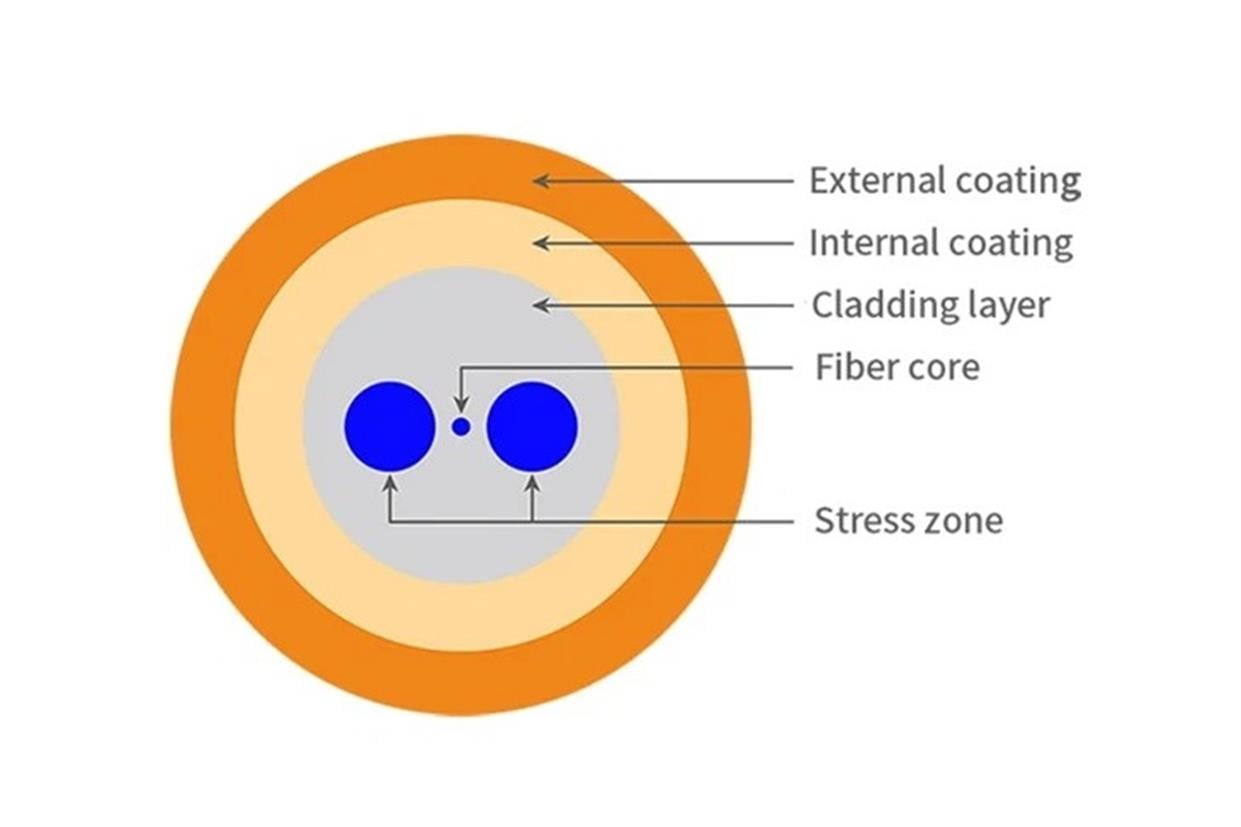
For polarization-maintaining (PM) fiber cables, whose core function is to preserve a linear polarization state, measuring the Polarization Extinction Ratio is not merely a test but a fundamental validation of their performance. A high PER confirms that the fiber's internal birefringence is effectively isolating the light along the intended slow axis, minimizing crosstalk to the fast axis. Any significant degradation in PER directly indicates localized stresses, manufacturing defects, or improper handling that compromise the fiber's ability to maintain polarization integrity. Consequently, rigorous PER measurement is indispensable for qualifying PM fibers used in sensitive applications such as interferometric sensing, coherent communications, and quantum photonics, where even minimal polarization crosstalk can lead to signal fading, elevated noise, and system failure.
Summary
The Polarization Extinction Ratio (PER) is a definitive metric for quantifying the purity of a linear polarization state, expressed as the power ratio in decibels (dB) between the principal polarization mode and its orthogonal counterpart. This parameter is critical in systems demanding strict polarization control, where a higher PER signifies a more idealized, perfectly polarized beam. The measured PER is a cumulative system property, influenced by the source's polarization state, mechanical misalignments at connections, and polarization effects from all traversed optical components.
The existing three principal measurement methodologies, each with distinct operational domains. The rotating polarizer technique offers a direct power-ratio measurement, valued for its simplicity but limited in distinguishing unpolarized from circularly polarized light. The polarimeter method deduces PER by analyzing the evolution of the State of Polarization on the Poincaré sphere, providing deep diagnostic insight but becoming unreliable for very high PER or low polarization light. For the most rigorous analysis, interferometer-based distributed crosstalk measurement instruments locate and quantify individual polarization defects along a device, enabling the calculation of total PER through integration and allowing for the characterization of exceptionally high-performance components.
In conclusion, method selection is dictated by application-specific requirements. The rotating polarizer serves for general-purpose verification, the polarimeter for axis alignment and behavioral analysis, and distributed crosstalk measurement for ultimate diagnostic precision in complex, high-performance polarization-maintaining systems.
The existing three principal measurement methodologies, each with distinct operational domains. The rotating polarizer technique offers a direct power-ratio measurement, valued for its simplicity but limited in distinguishing unpolarized from circularly polarized light. The polarimeter method deduces PER by analyzing the evolution of the State of Polarization on the Poincaré sphere, providing deep diagnostic insight but becoming unreliable for very high PER or low polarization light. For the most rigorous analysis, interferometer-based distributed crosstalk measurement instruments locate and quantify individual polarization defects along a device, enabling the calculation of total PER through integration and allowing for the characterization of exceptionally high-performance components.
In conclusion, method selection is dictated by application-specific requirements. The rotating polarizer serves for general-purpose verification, the polarimeter for axis alignment and behavioral analysis, and distributed crosstalk measurement for ultimate diagnostic precision in complex, high-performance polarization-maintaining systems.





No comments have been posted yet.