


.webp)


In 2025, why optical fiber can't replace network cables?
The two core material technologies used in almost all cables are optical fiber and copper. Whether it is an HDMI cable, USB cable, Ethernet cable, or any other type of network cable that transfers data, they are all constructed using either copper or optical fiber internal wiring.Fiber optics tend to be a better solution, while copper wire is more common, but why? What is the difference between these two cable types? Why hasn't fiber optics replaced Ethernet cables in millions of homes? Which one would you choose?
The difference between optical fiber and copper cable
Fiber optic cables, which consist of a core of quartz glass fiber about the width of a human hair, transmit data by bouncing light back and forth along the length of the glass core, while a glass cladding surrounds the core to ensure that the light is retained within it.
Fiber optic cable is wrapped with additional insulation, a layer of plastic to strengthen the core, followed by a layer of gelfilled casing or Kevlar (depending on the manufacturer), and finally a layer of colored plastic that identifies the type of fiber optic cable. The outer layer also provides a measure of fire resistance and determines whether the cable is suitable for running behind walls.
Copper cables, at their core, are copper wires, but there are a few different types: there’s solid copper cable (like coaxial cable, which is covered in multiple layers of insulation and protective coatings) and twisted-pair copper cable (which is made up of one to four pairs of insulated copper wires twisted together, then wrapped in various protective layers and insulation) . The specific configuration of a copper cable depends on its intended use, but the ultimate design is the same: a copper core surrounded by insulation and a protective coating.

Advantages of Fiber Optics
1. It is the fastest transmission medium currently. The maximum data rate is far beyond what any copper cable can achieve.
2. Fiber transmission distance is longer. The maximum transmission distance of a single copper cable is about 90 meters, while the transmission distance of some optical fibers can reach 40 kilometers. This is only the maximum transmission distance of single-mode optical fiber. The transmission distance of each multi-mode optical fiber can reach 300 meters.
3. Fiber optic stability and durability are higher. Although fiber optic cables are made of glass, they are also more durable than copper cables, which makes fiber optic cables less likely to wear out when subjected to any significant pressure during deployment. This enhanced durability also makes the service life of optical fibers longer.
4. Fiber optic cables have strong anti-interference capabilities and low attenuation. Fiber optic cables are also more resistant to human interference. Copper cables can be "eavesdropped" by connecting to power transmission lines, while optical fibers cannot be eavesdropped in the same way. Any such attempts can be quickly detected by the network, allowing administrators to shut down the relevant cables and investigate any potential violations.
Disadvantages of optical fiber:
It seems that there is nothing wrong with it except that it is expensive. The high cost of optical fiber is also reflected in the high maintenance cost after the installation is completed. After all, if it breaks, it requires specialized technicians to carry professional equipment to weld it, which is beyond the reach of ordinary people. Another point is that routers and network cards that support optical fiber are not popular. As we all know, if something is not popular enough, the cost of purchasing its accessories is high.
Advantages of copper cable
1. First of all, it is definitely the cost advantage of copper cables. With its affordable price, copper cables will always have a place. This cost advantage is also reflected in the low technical threshold of copper cable network cables . Ordinary people can independently complete the connection of network cables and the production of crystal heads with a little learning.
2. Existing infrastructure is widely used. Although the use of fiber optic cables in various digital infrastructures is growing, most existing cables, especially when it comes to traditional networks and systems, are still copper cables. The main application scenarios of copper cables are: network connection, engineering wiring, device port system connection (such as switches, routers, firewalls, etc.)
Disadvantages of copper ethernet cables :
The advantages of optical fiber correspond to the disadvantages of copper cable network cables, such as: the transmission distance is not as good as optical fiber, the signal attenuation is higher, the anti-interference ability is poor, etc.
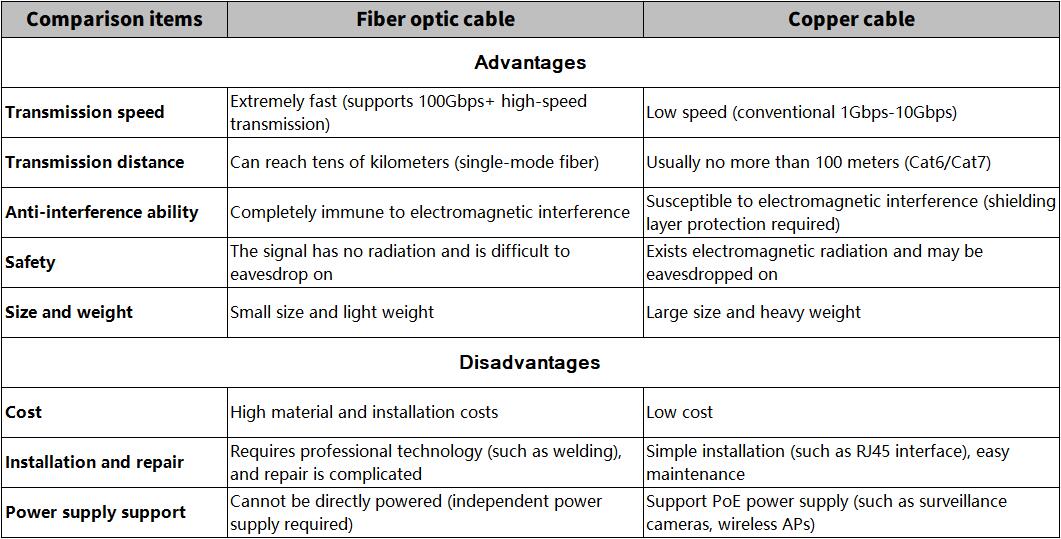
Finally, let's summarize : Network ethernet cables play an important role in voice transmission, indoor networks, integrated wiring, POE systems and other applications, and will not be completely replaced by optical fibers. If you are building an A/V system that requires long video transmission lines, you will need to use active HDMI cables (i.e., optical fiber HDMI cables), which can provide the performance required for long-distance high-bandwidth data transmission, which passive copper HDMI cables cannot achieve.





No comments have been posted yet.