


.webp)


Introduction of DWDM and CWDM
Wavelength Division Multiplexing (WDM) technology is a core technology in modern optical fiber communication networks. It significantly increases the transmission capacity of a single fiber by simultaneously transmitting multiple optical signals of different wavelengths. Based on the wavelength spacing, WDM technology is primarily divided into two types: Dense Wavelength Division Multiplexing (DWDM) and Coarse Wavelength Division Multiplexing (CWDM). Although these two technologies share similar basic principles, they have significant differences in characteristics, application scenarios, and technical requirements.
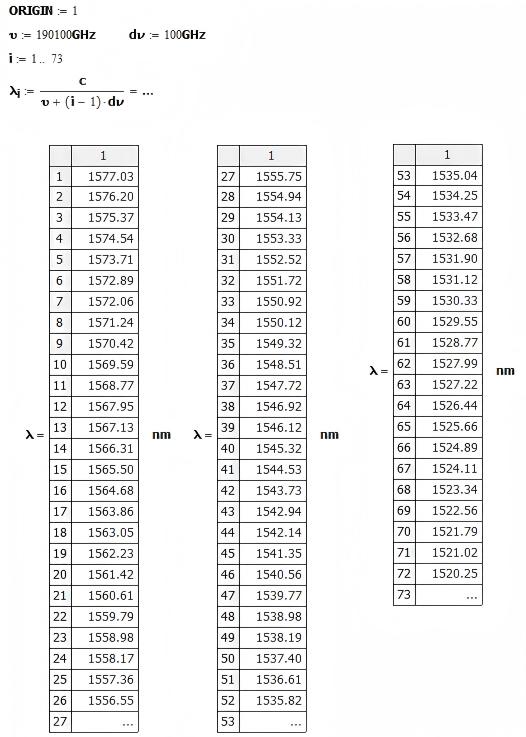
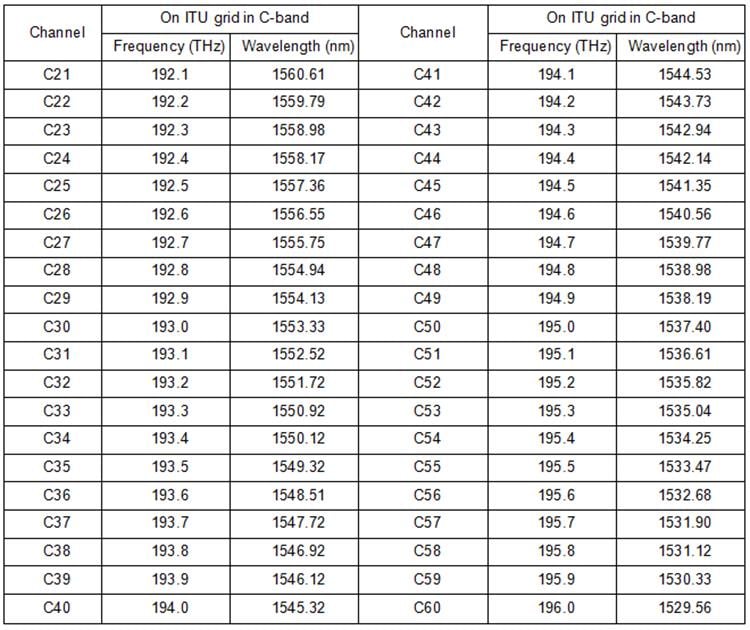
DWDM (Dense Wavelength Division Multiplexing) is characterized by dense channel spacing, typically 0.8nm (100GHz) or 0.4nm (50GHz), operating in the C-band (1525-1565nm) and L-band (1570-1610nm). This dense spacing allows DWDM systems to support a large number of channels (typically 40/80/96 channels), achieving extremely high transmission capacity, with single-fiber transmission capabilities reaching several Tbps or even higher. DWDM technology usually requires temperature control mechanisms to maintain wavelength stability, resulting in relatively higher power consumption and cost. It is mainly used in long-haul backbone transmission, core layers of large metropolitan area networks (MAN), and data center interconnect (DCI) scenarios requiring ultra-high capacity.
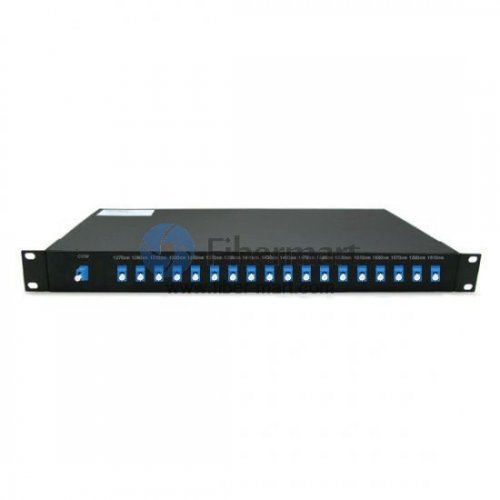
In contrast, CWDM (Coarse Wavelength Division Multiplexing) uses a wider channel spacing (20nm), operating on 18 wavelength channels from 1270nm to 1610nm. Due to the wide channel spacing, CWDM has lower requirements for laser wavelength accuracy (±3nm) and does not require temperature control devices. This gives CWDM systems the advantages of lower cost, reduced power consumption, and more compact size. The main application scenarios for CWDM include the MAN access layer, 5G fronthaul networks, and fiber resource optimization in enterprise networks.
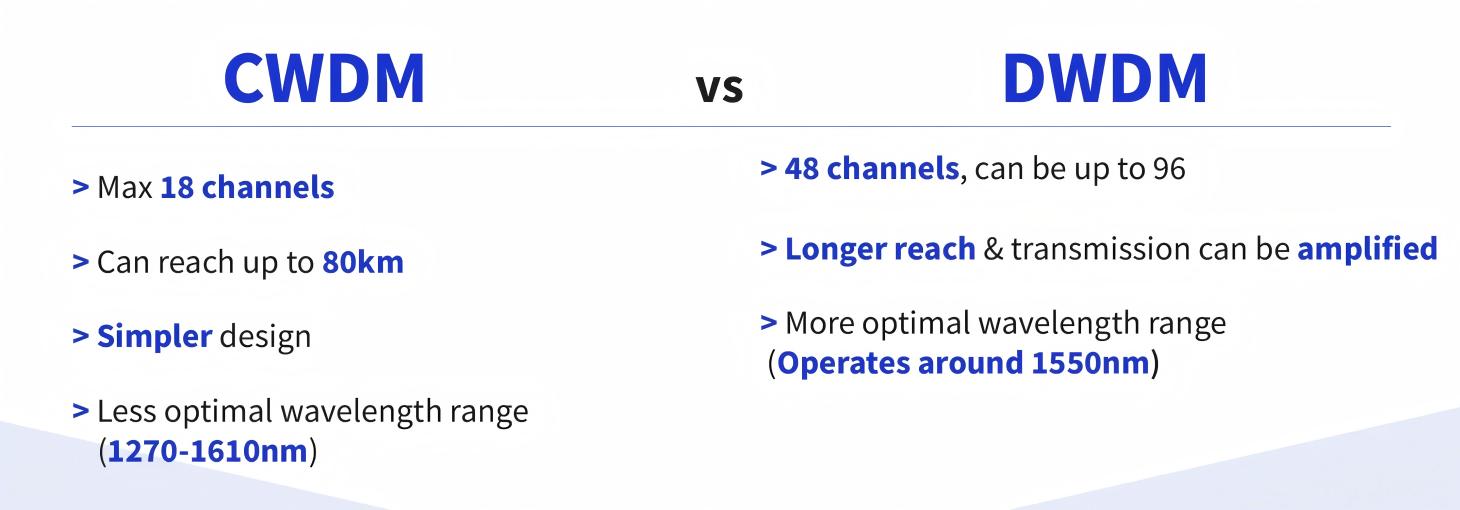
The following table compares the key technical parameters of DWDM and CWDM:
| Technical Parameter | DWDM | CWDM |
|---|---|---|
| Channel Spacing | 0.2nm-1.2nm (Dense) | 20nm (Coarse) |
| Wavelength Range |
1525nm-1565nm (C-band) 1570nm-1610nm (L-band) |
1270nm-1610nm |
| Number of Channels | 80-160 channels | 8-18 channels |
| Transmission Distance | Long Haul (Up to thousands of kilometers) | Short Haul (10km-120km) |
| Laser Type | Cooled Laser (Temperature Tuned) | Uncooled Laser (Electronically Tuned) |
| Cost | Higher | Lower |
| Primary Applications | Long-haul Backbone, Core Networks | Metro Access, Enterprise Networks |
From a technical implementation perspective, both DWDM and CWDM systems include the key components of multiplexers (Mux) and demultiplexers (Demux). The multiplexer combines multiple optical signals of different wavelengths onto a single fiber for transmission, while the demultiplexer separates the mixed signals from the fiber into individual wavelengths, connecting them to the corresponding receiving equipment. Both DWDM and CWDM systems are protocol transparent, supporting the mixed transmission of various service signals such as 10/100G Ethernet, SDH/SONET, and Fibre Channel.
What is DWDM AAWG?
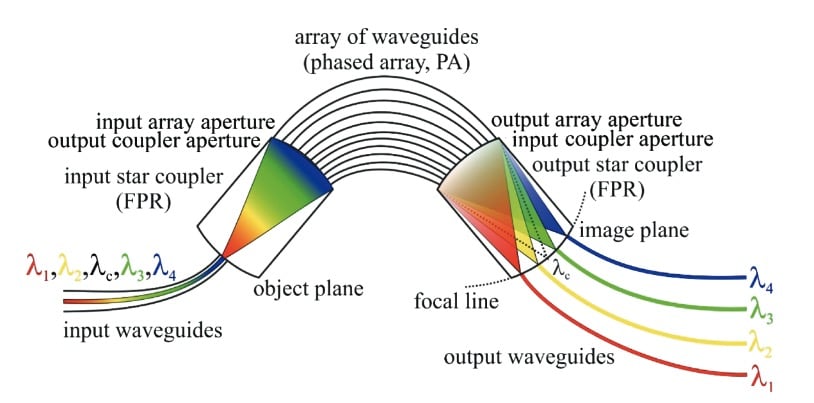
In DWDM systems, Arrayed Waveguide Grating (AWG) technology is one of the key technologies for implementing wavelength division multiplexing, and Athermal Arrayed Waveguide Grating (AAWG) is a significant evolution of AWG technology. AAWG technology, based on silica-based planar lightwave circuit (PLC) technology and unique athermal packaging design, requires no power supply, software, or temperature control, achieving a completely passive DWDM solution. Through special material selection and packaging design, this technology makes the device insensitive to temperature changes, maintaining stable performance within an ambient temperature range of -40°C to +85°C, avoiding the need for electrical power for temperature stabilization required by traditional thermal AWG (TAWG).
AAWG Advantages
The core advantage of AAWG modules lies in their perfect combination of excellent optical performance and long-term reliability. Silica-based PLC AAWGs feature low insertion loss, low polarization-dependent loss (PDL), and high channel isolation. A typical 48-channel AAWG DWDM module has an insertion loss of only ≤5.5dB, adjacent channel isolation ≥25dB, and non-adjacent channel isolation ≥30dB. This high performance makes AAWG particularly suitable for dense wavelength division multiplexing systems requiring a large number of channels, such as long-haul backbone networks, large metropolitan core networks, and data center interconnect (DCI) applications.
Modern AAWG modules support flexible channel configurations, typically offering options like 40/44/48 channels, with channel spacings of 100GHz (~0.8nm) or 50GHz (~0.4nm), complying with the ITU-T G.694.1 standard. These modules employ a compact packaging design, which can be plug-in card modules installed in standard racks or standalone devices to meet the needs of different application scenarios. For example, the 40-channel, 5.5dB insertion loss AAWG Demux module offered by Fibermart uses a 1U rackmount design with dimensions of 44x245x245mm, yet can provide transmission distances of up to 80KM.
AAWG technology also offers significant advantages in terms of network deployment and management. Support for visualized network management systems and remote monitoring functions allows operational staff to view critical data, alarms, and reports in real-time, greatly reducing operational difficulty and cost. Additionally, AAWG modules are typically designed with monitor ports for channel power monitoring and expansion ports for connecting Muxes of different channels, enabling flexible system capacity expansion.
AAWG Applications
For network operators and enterprise users, AAWG-based DWDM systems provide a future-proof network solution. They can not only meet current high-bandwidth demands but also support future network capacity expansion through flexible upgrade paths. For example, through a unified open config interface, AAWG systems support diverse deployment and removable functional modules, allowing users to independently upgrade various components based on needs, significantly reducing long-term maintenance costs.
What is CWDM Modules?
CWDM (Coarse Wavelength Division Multiplexing) technology, as the "economical" solution in the WDM family, plays an irreplaceable role in specific application scenarios with its unique advantages. CWDM systems use a wide 20nm channel spacing, covering 18 wavelength channels from 1270nm to 1610nm. This design significantly reduces requirements for laser precision and temperature control, leading to substantially lower system cost and power consumption.
The key feature of CWDM Modules
The technical characteristics of CWDM modules are mainly reflected in three aspects: relaxed wavelength tolerance, simplified temperature control, and diverse packaging forms. Due to the wide 20nm channel spacing, the wavelength accuracy requirement for CWDM lasers is relaxed to ±3nm, with a maximum allowable wavelength shift of up to ±6.5nm. This means that within the normal operating temperature range (-5°C to 70°C), wavelength drift caused by temperature changes remains within the allowable range. Lasers do not require complex Temperature Control mechanisms (TEC), thus simplifying laser structure, improving yield, and reducing cost.
CWDM Packages and Applications
CWDM modules offer various packaging forms to adapt to different installation environments and usage needs:
-
FMU Plug-in Module: Can be installed in an FMU chassis, suitable for high-density patching environments.
-
1U Rackmount Module: Installed directly on a standard 19-inch rack, facilitating centralized management.
-
ABS Box Module: Compact design, saves space, suitable for space-constrained scenarios.
These modules typically use Thin-Film Filter (TFF) technology, featuring low insertion loss (4-channel ≤1.7dB, 8-channel ≤2.6dB, 16-channel ≤4.5dB), high isolation (adjacent channel ≥30dB, non-adjacent channel ≥45dB), and excellent environmental stability. CWDM is protocol and rate transparent, supporting various applications such as 1G/10G Ethernet, SDH/SONET, and Fibre Channel, which can be transmitted over the same fiber link.
.jpg "Understanding CWDM Coarse Wave Division Multiplexing")
The application scenarios for CWDM systems are primarily focused on the MAN access layer, 5G fronthaul networks, and enterprise networks. In these scenarios, transmission distances are usually short (typically less than 80km), but cost sensitivity is high. CWDM can provide sufficient bandwidth while significantly reducing equipment and operational costs. For example, in 5G fronthaul networks, CWDM technology can fully utilize existing fiber infrastructure, carrying traffic for multiple wireless base stations over a single fiber, effectively addressing fiber resource constraints.
Modern CWDM modules also offer some enhanced functions to improve system flexibility and manageability. For instance, monitor ports can be used for channel power monitoring, aiding operational staff in troubleshooting; expansion ports (such as 1310nm or 1550nm ports) can be used to increase system capacity; and the 1310nm port can also connect 1310nm wavelength optical modules, supporting 1/10/25G BiDi transmission. These functions allow CWDM systems to adapt to more complex and diverse application requirements.
For network planners, CWDM technology offers a balance between cost and performance. While it is not the most powerful solution, in appropriate application scenarios, it can provide sufficient transmission capacity at one-third to half the cost of DWDM. This economic efficiency makes CWDM particularly suitable for small and medium-sized enterprises, distributed network scenarios, and cost-sensitive access network deployments.
DWDM vs CWDM, What is the Diffrence when we use them?
In the global optical network equipment market, there are multiple mature product solutions for DWDM AAWG modules and CWDM modules. Fiber-mart.com, as an internationally renowned fiber optic solution provider, offers various DWDM and CWDM products, which corroborate with products from mainstream suppliers in the market, reflecting current technological development trends.
DWDM AAWG products on Fiber-mart typically include 1U rackmount modules and plug-in card designs, supporting C-band 100GHz/50GHz spacing, with channel counts ranging from 4 to 96 channels. These products utilize AAWG technology, featuring low insertion loss (typically ≤5.5dB for 48 channels) and high isolation (adjacent ≥25dB, non-adjacent ≥30dB), complying with the ITU-T G.694.1 standard. For example, Fiber-mart's 96-channel DWDM module supports an expandable port design, allowing network operators to gradually increase capacity based on business growth, minimizing initial investment.
CWDM rack solutions on Fiber-mart typically offer 4/8/16 channel configurations, using 1U or 2U rack designs, supporting the 18 ITU-T standard wavelengths from 1270-1610nm. These products are based on thin-film filter technology, with low insertion loss (4-channel ≤1.7dB, 8-channel ≤2.6dB), high channel isolation (adjacent ≥30dB), and a wide operating temperature range (-40°C to +85°C), suitable for deployment in harsh environments. Fiber-mart's products offer various connector options (LC/SC/FC/ST) and polish types (UPC or APC) to meet different interface requirements.
When choosing between DWDM and CWDM solutions, network planners need to consider several factors:
-
Transmission Distance Requirement: DWDM is suitable for long-haul transmission (up to hundreds of km), while CWDM is typically used for short-haul applications (generally less than 80km).
-
Capacity Demand: DWDM supports higher channel counts (up to 96 channels), providing greater capacity; CWDM supports up to 18 channels, suitable for medium capacity needs.
-
Cost Budget: CWDM system cost and power consumption are usually lower than DWDM, suitable for budget-conscious scenarios.
-
Management Needs: DWDM systems typically offer more comprehensive management functions, including performance monitoring and remote configuration.
-
Future Scalability: DWDM provides higher scalability, supporting smooth upgrades from 40 channels to 80 or even 96 channels.
For Data Center Interconnect (DCI) applications, the DWDM AAWG solutions provided by Fiber-mart support mixed transmission of multiple rates (1G/10G/25G/40G/100G/200G Ethernet), enabling high-capacity connections between data centers. These systems often integrate EDFA optical amplifiers, DCM dispersion compensation modules, and optical supervisory channels (OSC), providing an integrated transmission solution.
In the MAN access layer and 5G fronthaul networks, Fiber-mart's CWDM products provide cost-effective solutions. For example, a 4-channel CWDM module can multiplex 4 wavelengths on a single fiber, increasing fiber utilization fourfold and significantly reducing fiber consumption. These modules often provide monitor ports for performance monitoring and expansion ports for future capacity upgrades.
It is noteworthy that choosing between DWDM and CWDM solutions is not a simple either/or question. Modern networks often adopt hybrid solutions, using different technologies in different parts of the network. For instance, using DWDM in the core layer to handle high-capacity traffic and using CWDM in the access layer to reduce costs. Some vendors even offer C&DWDM hybrid systems, allowing network operators to use both CWDM and DWDM technologies on the same platform, enabling flexible deployment based on actual needs.
Conclusion
DWDM and CWDM, as the two main forms of WDM technology, each have distinct application areas and advantages. DWDM AAWG technology, with its high channel count, high performance, and good stability, is suitable for long-distance, high-capacity core network applications. CWDM, with its cost-effectiveness and ease of deployment, plays a vital role in scenarios such as MAN access layers and 5G fronthaul.
Choosing the appropriate WDM solution requires comprehensive consideration of multiple factors including transmission distance, capacity requirements, cost budget, management needs, and future scalability. As technology continues to develop, trends such as software-defined networking, open interfaces, and power consumption optimization will further shape the future landscape of WDM technology.
Regardless of the technology chosen, reasonable network planning, high-quality equipment, and professional deployment are key factors in ensuring network performance. By deeply understanding the technical characteristics and application scenarios of DWDM and CWDM, network professionals can make more informed decisions to build efficient, reliable, and future-proof optical fiber network infrastructure.
DWDM vs. CWDM FAQ
Which is better, CWDM and DWDM?
Deciding between CWDM and DWDM depends on specific network requirements. CWDM is preferable for cost-effective solutions in moderate bandwidth scenarios, while DWDM excels in high-capacity, long-distance transmissions. The choice hinges on factors like budget constraints, bandwidth needs, and the complexity of the network.
Can CWDM and DWDM be used together in a network?
It is possible to integrate CWDM and DWDM in a network to leverage their distinct strengths. This hybrid approach allows for flexibility, enabling organizations to optimize their network infrastructure based on varying demands. The compatibility of CWDM and DWDM makes it possible to create a well-rounded and efficient network.
How many channels are available for CWDM and DWDM?
The number of channels varies for CWDM and DWDM. CWDM typically offers limited channels, ranging from 8 to 18, depending on the specific implementation. In contrast, DWDM, with its dense wavelength-packing, can accommodate a significantly larger number of channels, often exceeding 40 or more, providing higher data-carrying capacity.
What is the benefit of CWDM over DWDM?
CWDM's key benefit over DWDM lies in its cost-effectiveness for networks with moderate bandwidth requirements. It provides a simpler, more economical solution, making it suitable for organizations seeking scalability without the complexity associated with DWDM. CWDM is ideal for short to medium-distance transmissions, balancing efficiency and affordability.
Is DWDM active or passive?
Depending on the specific system design and deployment, DWDM can be both active and passive. Passive DWDM systems rely on filters and mirrors to manage wavelengths, making them simpler and more cost-effective for shorter distances. Active DWDM systems, on the other hand, incorporate optical amplifiers to extend the reach for long-distance transmissions, catering to high-capacity backbone networks and international connectivity.





No comments have been posted yet.