


.webp)


In the realm of optical engineering and photonics manufacturing, achieving accurate alignment between optical fibers and components like waveguides, chips, or photonic integrated circuits (PICs) is a make-or-break step for system performance. At the center of this critical process lies the fiber alignment stages—a specialized mechanical system designed to position fibers with micron or even sub-micron precision, ensuring optimal light coupling and minimizing signal loss. Unlike basic manual positioning tools, modern fiber alignment stages integrate advanced motion control, vision systems, and software workflows to meet the demanding requirements of high-volume production lines and cutting-edge research labs. As optical technologies evolve toward miniaturization and higher bandwidth, the role of fiber alignment stages in enabling reliable, repeatable fiber-to-component coupling has become increasingly indispensable.
What Are Fiber Alignment Stages and Why Do They Matter?
To grasp the significance of fiber alignment stages, it is first essential to understand the challenge they address: optical fiber coupling requires extraordinary precision. Even a tiny misalignment—on the order of a few microns—between a fiber’s core and a waveguide or chip interface can lead to severe signal attenuation, reduced system efficiency, or complete coupling failure. In applications like fiber-to-chip coupling or fiber array (FA) to waveguide alignment, this precision is non-negotiable, as the components involved (such as PICs or fiber array units, FAUs) have ultra-small target areas that demand exact positioning.
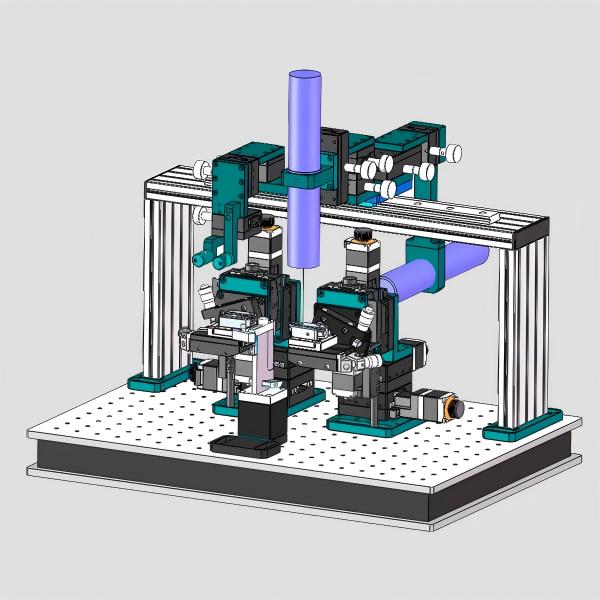
Fiber alignment stages solve this problem by providing controlled, high-resolution motion across multiple axes. Unlike manual tools (which rely on operator skill and are prone to human error), these stages use motorized actuators, differential micrometers, or stepper motors to adjust fiber position with consistent accuracy. A key distinction is their ability to handle multi-axis alignment—many advanced fiber alignment stages offer 6-axis positioning (covering x, y, z linear movements and pitch, yaw, roll rotational adjustments), ensuring that fibers can be aligned to even the most complex component geometries. For example, in fiber-to-chip coupling, a 6-axis fiber alignment stages can compensate for minor component placement errors and achieve the precise angular and linear positioning needed for optimal light transfer.
Beyond precision, fiber alignment stages also deliver repeatability—a critical factor for manufacturing environments. In high-volume production (such as PLC fiber splitter manufacturing), the same alignment parameters must be replicated across hundreds or thousands of units. Fiber alignment stages achieve this through software-controlled workflows and closed-loop feedback systems, which monitor alignment quality in real time and make minute adjustments to maintain consistency. This repeatability not only improves product quality but also reduces production time and waste, making fiber alignment stages a cornerstone of efficient optical component manufacturing.
Core Configurations and Types of Fiber Alignment Stages
One of the strengths of fiber alignment stages is their versatility, with configurations tailored to the unique needs of different applications—from manual research setups to fully automated production lines. Leading suppliers like FiberMart offer three primary types of fiber alignment stages, each optimized for specific use cases:
1. Manual Fiber Alignment Stages
Designed for low-volume applications, research labs, or prototyping, manual fiber alignment stages rely on thumbscrews or differential micrometers for positioning. They typically offer micron-level resolution, making them suitable for tasks where precision is needed but production speed is not a priority—such as testing new fiber-to-waveguide designs or conducting small-scale experiments. These stages are often compact, easy to set up, and cost-effective, making them an ideal choice for academic labs or small-scale manufacturers. For example, manual fiber alignment stages are commonly used in PLC fiber splitter manufacturing for initial prototype testing, where engineers can fine-tune alignment parameters before scaling to automated production.
2. Semi-Automated Fiber Alignment Stages
Bridging the gap between manual and fully automated systems, semi-automated fiber alignment stages combine manual adjustments with software-assisted control. They use PC workflow software to guide operators through alignment steps, monitor coupling efficiency via integrated power meters, and lock in optimal positions once achieved. These stages are well-suited for medium-volume production or applications where human oversight is still valuable—such as FAU-to-chip coupling in specialized optical modules. Semi-automated fiber alignment stages often include features like vision systems (with CCD cameras and displays) to help operators visualize fiber and component positioning, reducing the risk of human error while maintaining flexibility.
3. Fully Automated Fiber Alignment Stages
For high-volume manufacturing lines (such as those producing PIC packages or fiber array modules), fully automated fiber alignment stages are the gold standard. These systems offer up to 12-axis control (combining dual 6-axis stages for complex multi-component alignment) and are integrated with a complete suite of supporting tools: vibration isolation tables (to prevent environmental disturbances), UV curing systems (to secure aligned components), epoxy dispensers (for permanent bonding), and closed-loop feedback systems (to ensure continuous alignment accuracy). Fully automated fiber alignment stages operate without human intervention, using customized workflow software to handle every step—from component loading and alignment to bonding and quality testing. They deliver sub-micron resolution and high throughput, making them essential for meeting the demands of mass-produced optical components.
Key Components That Enhance Fiber Alignment Stages Performance
The precision and reliability of fiber alignment stages depend on a suite of integrated components, each playing a critical role in ensuring optimal alignment. These components work in tandem to address environmental challenges, improve visibility, and enable precise motion control:
Motion Controllers: Central to any motorized fiber alignment stages, motion controllers (such as 5-phase motor controllers for 12-axis systems) regulate actuator movement with exceptional accuracy. They interpret software commands, adjust motor speed and position, and ensure smooth, continuous motion—critical for avoiding overshoot or vibration during alignment.
Vision Systems: Equipped with CCD cameras, high-resolution lenses, and LED lighting, vision systems provide real-time visualization of fiber and component positioning. This allows operators (in semi-automated systems) or software (in fully automated systems) to detect even minor misalignments and make targeted adjustments. Vision systems are particularly valuable for aligning small components like PICs, where direct visual inspection is impossible.
Mechanical Fixtures with Touch Sensors: Customized fixtures secure fibers, FAUs, or chips in place during alignment, preventing movement that could disrupt precision. Touch sensors add an extra layer of accuracy by detecting component edges or surfaces, ensuring that initial positioning is consistent across every unit. For example, FAU fixtures with touch sensors in fiber alignment stages guarantee that fiber arrays are loaded in the same position every time, reducing setup time and improving repeatability.
Vibration Isolation Tables: Environmental vibrations (from nearby machinery or foot traffic) can disrupt sub-micron alignment. Vibration isolation tables stabilize fiber alignment stages by absorbing these disturbances, ensuring that alignment remains consistent even in busy manufacturing environments.
Power Meters and Light Sources: These tools measure coupling efficiency in real time, providing feedback to the fiber alignment stages software. Power meters detect the amount of light transmitted through the aligned components, while light sources provide a stable input signal—together, they ensure that alignment is optimized for maximum signal integrity.
UV Curing and Epoxy Dispenser Systems: Once alignment is achieved, these components permanently bond fibers to waveguides or chips. Epoxy dispensers apply precise amounts of adhesive, while UV curing systems quickly harden the epoxy—all while the fiber alignment stages maintain position, preventing misalignment during bonding.
Industrial Applications of Fiber Alignment Stages
The unique capabilities of fiber alignment stages make them indispensable across a range of optical manufacturing and research applications, where precision coupling directly impacts product performance:
1. Photonic Integrated Circuit (PIC) Manufacturing
PICs—miniaturized circuits that integrate multiple optical components (like waveguides, modulators, and detectors) on a single chip—require ultra-precise fiber-to-chip coupling. Fiber alignment stages (often fully automated 12-axis systems) are used to align fibers or fiber arrays to PIC interfaces, ensuring that light is efficiently transferred between the fiber and the chip’s internal waveguides. This alignment is critical for PIC-based devices like transceivers for 5G/6G networks, where signal loss must be minimized to support high bandwidth.
2. Fiber Array (FA) and FAU-to-Waveguide Coupling
Fiber arrays (groups of parallel fibers) are widely used in high-density optical systems, such as data center interconnects or sensor arrays. Fiber alignment stages (semi-automated or fully automated) align these arrays to waveguides or chips, ensuring that each fiber in the array is precisely matched to a corresponding waveguide. For example, in FAU-to-chip coupling for optical sensors, fiber alignment stages guarantee that every fiber in the FAU is aligned to the chip’s sensing elements, ensuring uniform performance across the array.
3. PLC Fiber Splitter Production
Planar Lightwave Circuit (PLC) splitters are essential components in fiber-optic networks, used to split a single optical signal into multiple paths. Manufacturing PLC splitters requires precise alignment between input/output fibers and the splitter’s internal waveguides. Manual or semi-automated fiber alignment stages are commonly used here, allowing engineers to fine-tune alignment for optimal signal splitting and minimal loss. These stages ensure that each splitter meets industry standards for signal uniformity.
4. Research and Development (R&D) Labs
In academic and industrial R&D labs, fiber alignment stages (often manual or semi-automated) are used to test new optical technologies—such as novel waveguide designs, quantum photonics components, or high-power laser systems. Researchers rely on the precision of these stages to conduct repeatable experiments, measure coupling efficiency, and validate new concepts. For example, in quantum optics research, fiber alignment stages are used to align fibers to quantum emitters, ensuring that fragile quantum signals are transmitted with minimal interference.

As optical technologies continue to advance toward miniaturization, higher bandwidth, and more complex component designs, the role of fiber alignment stages in enabling reliable, precise fiber-to-component coupling will only grow. From manual stages for research labs to fully automated 12-axis systems for high-volume manufacturing, fiber alignment stages are tailored to meet the diverse needs of the photonics industry. Their integration with advanced components—like vision systems, closed-loop controllers, and vibration isolation tools—ensures that they deliver the precision, repeatability, and efficiency required for modern optical applications.
For manufacturers, researchers, and engineers, investing in high-quality fiber alignment stages (from reputable suppliers like FiberMart) is not just a matter of improving product quality—it is a strategic step toward unlocking the full potential of next-generation optical technologies. Whether used to produce PICs for 6G networks, PLC splitters for fiber-optic infrastructure, or prototype new quantum devices, fiber alignment stages remain the backbone of precision optical engineering—enabling innovations that shape the future of communication, sensing, and beyond.





No comments have been posted yet.