


.webp)


In the field of fiber optic communication, we often focus on reducing signal loss and increasing transmission distance. But sometimes we actually need to intentionally reduce signal power - this is exactly where fiber optic attenuators come into play.
As energy-intensive passive optical components, fiber optic attenuators contain light-absorbing materials. They perform the opposite function of optical amplifiers, being specifically designed to reduce the power of the optical signal in fiber optic networks.
Why are Fiber Optic Attenuators Needed?
Optical modules have a receiver overload limit. If the optical power reaching the receiver is too high, the optical module can be damaged. To prevent this, optical attenuators are used to actively reduce the optical power.
In Wavelength Division Multiplexing (WDM) systems, it is necessary to balance the optical power levels in different channels to avoid transmission quality degradation caused by uneven power distribution. Optical attenuators help equalize the optical power in each channel.
Fiber optic attenuators reduce optical power through various mechanisms, including absorption, reflection, diffusion, scattering, deflection, diffraction, and dispersion. They precisely control signal power in optical communication lines, ensuring that the signal reaching the receiver remains within its dynamic range, preventing saturation, and maintaining the signal-to-noise ratio.
How Fiber Attenuators Work?
Fiber optic attenuators operate on several different principles:
-
Adjustable Air Gap Technology
-
Intentional Fiber Misalignment
-
Lens Assembly Configurations
-
Use of Bending Loss
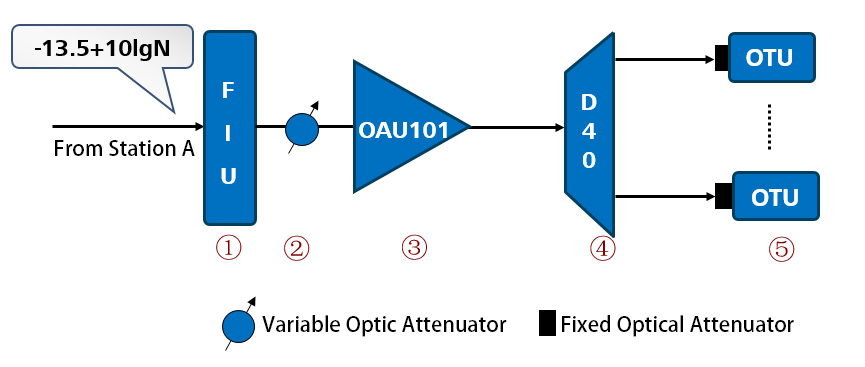
These different attenuation methods vary significantly in terms of ease of use, impact on wavelength and polarization, and mode dependence in multimode devices. Attenuators typically work by absorbing light, much like sunglasses absorb excess light energy.
They operate within specific wavelength ranges, absorbing all light energy uniformly. Properly designed attenuators should not reflect or scatter light at air gaps, as this can cause unwanted back reflections in fiber optic systems.
How to Choose the Right Fiber Optic Attenuator?
Selecting the appropriate fiber optic attenuator requires careful consideration of the following key factors:
Determine Attenuation Level and Type Requirements
-
Fixed Attenuator: Provides a predetermined level of attenuation (e.g., 1 dB, 5 dB, 10 dB, 15 dB). They are characterized by low cost and high stability, making them ideal for applications requiring constant signal attenuation. Examples include widely deployed telecommunications networks, FTTH (Fiber to the Home) systems, or compensating for known losses in specific link segments.

-
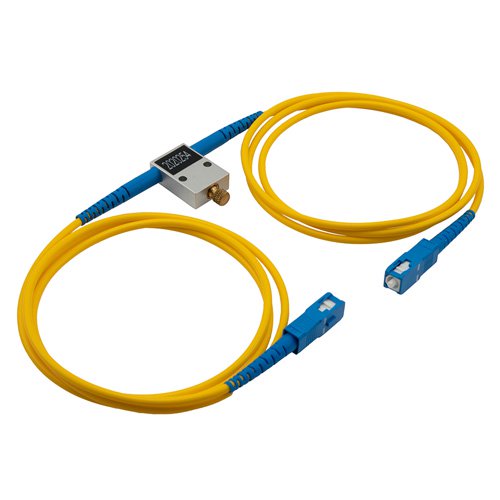
Variable Attenuator: The attenuation level can be adjusted continuously, either manually or via software. This offers greater flexibility for dynamic laboratory testing, network troubleshooting and optimization, equipment performance evaluation, and for research and development requiring frequent signal level adjustment.
Focus on Optical Specifications
- Operating Wavelength and Flatness: The attenuation value of an attenuator can vary depending on the wavelength. It is important to choose an attenuator that matches your system's operating wavelength (e.g., 850 nm, 1310 nm, 1550 nm, or CWDM/DWDM bands). In multi-wavelength systems, pay attention to flatness to ensure uniform attenuation across all channels.
- Attenuation Accuracy and Stability: High-precision attenuators (typically with a deviation within ±0.5 dB) provide precise signal control, which is critical for measurement and precision systems. Good temperature stability (minimal attenuation drift over a wide temperature range, e.g., from -40°C to 75°C) ensures reliable operation in various environmental conditions.
- Return Loss: High return loss means the attenuator reflects very little of the light signal back towards the source. This is particularly important for high-speed, high-data-rate transmission systems because excessive back reflection can interfere with laser operation and create noise. To achieve higher return loss, attenuators with Angled Physical Contact (APC) end faces are typically chosen.
Consider Mechanical and Connector Properties
-
Interface Type: Choose the attenuator's interface according to the types of fiber optic connectors present in your system to ensure compatibility. Common interface types:
| Interface Type | Characteristics | Common Application Scenarios |
|---|---|---|
| LC | Small form factor, push-pull latch, suitable for high density | Data Centers, High-Speed Optical Modules |
| SC | Square housing, push-pull latch, reliable connection | Local Area Networks, FTTH |
| FC | Metal threaded coupling, highly reliable, stable under vibration | Test Equipment, Telecom Rooms |
| ST | Bayonet connection, primarily used in multimode systems | Campus Networks, Multimode Fiber Equipment |
-
In-Line and Connector Style:
-
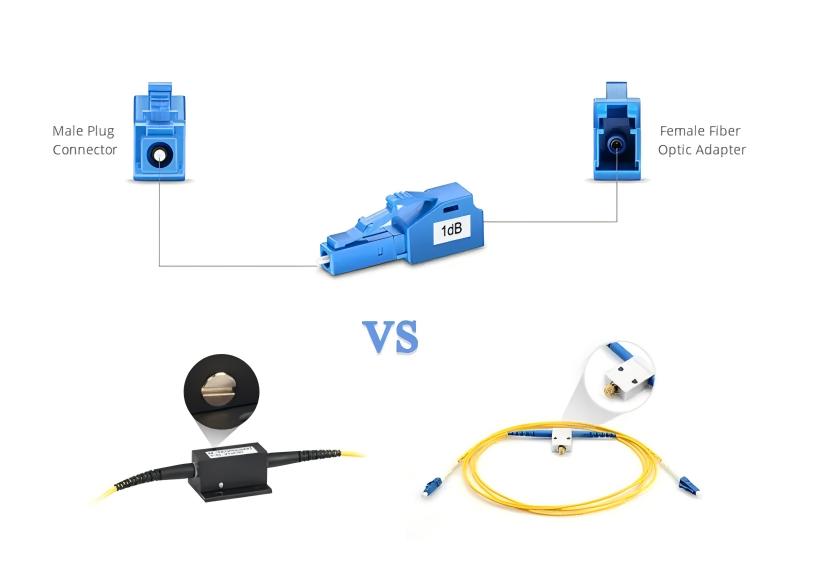
In-Line: Has a plug connector on each end (e.g., LC/LC), connected in series into the link via an adapter. Provides reliable installation, suitable for permanent use.
-
Connector Style: Male-female design (e.g., LC male -- LC female). Can be plugged directly into a device's optical interface or onto a patch cord connector, offering quick deployment and flexible configuration.
Power Handling and Reliability
-
Maximum Input Optical Power: Ensure the selected attenuator can handle the maximum optical power of your system; otherwise, permanent damage to the component is possible. Be especially careful in links with optical amplifiers (EDFA).
-
Reliability and Lifespan: Attenuators with metal housings generally offer better heat dissipation and mechanical strength, making them more reliable, especially under high power or harsh operating conditions. For variable attenuators, the durability and repeatability of mechanical components should also be considered.
Types of Fiber Optic Attenuators and Their Applications
Fiber attenuators come in various types, differing in their operating principles and application areas.
Classified by Attenuation Principle
-
Absorptive Attenuator: Uses a material doped with specific ions (e.g., nickel) to absorb light energy and convert it into heat, thereby providing attenuation. This method is widely used in fixed attenuators and offers stable and reliable performance.
-
Reflective Attenuator: Reflects a portion of the optical signal rather than absorbing it, using angled surfaces or dielectric films in the light path. This type is often used in applications requiring high-precision calibration.
-
Scattering/Diffractive Attenuator: Uses micro-bends or doped particles to scatter, diffract, or mode-couple the light, leading to power loss. This method is particularly suitable for multimode fiber optic systems.
Classified by Attenuation Adjustment Method
-
Fixed Attenuator:
-
Characteristics: Provides an unchangeable, preset attenuation value. Simple design, compact size, cost-effective, high stability.
-
Applications: Widely used for fixed attenuation of received power in fiber optic communication systems, calibration of fiber optic network test equipment, power balancing in LAN and CATV systems, and protection of optical equipment interfaces.
-
-
Variable Optical Attenuator (VOA):
-
Characteristics: Attenuation can be adjusted continuously or in steps. Includes manually adjusted models (mechanical knob) and electrically adjusted models (controlled by current or voltage, easily automated remotely).
-
Applications: Primarily used for testing optical devices, dynamic gain equalization in optical communication systems, channel power balancing in Dense Wavelength Division Multiplexing (DWDM) systems, system performance evaluation, and scientific research requiring precise optical power control.
-
Classified by Form Factor and Interface Style
-
Connector-style Attenuator:
-
Resembles an "adapter" with one male connector and one female connector, or a bulkhead design with female connectors on both ends.
-
Advantages: Easy connection, flexibility, and convenience, no splicing required.
-
Applications: Ideal for temporary testing, adjusting power at equipment interfaces, and quickly introducing attenuation during network maintenance.
-
-
In-Line Attenuator:
-
Looks like a fiber optic patch cord with fixed plug connectors on both ends, connected into the link via an adapter, or directly designed as a component that can be spliced into the fiber optic link.
-
Advantages: Stable performance, low return loss, more reliable connection.
-
Applications: More suitable for permanent installations, such as inside communication equipment, in front of Optical Network Units (ONUs), or for direct splicing with fiber optic cable lines.
-
Categorized by Operating Mode
-
Single-Mode Fiber Attenuator: Designed specifically for single-mode fiber and intended to attenuate the fundamental mode. Performance parameters are optimized for single-mode communication ranges such as 1310 nm and 1550 nm. This is the most common type.
-
Multimode Fiber Attenuator: Designed specifically for multimode fiber (e.g., OM1/OM2/OM3/OM4). The influence of mode distribution on the attenuation value must be considered. Typically used for multimode systems with wavelengths of 850 nm or 1310 nm.
Key Application Areas of Fiber Optic Attenuators in Optical Networks
Despite their small size, fiber optic attenuators play an indispensable role at various levels of modern optical networks.
Protecting Receivers from Overload
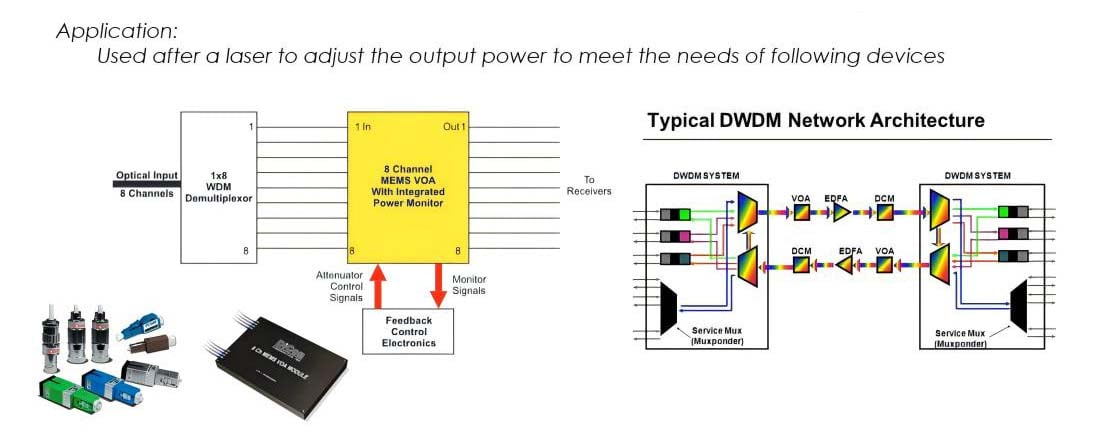
Optical receivers (e.g., optical modules) have a maximum permissible input optical power. Excessively high input power can lead to saturation or even permanent damage to the receiver. Fiber attenuators are often used between the transmitter and receiver to reduce the signal power to within the linear operating range of the receiver, ensuring correct signal interpretation and long-term stable equipment operation. This is their most fundamental and important application.
Balancing Optical Power, Optimizing System Performance
-
In DWDM/CWDM Systems: Optical signals at different wavelengths can have different power levels after transmission through fiber and optical amplifiers. This power imbalance can degrade overall system performance. Installing appropriate attenuators in channels with excessive power allows for leveling the power across all channels, improving the system's signal-to-noise ratio and transmission quality.
-
In FTTH (Fiber to the Home) Networks: The signal power reaching each user may differ because the transmission distance from the Optical Line Terminal (OLT) to each Optical Network Unit (ONU) varies. Installing attenuators in front of ONUs located closer to the OLT helps balance the received optical power for all users, ensuring consistent Quality of Service (QoS).
Simulation, Testing, and Measurement
In laboratories and during network maintenance, engineers often need to simulate signal loss in various real-world scenarios.
-
Testing System Power Budget: By adding attenuators to gradually increase link loss, the system's maximum allowable loss value (power budget) can be tested, assessing network reliability.
-
Evaluating Equipment Performance: Testing the receive sensitivity and overload point of optical transceiver modules requires the use of variable attenuators to precisely control the input power.
-
Simulation and Fault Diagnosis: Using attenuators to simulate increased link loss can help identify potential faults in the system and verify network behavior under degraded performance conditions.
Optimizing Optical Amplifier Operating State
Optical amplifiers (e.g., EDFA) have an optimal input power range. Too low input power leads to a degraded signal-to-noise ratio, while too high input power causes nonlinear effects (e.g., four-wave mixing, Stimulated Brillouin Scattering - SBS) that can also impair the signal. Attenuators can be used to adjust the signal power entering the optical amplifier to the optimal range, thereby optimizing the performance of the entire amplification path.
Reducing Reflection Interference, Improving Signal Integrity
Some high-performance attenuators (especially those with APC end faces) provide very high return loss, meaning they minimize reflected light to a very low level. Using such attenuators in systems sensitive to reflections helps maintain signal integrity.





No comments have been posted yet.