


.webp)


In fields such as optical communications, laser systems, and precision measurement, fiber optic collimators are playing an increasingly vital role as key optical components. This article will provide an in-depth understanding of the technical principles and type classifications of fiber optic collimators.
Working Principle of Fiber Collimators
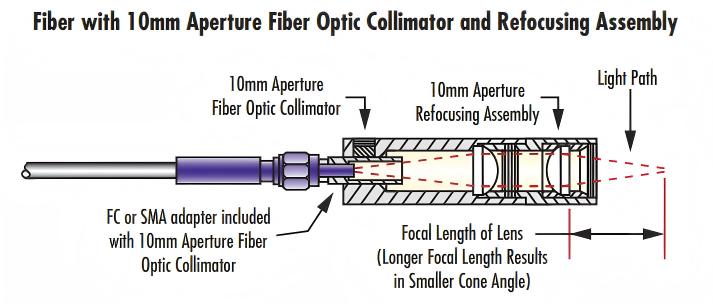
A fiber collimator is a critical device used in fiber optic systems for beam shaping and collimation. It converts the divergent light emitted from the end of an optical fiber into collimated light (parallel light), or focuses collimated light into the fiber. Its core function is to ensure the transmission efficiency of optical signals and reduce signal loss.
It operates based on the optical focusing and collimation principles of lenses. When light exits the fiber end, the beam diverges gradually due to diffraction effects. The lens group within the fiber collimator (typically including spherical lenses, aspheric lenses, or achromatic lenses) converts these divergent rays into a parallel beam. Conversely, at the receiving end, the collimator can also focus external parallel light into the fiber core, achieving efficient optical coupling. Focal length and numerical aperture are two key parameters determining collimator performance, which must be precisely matched to the fiber characteristics to achieve optimal performance.
Main Types of Fiber Collimators
Fiber optic collimators can be classified in various ways, including by lens type, fiber mode, adjustment mechanism, and polarization handling capability.
Classification by Lens Type and Optical Design
Based on lens type and optical design, fiber optic collimators can be divided into the following main types:
-
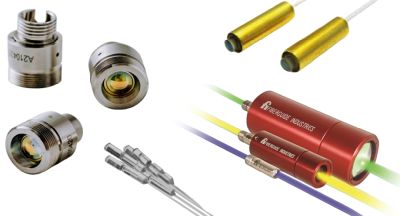
Aspheric Lens Collimators: Use aspheric lenses to reduce spherical aberration, providing high-quality wavefront performance.
-
Achromatic Lens Collimators: Composed of multiple lens elements, they reduce chromatic aberration and are suitable for broadband spectrum applications.
-
High Numerical Aperture (NA) Collimators: The technological breakthrough for high NA fiber collimators (typically NA ≥ 0.5, compared to NA ≤ 0.25 for traditional collimators) lies in micro-lens array design (e.g., aspheric lenses, binary optical elements) and precision alignment processes (sub-micron assembly accuracy). This directly impacts beam quality (M² ≤ 1.3) and coupling efficiency (≥ 90%).
Classification by Fiber Mode
Based on the mode characteristics of the connected fiber, fiber optic collimators are mainly divided into:
-
Single-Mode Fiber Collimators: Designed for single-mode fiber, typically featuring smaller beam diameters and smaller divergence angles.
-
Multimode Fiber Collimators: Used with multimode fiber, typically featuring larger beam diameters and larger numerical apertures.
Among these, Polarization-Maintaining (PM) Fiber Collimators represent an important sub-segment, with global revenue reaching millions of USD in 2023. They are primarily used in applications requiring maintenance of the light's polarization state, such as fiber lasers, fiber amplifiers, and fiber sensors. PM fiber collimators can be further subdivided into PM Single Fiber Collimators and PM Dual Fiber Collimators.

Classification by Adjustment Mechanism
Based on the adjustment mechanism and flexibility, optic collimators can be classified as:
-
Fixed Collimators: Have a fixed focal length, preset at the factory, suitable for specific wavelengths and application scenarios.
-
Adjustable Fiber Collimators: Allow users to adjust the focal length as needed, offering greater flexibility. They consist of a fiber interface, collimating lens group, focusing mechanism, and output interface, characterized by high flexibility, high-quality beam, high coupling efficiency, and repeatability. Based on structure, adjustable fiber collimators can be categorized into types like "Steel Metal Sleeve/Physical Contact" and "Steel Metal Sleeve/Angled Physical Contact".
-
Precision Adjustable Collimators: Provide higher precision adjustment mechanisms.
Special Function Fiber Collimators
Beyond the basic types above, there are also fiber optic collimators with special functions:
-
Collimators with Integrated Polarization Function: For example, collimators with integrated adjustable quarter-wave plates can be used to generate left or right-hand circularly polarized radiation, suitable for polarization-sensitive applications.
-
Collimators with Power Monitoring: Integrate a power monitor for real-time optical power monitoring.
-
Large Beam Collimators: Feature beam sizes up to tens of millimeters with low wavefront error, suitable for high-precision optical systems.
The following table summarizes the main types of fiber collimators and their typical characteristics:
| Basis of Classification | Type | Main Characteristics | Typical Application Scenarios |
| Lens Type | Achromatic Lens Collimator | Reduced spherical aberration, high-quality wavefront performance | General optical communications |
| Single-Mode Collimator | Reduced chromatic aberration, wide-spectrum applications | Spectroscopy, multi-wavelength systems | |
| PM Fiber Collimator | NA ≥ 0.5, high coupling efficiency (≥ 90%), precision alignment | Medical endoscopes, high-power transmission | |
| Adjustment Mechanism | Adjustable Collimator | Small beam diameter, small divergence | High-speed communications, precision measurement |
| Integrated Polarization | Large beam diameter, high numerical aperture | High-speed communications, precision measurement | |
| Large Beam Collimator | Maintaining polarization state, single-fiber/dual-fiber segmentation | Fiber lasers, fiber sensors, quantum systems | |
| Adjustment Mechanism | Fixed Collimator | Fixed focal length, factory preset | Specific wavelength, fixed application scenario |
| Adjustable Fiber Collimator | User-adjustable focus for high flexibility and high coupling efficiency | R&D, multi-wavelength systems, and test environments | |
| Precision Adjustment Collimator | High-precision adjustment mechanism | High-precision optical systems and research | |
| Special Features | Collimator with Integrated Polarization Function | Generates light with a specific polarization | Polarization-sensitive applications such as quantum optics and coherent detection |
| Collimator with Power Monitoring | Real-time optical power monitoring | System monitoring and feedback control | |
| Large Beam Collimator | Large beam size and low wavefront error | Free-space communications and high-precision optical systems |
Fibermart Product Recommendation: Fibermart offers a variety of high-quality Polarization-Maintaining (PM) Fiber Collimators and Adjustable Fiber Collimators. They are precisely designed to meet the demands of various stringent applications for polarization maintenance and flexible adjustment. Visit the Fibermart official website for more details.
Key Technical Parameters of Fiber Collimators
When evaluating and selecting a optic collimator, the following key technical parameters need to be considered:
-
Operating Wavelength Range: Different collimators are designed for different wavelength ranges, e.g., 350-1600nm or 350-2300nm.
-
Numerical Aperture (NA): Determines the acceptance angle. High NA collimators are typically ≥ 0.5.
-
Beam Diameter: Determines the size of the collimated beam, ranging from a few millimeters to tens of millimeters.
-
Wavefront Error: An important parameter for measuring beam quality. High-performance collimators can achieve < λ/10 (where λ is the wavelength).
-
Divergence Angle: Indicates the parallelism of the beam, typically less than 0.05 mrad.
-
Insertion Loss (IL): The total loss of light in the collimator, typically required to be < 0.5 dB.
-
Return Loss (RL): The amount of light reflected back to the source, typically required to be ≥ 60 dB (can be improved with angled end faces and coatings).
-
Extinction Ratio (ER) (for PM collimators): Measures the polarization-maintaining capability, typically ≥ 20 dB or higher.
-
Thermal Stability: Performance stability under different temperatures. Using ultra-low expansion glass materials can significantly improve thermal stability.
Application Fields and Market Prospects
The application of fiber collimators has penetrated numerous high-tech fields, demonstrating broad market prospects. In the telecom and data communications sector, the large-scale deployment of 5G networks and the explosive growth of data center traffic drive demand for high-speed optical modules, which in turn fuels demand for high-performance collimators, especially in 100G/400G and above optical transceivers. In the medical field, fiber collimators are widely used in precision medical equipment such as endoscopic imaging, laser surgery, and Optical Coherence Tomography (OCT), where requirements for miniaturization, high resolution, and reliability are extremely high. In industrial manufacturing, high-power optic collimators are core components of equipment for laser cutting, welding, and cladding, directly related to processing precision and efficiency. Furthermore, in scientific research and defense, from quantum communication and computing, LiDAR (Light Detection and Ranging) to precision spectroscopic measurements, fiber optic collimators play an indispensable role. In the future, with the development of emerging technologies such as silicon photonics, integrated photonics, and artificial intelligence, fiber optic collimators will evolve towards higher performance, smaller size, lower cost, and greater intelligence, indicating huge market potential.
Frequently Asked Questions
Q: How do I choose between different lens types for my collimator?
A: Lens selection depends on various factors including your required beam diameter, wavelength range, and application-specific needs. Aspheric lenses are great for reducing aberrations, achromatic doublets work well for broadband applications, and GRIN lenses offer compact designs for small beam diameters.
Q: What's the difference between working distance and Rayleigh range?
A: Working distance is the optimal distance from the collimator where the beam is best collimated, typically close to the lens focal length. Rayleigh range is the distance over which the beam remains reasonably collimated before significant divergence occurs.
Q: How does wavelength affect collimator performance?
A: Wavelength affects several aspects of collimator performance:
- It influences the mode field diameter of the fiber
- It impacts the focal length of the lens due to material dispersion
- It determines the minimum achievable beam waist and divergence Always input the correct operating wavelength for accurate calculations.
Q: What should I do if I need a collimated beam size outside the standard range?
A: For very small or large beam sizes, you may need to consider custom optics or multi-lens systems. Our calculator can still provide a starting point, but we recommend consulting with our specialists for these specialized requirements.
Q: What should I do if I need a collimated beam size outside the standard range?
A: For very small or large beam sizes, you may need to consider custom optics or multi-lens systems. We recommend consulting with our specialists for these specialized requirements.
Conclusion
As a key component in fiber optic systems, fiber optic collimator technology continues to innovate, and types are increasingly diverse. From fixed to adjustable, single-mode to multimode, standard to polarization-maintaining, different types of fiber optic collimators meet the needs of various application scenarios worldwide. With the rapid development of technologies like 5G, the Internet of Things (IoT), and data centers, coupled with the continuous pursuit of higher precision and performance, fiber optic collimator technology will continue to develop towards miniaturization, integration, high performance, and multi-functionality.
For users requiring high-quality fiber optic collimators, it is advisable to choose reputable suppliers. For example, Fibermart offers various types of fiber optic collimator products, including PM collimators and adjustable collimators, capable of meeting the needs of different applications.
Visit the Fibermart official website to learn more detailed information and technical specifications about our fiber optic collimator products. Our expert team is ready to provide you with technical support and service.





No comments have been posted yet.