


.webp)


Multimode fiber is a type of fiber used for short-distance transmission and is commonly found in campus networks, enterprise LANs, and data centers. Currently, the five types of multimode fiber available on the market include OM1, OM2, OM3, OM4, and OM5, each with varying data transmission capabilities. With so many different types of multimode fiber, are you overwhelmed by the choice? This article will focus on the differences between OM1, OM2, OM3, OM4, and OM5 fibers. We believe that after reading this article, you will have a clearer understanding of the selection process for multimode fiber.
Multimode Fiber Types and Their Key Differences
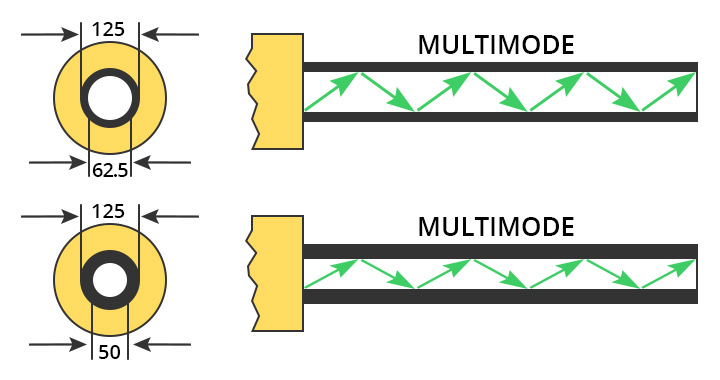
Compared with single-mode optical fiber, multimode optical fiber has a larger core diameter, usually 50μm or 62.5μm, and supports multiple optical mode propagation. According to the ISO 11810 standard, multimode optical fiber is divided into OM1, OM2, OM3, OM4 and OM5 optical fibers.
OM1 fiber refers to multimode fiber with a full injection window of 850/1300nm and a bandwidth of 200/500MHz.km or higher. It uses an LED light source, has a core diameter of 62.5μm, and is typically coated in orange. It can be used for Ethernet speeds below 10Gbps and is most commonly used in 100M Ethernet. Due to its larger core diameter, OM1 fiber offers superior light collection and bend resistance.
OM2 fiber refers to multimode fiber with a full injection window of 850/1300nm and a bandwidth of 500/500MHz.km or more. It uses an LED light source, has a core diameter of 50μm, and is typically coated in orange. It can be used for Ethernet services up to 10Gbps and is most commonly used in Gigabit Ethernet. Compared to OM1 fiber, OM2 fiber has a smaller core diameter, effectively reducing the modal dispersion of multimode fiber, resulting in increased bandwidth and a one-third reduction in production costs.
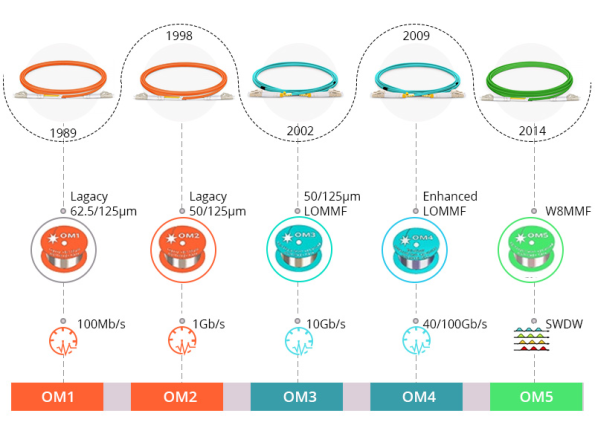
OM3 fiber is a laser-optimized multimode fiber. It utilizes an 850nm VCSEL laser source, has a core diameter of 50μm, and an aqua-blue outer sheath. It can be used for Ethernet transmission speeds up to 100Gbps and is most commonly used in 10GbE. Compared to OM1 and OM2 fiber, OM3 offers higher transmission rates and bandwidth, leading to its use as optimized multimode fiber or 10GbE multimode fiber.
OM4 fiber is an upgraded version of OM3 multimode fiber, offering superior performance. For example, OM4 fiber offers more than double the effective bandwidth of OM3 fiber and is compatible with OM3 fiber. Its outer sheath is aqua blue. In Ethernet networks with speeds above 10 Gbps, OM4 fiber offers a longer transmission distance than OM3, reaching up to 400 meters.
OM5 fiber is a newly introduced, high-bandwidth multimode fiber that is compatible with OM4 fiber. Its core diameter is the same as OM2/OM3/OM4 (50 μm), and its outer jacket is lime green. For more information, visit "What is the difference between OM5 fiber and existing multimode fiber?" and see the OM5 FAQ .
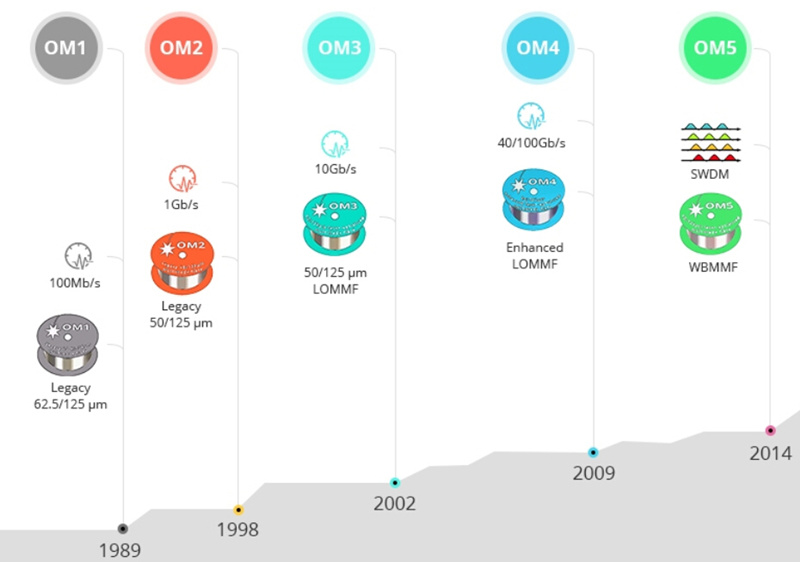
In summary, the biggest difference between OM1, OM2, OM3, OM4 and OM5 multimode optical fibers lies in the differences in physics and application.
1. Physical differences
Different multimode optical fibers have different physical differences, mainly reflected in diameter, outer sheath color, light source and bandwidth, as shown in the following table:
|
Multimode fiber type |
diameter |
Outer sheath color |
light source |
bandwidth |
|
OM1 |
62.5/125µm |
orange color |
led |
200MHz*km |
|
OM2 |
50/125µm |
orange color |
led |
500MHz*km |
|
OM3 |
50/125µm |
aqua blue |
VSCEL |
2000MHz*km |
|
OM4 |
50/125µm |
aqua blue |
VSCEL |
4700MHz*km |
|
OM5 |
50/125µm |
lemon green |
VSCEL |
28000MHz*km |
2. Application Differences
Different multimode optical fibers are used in different Ethernet networks and support different maximum transmission distances, as shown in the following table:
|
Multimode fiber type |
Fast Ethernet |
1G Ethernet |
10G Ethernet |
40G Ethernet |
100G Ethernet |
|
OM1 |
2000 meters |
275 meters |
33 meters |
/ |
/ |
|
OM2 |
2000 meters |
550m |
82 meters |
/ |
/ |
|
OM3 |
2000 meters |
550m |
300 meters |
100 meters |
100 meters |
|
OM4 |
2000 meters |
550m |
550m |
150 meters |
150 meters |
|
OM5 |
/ |
/ |
550m |
440m |
150 meters |
Development Trends and Applications of Multimode Fiber
Driven by the demands of high-speed network applications, multimode fiber is evolving towards low loss, high bandwidth, and multi-wavelength multiplexing. With the continuous advancement of optical fiber technology, multimode fiber has evolved from the original OM1 fiber to the current OM5 fiber that supports 40/100G networks, offering even better performance. Currently, OM1 and OM2 multimode fibers are primarily used for 1G Ethernet links within computer rooms, while OM3 and OM4 multimode fibers are primarily used for 10G/40G data center fiber cabling. OM5 multimode fiber is suitable for 40/100G high-speed Ethernet link transmission. Compared to OM1/OM2/OM3/OM4 multimode fibers, OM5 multimode fiber offers high scalability and flexibility, supporting higher-speed network transmission with a smaller fiber count, while also offering significantly lower cost and power consumption than single-mode fiber. This suggests that OM5 multimode fiber is likely to be widely used in ultra-large 100G/400G/1T data centers in the future.
FAQs about Multimode Fiber
1. What is the difference between multimode fiber and single-mode fiber?
Core diameter : Multimode fiber has a larger core diameter (typically 50/62.5 μm) and can transmit multiple modes of light. Single-mode fiber has a smaller core diameter (typically 9 μm) and can only transmit one mode of light.
Bandwidth : The bandwidth of single-mode fiber is usually higher than that of multimode fiber, and can be as high as 100,000 GHz.
Light source : Multimode optical fiber generally uses LED light source, while single-mode optical fiber generally uses laser light source.
Distance : Multimode fiber is suitable for short-distance applications, and the maximum transmission distance can usually reach 550m.
Cost : Multimode fiber generally costs less than single-mode fiber.
This article compares the differences between single-mode fiber and multimode fiber in detail: "Detailed discussion of the differences between single-mode fiber and multimode fiber and answers to common questions . "
2. Multimode fiber connector types
Currently, common multimode fiber optic connectors (i.e., connectors) include ST, SC, FC, LC, MU, E2000, MTRJ, SMA, DIN, and MTP & MPO. ST, SC, FC, LC, and MTP/MPO are the most commonly used types of fiber optic connectors. These five types of fiber optic connectors have different advantages, disadvantages, and functions. So, what are the differences between them? The following table lists the differences between ST, SC, FC, LC, and MTP/MPO multimode fiber connectors in terms of ferrule size, insertion loss, and other aspects:
|
Multimode fiber optic connectors |
Ferrule size (ceramic) |
Insertion loss (dB) |
Cost |
|
SC |
φ2.5mm |
0.25~0.5dB |
US$1.00 |
|
LC |
φ1.25mm |
0.25~0.5dB |
US$1.20 |
|
FC |
φ2.5mm |
0.25~0.5dB |
US$1.00 |
|
ST |
φ2.5mm |
0.25~0.5dB |
US$1.00 |
|
MTP/MPO |
φ2.5mm |
0.25~0.5dB |
/ |
Note: The ferrule is the precisely aligned cylindrical element in the fiber optic connector plug, with a microscopic hole at its center for securing the optical fiber. Depending on the material used, the ferrule can be categorized as ceramic, glass, plastic, or metal.
Recommended article: "How are fiber optic patch cords classified? Detailed explanation of fiber optic patch cord types . "
3. Advantages of multimode fiber
Although single-mode fiber has advantages in bandwidth and transmission distance, multimode fiber can support the transmission distance requirements of most indoor applications and data centers, and its installation and maintenance costs are much lower than single-mode fiber. In addition, multimode fiber has some significant advantages, as described below:
A lossless, interference-free, multi-user backbone network : The greatest characteristic of multimode fiber is its ability to carry multiple optical signals simultaneously on the same link. More importantly, optical signal power is virtually lossless. Therefore, network users can send multiple data packets simultaneously over a multimode fiber patch cord, and all information will be securely transmitted to its destination without any interference and intact.
Support for multiple protocols : Multimode fiber supports a variety of data transmission protocols, including Ethernet, InfiniBand, and Internet Protocol. Therefore, multimode fiber is considered the foundation for implementing core applications.
4. Can multimode optical fiber be used as single-mode?
No, because multimode optical fiber has large dispersion and loss, optical signals cannot be transmitted over long distances on multimode optical fiber.
Conclusion





No comments have been posted yet.