


.webp)


In the intricate ecosystem of optical communication networks, precision components play pivotal roles in ensuring signal integrity, network flexibility, and operational efficiency. Two such indispensable devices are the optical switch and the optical attenuator. While both operate within the realm of optical signal management, their core functionalities, operational principles, and application scenarios diverge significantly. Understanding these differences is critical for network designers, engineers, and technicians tasked with building robust, high-performance optical systems. This article delves into the fundamental distinctions between the two components, shedding light on their unique roles in modern optical networks.

Core Functional Definitions: Purpose at a Glance
1.Guiding Signal Paths: The Dynamic Component
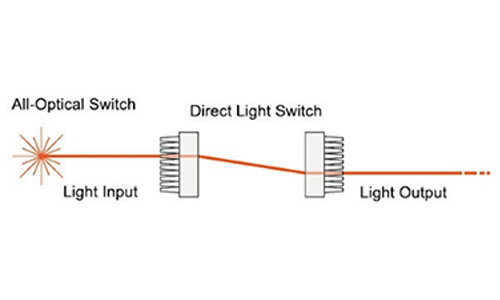
One key device is engineered for dynamic signal routing, designed to selectively redirect light signals from one optical path to another. Its primary function is to enable seamless switching between input and output ports, offering active reconfiguration that allows network operators to adapt to changing traffic demands, perform system maintenance, or initiate fault recovery without disrupting overall network operations.
This dynamic component operates across a broad wavelength range—typically from 460nm to 1660nm—and supports various configurations, including 1xN, 2x2, and NxN matrices. It leverages technologies such as micro-electro-mechanical systems (MEMS), opto-mechanical actuation, and polarization-maintaining (PM) designs to achieve low insertion loss, high crosstalk isolation, and rapid switching times (often less than 10ms). Whether deployed in data centers, telecom networks, or laboratory test setups, it serves as the backbone of dynamic signal routing, enabling network reconfiguration, protection, and multiplexing.
2.Controlling Signal Power: The Passive Regulator
In contrast, the optical attenuator is a passive component engineered to reduce the power level of an optical signal in a controlled, predictable manner. Its core purpose is to mitigate signal overloading in optical receivers, prevent nonlinear effects in fiber optic cables, and ensure consistent signal strength across different segments of a network. Unlike the dynamic routing device, which alters signal paths, the optical attenuator maintains a fixed signal route while attenuating (weakening) the signal power to a desired level.
Optical attenuators are available in fixed or variable configurations, with attenuation levels ranging from a few decibels (dB) to 60dB or more. They operate based on principles such as absorption, reflection, or scattering of light, and are designed to introduce minimal distortion to the signal—preserving key characteristics like wavelength, polarization, and signal integrity. Common applications include adjusting signal levels in dense wavelength division multiplexing (DWDM) systems, calibrating test equipment, and compensating for power discrepancies in long-haul fiber links.

Operational Principles: How They Work
1.Mechanisms of Dynamic Routing
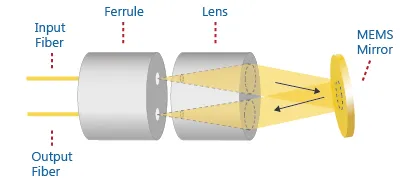
The functionality of the signal-routing component hinges on its ability to physically or electronically redirect light paths. Two dominant technologies power these devices: opto-mechanical and MEMS.
Opto-mechanical variants use mechanical components—such as stepper motors, prisms, or movable fiber connectors—to align or reposition light paths. When a switching command is received (via control interfaces like RS232, USB, or TTL), the mechanical structure adjusts to connect the input port to the desired output port. These are valued for their simplicity, high optical performance, and long operational lifetimes (exceeding 10⁸ cycles).
MEMS-based models utilize microscopic mirrors etched onto a silicon wafer. These mirrors tilt or rotate electronically in response to electrical signals, steering light beams toward the target output port. They offer several advantages, including compact size, fast switching speeds, and scalability—making them ideal for high-density applications like data center optical cross-connect (OXC) systems. Regardless of the technology, the design prioritizes minimizing signal disruption, ensuring low insertion loss (often ≤ 0.5dB) and high directivity (≥ 55dB) to maintain signal fidelity during switching events.

2.Mechanisms of Signal Attenuation
Optical attenuators operate on passive principles, meaning they require no external power to function. Fixed optical attenuators achieve signal reduction through absorption-based materials (such as doped glass or metal films) that absorb a specific portion of the light energy. The attenuation level is predetermined during manufacturing, making these attenuators suitable for applications where signal power needs to be consistently reduced by a fixed amount.
Variable optical attenuators (VOAs) offer adjustable attenuation, allowing users to fine-tune signal power as needed. They employ mechanisms such as variable absorption, micro-electro-mechanical tuning, or liquid crystal modulation to control the amount of light transmitted. For example, some VOAs use a sliding filter that adjusts the length of the light path through an absorbing material, while others use MEMS-based mirrors to reflect a portion of the light away from the signal path. Regardless of the design, optical attenuators are engineered to introduce minimal polarization-dependent loss (PDL) and wavelength-dependent loss (WDL), ensuring that the attenuated signal remains true to its original characteristics.
Key Performance Metrics: What Sets Them Apart
1.Metrics for Dynamic Routing Devices
When evaluating the signal-routing component, performance metrics focus on its ability to route signals efficiently and reliably. Key parameters include:
● Switching Time: The time required to reconfigure the signal path, with MEMS-based models typically offering faster switching (≤ 8ms) than opto-mechanical variants.
● Insertion Loss: The signal power loss incurred when the device is in the “on” state, with high-performance models achieving insertion loss ≤ 0.6dB.
● Crosstalk: The degree of isolation between adjacent signal paths, with single-mode (SM) variants typically offering crosstalk ≥ 55dB to prevent signal interference.
● Configuration Flexibility: Support for various port counts (e.g., 1x2, 1x32, 2x2) and fiber types (SM, multimode, PM) to adapt to diverse network needs.
● Control Interfaces: Compatibility with standard interfaces (RS232, USB, TTL) for seamless integration into automated systems.
2.Critical Metrics for Optical Attenuator
For optical attenuators, performance metrics center on their ability to reduce signal power accurately and consistently. Key parameters include:
● Attenuation Range: The minimum and maximum amount of signal reduction the device can achieve (e.g., 0–30dB for variable attenuators).
● Attenuation Accuracy: The precision with which the attenuator delivers the desired attenuation level, typically specified as ±0.1dB to ±0.5dB.
● Insertion Loss: The inherent power loss of the attenuator when set to 0dB attenuation (ideally ≤ 0.3dB).
● Polarization-Dependent Loss (PDL): The variation in attenuation across different polarization states, with low PDL (≤ 0.2dB) critical for maintaining signal integrity in polarization-sensitive systems.
● Wavelength Dependence: The consistency of attenuation across the operating wavelength range, ensuring stable performance in multi-wavelength systems like DWDM.
Application Scenarios: Where They Shine
1.Use Cases for Dynamic Routing
The dynamic routing capability makes this component indispensable in scenarios requiring flexibility and adaptability. Key applications include:
● Network Protection and Restoration: In telecom fiber ring networks, it enables rapid fault recovery by switching traffic to redundant paths when a fiber link fails.
● Optical Cross-Connect (OXC) Systems: OXCs use NxN variants to route signals between multiple input and output ports, enabling efficient traffic management in large-scale telecom networks.
● Automated Test Equipment (ATE): Laboratories and manufacturing facilities use these devices to automate testing of optical components, allowing sequential testing of multiple devices without manual reconfiguration.
● Data Center Networks: High-performance computing clusters and cloud data centers rely on them to dynamically route signals between servers, storage systems, and network devices, supporting high-bandwidth applications.
● Sensor Network Multiplexing: In research and industrial setups, they multiplex signals from multiple sensors onto a single fiber, reducing cabling complexity and enabling centralized data collection.
2.Optical Attenuator Applications
Optical attenuators excel in scenarios where precise signal power control is essential. Key applications include:
● DWDM Systems: In dense wavelength division multiplexing, optical attenuators adjust signal power levels to ensure all wavelengths arrive at the receiver with consistent strength, preventing nonlinear effects like four-wave mixing.
● Receiver Protection: Optical receivers are sensitive to high-power signals, which can cause damage or distortion. Attenuators reduce signal power to safe levels, extending receiver lifespan and improving performance.
● Test and Measurement: Calibrating optical test equipment (such as power meters and optical spectrum analyzers) requires precise signal attenuation, making optical attenuators a staple in laboratory settings.
● Long-Haul Fiber Links: In long-distance fiber optic networks, signal power can accumulate due to amplification. Attenuators compensate for this excess power, ensuring signal stability across the entire link.
● Passive Optical Networks (PONs): PON systems use optical attenuators to balance signal levels between different users, ensuring equitable bandwidth distribution and reliable connectivity.
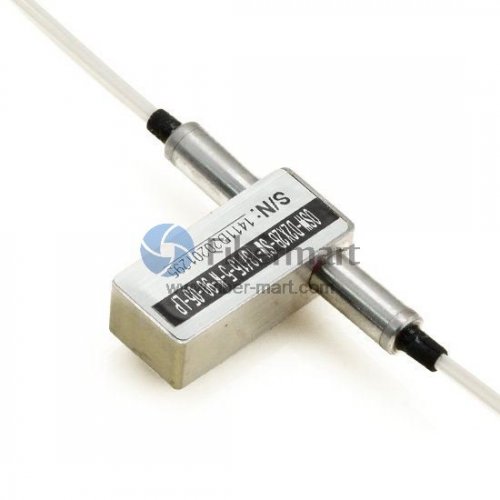
In summary, the optical switch and optical attenuator serve distinct yet complementary roles in optical networks. The former is an active component that enables dynamic signal routing, supporting network reconfiguration, protection, and multiplexing. Its ability to alter signal paths makes it indispensable for flexible, adaptive networks where traffic demands or system conditions change regularly. On the other hand, the optical attenuator is a passive component that provides controlled signal power reduction, mitigating overloading, nonlinear effects, and power discrepancies to ensure consistent signal integrity.
When selecting between these components, network designers must consider their specific needs: if the goal is to redirect signals or reconfigure the network, the optical switch is the ideal choice. If the requirement is to adjust signal power without changing the signal path, an optical attenuator is the right solution. In many cases, these components work in tandem—for example, the dynamic routing device may route a signal to a specific path, while an optical attenuator adjusts its power level before it reaches the receiver.
As optical networks continue to evolve toward higher speeds, greater capacity, and increased flexibility, the importance of understanding the functional differences between these two components will only grow. By leveraging the unique capabilities of each, network operators can build robust, efficient systems that meet the demands of modern communication—whether in data centers, telecom networks, or research laboratories. Both remain essential building blocks of the global optical infrastructure, each contributing to the seamless flow of data across the world.





No comments have been posted yet.